Every growing company eventually asks who should do its hiring. The usual options are a recruitment agency, an in-house recruiting team, or software that lets a small team do more. A fourth option sits between them: services that take a job description and return an evaluated shortlist, doing much of the agency's work at a software price.
This guide sets out when each option fits, how to evaluate an agency before you sign, and how to combine them. Cohesyve, which publishes it, is one of the sourcing-to-shortlist services; we have tried to describe the other options on their merits. For background on how agencies work, see our explainer on staffing and recruitment agencies.
Should you use a recruitment agency, hire in-house or use software?
Use an agency when hires are rare, senior or highly specialised; build in-house when hiring is steady and core to the business; use software when volume is regular but the team is small. The deciding factors are how many hires you make a year, how similar the roles are, and how much control you want over the candidate experience.
The decision table
| Factor | Recruitment agency | In-house recruiting | Recruitment software | Sourcing-to-shortlist service |
|---|---|---|---|---|
| How you pay | Fee per hire (contingency) or per search (retained) | Salaries, tools, job ads | Subscription or per-seat licence | Subscription |
| How cost scales | Rises with every hire | Mostly fixed; cheaper per hire as volume grows | Mostly fixed | Mostly fixed within a volume band |
| Speed to start | Fast: they already have a network | Slow: hiring the team takes time | Fast to buy, slower to adopt | Fast: give a job description |
| Control of process and brand | Low to medium | High | High | Medium to high |
| Network for niche or senior roles | Strongest | Builds over time | Depends on your team's skill | Depends on sources searched |
| Evaluation of candidates | Varies by agency; often interviews and résumé review | As good as your process | As good as your process and tools | Built in, if it includes job simulations or similar |
| Knowledge kept in the company | Little | All | All | Data and shortlists stay with you |
| Best for | Occasional, senior, confidential or hard-to-reach hires | Steady hiring in recurring roles | Teams with recruiters who need leverage | Regular hiring without a full recruiting team |
Cohesyve
Comparing Recruitment Agency and In-House vs Software? Try a third option on a live role
Cohesyve takes a job description, finds candidates, reaches out to them and runs an AI job simulation of the real work, then returns a ranked shortlist. Ten candidates free, no card.
How agencies charge
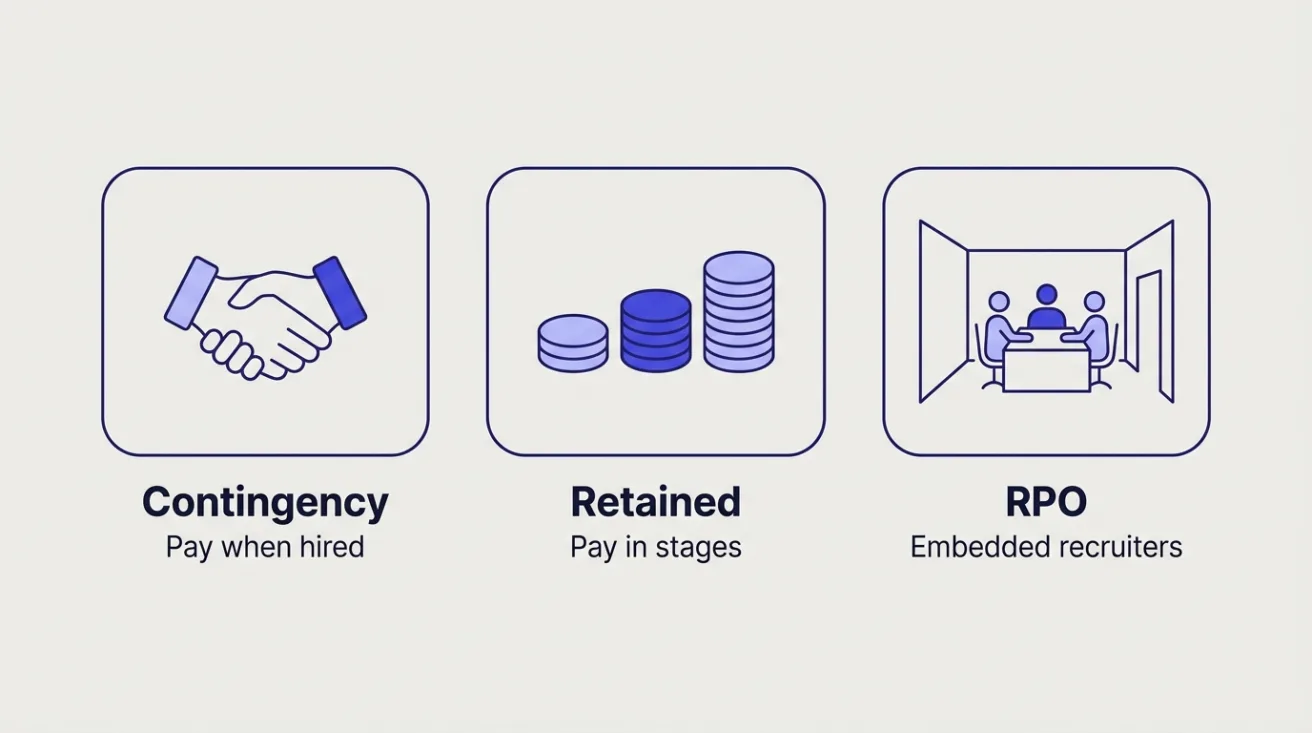
Fee models vary, so get written quotes. The three common structures:
- Contingency. You pay only when a candidate the agency introduced is hired, usually a fee tied to the hire's salary. Several agencies may compete for the same role. Low risk up front, though agencies may prioritise the roles most likely to pay out.
- Retained. You pay in stages, starting before candidates are presented, for an exclusive search. Common for executive and very specialised roles. You get more commitment and a more thorough search, and you pay whether or not you hire.
- Recruitment process outsourcing (RPO). A provider runs part or all of your recruiting, often with recruiters embedded in your team, for a management fee or a fee per hire. Closer to outsourcing a department than buying a search.
Ask every agency for its fee, its guarantee (what happens if the hire leaves within the first months), its payment terms and whether candidates it introduces stay "theirs" for a period after introduction.
When is a recruitment agency the right choice?
An agency is the right choice when the role is rare for you, hard to reach through ads and searches, or confidential, and when getting it filled quickly is worth a significant per-hire fee. Typical cases:
- An executive or senior specialist hire you make once every few years.
- A role in a market where your company is unknown and an agency has relationships.
- A confidential replacement you cannot advertise.
- A sudden spike in demand you do not expect to last, especially for temporary or contract staff, where staffing agencies also employ the workers.
An agency is usually the wrong choice for roles you hire repeatedly. Each hire costs the full fee again, and the knowledge of how to find those people stays with the agency.
When in-house recruiting wins
In-house recruiting pays off when hiring is continuous. A recruiter who fills the same kinds of roles every quarter learns the hiring managers, builds a pipeline of past candidates and improves the process over time. The company keeps that knowledge.
The costs are salaries, tools and the time to build the team, and the risk is a fixed cost when hiring slows. In-house teams also hit capacity limits: when volume spikes, the quality of screening often slips first.
When software is enough
Software makes a small team behave like a larger one. An applicant tracking system organises the process; sourcing tools widen the pipeline; scheduling tools remove coordination; assessment tools take over first-round evaluation. Our guides to sourcing and outreach automation and tools that reduce time to hire cover the categories.
Software still needs someone to run it. A founder or hiring manager with a few hours a week can run a lightweight setup for a handful of hires a year; more than that usually needs a dedicated recruiter.
The middle option: sourcing to shortlist
Between hiring an agency and running everything yourself is a newer kind of service: you provide a job description, and it sources candidates, contacts them, evaluates the people who respond and returns a ranked shortlist. You interview only the people on it.
Compared with an agency, the cost is usually a subscription rather than a fee per hire, and the evaluation is visible: you see the evidence behind each name. Compared with in-house, you do not have to build a team. The trade-off is less of the relationship-led persuasion a good agency recruiter brings to a passive senior candidate.
Cohesyve, which publishes this guide, works this way. A company gives it a job description; it sources candidates, runs outreach, puts applicants through job simulations of the real work and returns a ranked shortlist, so interview time goes only on the strongest candidates. Plans are subscriptions sized to annual hiring volume, from $199 a month, with ten free candidates on signup. See pricing for details.
How can I assess a recruitment agency before signing a contract?
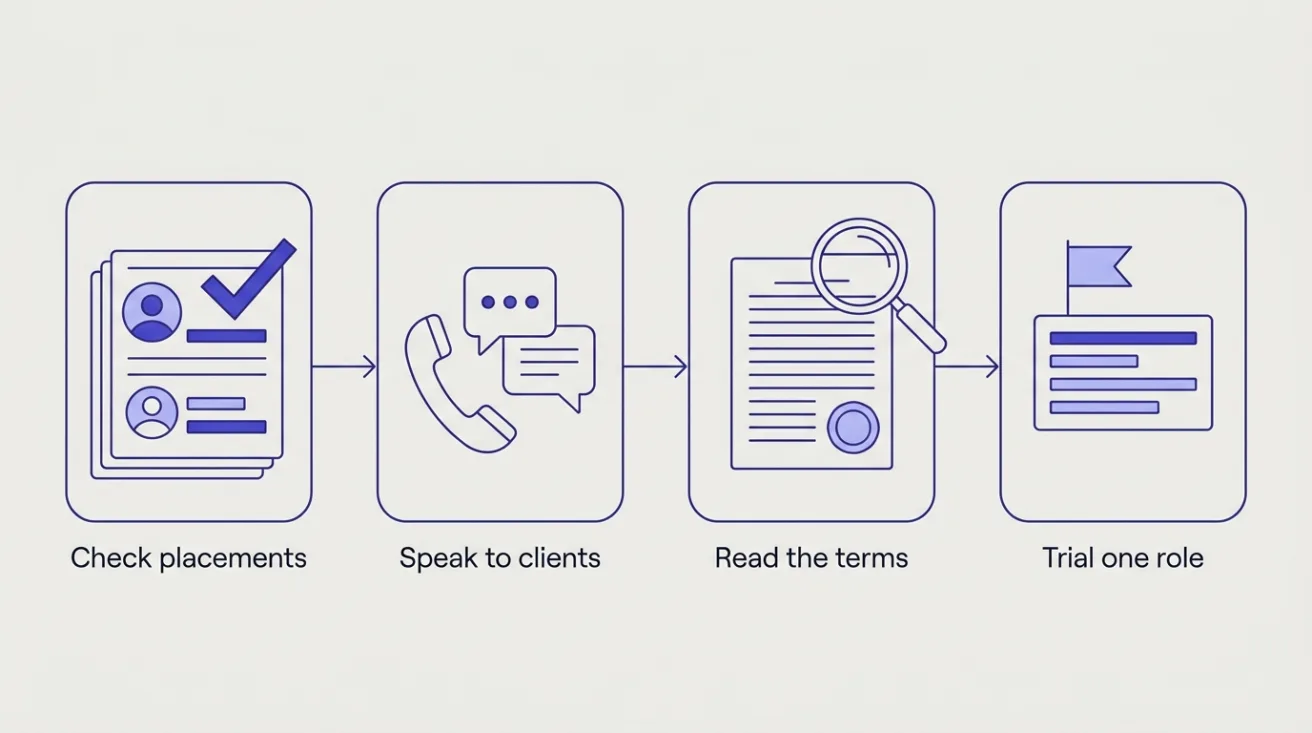
Ask for evidence of placements in your exact role and level, speak to two clients who hired through them recently, and read the terms on fees, guarantees and candidate ownership before you share a role. Then run one role as a trial before committing to more.
Questions to ask:
- How many people have you placed in this role, at this level, in the past year? Can we speak to two of those clients?
- Who will work on our role, and how many other roles do they carry?
- Where will candidates come from: your existing network, job ads, or searches we could run ourselves?
- How do you screen candidates before sending them? Do you assess skills, or review résumés and interview?
- How many candidates do you expect to present, and how quickly?
- What is the fee, when is it due, and what is the guarantee if the hire leaves early?
- How long do candidates you introduce remain yours, and what counts as an introduction?
- Will you represent us accurately to candidates, and can we approve how the role is described?
- What data on candidates do you keep, and how do you handle their personal data?
- What happens if we find the hire through another route?
Can staffing agencies do technical screening?
Some do; ask exactly what their screening involves. If the answer is a résumé review and a recruiter's call, plan to run your own technical evaluation, such as a short coding task or job simulation, before your engineers spend time on interviews. Agencies that do run skills assessments should show you the task and the scoring.
What is the best way to manage recruitment agencies as a hiring team?
- Use fewer agencies. One or two that know you well usually beat five competing on the same role.
- Brief properly. A clear job description, a scorecard of what good looks like, and the salary range.
- Give fast feedback. Every day a candidate waits for your answer is a day they can accept another offer.
- Track results. Candidates presented, interviews, offers, hires and how those hires perform, by agency.
- Use your own evaluation. Run agency candidates through the same assessment as everyone else, so you compare like with like.
Mixing the options
Many companies end up with a mix. One pattern is an in-house recruiter or two for recurring roles, software for volume and first-round evaluation, and an agency for the occasional executive or specialist search. The question to revisit each year is whether you are paying agency fees for roles you hire often enough to handle yourself. Our guides to reducing cost per hire and the cost of a bad hire help put numbers on that decision.
Common questions
Is an agency cheaper than an in-house recruiter? For a few hires a year, usually. As volume rises, per-hire fees add up and an in-house recruiter or software becomes cheaper per hire. Compare your expected annual hires at quoted agency fees against a recruiter's full cost plus tools.
What is a recruitment agency alternative? In-house recruiting, recruitment software, or a sourcing-to-shortlist service that takes a job description and returns evaluated candidates for a subscription.
Do agencies find better candidates? For senior and niche roles, a specialist agency's network can reach people who would never answer an advert. For recurring roles, the candidates are often the same ones you could reach yourself.
Can we use an agency and software together? Yes. Put agency candidates through the same evaluation as your own applicants so every shortlist is judged the same way.