The cost of a bad hire is often introduced as a tidy rule of thumb. The problem is that real hiring mistakes are never tidy.
The U.S. Department of Labor estimate cited by HumCap puts the cost at up to 30% of an employee's first-year earnings, which equals $24,000 for an $80,000 salary. The same source notes that the impact extends beyond the obvious, into lost productivity, team morale and client relationships. That framing matters because most hiring teams still discuss hiring mistakes as if they're mainly recruitment waste.
They aren't. A bad hire is rarely just an HR expense. It shows up in delayed projects, awkward handoffs, slower managers, frustrated peers, and a team that starts lowering its standards to cope. I've seen leaders budget carefully for salary and agency fees, then completely miss the cost of six months of drag on execution.
If you're a founder, hiring manager, TA lead, or CTO, that's the shift worth making. Stop asking, "What did this hire cost us?" Start asking, "What did this decision force everyone else to spend?"
More Than Just a Number The Ripple Effect of a Bad Hire
The easy mistake is treating a bad hire like a line item. Recruit, onboard, terminate, replace. Add those costs up and move on.
That view misses the full story. The visible bill is usually the smallest part of the damage. The larger cost comes from what the team has to absorb while the problem is still on payroll.
A weak hire changes how good people spend their week. The manager starts coaching reactively instead of leading. A teammate rewrites work that should've been usable. Customer-facing teams work around missed commitments. In technical teams, the impact is even sharper because poor work doesn't stay contained. It creates rework, review load, and decision fatigue.
Why the floor is not the total
The 30% of first-year salary number is useful because it gives finance and hiring managers a shared starting point. It creates a baseline for discussion. But it doesn't capture the way poor performance spreads through a team after the offer letter is signed.
A hiring mistake also tends to stay hidden longer than leaders expect. In many companies, the first signs don't look like hiring problems. They look like "communication issues," "slow ramp," or "needing more support." By the time everyone agrees the person isn't working out, the team has already paid for the mistake in attention and momentum.
A bad hire doesn't only fail to add value. They often redirect value away from the people who were already performing.
Why this matters more in operating roles
The cost rises fastest in roles tied directly to delivery. Engineering, sales, operations, consulting, finance, and frontline management all have one thing in common. One weak performer can interrupt the work of several strong ones.
That's why the conversation shouldn't stay trapped in generic salary multiples. A bad sales hire can distort pipeline quality and forecasting. A bad people manager can lower trust. A bad engineer can slow a sprint without writing much code at all. Different roles create different forms of cost, and hiring leaders need a framework that captures those differences.
The Four Layers of a Bad Hire's Financial Impact
Organizations often underestimate the cost of a bad hire because they only count the top of the iceberg. They can see the invoice, but they can't see the drag underneath it.
A more practical way to assess the damage is to split it into four layers: direct costs, indirect costs, opportunity costs, and cultural costs.
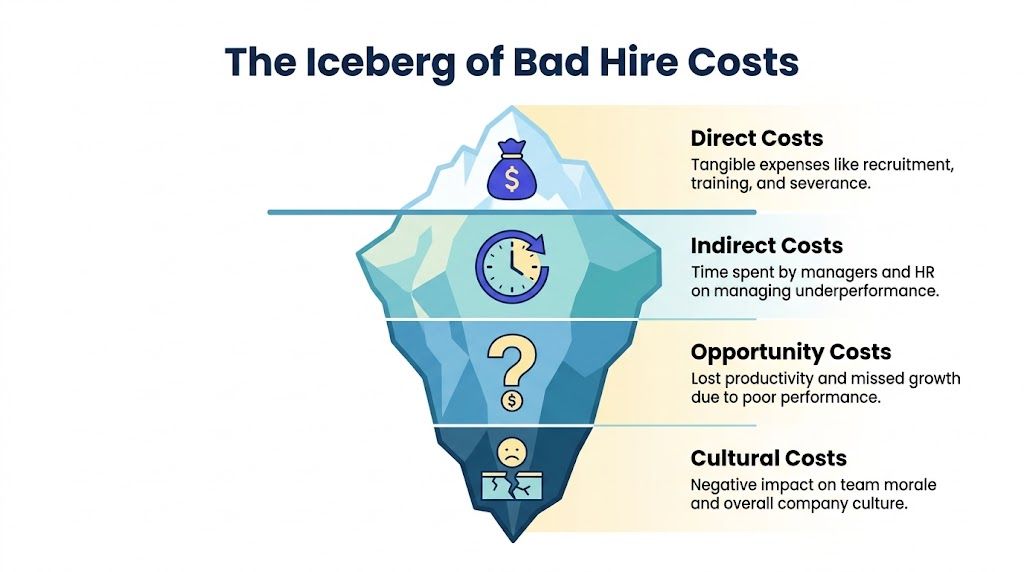
The Recruitment & Employment Confederation figure reported by Vestd is a good reminder of how large that iceberg can get. A bad hire in a mid-level role can cost over £132,000. The same source breaks the damage down into direct costs like recruitment fees of 15% to 25% of salary, but also broader effects such as 17% of a manager's time being spent managing an underperformer.
Direct costs
These are the costs most finance teams will recognize immediately. They're visible, documentable, and usually easiest to defend in a budget review.
They often include:
- Recruitment spend: Agency fees, job ads, sourcing tools, background checks, and recruiter time.
- Onboarding costs: Equipment, systems access, training time, and initial enablement.
- Compensation already paid: Salary and benefits paid during a failed ramp.
- Exit costs: Severance, legal review, and the cost of reopening the search.
Direct costs matter, but they create false confidence. Teams often stop counting here because these numbers are clean. Unfortunately, the clean numbers are rarely the expensive ones.
Indirect costs
Indirect costs sit just below the surface. They don't always appear in a report, but managers feel them every day.
This is the time tax created by a weak hire. Performance conversations. More check-ins. Work review that should've been unnecessary. Extra interview loops to restart the process. Colleagues filling gaps while trying not to let their own work slip.
Practical rule: If a manager keeps saying, "I'm spending too much time on this one person," you're already paying indirect costs.
These costs show up as reduced leadership bandwidth. The manager who should be planning, coaching top performers, or shipping priorities spends that energy on correction and containment instead.
Opportunity costs
This layer is where the cost of a bad hire gets serious. Opportunity cost asks a harder question: what didn't happen because the wrong person was in the role?
Maybe a product launch slipped. Maybe a territory underperformed. Maybe your operations team kept firefighting instead of improving process quality. The money isn't always easy to isolate, but the lost momentum is real. In many cases, the larger issue isn't the underperformance itself. It's the work the business postponed while dealing with it.
A vacant role can slow a team. A bad hire can slow a team and create new problems at the same time.
Cultural costs
This is the layer leaders talk about softly and feel strongly. A bad hire changes how a team experiences work.
When standards become inconsistent, strong employees notice. When one person creates friction, everyone starts managing around them. Trust drops first. Candor usually follows. Then good people begin asking whether leadership is willing to protect the team.
Cultural costs are harder to convert into a spreadsheet, but they shape retention, collaboration, and execution quality. Ignore them, and the same hiring issue keeps reappearing in a different role with a different name.
Cohesyve
See what candidates can do before you interview them
Cohesyve turns your job description into a role-specific assessment with a scoring rubric. Each candidate gets a different version, so questions cannot be shared. Ten candidates free, no card.
How to Calculate Your Company's True Cost of a Bad Hire
If you want leadership to take hiring quality seriously, don't walk in with a vague warning. Walk in with a calculation.
A usable model doesn't need to be perfect. It needs to be consistent enough that finance, HR, and hiring managers can use the same logic. Start with one failed hire from the last year and rebuild the cost in four parts.
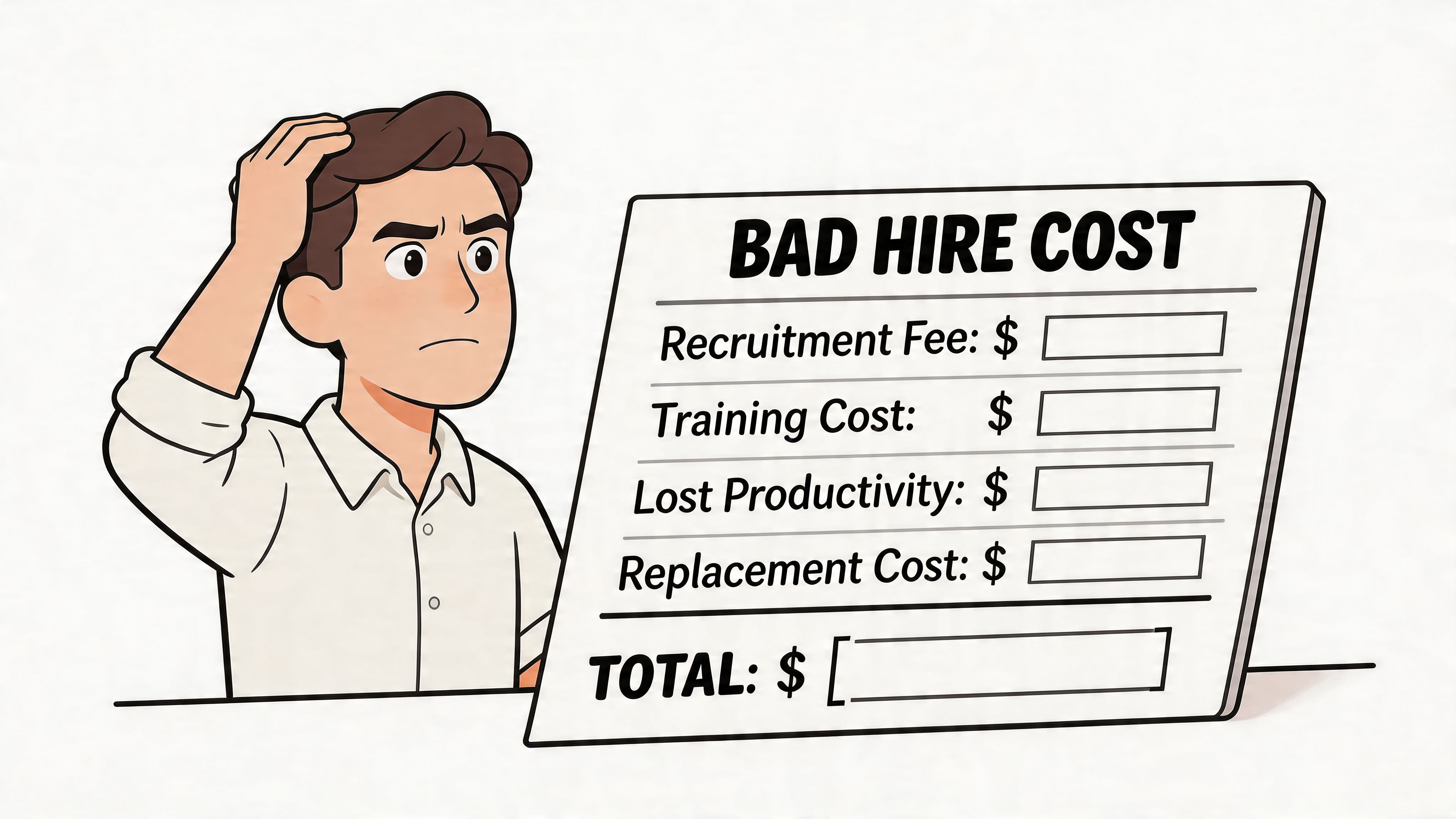
The HBK analysis is useful here because it points out where standard models fall short. It counts the management time spent correcting mistakes as a productivity loss, alongside slow ramp-up and errors from an ill-fitting hire. It also flags the morale impact, from teammates covering the gaps to higher turnover among other employees. That's why your worksheet can't stop at agency fees and salary.
Step one count direct costs
This is the cleanest part of the exercise. Pull actual figures where possible.
Use a simple subtotal like this:
| Direct cost item | What to include |
|---|---|
| Recruiting spend | Agency fees, job ads, sourcing platforms, recruiter hours |
| Hiring process admin | Background checks, scheduling time, assessments, coordination |
| Onboarding | Equipment, licenses, training sessions, manager ramp time |
| Compensation paid | Salary and benefits paid before exit |
| Exit and replacement | Severance, legal review, reopening the role |
If your company doesn't track some of these items precisely, estimate them in a way that you'd be comfortable defending in a hiring review. Precision helps, but consistency matters more.
Step two estimate indirect time loss
Most companies tend to undercount. You need to attach a value to time lost by the people who had to carry the problem.
Start with these questions:
- Manager time: How many hours per week did the manager spend on corrective coaching, rework review, or escalation?
- Team time: Which teammates had to cover gaps, redo work, or step into customer conversations?
- Recruiting restart time: How much time did TA and interviewers spend reopening and rerunning the process?
A straightforward formula is:
Indirect cost = hours lost x loaded hourly cost of each person involved
You don't need exotic finance models for this. You need honesty. If your engineering manager spent a chunk of the week correcting one hire's work, that's a real operating cost.
Teams rarely argue with direct hiring costs. They usually argue with time costs until they see how much senior talent was pulled off critical work.
Step three account for opportunity cost
This part is less about payroll and more about delayed outcomes. It often produces the biggest discussion because it reveals what the organization gave up.
Good prompts include:
- What did the team delay? Product work, sales follow-up, process improvements, client deliverables.
- What did leaders stop doing? Strategic planning, coaching, market expansion, quality improvements.
- What did customers or internal stakeholders experience? Slower response, weaker execution, missed deadlines.
You don't need to force a fake number if you don't have one. A qualitative line item is still useful if it captures a real business consequence. If your support manager postponed workflow improvements for months because they were covering an underperformer, write that down plainly.
This is also where stronger analytics help. If you're trying to connect hiring outcomes with business results, this guide to HR data analytics is a practical way to think about what to measure and why.
A related priority is retention. The better your process gets at spotting weak fit before the offer stage, the easier it becomes to reduce employee turnover without relying on reactive fixes after someone joins.
Here's a useful explainer on how leaders think about the wider financial picture:
Step four capture cultural cost without pretending it's precise
This is the hardest category, and it's still worth documenting.
Use a short scorecard rather than a fake financial estimate if that's more credible for your business. Rate the impact on:
- Team morale: Did peers lose confidence in the team or manager?
- Standards: Did quality bars slip because people were compensating?
- Retention risk: Did stronger employees show signs of frustration or disengagement?
- Manager credibility: Did the team question the hiring decision or follow-up?
You can also add notes from exit interviews, manager retrospectives, or postmortems. The point isn't to turn culture into a perfect formula. The point is to stop treating it like a soft issue with no cost.
A simple worksheet leaders will actually use
Use this structure in a hiring review:
| Cost layer | Your estimate |
|---|---|
| Direct costs | $ / £ actuals |
| Indirect costs | Hours lost x loaded hourly cost |
| Opportunity costs | Delayed outcomes, missed work, lost momentum |
| Cultural costs | Retention risk, morale damage, quality impact |
That gives you a figure, but it also gives you a shared language. Once leaders see the same categories every time, hiring quality becomes easier to discuss as an operating discipline rather than an HR debate.
Cost Benchmarks From an Intern to a Senior Engineer
Benchmarks are useful when they stop people from using one lazy rule for every role.
The cost of a bad hire doesn't scale evenly. Some roles are inconvenient to replace. Others create drag across an entire system. That difference is why salary alone is a poor proxy for risk.
For technical hiring, the Exodata breakdown is especially telling. For a mid-level technical role with a $140,000 salary, the direct costs of a bad hire alone run $78,400 to $166,500, and the total typically lands between $100,000 and $300,000+. That includes project delays, and in engineering teams a single weak link can reduce overall team output by 20% to 40%.
Estimated cost of a bad hire by role
Below is a benchmark table you can use as a decision aid. Where verified role-specific data exists, it's reflected directly. Where it doesn't, the ranges are qualitative so you don't end up forcing precision that isn't there.
| Role | Typical Annual Salary | Estimated Total Cost (as % of Salary) | Estimated Total Cost (USD) |
|---|---|---|---|
| Intern | Lower-salary role relative to full-time hires | Often below specialized technical replacement levels, but still meaningful once manager oversight and lost team time are included | Best estimated using your internal direct, indirect, opportunity, and cultural worksheet |
| Customer support agent | Moderate frontline salary | Can exceed the baseline rule when customer experience, retraining, and team workload are affected | Best estimated using your internal worksheet |
| Mid-level sales representative | Mid-range commercial salary | Often higher than direct replacement costs alone because poor pipeline quality can distort team output | Best estimated using your internal worksheet |
| Department manager | Varies by function and seniority | Can become materially larger than direct costs because team execution and retention sit under this role | Best estimated using your internal worksheet |
| Senior software engineer | $150,000 example available | Cost can exceed salary substantially in technical settings | Over $250,000 |
Why technical roles get expensive fast
A weak commercial hire can waste activity. A weak technical hire can reshape the output of the whole team.
In engineering, poor performance creates downstream work. Other developers review more carefully, rewrite more often, and spend longer tracing defects. Product managers adjust scope. Engineering managers step in to unblock and contain. The role becomes expensive not only because of what the person does, but because of what everyone else must do around them.
That's why "we can coach them up" needs scrutiny in technical environments. Sometimes coaching is the right call. Sometimes the team is paying for weeks of reduced velocity while hoping the ramp catches up.
If a role sits inside a tightly coupled workflow, a bad hire rarely stays isolated. The cost spreads to everyone connected to the output.
Why sales and management roles create a different kind of risk
A weak sales hire doesn't just miss quota. They can clog the pipeline with low-quality opportunities, create bad handoffs, and waste leadership attention on forecast noise. The damage is less visible than a broken sprint, but it can be just as operationally expensive.
Management roles are different again. The issue isn't usually one person's individual output. It's the quality of decisions, coaching, hiring judgment, and day-to-day standards under them. When a manager is the bad hire, the team can remain "busy" while performance gradually deteriorates.
How to use benchmarks without fooling yourself
Benchmarks should guide the conversation, not replace your own math.
Use them for two things:
- Prioritization: Put more rigor into roles where weak performance affects many others.
- Calibration: Match your interview depth and assessment design to the likely business impact of getting the hire wrong.
If your company uses the same hiring process for an intern, a support role, and a senior engineer, you're treating very different business risks as if they're identical. They aren't.
Strategies to Sidestep Bad Hires Before They Happen
Most bad hires don't come from one disastrous interview. They come from a chain of small shortcuts.
The role is open too long, so the manager wants speed. The candidate has a strong resume, so the team assumes capability. The interview panel likes the conversation, so nobody pushes hard on evidence. A few warning signs get explained away as nerves, ramp time, or style. Then everyone acts surprised later.
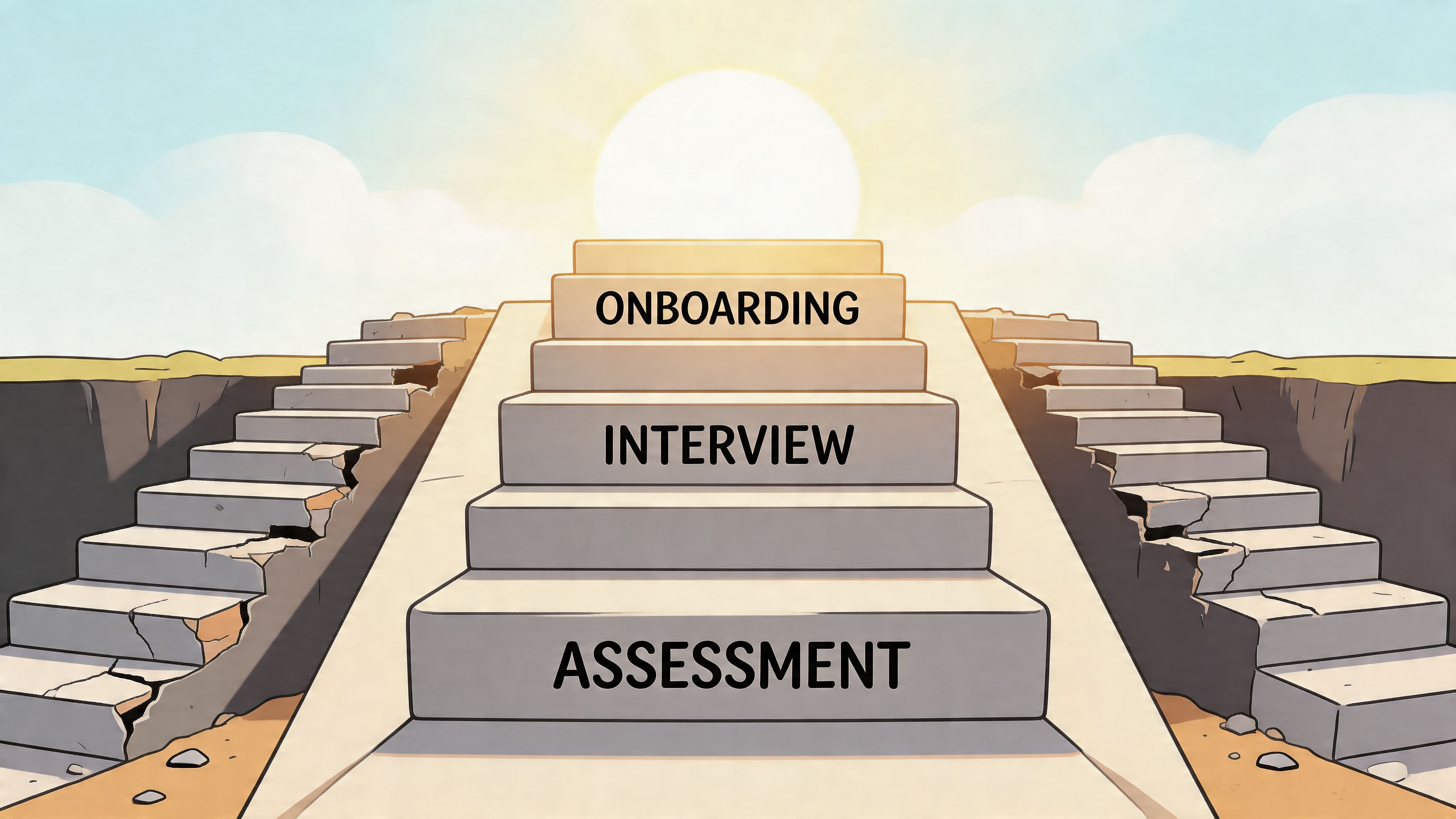
For specialized roles, the Tesseon breakdown shows why prevention matters so much. The training investment in those roles can be substantial, and it is completely lost when the hire fails. The same source notes that bad hires often drive away the very high performers you most want to keep, and recommends structured interviews, reference checks and trial projects to prevent bad hires before they happen.
Stop hiring on proxies
Resume prestige is a proxy. Pedigree is a proxy. Confidence in an interview is a proxy.
Some proxies are useful. None should carry the decision on their own.
The stronger approach is to ask, "What does success in this role look like in the first six months?" Then design the process around evidence of those behaviors. For a sales role, that might be discovery quality and written follow-up. For an analyst, it might be judgment with ambiguous information. For an engineer, it might be debugging, trade-off reasoning, and communication in review.
Use role-specific work samples early
General interviews are good at measuring polish. They are not always good at measuring job performance.
A work sample doesn't need to be long or theatrical. It needs to resemble the work. Good hiring teams use short, role-specific exercises that reveal how a candidate thinks, writes, decides, and communicates under realistic conditions.
That can include:
- Written scenarios: Ask candidates to respond to the kind of problem they'll face.
- Live reasoning exercises: Useful when judgment matters as much as the final answer.
- Technical tasks: Keep them relevant to the role rather than turning them into trivia contests.
- Structured behavioral prompts: These can complement skills evidence. This overview of pre-employment behavioral assessments is a helpful reference if you're deciding where behavioral tools fit and where they don't.
Make interviews more structured than comfortable
Unstructured interviews tend to reward familiarity and chemistry. That's risky.
A better panel uses a shared scorecard, consistent questions, and clear evidence criteria. That doesn't make the process robotic. It makes it fairer and easier to compare candidates without getting swayed by storytelling alone.
If your team needs a practical template, this structured interview guide is a solid reference point for building interviews around observable evidence rather than instinct.
The best interview process doesn't feel harsher to candidates. It feels clearer. Serious candidates usually appreciate knowing what good looks like.
Fix the handoff between assessment and interview
A common failure point is treating assessments and interviews as separate worlds. The candidate completes one set of tasks, then the panel ignores the results and starts fresh.
Use assessment signals to sharpen the interview. If someone's written judgment is strong but their prioritization looked shaky, probe that. If their technical task was competent but communication was thin, test collaboration. The handoff should help humans ask better questions, not remove humans from the process.
Keep the bar high when the role is painful to fill
This is the part organizations recognize and still struggle with.
A long vacancy creates pressure. Pressure makes "good enough" sound practical. But for roles with broad downstream impact, "good enough" often becomes the expensive option. If the role affects revenue, customer trust, or team velocity, lowering the bar usually saves time only in the very short term.
The healthier move is to shorten the path to real evidence. Don't drag candidates through bloated rounds. Tighten the process around proof.
From Cost Center to Value Driver The ROI of Great Hiring
The most useful shift isn't from one calculator to another. It's from defensive hiring to strategic hiring.
When leaders understand the cost of a bad hire in layers, they stop treating hiring as an administrative function. It becomes a lever on execution quality, team stability, and operating speed. That matters because the upside of better hiring isn't limited to avoiding waste. It's also about getting stronger output from the people you do bring in.
A good process does three things well. It makes the work of the role visible before the offer. It helps hiring teams compare candidates on evidence instead of confidence. And it protects managers from spending months cleaning up a decision that should've been tested earlier.
That is why quality of hire deserves the same seriousness as time to fill or cost per hire. If you need a framework for measuring that more rigorously, this guide to quality of hire metrics is a strong place to start.
Hiring teams don't need perfect prediction. They need better proof, better calibration, and fewer decisions made on hope. Get that right, and hiring stops looking like a cost center. It starts looking like one of the clearest value drivers in the business.
If you want a more reliable way to assess real ability before interviews, Cohesyve helps teams verify role-specific skills instead of relying on resume guesswork. It’s built for companies that want to move faster, evaluate candidates on evidence, and avoid the hidden cost of a bad hire without stripping the human judgment out of hiring.