Most advice on how to reduce cost per hire starts with trimming the obvious line items. Cut a job board. Negotiate an agency fee. Swap one tool for a cheaper one.
That’s fine, but it’s not where the significant money goes.
A hiring team can save a little on sourcing and still lose a lot by pushing the wrong candidates into interviews, dragging a role open for weeks, or making a hire who never really gets productive. The spreadsheet may show a lower recruiting cost. The business feels the opposite.
The teams that bring cost per hire down over time don’t just buy cheaper inputs. They build a hiring system that produces fewer misses, faster decisions, and stronger ramp-up after the offer is signed.
Stop Chasing the Wrong Hiring Metric
A lot of hiring dashboards treat cost per hire like the whole story. It isn’t.
The traditional version of the metric usually captures spend that finance can see quickly. Agency invoices, recruiter salaries, software, maybe a few interview expenses. Useful, yes. Complete, no. The bigger cost often shows up later, after the req is closed and everyone moves on.
The harshest example is a bad hire. Leoforce notes that replacing a bad hire costs 50% to 200% of the employee’s annual salary. In high-growth technical teams, a single poor engineering hire can cost $150,000 to $300,000 in opportunity cost, rework, and severance. That number makes most sourcing savings look tiny.
Cheap hiring can be very expensive
If a company celebrates a lower cost per hire while interview loops are full of weak candidates, the metric is lying by omission.
A process that optimizes for cheapness usually has a few familiar symptoms:
Resume-heavy screening that rewards keyword matching over real capability
Too many interviews because nobody trusts the earlier filters
Slow decisions that keep roles open and teams understaffed
Weak quality checks that let polished but underqualified candidates slip through
No ramp tracking after the hire, so hiring mistakes never show up in recruiting reviews
The most expensive hire isn’t always the one with the largest recruiting bill. It’s often the one who looked affordable on paper and failed in the role.
That’s why reducing cost per hire has to start with a broader question. What did this hire cost the business to source, assess, close, onboard, and make productive?
A better lens for hiring teams
A useful hiring metric should force trade-offs into the open.
If one process is cheaper but produces more interview waste, more manager frustration, and more early attrition, it isn’t more efficient. It’s just moving cost out of the recruiting line and into everyone else’s calendar.
That shift matters most in high-growth companies, where managers don’t have spare time and one weak hire can slow an entire team. Good talent leaders know that hiring cost is really a mix of cash cost, time cost, and quality risk. Ignore any one of those, and the metric becomes easy to game.
First Diagnose Your Real Cost Drivers
Before changing tools or channels, get honest about where the money is going.
Many organizations already know their visible costs. Fewer know how much interview time they burn on weak candidates, how long open roles stall delivery, or how often they confuse a closed req with a successful hire. If you want to know how to reduce cost per hire in a way that lasts, start with an audit.
Build the full picture
The baseline formula is simple enough: total recruiting costs divided by total hires.
What usually goes wrong is the definition of “total recruiting costs.” Teams count invoices and ignore the labor hidden in the process. They track the spend to acquire a candidate, but not the cost of evaluating the wrong ones.
A practical audit should include at least these buckets:
External costs such as agency fees, job board spend, assessment tools, and background checks
Internal recruiting costs such as recruiter time, coordinator time, and system costs
Hiring manager costs including interview prep, interview time, calibration, and debriefs
Vacancy costs from delayed output while a role stays open
Quality costs tied to weak hiring decisions, poor fit, and slow ramp
If your team only tracks the first two, you’re probably undercounting meaningfully.
Visible vs. hidden hiring cost diagnostic
| Cost Category | Example Expenses | How to Measure |
|---|---|---|
| Visible external costs | Agency placements, paid sourcing tools, job advertising, background checks | Pull invoices, contracts, and monthly vendor spend |
| Visible internal costs | Recruiter salary allocation, coordinator support, ATS and workflow tools | Estimate time by role and allocate software cost across hires |
| Interview process costs | Hiring manager screening calls, panel interviews, debrief sessions | Count interview hours by participant and map where candidates are getting rejected |
| Vacancy costs | Work delayed while the role stays open, coverage by already stretched team members | Track days open and note where projects slow, backlog grows, or managers absorb extra work |
| Bad hire costs | Rework, replacement effort, severance, onboarding reset, team disruption | Review early exits, failed probation outcomes, and hires who never reached expected performance |
| Ramp costs | Extended training, shadowing, repeat coaching, slow independent output | Ask managers when the hire became reliably productive and where the ramp dragged |
That last row is where many teams discover the underlying problem.
For a useful outside perspective on the downstream impact of poor hiring decisions, MyCulture.ai on preventing bad hires is worth reading. It’s a good reminder that recruiting costs don’t stop when the offer is accepted.
Look for the process leaks
Not every cost driver deserves the same attention.
I’d look first for places where the process creates repeated waste, not just isolated expense. These are the leaks that compound:
Too many low-signal applicants reaching humans
If recruiters or hiring managers spend hours reviewing profiles that never had a real shot, the top of funnel is too noisy.Panels doing basic screening work
Final-round interviewers shouldn’t be discovering obvious gaps. By that stage, the process should be validating fit, not catching fundamentals.Roles sitting open because of coordination, not scarcity
When a req drags because calendars won’t align or feedback arrives late, that’s an operating problem.New hires ramping slower than expected
This usually points back to weak assessment, unclear role definition, or both.Repeated use of expensive channels for roles that could be filled directly
This is often habit, not strategy.
A simple internal review like this breakdown of the cost of a bad hire can help teams connect recruiting choices to downstream financial impact. That conversation tends to land better with finance and functional leaders than a narrow sourcing report.
Practical rule: If your team can’t explain where hiring manager time is going, your cost-per-hire number is incomplete.
What to measure going forward
Once the audit is done, don’t stop at a single blended number.
Monitor expenses by role family, source, and hiring stage. A company might maintain a reasonable average while a single function absorbs most of the waste. Technical roles, revenue roles, and leadership roles often break in different ways.
The point isn’t to create a more complicated dashboard for its own sake. It’s to find the few costs you can change. Usually that means reducing dependence on expensive external channels, stopping weak candidates earlier, and shortening avoidable delays between interview and decision.
Cohesyve
See what candidates can do before you interview them
Cohesyve turns a job description into a role-specific assessment with a scoring rubric. Each candidate gets a different version, so questions cannot be shared. Ten candidates free, no card.
Optimize Your Talent Attraction Engine
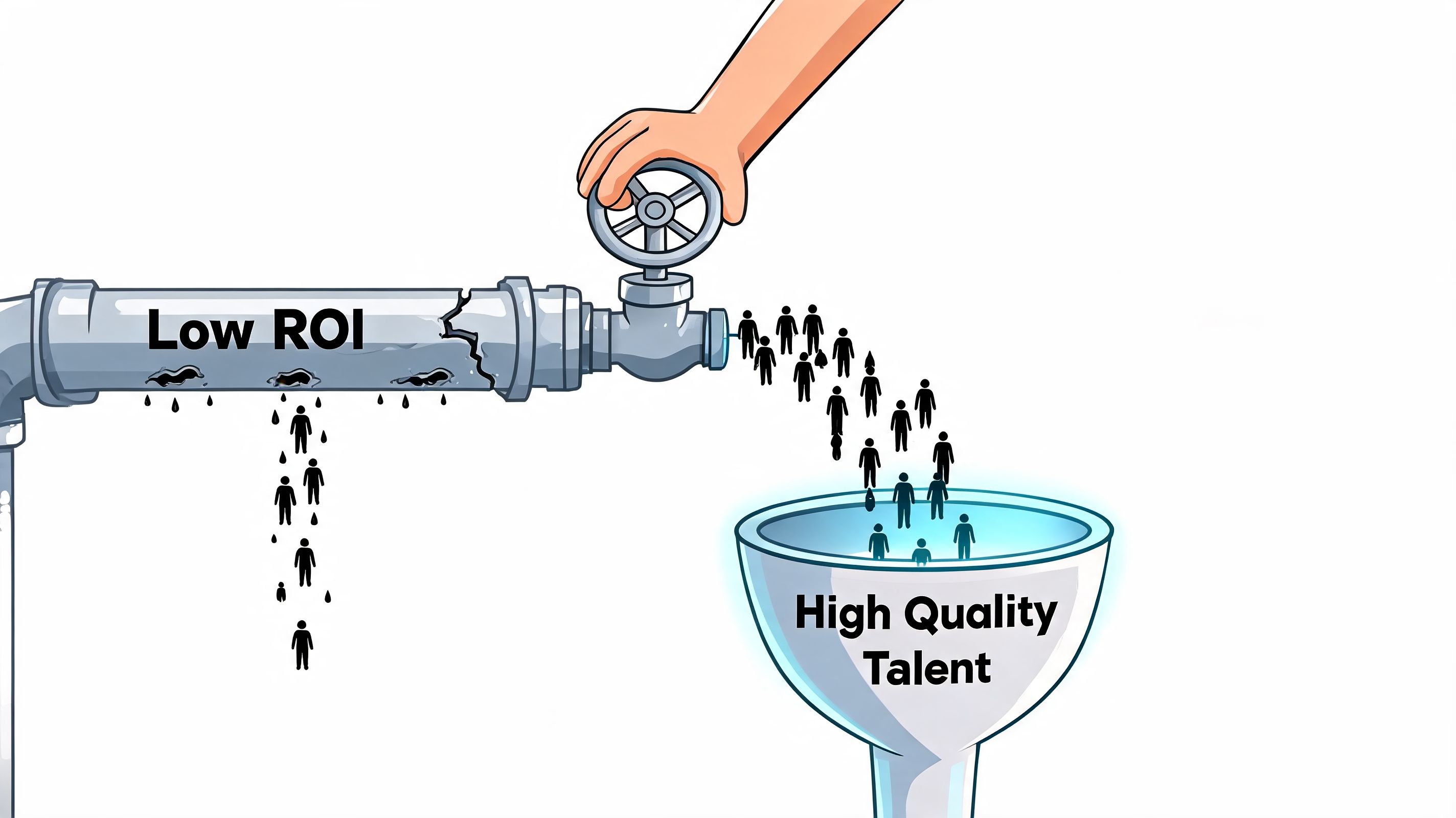
If your diagnosis says too much money is going into the top of funnel, don’t respond by squeezing every channel equally. Redirect the spend.
The best talent teams treat sourcing like portfolio management. Some channels are efficient and durable. Others are useful only in narrow cases. The trick is knowing which is which.
Make referrals a real system
Referral programs are still underrated because many companies run them casually. They announce a bonus, hope for the best, and wonder why the results are mixed.
That misses the point. A strong referral program works because employees pre-vet people who are more likely to fit the work and the environment. Metaview reports that referrals are typically five times cheaper than agency hires. The same source cites a Deloitte case study with a 25% reduction in overall hiring costs after implementing a structured referral program, and says referred candidates were 40% more likely to stay beyond three years.
That retention piece matters more than it commonly receives credit for. A cheaper hire who leaves early isn’t cheaper.
What tends to work in practice:
Targeted asks instead of generic company-wide blasts. Ask for specific profiles, not “any great people.”
Fast response to referrals so employees trust the process.
Clear ownership within TA, so referred candidates don’t disappear into the same backlog as everyone else.
Simple incentives that feel fair and easy to understand.
What doesn’t work is a referral program with no operating rhythm. If nobody follows up, employees stop referring.
Use agencies selectively, not by default
Agencies have a place. I’d still use them for true executive search, tightly specialized roles, or moments when internal bandwidth is broken and speed matters more than process purity.
But a lot of teams keep agencies around for work that should already be handled in-house. That’s where costs balloon.
Mindhunt AI’s analysis says recruitment agencies typically charge 15% to 25% of first-year salary per placement, which means a $100,000 hire costs $15,000 to $25,000 in agency fees alone. The same source notes that AI sourcing tools can scan 850 million+ profiles for as little as $100 per month, and that replacing just five agency placements per year can save $75,000+ while delivering a 60x return on investment.
That doesn’t mean every team should fire every agency. It means agency spend should be a deliberate exception.
Here’s a simple decision lens:
| Use in-house direct sourcing when | Consider agencies when |
|---|---|
| The role is repeatable and hiring volume is steady | The role is highly specialized or confidential |
| Your internal team understands the market well | You need access to a niche network quickly |
| You can assess candidates accurately once sourced | You lack bandwidth to run a focused search |
| The main problem is channel cost, not market scarcity | The business accepts the premium for urgency or scarcity |
Later in the funnel, this matters even more. A cheap sourcing tool only helps if your team can separate signal from noise once candidates enter process.
A quick refresher on channel economics helps here:
Shift spend toward owned channels
The lowest-stress hiring systems rely less on rented access and more on owned advantage.
That usually means stronger referrals, better outbound discipline, tighter employer messaging, and a process that candidates finish. It also means using technology where it replaces repetitive sourcing labor, not where it creates more software sprawl.
If you’re paying premium agency fees for roles your recruiters could fill with better sourcing infrastructure, you don’t have a talent shortage. You have a systems problem.
When teams ask how to reduce cost per hire, the answer at the attraction stage is rarely “spend less everywhere.” It’s “stop overspending on channels that mask weak internal capability.”
Replace Resume Guesswork with Skill Verification
Most interview waste starts before the first interviewer joins Zoom.
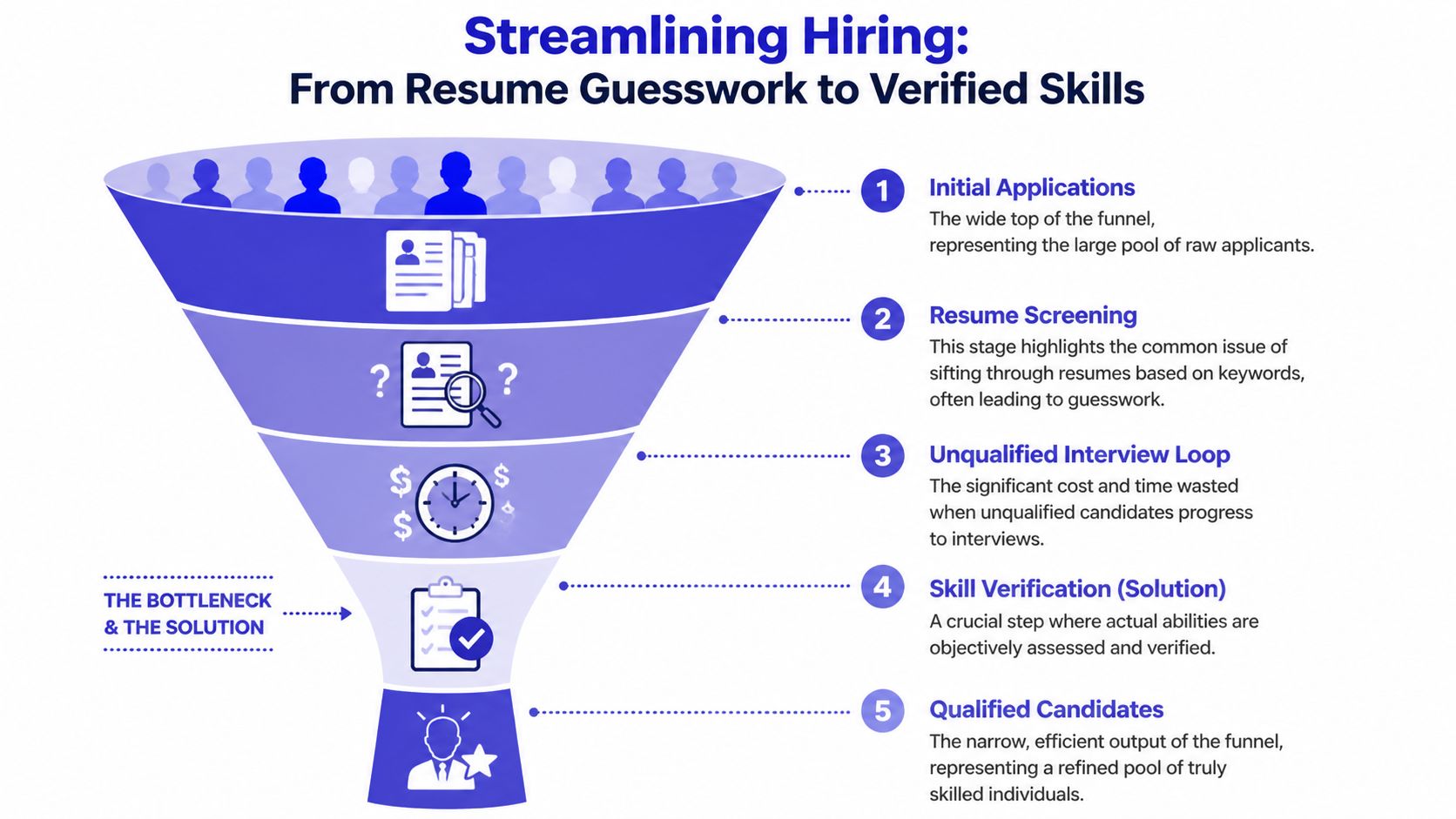
It starts when teams confuse a polished resume with evidence. A recruiter sees the right title, a familiar company, a handful of keywords, and the candidate moves forward. Then the hiring manager spends valuable time discovering that the person can talk about the work better than they can do it.
That’s one of the biggest hidden costs in hiring.
Automation helps, but basic automation isn’t enough
Plenty of teams have already automated part of screening. That’s a good start. It reduces repetitive manual work and clears obvious mismatches faster than a recruiter can.
But automation alone doesn’t solve the quality problem. Airswift reports that AI-powered automated screening can reduce screening time by up to 75%. That’s meaningful. The same source adds something more important: combining automated screening with custom skill assessments reduces false positives by 40%.
That distinction matters.
A generic screen is useful for filtering out candidates who clearly don’t fit. It’s much less useful for identifying who can actually perform in the role. If your process stops at knock-out questions and resume parsing, you’ll still send too many weak candidates into expensive interview stages.
What strong skill verification looks like
The best screening systems answer a practical question early. Can this person do the work at the level this role requires?
That calls for role-specific assessment, not generic trivia. A good screen should test for the kind of output the candidate will be asked to produce after they join.
For technical hiring, that could mean coding tasks based on real constraints. For operations, it might be scenario judgment and prioritization. For consulting or finance, case-style reasoning often tells you more than a polished CV ever will. For customer-facing roles, communication and judgment matter at least as much as raw knowledge.
A useful framework:
Start with fundamentals
Confirm baseline fit on essential criteria. Basic automation works well here.Verify applied skill
Ask candidates to solve a problem that resembles the job, not a puzzle detached from it.Evaluate judgment
Strong candidates don’t just get answers. They make good decisions with incomplete information.Check communication
Many hires fail because they can’t explain their reasoning clearly to teammates or customers.
For teams hiring distributed technical talent, this guide for assessing remote tech talent offers practical examples of what to evaluate beyond a resume review.
Stop sending uncertainty into interviews
If hiring managers use interviews to discover basic competence, the process is upside down.
Interview time is expensive because it pulls senior people out of real work. Every weak candidate who reaches that stage creates direct labor cost and indirect frustration. It also degrades confidence in recruiting. Once managers stop trusting the shortlist, they add more rounds, more stakeholders, and more delay.
That’s why I prefer a system where interviews start after evidence exists.
One option in that category is Cohesyve’s skill assessment approach, which uses role-specific verification rather than relying on static resume screening. The broader principle is what matters: candidates should prove relevant ability before the business commits scarce interviewer time.
Hiring shortcut: Don’t ask the panel to discover whether someone can do the job. Ask the panel to explore how they do it, where they’ll thrive, and what support they’ll need.
Match the assessment to the role
Teams sometimes overcorrect. They hear “skill verification” and create a long, rigid process for every role.
That backfires.
A lightweight screen may be enough for high-volume, lower-complexity roles. A deeper simulation makes more sense when the role has high business impact, long ramp time, or a high risk of mismatch. Senior and unusual profiles also need room for human judgment earlier in the process.
The right setup usually follows a few principles:
| Role context | Better screening approach |
|---|---|
| Entry-level or high-volume roles | Heavier use of automated filtering and short practical screens |
| Technical specialist roles | Applied tasks tied closely to actual job demands |
| Senior or unconventional profiles | Earlier human review combined with selective skill verification |
| Cross-functional or client-facing roles | Assessment of judgment, communication, and scenario handling |
The point isn’t to automate everything. It’s to remove guesswork where guesswork is most expensive.
Resume review still has a place
Resumes aren’t useless. They’re just weak evidence on their own.
They can show trajectory, context, domain exposure, and communication style. That’s valuable. What they can’t do reliably is prove current capability. Once teams accept that, the process gets cleaner fast.
You don’t reduce cost per hire by reading resumes faster. You reduce it by making sure fewer unqualified candidates ever earn a calendar slot.
Accelerate Your Interview and Offer Velocity
After you’ve built a cleaner shortlist, speed starts to matter more than volume.
At this point, the candidates are usually good enough to hire. The problem is no longer sourcing noise. It’s process drag. Calendars slip. Feedback takes too long. Decision-makers add one more conversation because they’re nervous. Good candidates interpret the delay correctly and move on.
That hesitation costs real money. Pin reports that each day of vacancy costs about $500 in productivity loss, that the median time-to-fill is 44 days, and that organizations using automation can fill roles 30 days faster, which the same source says translates to $750,000 in recovered vacancy costs across a 50-hire cohort.

Remove delay that adds no signal
A lot of interview time feels serious without improving the decision.
The worst offenders are easy to spot:
Back-and-forth scheduling across too many stakeholders
Unstructured interviews that produce duplicate data
Late interviewer additions because someone senior wants a look
Slow feedback loops after each round
Offer approvals that start only after a final yes
If a candidate is waiting while your team coordinates internally, that’s not rigor. That’s admin.
A leaner process usually includes a fixed panel, a clear scorecard, and interview blocks reserved in advance for priority hires. Many teams also benefit from moving debriefs to same-day or next-day cadence so concerns surface while impressions are fresh.
Design for decision speed
Interview velocity improves when every stage has a job.
Use the early stage to confirm fit against known requirements. Use the middle to probe capability, judgment, and collaboration. Use the final stage only for issues that still need resolution. If the same question is being re-litigated in every round, the process wasn’t designed.
A few practical moves work well:
Automate scheduling wherever possible
Calendar coordination is low-value work. Let software handle it.Use structured scorecards
Vague feedback creates extra rounds because nobody can compare candidates cleanly.Set service levels for interviewer feedback
Not as bureaucracy. As operating discipline.Prepare offer ranges early
Don’t wait for finalist approval to discover compensation misalignment.Keep a warm bench
Good backup candidates reduce panic if the first choice declines.
For teams trying to tighten this stage, practical ways to reduce time to hire are often more useful than another sourcing experiment. The middle of the funnel is where many companies subtly lose both money and candidate trust.
A slow process doesn’t feel slow inside the company. It feels careful. Outside the company, it often feels indecisive.
Protect the candidate experience while moving faster
Faster doesn’t mean rushed. Good candidates can tell the difference.
A respectful process gives people clarity on steps, timeline, and decision criteria. It avoids long silences. It closes loops. It doesn’t ask for duplicative work. Ironically, the teams that move fastest usually feel more thoughtful because candidates aren’t left guessing.
One more thing matters here. Don’t confuse “more stakeholders” with better hiring. If a panel can’t evaluate a candidate without adding fresh interviewers at the last minute, the panel is poorly designed.
Build a Cost-Efficient Hiring Culture That Lasts
Most hiring savings disappear when they live as a side project inside talent acquisition.
One quarter, the team cuts agency spend. The next quarter, managers panic over an urgent role and the old habits return. Someone adds more interviews after a mis-hire. A new leader asks for resume review “just to be safe.” Soon the process is expensive again, only now in different places.
Sustainable cost control comes from a better hiring culture, not from one-off cuts.

Use a better north star
A plain cost-per-hire metric is too narrow to guide good decisions on its own.
Business Management Daily argues that current benchmarks often ignore the difference between a fast, cheap hire who takes 6 months to ramp and a more carefully vetted hire who becomes productive in 6 weeks. That’s the right frame. A hire isn’t valuable because they accepted an offer. They’re valuable when they contribute reliably.
That’s why mature teams start thinking in terms like quality-adjusted cost per hire or cost per productive employee. The label matters less than the behavior it encourages. You stop rewarding cheap closure and start rewarding strong outcomes.
What durable hiring discipline looks like
This shift usually shows up in operating choices, not slogans.
Recruiters and hiring managers share ownership of both speed and quality
Interviewers know their role in the process and don’t duplicate one another
Assessment quality is tied to ramp quality, not treated as a separate issue
Post-hire outcomes feed back into recruiting design
Finance sees hiring as an investment system, not just a procurement category
Leadership test: If a process saves money upfront but consistently produces slow-ramping hires, it isn’t efficient.
A phased plan that teams can actually run
You don’t need a full rebuild at once. Most companies can make progress in phases.
This quarter
Start with the operational changes that remove obvious waste.
Audit real hiring costs including interview time and vacancy drag
Review source mix and identify roles where agency use has become default behavior
Tighten shortlist quality by adding stronger early-stage verification
Standardize interview scorecards so teams stop collecting fuzzy feedback
Over the next two quarters
Build more durable process improvements.
Formalize referrals so they run as a channel, not a campaign
Map role families to assessment methods based on complexity and risk
Set hiring stage service levels for scheduling, feedback, and approvals
Track early performance and ramp signals with hiring managers after start date
Longer term
Here, hiring becomes a repeatable company capability.
Define success profiles for key roles using real on-the-job evidence
Connect recruiting data to post-hire outcomes so weak patterns get corrected
Train interviewers continuously instead of once a year
Treat process exceptions as exceptions and inspect why they happened
The point isn’t perfection. It’s consistency. Teams that know how to reduce cost per hire over the long run don’t obsess over one magic tactic. They make better trade-offs repeatedly.
The win is simple. Hire fewer people you’ll need to replace. Get strong candidates to decision faster. Help new hires become productive sooner. When those three things happen together, the cost metric finally starts telling the truth.
If your team wants to cut hiring waste without lowering the bar, Cohesyve is built for that part of the problem. It helps teams replace resume-first screening with role-specific skill verification, so fewer weak candidates reach interviews and stronger candidates reach decision faster.