Most hiring processes still try to predict how someone will do the work by reading about them: a résumé, a cover letter, a conversation about past jobs. A job simulation skips the prediction step. It asks the person to do a piece of the work and looks at what they produce.
This guide defines the term, separates it from the formats it gets confused with, summarises what the research says, and gives worked examples for six common roles. One disclosure: Cohesyve, which publishes this guide, builds job simulations. Beyond the summary above, it is described only in the section on AI-generated simulations, alongside other vendors.
What is a job simulation?
A job simulation is a short, realistic task from the role, set in the context the work actually happens in, that an applicant completes and is scored on. The context is what makes it a simulation: a brief from a fictional manager, a dataset with the usual mess in it, a customer thread, a deadline.
A simulation for a support role might give the applicant three open tickets, a help-centre article and a refund policy, and ask them to reply to each. A simulation for an analyst might give them a spreadsheet export, a question from the head of sales and thirty minutes. What gets scored is the output (the replies, the analysis) and sometimes the choices made along the way.
What is a workplace simulation?
A workplace simulation is the same idea applied more broadly: a recreated work environment in which a candidate handles tasks, information and people as they would on the job. The term is common in large-employer and graduate assessment, where a "day in the life" exercise might combine an inbox, a scheduling problem and a written recommendation.
The older, in-person versions are the assessment centre exercises: in-tray tasks, role-plays with a trained actor, group discussions. The US Office of Personnel Management describes role-plays with a trained actor as a form of performance test alongside classic work samples. Online job simulations are the descendants of these exercises, cheaper to run and easier to standardise.
Cohesyve
Test candidates on the work itself
Cohesyve builds an AI job simulation of the role from your job description, finds and contacts candidates for it and returns a ranked shortlist. Ten candidates free, no card.
What is a work sample test?
A work sample test asks an applicant to perform a task that mirrors one employees do on the job, and scores the result. OPM's definition is close to that wording: tasks or work activities that mirror those performed on the job, scored by trained assessors or by measuring the outcome. Typing tests, a short coding exercise or a written marketing brief are all work samples.
The difference from a job simulation is mostly one of scope. A work sample can be a single isolated task. A simulation wraps that task in context. In practice the terms overlap, and many vendors use them interchangeably. Our explainer on the work sample test goes deeper on the classic format.
Job simulations compared with other assessment formats
| Format | What the candidate does | What it measures | Best used for |
|---|---|---|---|
| Job simulation | Completes a realistic task with context, materials and a deadline | Ability to do the actual work | Roles where output can be observed and scored |
| Work sample test | Performs one job task in isolation | A specific skill as applied | Clearly defined, repeatable tasks |
| Situational judgement test | Rates or ranks responses to written or video scenarios | Judgement about how to handle situations | High-volume roles, behaviours that are hard to observe directly |
| Skills test | Answers questions on a skill or tool (multiple choice, short answer) | Knowledge of the skill | Quick knowledge checks early in a funnel |
| Cognitive ability test | Solves timed reasoning problems | General reasoning and problem-solving ability | Roles with heavy learning demands |
| Personality questionnaire | Describes their own preferences and habits | Self-reported traits | Development and coaching more than selection |
A situational judgement test asks people what they would do; a simulation asks them to do it. Our guide to situational judgement tests covers the SJT format in detail, and the psychometric assessment explainer covers trait and ability measures.
What does the research say about work samples?
Work samples have consistently ranked among the stronger predictors of job performance in the selection research, although the most recent estimate is lower than the figure most articles still quote.
- Schmidt and Hunter (1998). Their widely cited meta-analysis in Psychological Bulletin reported an operational validity of .54 for work sample tests, the highest of the 19 methods in the table, ahead of general mental ability (.51) and structured interviews (.51).
- Sackett, Zhang, Berry and Lievens (2022). Writing in the Journal of Applied Psychology, they argued that earlier corrections for range restriction overstated many validities. Their revised estimates put structured interviews first (.42), then job knowledge tests (.40), empirically keyed biodata (.38), work samples (.33) and cognitive ability (.31).
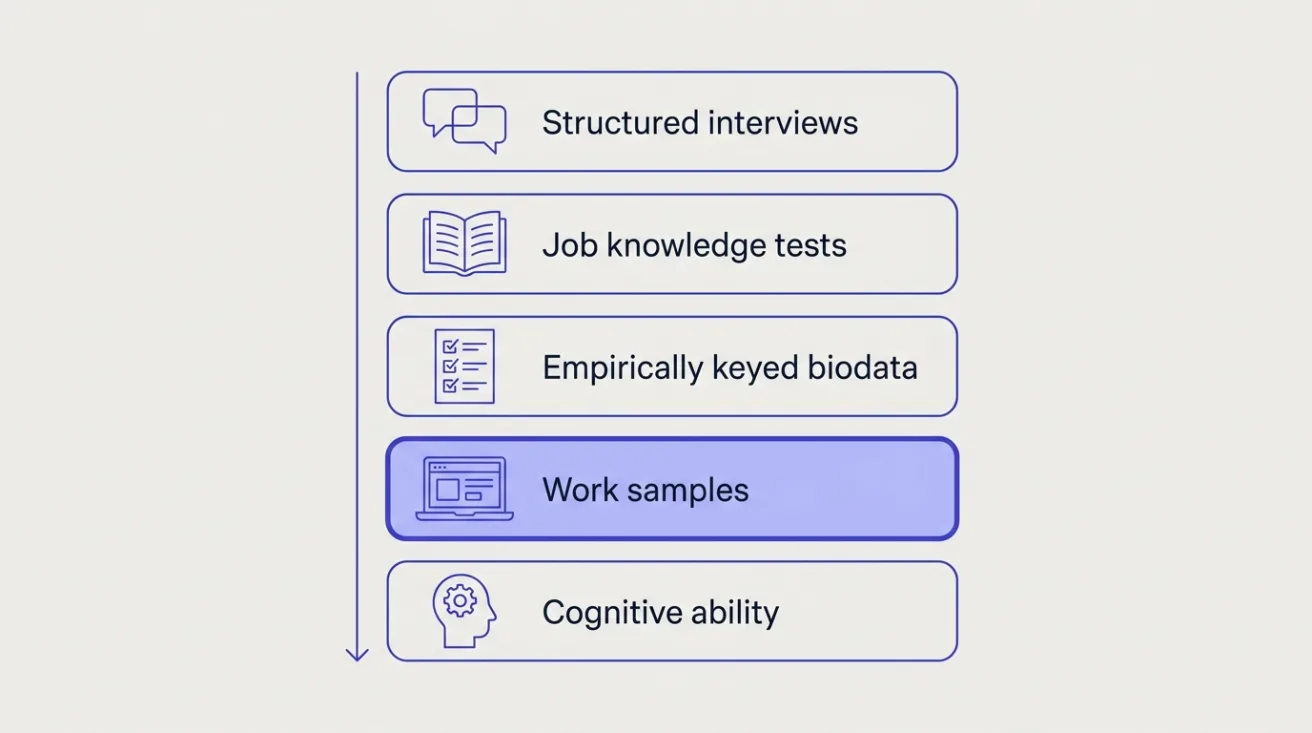
So work samples moved from first place to fourth in the revised ranking, and they remain clearly ahead of unstructured interviews and years of experience. A validity of .33 is a correlation: it means work sample scores and later performance rise together to a useful degree, with plenty of individual exceptions.
OPM's guidance adds three practical points. Applicants often see work samples as very fair. Differences between men and women or between racial groups are generally small or absent, depending on what the task measures. And they can be costly to build and need updating when the job's tools change.
Can you give me an example of a work sample test?
Yes: for a customer support role, give the applicant three real-looking tickets and the refund policy, and ask for written replies within 30 minutes. Score tone, accuracy against the policy and whether each reply resolves the problem. Here are examples for six roles.
| Role | The simulation | What a strong response shows |
|---|---|---|
| Data or business analyst | A messy CSV export and a question from a sales leader ("why did Q3 churn rise?"); deliver a short written answer with one chart | Cleans data without being told, answers the question asked, states the caveats |
| Customer support | Three open tickets of rising difficulty, a help-centre article and a refund policy; reply to each | Applies the policy correctly, de-escalates, knows when to hand off |
| Sales (SDR or AE) | A prospect's website and a one-paragraph ICP; write a first outreach email and plan a discovery call | Researches before writing, leads with the prospect's problem, asks good questions |
| Software engineer | A small repository with a failing test and a feature request; fix the bug, add the feature, explain the trade-off | Reads existing code, writes tests, communicates decisions |
| Marketer | A product brief and last month's campaign numbers; propose next month's plan and write one ad | Uses the data, picks a priority, writes for the audience |
| Operations | A week of order data with a fulfilment bottleneck; find the cause and recommend a fix | Structures the problem, quantifies the impact, proposes something workable |
Each of these can be scored against a rubric of four or five criteria written before anyone takes the task. For more role-by-role detail, see how to assess data analysis, customer service, sales discovery, system design, copywriting and operations management.
What is an assessment test for a job sample?
It is a pre-employment assessment built from a sample of the job's real tasks, as opposed to one built from general aptitude or personality questions. Employers use the phrase for anything from a single take-home exercise to a full online simulation. The defining feature is that the content comes from the job: if you could not imagine the task appearing in the person's first month, it is not a job sample.
Ready-made versions exist for common skills, such as a data analyst skills assessment, a customer service assessment or a sales skills assessment. Custom versions are built from the specific job description.
What are skills-based hiring examples?
Skills-based hiring means deciding on evidence of what someone can do rather than on proxies such as degrees, job titles or years of experience. Examples in practice:
- Removing a degree requirement from a job advert and adding a work sample to the first stage instead.
- Replacing the recruiter phone screen with a 30-minute job simulation that every applicant is invited to take.
- Scoring structured interviews against a shared scorecard of the skills the job needs.
- Opening a role to career changers whose experience is in a different industry, and letting the simulation decide who advances.
Job simulations are the most direct evidence a skills-based process can collect. Our overview of skills-based hiring covers the wider practice.
How to design a job simulation
- Start from the work itself. A job description lists requirements; it rarely describes the work. Ask the hiring manager what a new hire will spend the first ninety days doing, and what separates a good week from a bad one. Pick one or two of those tasks.
- Write the rubric first. Four or five criteria, each with a description of weak, acceptable and strong. If two reviewers would score the same response differently, the rubric is not finished.
- Add context and keep it short. A short brief, realistic materials and a clear deliverable. The context is what makes the task feel like the job; extra steps just make it longer.
- Set a time box and state it. Tell candidates up front how long the task takes, and cut any step that is not the work itself. Multi-day take-home projects belong at the final stage, if anywhere.
- Pilot it on current employees. Ask two or three people who do the job well to take it. If they struggle, or finish in five minutes, adjust it.
- Place it to replace a step. A simulation instead of a phone screen saves time for everyone. A simulation on top of a phone screen, two interviews and a take-home is how you lose candidates.
- Review the results against outcomes. After a few hires, check whether simulation scores line up with how people actually performed. Adjust the rubric if they do not.
Pitfalls to avoid
Length and drop-off. Every assessment is a request for a candidate's time, and the people with the most options are the least willing to give it. Tell candidates up front how long the task takes and why you are asking, and keep early-stage simulations short.
Unpaid real work. Never ask candidates to produce something you will use, such as a real campaign or a fix to your production code. Use fictional companies and synthetic data. It is fairer, and it removes any suspicion that the process is free consultancy.
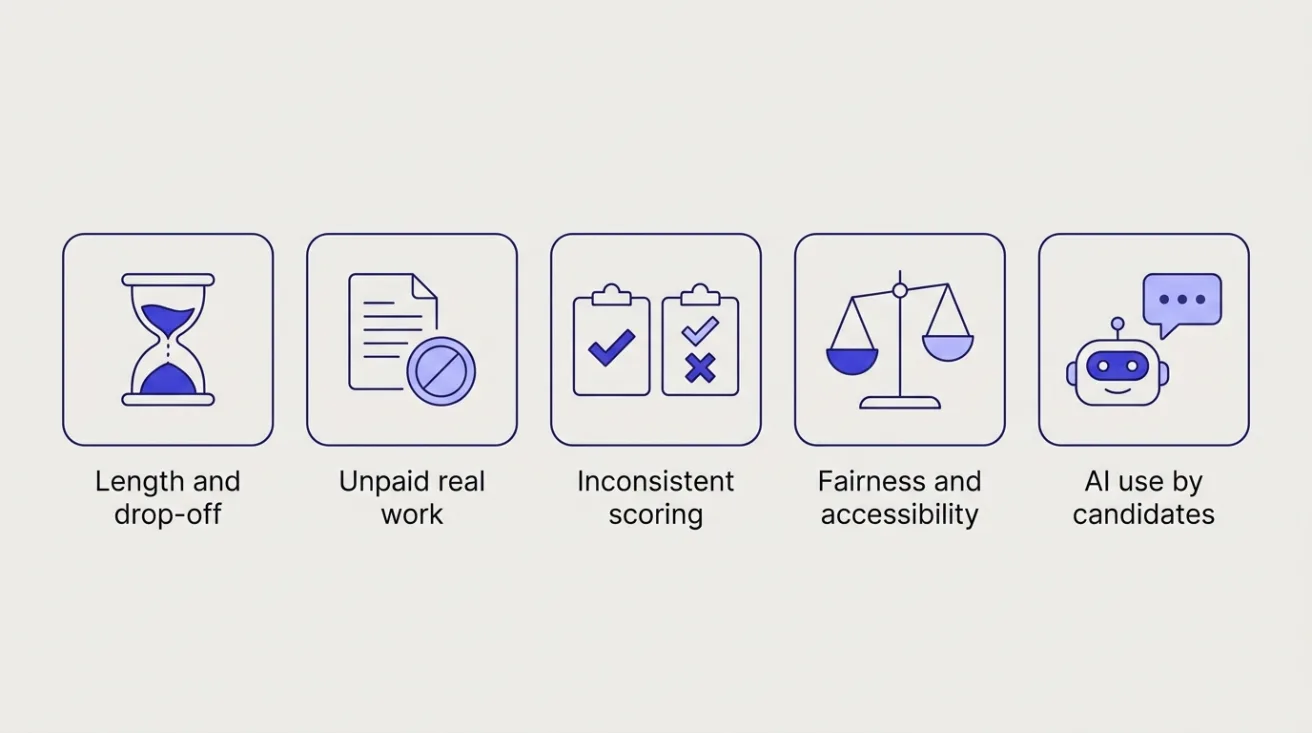
Inconsistent scoring. A simulation scored on a reviewer's gut feel is an unstructured interview with extra steps. Use the rubric for every candidate and, where possible, have the reviewer score without seeing the résumé.
Fairness and accessibility. In the US, the EEOC's guidance on employment tests is direct: a test that screens out a protected group has to be job-related and consistent with business necessity, and under the ADA employers must provide reasonable accommodations in how a test is given, such as a reader or extra time, unless that causes undue hardship. A well-built simulation helps on the first point because its content is the job. For the second, say clearly how to request an accommodation, and make sure the tool supports screen readers, keyboard navigation and extended time. The EEOC also notes that employers stay responsible for validation even when a vendor supplies the evidence.
AI use by candidates. Candidates now have AI assistants. Decide whether the role allows them. If the job will involve using AI, a simulation that permits it and scores the judgement applied to its output is often more realistic than one that bans it. If you ban it, say so, and tell candidates up front what the proctoring records. Our explainer on what "proctoring enabled" means covers the candidate's side.
AI-generated job simulations
The cost of building and maintaining simulations, the drawback OPM flags, is what newer tools attack. Instead of drawing from a fixed library, they generate a simulation from a job description, so each role gets its own task and the content can change from candidate to candidate.
Vendors in this space, described by their own positioning:
- WorkProbe builds a simulated task from a job posting, with documents, an AI assistant and simulated colleagues, and returns a ranked shortlist.
- TaTiO builds quick online work simulations for any position so hiring teams can see how applicants handle tasks.
- Vervoe offers job simulations and skills assessments with AI grading built on real job tasks.
- Cohesyve, which publishes this guide, takes a job description, sources and contacts candidates, puts applicants through role-specific job simulations with AI scoring, and returns a ranked shortlist. It is built for teams that want to spend interview time only on the strongest applicants.
Whichever you look at, ask the same questions: can you see and edit the rubric, how does the tool handle accommodations, what is the candidate told about AI use, and what evidence is there that scores relate to performance. Our buyer's checklist for assessment platforms has the full list.
Common questions
How long should a job simulation be? Short enough that a strong candidate finishes comfortably in one sitting, and no longer than the task needs. Tell candidates the length up front so they can plan for it. Multi-day take-home exercises should be reserved for finalists and, ideally, paid.
Are job simulations better than interviews? They measure different things and work best together. In the 2022 re-analysis, structured interviews ranked first and work samples fourth; a simulation early and a structured interview later uses both.
Can a job simulation replace the phone screen? For most roles, yes, and that is where it saves the most time. The phone screen mostly checks interest and basic fit; a short simulation checks interest and capability at once.
Do candidates like job simulations? OPM reports that applicants often see work samples as very fair, because the link to the job is obvious. Candidates object to tasks that are long, irrelevant or look like unpaid work, so keep them short and fictional.