At its core, skills-based hiring is a practical concept: you hire people based on what they can do, not just what their resume says.
Imagine you're looking for a guitarist for your band. You wouldn't just look at a list of their past gigs and call it a day, right? You'd ask them to play. You want to hear their talent for yourself. That's skills-based hiring in a nutshell—it's about focusing on verifiable abilities over traditional proxies like degrees or years of experience.
The Shift from Resumes to Real Skills
For decades, hiring has relied on certain shortcuts. Signals like a diploma from a specific university or a number of years in a role have been used to predict a candidate's future success. This approach assumes that these credentials automatically equal competence.
But that's not always the case. This traditional method can screen out talented, self-taught individuals or people who took a non-traditional career path.
Skills-based hiring addresses this problem directly. It’s a change in mindset that brings the focus back to what matters most: can this person do the job well? Instead of asking, "Where did you get your degree?" the question becomes, "Can you show me how you'd solve this problem?"
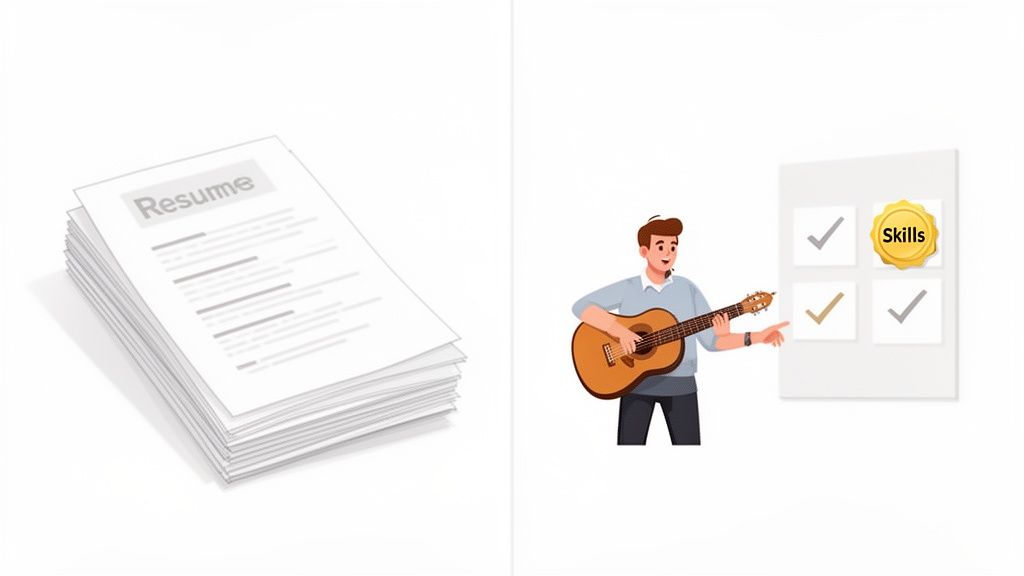
From Paper Credentials to Proven Abilities
Making this change means looking past the resume to directly measure the skills someone brings to the table. As companies start moving away from a paper-first approach, understanding different methods for assessing competencies in the workplace is key to making it work.
This hands-on evaluation can look different depending on the role:
- A software developer might be asked to complete a coding challenge that reflects a real-world project.
- A marketing candidate could be tasked with creating a sample campaign brief.
- A financial analyst might have to build a forecast model using a sample dataset.
The point is to replace assumptions with concrete evidence. When you do that, you build a hiring process that is more objective, fair, and effective at finding the right person, regardless of their background.
Traditional vs Skills Based Hiring at a Glance
To see how different these two approaches are, let’s compare them side-by-side. The table below highlights the shift in focus from pedigree to performance.
| Aspect | Traditional Hiring | Skills Based Hiring |
|---|---|---|
| Primary Focus | Resumes, degrees, job history, years of experience. | Verifiable skills, competencies, and problem-solving abilities. |
| Evaluation Method | Resume screening, keyword matching, unstructured interviews. | Practical assessments, work samples, structured interviews. |
| Key Question | "What is your background?" | "What can you do?" |
| Talent Pool | Often limited to candidates with specific credentials. | Broader and more diverse, including non-traditional talent. |
| Predictor of Success | Assumes past experience and education equals future performance. | Relies on demonstrated ability to perform job-related tasks. |
This comparison makes it clear. It's not about ignoring a person's history; it’s about validating their claims. The focus moves from a candidate's past to their present, provable skills—a more direct path to building a high-performing team.
Why Top Companies Are Rethinking Credentials
The move toward skills-based hiring isn't just a trend. It’s a practical response to a common challenge: the old way of hiring isn't always effective. For years, the system operated on a simple assumption—if a candidate had a four-year degree or a certain job title on their resume, they must be qualified.
But as many companies have learned, that's a costly assumption to make. A diploma doesn't guarantee a person can perform the job, and requiring one often filters out capable people who took a different path. It's a frustrating situation: leaders express concern over a "talent shortage" while their own screening processes may overlook a large pool of potential.
When a hire doesn't work out, the costs can add up. A bad hire can affect productivity, team morale, and resources for recruiting and training a replacement. This kind of financial and cultural impact is causing leaders to ask: are we really finding the best people this way?
The Widening Gap Between Degrees and Demands
At the heart of the problem is a growing disconnect between what a traditional education offers and what today's jobs require. Business needs and technology are evolving so quickly that a degree from a few years ago might not reflect the skills someone needs now. This is especially true in rapidly changing fields like tech, marketing, and data science.
By focusing on objective, measurable skills, companies can build a more reliable and effective hiring process. This isn't just about fairness; it's about finding the most capable person for the role, regardless of their background.
This isn't a niche concern. In 2023, 73% of companies globally were using skills-based hiring methods, a significant increase from 56% the year before. This trend is accelerating as 77% of employers report struggling to fill key roles. You can find more details in The State of Skills-Based Hiring 2023 report.
A More Reliable Predictor of Performance
Ultimately, what's driving this shift is a business need for predictability. Past performance is a useful indicator, but only if you're measuring what truly matters for the role.
Instead of assuming that a specific degree will translate to on-the-job success, a skills-first approach gives you direct evidence. It answers the one question every hiring manager has: "Can this person do the work?"
By verifying skills upfront with practical assessments and real-world work samples, you take some of the guesswork out of hiring. You build teams based on proven ability, which can lead to a more capable and high-performing organization. It’s a simple switch from credentials to capability.
Cohesyve
See what candidates can do before you interview them
Cohesyve turns a job description into a role-specific assessment with a scoring rubric. Each candidate gets a different version, so questions cannot be shared. Ten candidates free, no card.
The Business Impact of Hiring for Skills
Switching to a skills-first hiring strategy is more than just a process update; it can deliver measurable results. When you prioritize proven abilities over paper credentials, you can make more informed, efficient decisions that strengthen the organization. The benefits can show up in your budget, timelines, and team's performance.
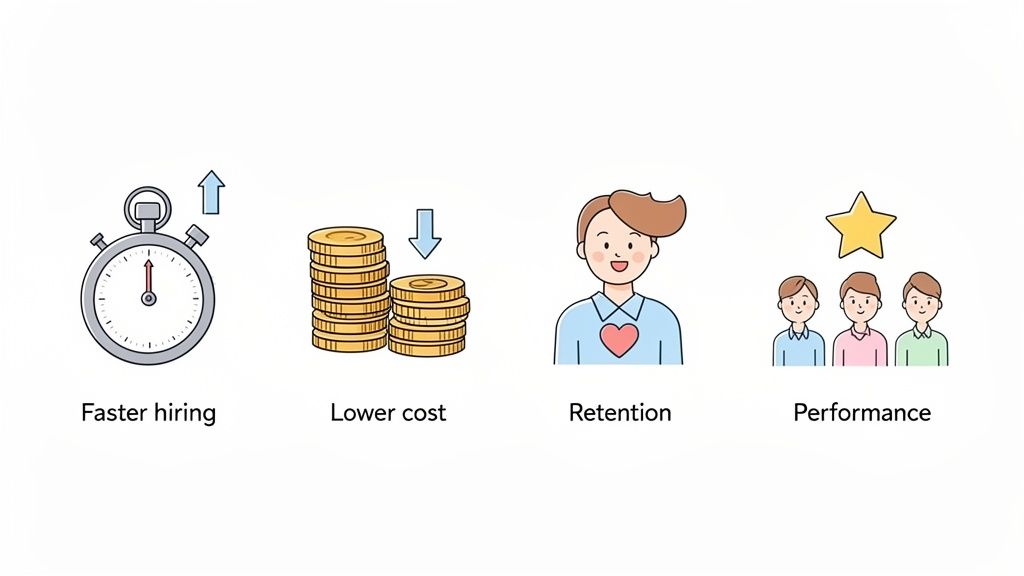
This shift can create a positive ripple effect, starting with how you spend your time and money during the recruiting cycle.
Faster and More Cost-Effective Recruiting
Traditional hiring can be a numbers game. It often involves sifting through hundreds of resumes to find a handful of people to interview. It can be a slow and expensive administrative process.
Verifying skills early in the process changes this model.
Instead of guessing who might be a good fit based on their resume, you get clear evidence of a candidate's abilities from the start. This means you can bypass endless screening calls and move straight to a much smaller, highly qualified pool of people.
The result is a more focused and efficient hiring engine. Companies that put skills first often see improvements in their recruiting metrics:
- Reduced Time to Hire: By focusing on candidates who have proven they can do the job, you can shorten the hiring timeline and fill roles faster.
- Lower Recruitment Costs: A shorter hiring cycle means fewer billable hours for recruiters and less time taken from hiring managers' core duties, leading to potential savings.
- Improved Recruiter Productivity: Your talent team can spend less time on administrative work and more time engaging with top contenders.
Better Retention and Stronger Performance
The benefits don't stop once the offer letter is signed. When you hire someone based on their demonstrated ability to do the work, you create a better match between the person and the role. That alignment is a driver of both employee satisfaction and long-term success.
Hiring for skills is a reliable way to build a resilient, high-performing team. Research shows that 94% of companies observed that skills-based hires outperform those selected based on traditional credentials.
This isn't a coincidence. Employees who are a good fit for their jobs from day one are often more engaged, productive, and likely to stay. They feel competent and valued because the role plays to their actual strengths.
This can lead to higher retention rates, which cuts down on the expensive cycle of turnover and retraining. You end up building a team based on what people can do, creating a more agile and effective workforce.
Building a More Inclusive and Equitable Workplace
One positive outcome of skills-based hiring is that it can naturally build a more diverse, equitable, and inclusive team. When you stop using traditional gatekeepers—like a specific degree or a linear career path—you open the door to a wider, more representative group of people. This can be a strategic advantage.
Traditional hiring methods can carry unintentional bias. They may favor candidates who went to certain schools or followed a conventional career trajectory, which can screen out pools of talent. Shifting the focus to what someone can do helps dismantle these barriers. It creates a fairer process where capability is the primary consideration.
This approach gives an opportunity to talented people who might have been overlooked before. It levels the playing field for individuals who are self-taught, came up through apprenticeships, or have taken a non-linear career path.
Expanding the Talent Pool
When you hire for skills, you’re no longer limited to a small, familiar pool of candidates. You can cast a wider net. Consider all the candidates with hands-on abilities but no four-year degree—that’s a significant portion of the workforce.
By focusing on what people can do, you gain access to them.
This has a measurable impact on diversity. Skills-based hiring is already making a difference. One recent study found that 73% of surveyed Black, Asian, and Arab employees landed new job opportunities because of these practices. This approach can expand a company's talent pipeline by nearly 10 times compared to degree-focused methods. You can read more about how skills-based hiring is changing the game for workers on IYFglobal.org.
By removing arbitrary requirements, skills-based hiring doesn't just invite more people to apply—it ensures that every applicant is judged on their actual ability to succeed in the role, fostering true equity.
This is what makes it a powerful tool for building the kind of diverse, high-performing teams many modern companies are trying to create.
From Unconscious Bias to Objective Evidence
Every hiring manager wants to be fair, but unconscious biases are a part of being human. We might naturally gravitate toward a candidate from our own alma mater or someone whose resume looks like our own did five years ago. A skills-first model helps counter these biases by basing decisions on objective data.
Instead of relying on gut feelings or familiar patterns on a resume, you have concrete proof of what a candidate is capable of. A well-designed skills assessment gives you a standardized way to evaluate everyone, ensuring each person is measured against the same clear criteria.
When a candidate’s performance on a real-world task is what you're focused on, their background becomes interesting context, not a barrier to entry. This creates a more equitable process where the best person for the job can shine, no matter where they came from.
How to Implement a Skills-Based Hiring Process
Switching to a skills-based hiring model may sound like a large undertaking, but it’s more of a strategic pivot than a complete overhaul. Think of it as building a smarter, more effective hiring process. By breaking it down into a few manageable stages, you can start shifting your focus from resumes to real, verifiable abilities.
Before you start, it’s helpful to get a clear picture of your current talent landscape by conducting a skills gap analysis. This initial step helps you pinpoint which skills are most critical for your team's success, giving you a solid foundation to build upon.
Redefine Roles Around Critical Skills
First, take a look at your job descriptions. It's common to start with a list of required degrees or years of experience, but it's time to change the approach. Instead, begin by defining the core competencies someone needs to succeed in the role.
Get your team involved. Ask them, "What does someone in this job do every day? What are the top three to five skills that determine their performance?"
- For a sales rep, you might land on persuasive communication, negotiation, and CRM proficiency.
- For a project manager, it could be resource allocation, risk assessment, and stakeholder communication.
Once you have this list, rewrite your job descriptions to put these skills front and center. This does more than just attract candidates with the right abilities; it reframes how you'll evaluate them from the start.
Integrate Assessments Early in the Funnel
This is where the process becomes more efficient. Instead of saving assessments for the final round, move them to the top of your hiring funnel. Placing a role-specific skill challenge immediately after the initial application lets you screen for capability, not just resume keywords.
By verifying skills upfront, you can reduce the task of manually sifting through hundreds of resumes. This frees up your team to invest their time and energy on a smaller, highly qualified pool of candidates who have already proven they have the required skills.
Modern assessment platforms can create relevant challenges—from coding tests for developers to case studies for marketers—based on your skill-focused job description. This can make the process smoother and ensures your evaluation is directly tied to what the job demands. To learn more about how these tools work, see this guide on what is a pre-employment assessment.
Conduct Skill-Focused Interviews
By the time a candidate gets to the interview stage, you already have evidence that they possess the necessary hard skills. This changes the dynamic of the conversation. Instead of the usual "walk me through your resume," your interviews can become more strategic.
Now, you can dig into how they apply their skills in real-world scenarios. Ask behavioral questions that reveal their problem-solving process, their collaboration style, and how they handle pressure. The interview becomes less of a quiz and more of a practical conversation about their craft.
This diagram shows how a more inclusive, skills-first process works to remove traditional barriers, widen your talent pool, and create more equitable outcomes.
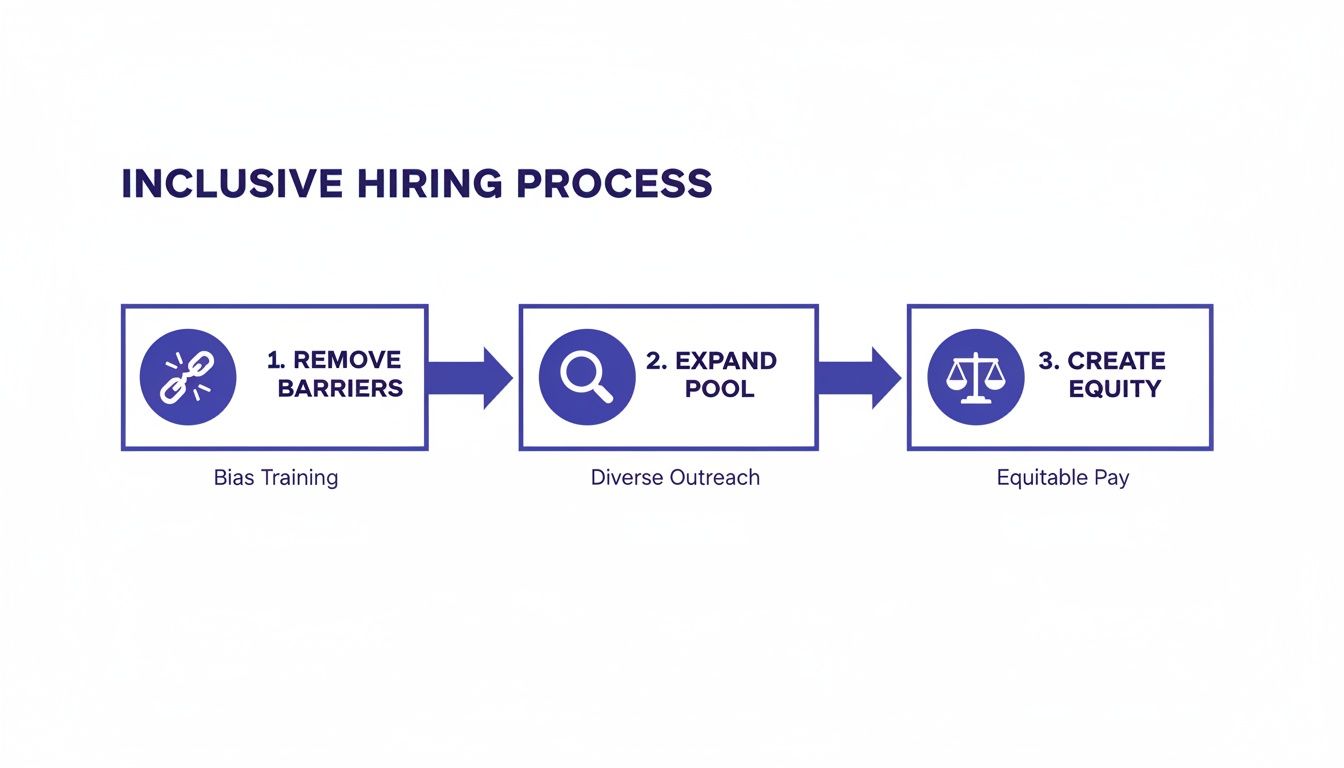
This approach ensures that every step, from sourcing candidates to making the final offer, is designed to fairly and accurately evaluate a person's potential.
Answering Common Questions About This Approach
It's natural to have questions when considering a change to your hiring process. Shifting to a skills-first mindset is a significant step, and it's smart to explore how it holds up in the real world. Let’s walk through some of the most common questions from hiring managers and talent teams.
Think of this not as throwing out your old playbook, but as adding a new, data-driven chapter to make your decisions sharper.
Does Skills-Based Hiring Ignore Experience?
Not at all. It just puts experience into perspective. Instead of using "years of experience" as a strict gatekeeper, this approach treats it as valuable context for a candidate's proven skills.
A skills assessment might show you that a candidate with three years of experience is a stronger problem-solver than someone with seven. You end up hiring for what someone can do now, not just how long they've held a title. The experience is still important, but it's the skills they built during that time that really count.
How Can You Assess Soft Skills This Way?
This is a common question. Modern assessment tools are often more sophisticated than a simple quiz and are not just limited to multiple-choice questions.
Today's platforms can use interactive, job-relevant scenarios to see how people think. Things like situational judgment tests, virtual case studies, and simulated client calls can measure a candidate's communication, critical thinking, and collaboration skills in a way that mirrors the actual work.
These methods can provide data on how a candidate handles the human side of the job.
Is This Method Only for Tech Roles?
No. While it gained popularity in tech, skills-based hiring works for almost any role—from marketing and finance to customer success and operations. The underlying principle is the same.
The key is to first pinpoint the skills that drive success in a specific role. Whether that's financial modeling for an analyst, persuasive writing for a copywriter, or project management for a team lead, you can build an assessment to see who has the relevant abilities.
Does This Approach Take More Time?
There can be more work upfront to define the core skills and set up the right assessments. But that initial investment can save a significant amount of time later.
You may spend far less time sifting through irrelevant resumes or conducting interviews with people who look good on paper but can't perform the job. By getting proof of skill early on, you ensure you're only talking to strong contenders. This can tighten up the whole hiring cycle, helping you fill roles faster and with more confidence.
Ready to stop guessing and start verifying? Cohesyve helps you build a hiring process based on proven ability, not just paper promises. Our AI-driven platform designs role-specific assessments in seconds, so you can skip the resume pile and move straight to interviewing the top 5% of candidates. See how it works at https://www.cohesyve.com.
Article created using Outrank