When an online assessment says "proctoring enabled," what does that actually mean for you and your candidates? It's a signal that the test is being monitored to maintain its integrity and ensure a fair experience for everyone.
Think of it as the digital version of the quiet, watchful supervisor in a traditional exam room. The goal is the same: create a level playing field where every candidate can showcase their genuine skills without distraction or unfair advantages.
What Proctoring Enabled Really Means
At its heart, a proctoring enabled test is simply an online assessment with a digital security system switched on. Just as a home security system uses cameras and sensors to monitor for anything out of the ordinary, proctoring software uses a computer's own tools to create a secure testing environment.
This isn't just a niche feature; it's become a key part of modern remote hiring. The global market for online proctoring is projected to reach $2.1 billion by 2030. The growth in remote work has encouraged companies to find reliable ways to verify skills from anywhere in the world, and proctoring was an available answer.
How the Technology Works Behind the Scenes
So, what happens when a candidate clicks "start" on a proctored test? Let's look behind the curtain. Enabling proctoring activates several functions that work together to validate the session.
To make it simple, here’s a quick breakdown of what these systems are actually doing.
Core Functions of a Proctored Assessment
| Feature | Purpose | Example |
|---|---|---|
| Identity Verification | Confirms the right person is taking the test. | Candidate holds their photo ID up to the webcam for a snapshot. |
| Webcam Monitoring | Observes the candidate and their immediate surroundings. | The system flags if another person enters the room or if the candidate leaves their seat. |
| Screen Recording | Captures all on-screen activity during the test. | Prevents candidates from opening new browser tabs to search for answers. |
| AI Analysis | Automatically detects patterns that might suggest cheating. | AI flags suspicious head movements, like repeatedly looking down at a phone. |
These features work in concert to give you confidence that the test results you're seeing are a true measure of a candidate's abilities. Understanding this process is the first step in deciding if this security level is right for your hiring goals, especially when weighing it against other forms of pre-employment skills testing.
The Three Main Flavors of Online Proctoring
So, you understand what "proctoring enabled" means in principle. But in practice, it’s not a one-size-fits-all solution. Think of it like choosing a security system for your home—you could hire a live guard, review security tapes later, or set up an automated alarm. Each comes with a different balance of security, cost, and how it makes people feel.
The real difference between these approaches boils down to human involvement. This single factor has a ripple effect on everything from scalability to the candidate's personal experience with your brand.
Live Proctoring
This is the digital version of having a supervisor right there in the room with you. A trained human proctor watches candidates in real-time, monitoring both their webcam feed and their screen activity. If they spot something that doesn't look right—like a candidate glancing at their phone or another person entering the room—they can step in and address it on the spot.
Live proctoring offers a high degree of security because a real person can interpret context and nuance in a way that software can't. The trade-off? It’s the most expensive and least scalable option. After all, one proctor can only keep a close eye on a small group of candidates at a time.
You’ll often see this approach used for high-stakes professional certifications or final university exams, where the cost is justified by the need for test integrity. For some, that human-to-human connection can even feel reassuring.
Record-and-Review Proctoring
Here we have the middle ground. The candidate’s entire session is recorded from start to finish—we're talking video from the webcam, audio from the microphone, and a full recording of their on-screen activity. Once the assessment is over, a human proctor reviews the footage. They often work with AI that flags suspicious moments, allowing them to quickly zero in on potential issues.
This method is more scalable and budget-friendly than live proctoring, as one person can review dozens of recorded sessions when it fits their schedule. The catch, of course, is that there’s no real-time intervention. You can only identify and act on potential cheating after the test has already been submitted.
Automated Proctoring
With automated proctoring, AI manages the monitoring. The software is trained to analyze a candidate's behavior, their environment's audio, and all on-screen actions, automatically flagging anything that breaks the rules. This could be anything from detecting a second voice in the room, noticing the candidate has opened a new browser tab, or flagging unusual head movements that suggest they're looking at notes.
This is the most scalable and cost-effective model, able to monitor thousands of tests at once without direct human oversight. The rise of these proctoring enabled features has changed the landscape for secure online testing. While live proctoring remains a standard for trust in academia, automated systems are gaining ground in the corporate world. For example, some market analyses show high adoption of analytics-driven monitoring to keep up with demand. You can dig deeper into these market trends and their rapid growth, especially in growing regions like Asia-Pacific.
This simple diagram shows how the core technologies come together to make this possible.
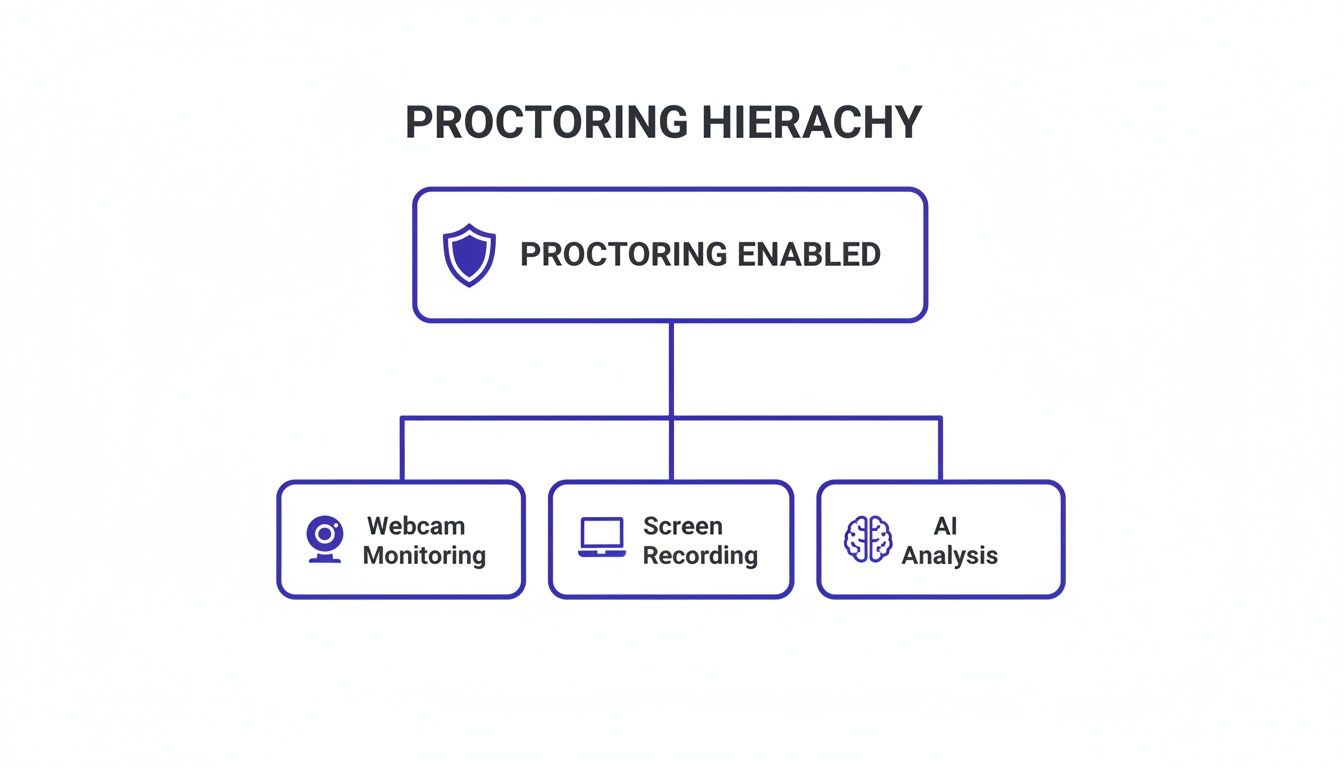
As you can see, webcam monitoring, screen recording, and AI analysis are the essential building blocks for creating a secure proctored testing environment.
Cohesyve
See what candidates can do before you interview them
Cohesyve turns a job description into a role-specific assessment with a scoring rubric. Each candidate gets a different version, so questions cannot be shared. Ten candidates free, no card.
How Proctoring Shapes the Candidate Experience
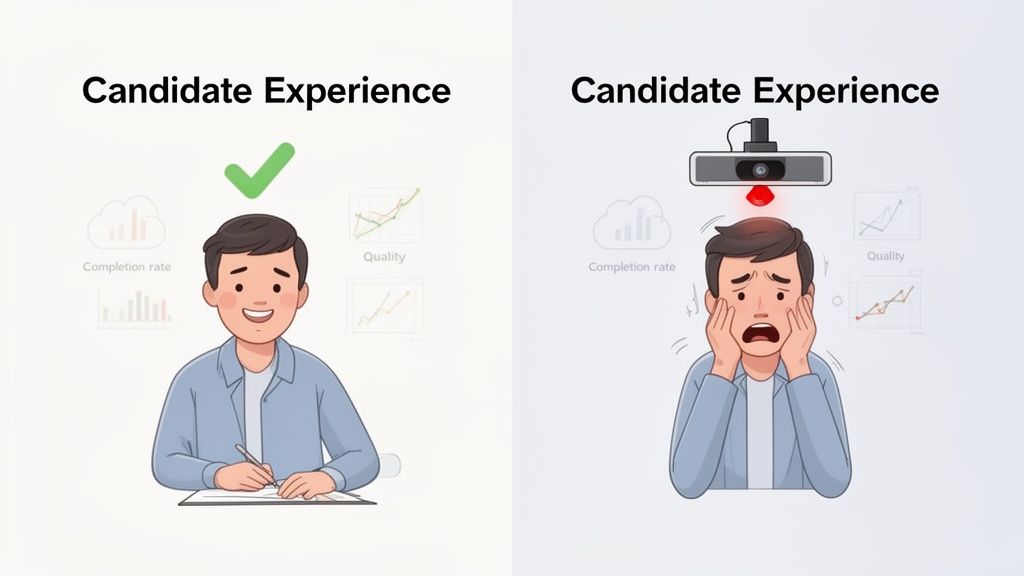
When we talk about a proctoring enabled assessment, it’s easy to get lost in the technology. But one of the most significant impacts is on the person taking the test, trying to prove they’re the right fit for the job. Their experience during that assessment will color their entire perception of your company.
There’s certainly an upside you can communicate. Explaining that a test is proctored to keep things fair can signal that you’re a company that values merit. It tells candidates you’re serious about creating a level playing field where their actual skills are what count.
However, the feeling of being watched can be stressful. For many talented people, knowing their every glance and movement is being recorded creates pressure. An innocent habit, like reading a question aloud to process it or looking up at the ceiling to think, can suddenly feel like a suspicious act that needs to be suppressed.
The Trade-Off Between Security and Comfort
This creates a real tension for hiring teams. Is the added security from proctoring worth the risk of making your best candidates feel anxious and untrusted? The right answer really depends on your company's culture and what you're trying to achieve with your hiring process.
A bad experience isn't just a feeling; it can show up in your hiring data. Many candidates will drop out of a hiring process that feels too difficult or invasive. When your top talent feels like they’re under a microscope, they might just decide it’s not worth it and walk away. You could then be left with a smaller, and potentially less qualified, pool of applicants.
The core issue isn't just about catching cheaters; it's about building trust. An assessment process that feels like an interrogation can damage the relationship before it even begins, leading great people to question if your company culture is the right fit for them.
Finding the Right Balance for Your Team
To get this right, you have to see it from their side. Think about the role you’re hiring for. For a high-stakes security position, strict proctoring can make sense. But for many other roles, a lighter touch that builds trust might get you better results and a stronger team in the long run.
The goal should always be to create an environment that feels both fair and respectful. This starts with being transparent about why security measures are there and exactly what candidates can expect. If you’re looking for more ways to create a welcoming process, our guide on how to improve the candidate experience is a great place to start.
When you strike this balance, you’ll see benefits across the board:
- Higher Completion Rates: When people feel respected, they’re more likely to finish the assessment and stay engaged in the process.
- Better Performance: A relaxed candidate is a focused candidate. Less stress allows them to truly showcase their skills, giving you a more accurate picture of their abilities.
- Stronger Employer Brand: A positive, thoughtful assessment experience reflects well on your company. It can turn candidates into advocates, even if they don’t get an offer.
By carefully considering these human factors, you can build a process that maintains integrity without pushing away the very people you hope to hire.
Navigating the Privacy and Bias Minefield
Let's be practical. When you make a test proctoring enabled, you’re stepping into a world of sensitive candidate data. It’s a significant responsibility, and with it come two major hurdles to consider: data privacy and algorithmic bias. Mishandling this can damage your hiring process and company reputation.
Think about it from the candidate's perspective. They have every right to ask what information you're gathering, where it's going, and who gets to see it. Thanks to regulations like GDPR, the bar for transparency is high. A vague statement like, “we monitor tests for fairness,” is not sufficient. People deserve to understand what’s happening behind the screen.
The Problem of Algorithmic Bias
Beyond just collecting data, the AI doing the monitoring can create its own set of problems. These algorithms are built to spot behavior that strays from a pre-defined “normal.” But what does normal look like?
Someone who silently reads questions aloud to concentrate, or a person with a medical condition that causes involuntary movements, could be flagged. This isn't a hypothetical—it happens.
This issue gets even more complicated when you look at different demographics. Studies have shown that some facial recognition systems are less accurate for women and people of color, leading to a higher rate of false positives. Every unfair flag can create anxiety for the candidate and extra review work for your team.
A core principle for using this technology responsibly is remembering that it should assist, not decide. A human being should have the final say, someone who can look at the context and make a fair, informed judgment.
How to Minimize Risks Responsibly
Building trust is essential. It starts with choosing technology partners who are open about how their AI works and how they protect data. But how you communicate with your candidates is just as crucial.
Here are a few practical steps you can take:
- Be Transparent: Don't just say you're using proctoring; explain why it's in place—to guarantee a fair shot for everyone. Be specific about what is being monitored.
- Provide a Clear Appeals Process: Give candidates a clear path to follow if they believe they were flagged by mistake or ran into a technical glitch. Let them know a real person is there to help.
- Always Keep a Human in the Loop: Treat AI-generated flags as a signpost, not a verdict. Human oversight is the way to catch the nuances that algorithms miss and prevent bias from creeping in.
By facing these ethical questions head-on, you can protect the integrity of your assessments without undermining the candidate experience. If you’re interested in digging deeper, you can learn more about ethics across different AI-powered recruitment tools and their role in modern hiring.
Building Trust Through Smarter Skill Verification
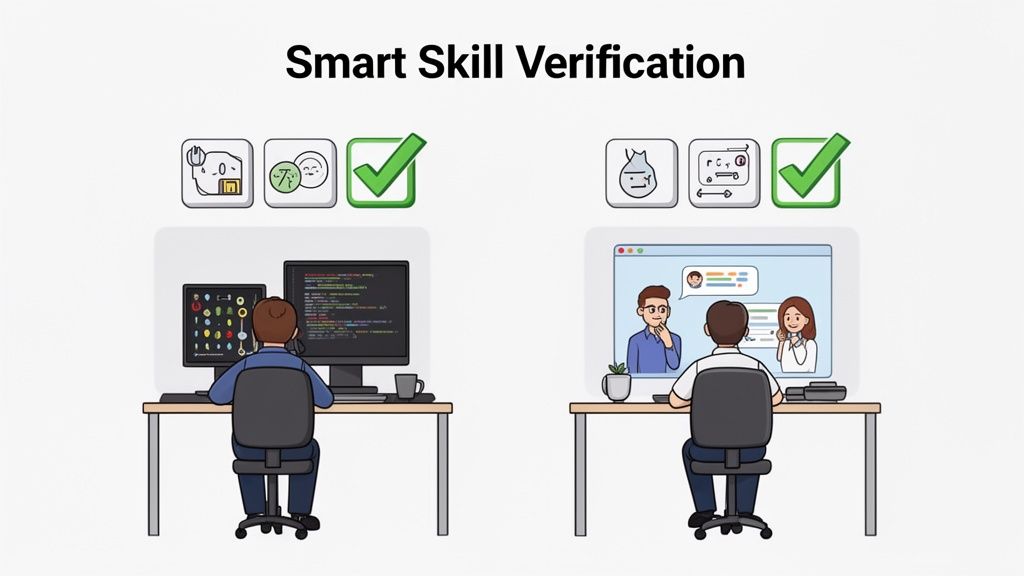
While the phrase proctoring enabled meaning is usually tied to securing an assessment, it's worth asking a different question: what if your assessments were designed so well that surveillance wasn't the primary focus?
Instead of just trying to catch unwanted behavior, we can build assessments that are inherently more difficult to cheat on and more engaging for the people taking them.
This changes the dynamic. The goal is no longer about preventing cheating; it’s about positively identifying talent. You’re not just hoping someone is trustworthy—you're verifying their skills in a way that feels productive, respectful, and a true reflection of the job.
Moving Beyond Surveillance
The traditional proctoring model is built on a foundation of suspicion. Think of it like putting security cameras in every room of a house because you’re worried someone might break the rules. But what if you could design a house so intelligently that breaking in isn't just hard, it's pointless?
That's the philosophy behind dynamic skill verification.
Instead of asking every candidate the same multiple-choice questions from a predictable list, you give each person a unique, interactive challenge that reflects the job they’re applying for. A software engineer might get a real-time coding problem. A marketing candidate could be asked to analyze a dataset and record their strategic recommendations.
This approach measures how someone thinks, solves problems, and communicates their ideas—skills that are difficult to look up on Google or outsource to a friend.
The power here is shifting from a 'gotcha' mindset to an 'opportunity' mindset. Assessments become a chance for great candidates to shine and show you what they can do, rather than a hurdle designed to catch them making a mistake.
When assessments focus on role-specific, on-the-job challenges, the candidate experience often improves. People feel like they’re demonstrating real value, not just taking another generic quiz. That builds trust from the very first interaction and gives you data that can help predict performance.
Designing Cheat-Resistant Assessments
This shift toward practical, hands-on tests also addresses the security issues proctoring was meant to solve. Preventing cheating isn't just about academic integrity; it has financial implications. The cost of a bad hire can be steep, which is one reason why the market for secure online testing is expanding so rapidly.
You can design assessments to be more resistant to cheating.
When every candidate gets a unique set of adaptive tasks, conventional cheating methods become less effective. There are no standard answers to copy when there are no standard questions.
This table highlights the difference in thinking.
Traditional Proctoring vs. Dynamic Skill Verification
| Approach | Focus | Candidate Experience | Effectiveness |
|---|---|---|---|
| Traditional Proctoring | Monitoring for unwanted behavior | Can feel stressful and untrusting | Catches cheating after the fact |
| Dynamic Skill Verification | Demonstrating real-world ability | Feels relevant and engaging | Designs out cheating from the start |
Moving toward skill verification isn't about ignoring security; it's about achieving it in a smarter, more effective way. It's about designing assessments that are so authentic that the only way to succeed is to actually have the skills you're looking for.
Ultimately, your goal is to find people who can do the job. A dynamic skill verification platform like Cohesyve helps you do that by measuring practical ability and judgment. It’s an approach built on trust from the ground up, designed to identify top performers who are ready to make an impact.
How to Talk to Candidates About Their Assessment
The way you introduce an assessment can influence the candidate experience. Let's be honest, an email with the word "test" in it can cause some anxiety. But with the right approach, you can transform that potential unease into a more positive feeling.
Think of your email as an invitation, not a summons. It’s your chance to welcome a candidate to a challenge, show them you respect their time, and give them a glimpse of your company's culture. You're not just sending instructions; you're setting the tone for a potential partnership.
Messaging for a Proctored Assessment
When your test has proctoring enabled, meaning it's monitored for fairness, your best tool is transparency. Don't avoid the topic of monitoring. Address it directly, but frame it as a positive.
Explain that proctoring is your commitment to a level playing field. It ensures that every applicant is judged on their true skills, protecting the integrity of the process for everyone involved—especially them.
Here’s a way to phrase it that feels supportive, not suspicious:
Subject: Your Assessment for the [Role] Position
Hi [Candidate Name],
As a next step, we'd like to invite you to complete an online skills assessment.
To ensure a fair and consistent experience for all candidates, this assessment is proctored. This simply helps us give everyone an equal opportunity to showcase their abilities on their own merit.
You’ll need a quiet space where you won’t be interrupted, along with a working webcam and microphone.
We’re looking forward to seeing your work!
Best, The [Company] Team
This message is direct, explains the why behind the proctoring, and sets clear expectations. It turns a potentially intimidating step into a structured and professional part of the journey.
Messaging for a Dynamic Skill Assessment
When you're using a dynamic, task-based assessment, your messaging should be all about the opportunity. This isn't a multiple-choice quiz; it's a sandbox where candidates can show off their talent.
Your goal is to get them interested. Frame it as their chance to move beyond resume buzzwords and get straight to what they do best: solving real problems.
Try an approach that sparks curiosity and confidence:
Subject: Ready to Show Us Your Skills for the [Role] Position?
Hi [Candidate Name],
Get ready for something different. Instead of a traditional test, we’re inviting you to an interactive skill challenge. This is your chance to tackle the kind of real-world problems you’d solve with our team.
Forget memorization. We just want to see how you think and create. This is where your talent can truly shine.
We can't wait to see you in action!
Best, The [Company] Team
Common Questions and Straight Answers
It's natural to have questions as you navigate the world of proctoring and skill verification. Let's tackle a few of the most common ones we hear from hiring teams to give you clarity and confidence.
How Good Is AI at Actually Catching Cheaters?
AI is effective at detecting anomalies—things like a second voice in the room or unusual head movements. It's a useful tool for flagging potential issues, but it's not infallible. Many of us have read a question aloud to ourselves to better understand it, right? An AI might flag that simple, innocent act as suspicious.
Here's our philosophy on this: AI should be a co-pilot, not the final decision-maker. The system’s role is to highlight moments that need a closer look, but a human must always review the context and make the final judgment. This principle helps prevent good candidates from being unfairly penalized.
What Happens When a Candidate’s Tech Fails?
Technical problems are a fact of life. A candidate’s Wi-Fi might drop, their webcam could freeze, or their browser might act up. The best assessment platforms are built with this reality in mind and offer immediate, accessible support.
This means having a real person available via chat or phone to help a candidate troubleshoot in the moment. Your team needs a clear policy for how to handle these interruptions fairly, ensuring that a simple tech hiccup doesn’t knock a fantastic applicant out of the running.
Is Dynamic Skill Verification Just for Tech Roles?
Not at all. While it’s a natural fit for evaluating developers, the core principle—verifying skills by having candidates perform real work—is versatile and can be adapted for nearly any function.
- For a sales role: Instead of a multiple-choice quiz, ask the candidate to record a video response to a simulated client objection.
- For a marketing position: Give them a small, anonymized dataset and ask them to outline a high-level campaign strategy.
This approach gives you a window into how someone actually thinks and performs on the job. It’s one of the most effective predictors of success you can find, no matter the department.
Ready to move beyond surveillance and start verifying real-world skills? Cohesyve replaces resume guesswork with dynamic, role-specific assessments that top candidates enjoy. See how you can identify the best talent faster.