Assessment platforms look alike in a demo. Each has a library, a candidate link, a dashboard and a score. The differences that matter appear later: when a hiring manager asks why a candidate scored low, when a candidate asks for an accommodation, when the renewal arrives at twice the expected volume, or when a regulator asks for a bias audit.
This checklist is built around those later moments. It covers nine criteria, a scoring table you can copy into a spreadsheet, and thirty questions to send every vendor in writing. Cohesyve, the company publishing it, sells in this market; the questions apply to us as much as anyone.
What should employers compare when choosing a pre-hire assessment tool?
Compare nine things: what is measured, role coverage, candidate experience, validity evidence, integrity controls, integrations, privacy and AI-law compliance, pricing model, and where the tool's job ends. The first and the last decide which platforms belong on the shortlist at all; the rest decide between them.
1. What does it measure: traits or work?
Platforms fall into two broad camps. Some measure attributes believed to predict performance: cognitive ability, personality, values, culture fit. Others measure the work itself through work samples, coding tasks or job simulations. Many mix both.
Neither is wrong, but they answer different questions. A trait measure tells you how someone describes themselves or how fast they reason on abstract problems. A work measure tells you how they handled a task from the job. Hiring managers usually find the second easier to trust because they can read the output. Our explainers on psychometric assessments and job simulations cover both camps.
Ask: for a given role, what exactly will the candidate do, and what will the hiring manager see afterwards?
2. Role coverage
A library of hundreds of tests can still miss your roles. Engineering-focused platforms are strong on code and thin on sales, support and operations. General platforms cover many skills with short multiple-choice tests that may not resemble the job.
Ask each vendor to show a complete assessment for the five roles you hire most, built the way you would actually use it. If they need custom content, ask who builds it, how long it takes and what it costs.
3. Candidate experience and completion
Every assessment asks a candidate for time, and the strongest candidates have the most alternatives. Look at length, device support (can it be done on a phone?), clarity of instructions, how candidates are told what to expect, and what feedback they get.
Ask for completion data from customers hiring for roles like yours, and how it is measured. Then take the assessment yourself, start to finish, on a phone.
4. Validity evidence
"Scientifically validated" on a website is a claim. The evidence is the studies behind it, so ask for them: what roles, what sample, what outcome measure, and what the relationship between scores and performance was. Ask too for adverse-impact data, meaning pass rates by group.
In the US this is your problem as well as the vendor's. The EEOC's guidance says a test that disproportionately excludes a protected group must be job-related and consistent with business necessity, and that the employer remains responsible for validation under the Uniform Guidelines even when a vendor supplies the documentation. Under the Uniform Guidelines, a test that is a representative sample of the job can be supported by content validity, and the closer it is to the real work, the stronger that basis. The Guidelines rule that route out for tests of traits such as aptitude or personality.
5. Integrity controls
Ask what the platform does to make sure the person taking the assessment is the applicant and is working within the rules: identity checks, proctoring, randomised or generated content, and how flagged sessions are shown to reviewers. Ask how candidates are told about it in advance, and whether a flag can reject someone automatically. It should not; a person should review it. Our explainer on proctoring describes what candidates see.
Ask, too, about candidate use of AI assistants: is it blocked, allowed, or something the assessment is designed around?
6. ATS integration
Most teams will not adopt a tool that lives outside the applicant tracking system. Check that the integration with your ATS is native, which direction data flows, whether assessments can be triggered automatically at a stage, and whether results and reports appear on the candidate record.
Ask for a customer reference who uses the same ATS.
7. Data, privacy and AI-law compliance
Assessment tools process personal data and, increasingly, fall under AI-specific hiring rules. In New York City, an automated tool that substantially assists a hiring decision needs an independent bias audit and candidate notice. Under the EU AI Act, AI used to evaluate candidates is high-risk, with the obligations for those systems applying from 2 December 2027. Illinois's rules on AI in employment decisions have applied since 1 January 2026, and Colorado's replacement AI law takes effect on 1 January 2027. Our guide to AI hiring laws in 2026 sets out who has to do what.
Ask where data is stored, how long it is kept, who the subprocessors are, whether candidate data trains the vendor's models, and how a candidate can request access or deletion.
8. Pricing model
Assessment platforms are priced in one of four ways: per candidate or per assessment (often as credits), an allowance of candidate invites plus a set number of user seats, a subscription sized to annual candidate volume, or an annual subscription sized to company headcount. Each behaves differently as hiring grows. Per-candidate pricing quietly discourages assessing everyone; plans with a fixed number of seats discourage giving hiring managers access. Our guide to assessment software pricing works through the cost at different volumes and the fees that are often left off the first quote.
Ask for the total cost for twelve months at your real volume, including setup, custom content and overage.
9. Does it stop at testing?
Most assessment platforms start when you send a link and stop when they return a score. Someone still has to find the candidates, contact them, chase completions and turn scores into a shortlist. Some newer services cover more of that chain: they take a job description, source and contact candidates, run the evaluation and return a ranked shortlist.
Which you want depends on where your bottleneck is. If you have plenty of applicants and too little time to evaluate them, a testing tool is enough. If the problem is getting good applicants in the first place, a tool that only tests will not help much.
A scoring table to copy
| Criterion | What good looks like | Red flag |
|---|---|---|
| What it measures | The candidate does a task from the job; managers can read the output | Only a number, no visible work |
| Role coverage | A credible assessment for each of your top five roles | "We can build that" with no timeline or example |
| Candidate experience | Works on a phone, clear time estimate, short | Long, desktop-only, unexplained |
| Validity evidence | Role-relevant studies and adverse-impact data on request | Marketing claims, no documents |
| Integrity controls | Clear controls, disclosed to candidates, reviewed by a person | Automatic rejection on a flag |
| ATS integration | Native, triggered by stage, results on the candidate record | CSV export only |
| Privacy and AI law | Bias audit available, clear retention, documented subprocessors | "We are compliant" without documents |
| Pricing | Clear twelve-month total at your volume | Per-candidate fees that rise with success |
| Scope | Matches your bottleneck (testing only, or sourcing to shortlist) | Solves a stage that was never slow |
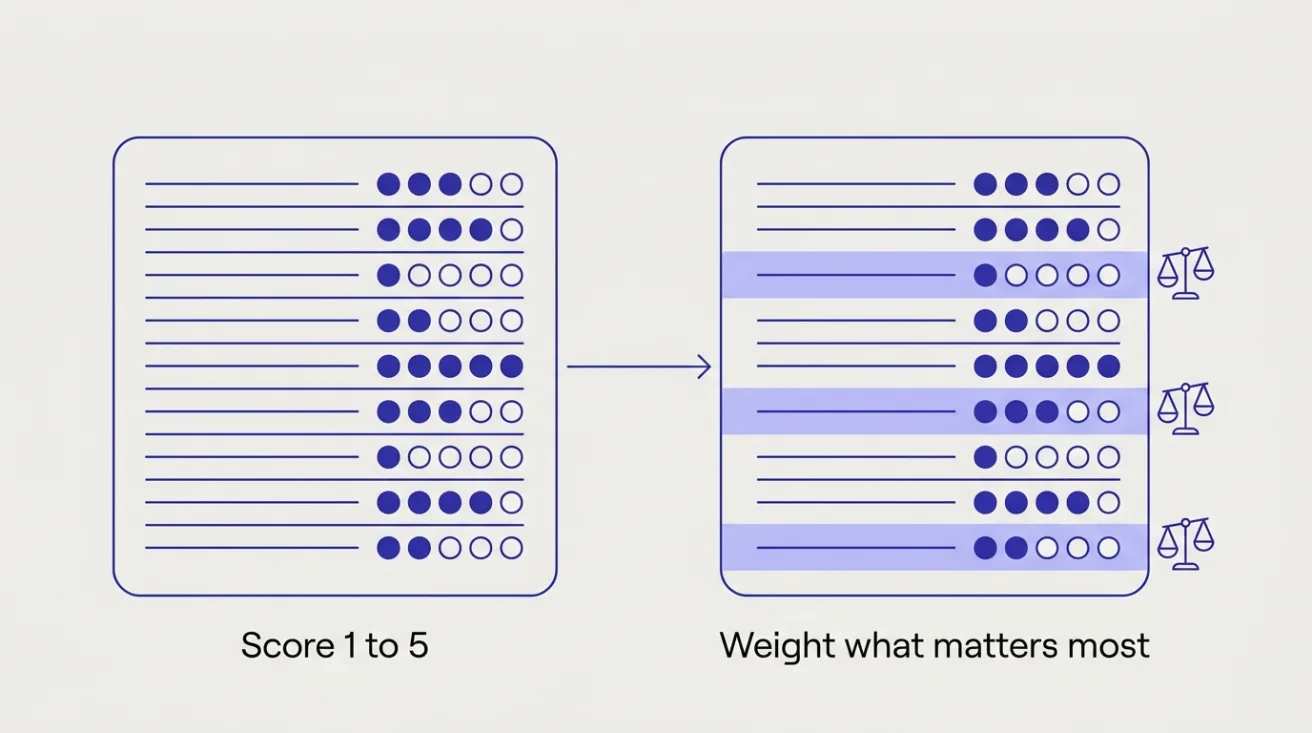
Score each criterion from 1 to 5 and weight the two or three that matter most for your team.
Cohesyve
Putting together a list of tools to try?
Cohesyve takes a job description, finds candidates, reaches out to them and runs an AI job simulation of the real work, then returns a ranked shortlist. Ten candidates free, no card.
RFP questions to send every vendor
Send these in writing before the demo. The answers are easier to compare, and the demo can focus on gaps.
What it measures and for which roles
- For each of these five roles [list them], what would a candidate do in your assessment, and what would the hiring manager see?
- Is the content fixed (a library), customised by your team, or generated per role or per candidate?
- How long does each assessment take a typical candidate?
- Can we see and edit the scoring rubric?
Evidence and fairness
- What validity evidence do you have for roles like ours? Please share the studies.
- What adverse-impact data do you have, by sex and race or ethnicity, and how recent is it?
- Do you have an independent bias audit? When was it conducted, and by whom?
- What accommodations does the platform support (extended time, screen readers, keyboard navigation), and how does a candidate request one?
Candidate experience
- Can candidates complete the assessment on a phone?
- What do candidates see before starting, and what feedback do they receive afterwards?
- What completion rates do customers hiring for similar roles see, and how is completion defined?
Integrity
- How do you confirm the candidate is the person who applied?
- What does proctoring record, and how are candidates told about it?
- What is your approach to candidates using AI assistants?
- Can any integrity flag reject a candidate without a person reviewing it?
Integration and workflow
- Do you integrate natively with [our ATS]? Which data flows each way?
- Can an assessment be triggered automatically when a candidate reaches a stage?
- Can hiring managers view results without a paid seat?
Data, privacy and AI law
- Where is candidate data stored and processed, and for how long?
- Who are your subprocessors?
- Is candidate data used to train your models?
- How do you support NYC Local Law 144, the EU AI Act and Colorado's automated decision-making law, which takes effect on 1 January 2027?
- How does a candidate request access to or deletion of their data?
Pricing and contract
- What is the total twelve-month cost at [our annual volume], including setup and custom content?
- What happens if we exceed the volume in the plan?
- What does renewal look like, and what is the price if we leave after year one?
Scope
- Does your product source or contact candidates, or does it start once we send a link?
- What does the output look like: individual scores, or a ranked shortlist with reasons?
- Who on your side supports us during the first month?
- Can we run a two-week pilot on one live role, and what would success look like to you?
Run a pilot before you sign
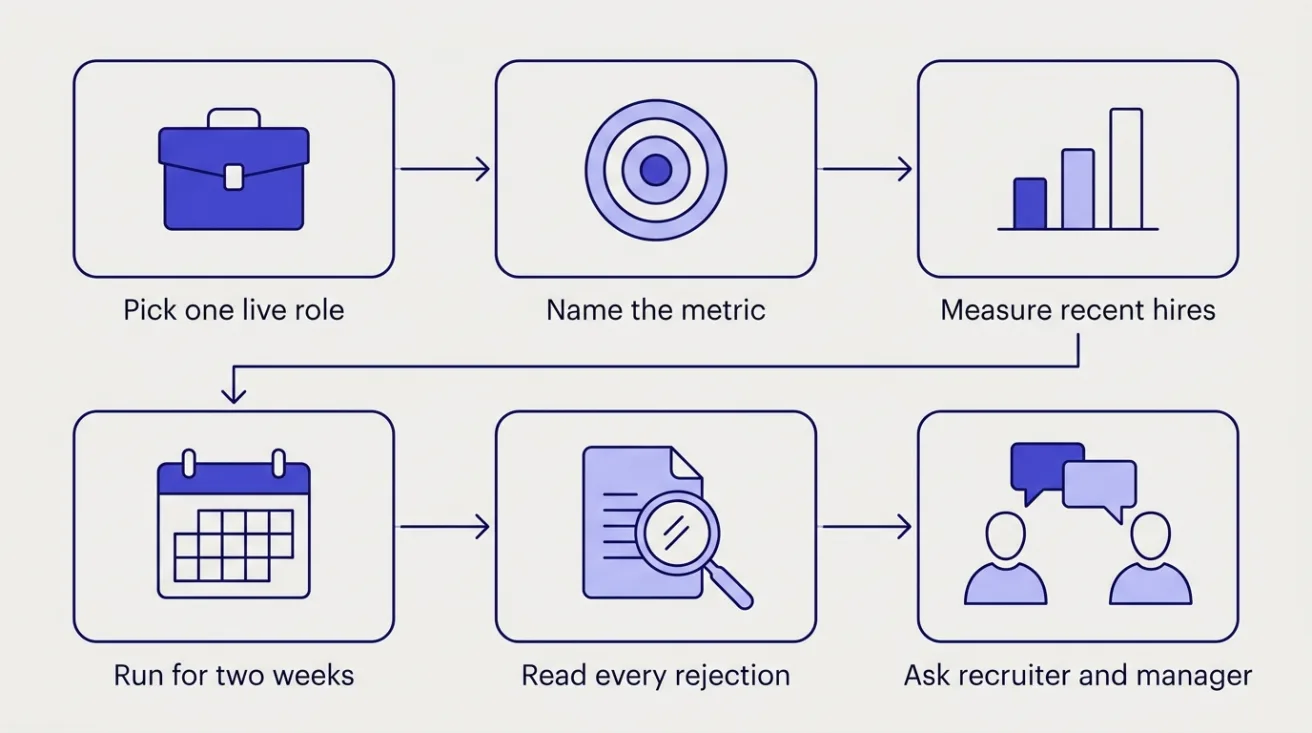
A pilot answers one question: does this tool make one specific stage faster or better for your candidates and your roles?
- Pick one live role with enough applicants to compare, ideally thirty or more.
- Name the metric you expect to move: interviews per hire, days from application to interview, or hiring-manager agreement with the shortlist.
- Measure the same metric for the last few hires into a similar role.
- Run the tool for two weeks without changing anything else.
- Have a person read every rejection during the pilot.
- Ask the recruiter and the hiring manager whether they would keep using it.
Common questions
What is the most important criterion? Whether the assessment resembles the work. A hiring manager who can read a candidate's output will use the results; one who receives an unexplained number usually will not.
Should we buy one platform for every role? If one platform credibly covers your top roles, yes, because one integration and one candidate experience are simpler. If engineering and non-technical hiring need very different tools, two specialists are often better than one compromise.
How many vendors should we evaluate? Three to five on paper, two in a pilot. More than that and the comparison becomes a project of its own.
Where can we compare specific vendors? Our list of pre-employment assessment tools and the alternatives pages go through the main products one at a time.