If your hiring process feels like a constant struggle, you’re not alone. Many organizations face the same challenges: large resume piles, long interview cycles, and a lingering feeling that hiring decisions are based more on guesswork than on evidence.
A practical way to address this is to shift your focus from reviewing credentials to verifying skills. This guide offers a framework to build a hiring process that helps you consistently identify capable talent with more confidence and efficiency.
It's Time to Move Beyond the Resume
A significant bottleneck in many hiring workflows is the reliance on resumes. Resumes are marketing documents, crafted to present a candidate's experience in the best possible light. They tell you what a candidate claims they’ve done, not necessarily what they can actually do.
This can leave hiring managers in a cycle of screening for keywords and prestigious company names, hoping for a sign of a good match. This approach can be inefficient and may not be the most reliable way to build a great team. It can lead to extended interview loops where the primary goal is simply to find out if the person can handle the work.
Adopting a Skills-First Mindset
The first step toward a better hiring process is a change in perspective. Stop asking only, "Does this candidate have the right background?" and start asking, "Can this candidate do the job and thrive here?"
This doesn't mean you ignore experience entirely. It just means experience is not the sole gatekeeper. A skills-first approach prioritizes a candidate’s practical abilities and potential over the bullet points on their resume. It creates opportunities for people to show you what they can do in a context that reflects the actual job.
The goal is to supplement subjective resume reviews with objective evidence. When you see skills in action, you can make decisions with more confidence, reduce bias, and improve the quality of your hires.
Why the Traditional Way Has Its Flaws
Relying primarily on resumes and unstructured interviews can introduce weaknesses into your hiring pipeline. These issues don't just slow you down—they can increase the risk of costly hiring mistakes.
Traditional hiring can be affected by a few common problems:
- Unconscious Bias: Resumes contain information like names, universities, and former employers that can trigger our hidden biases. This may cause us to unintentionally overlook qualified candidates who don't fit a preconceived mold.
- Inefficient Use of Time: Consider the hours your team spends screening hundreds of resumes or conducting interviews just to validate basic skills. One industry report noted that some recruiters end up interviewing over half their applicants—a sign that qualified people aren't being identified efficiently in the early stages.
- A Poor Candidate Experience: Long, vague, and repetitive interview processes can be disrespectful to a candidate's time. In a competitive market, top candidates may not wait around; they might accept an offer from a company that provides a clearer, more engaging experience.
To see the difference, it helps to compare the traditional approach with a skills-first strategy side-by-side.
Traditional Hiring vs. Skills-First Hiring
The table below breaks down how these two philosophies differ in practice and in the results they can produce.
| Aspect | Traditional Hiring | Skills-First Hiring |
|---|---|---|
| Primary Focus | Credentials, experience, and education listed on a resume. | Verifiable skills, practical abilities, and problem-solving. |
| Screening Method | Keyword matching and scanning for specific names. | Role-specific assessments that simulate real job tasks. |
| Candidate Pool | Often limited to those with "perfect" on-paper backgrounds. | Wider and more diverse, including self-taught and non-traditional talent. |
| Decision-Making | Relies more heavily on "gut feeling" and subjective interview feedback. | Based on objective performance data from assessments and structured interviews. |
| Outcome | Higher risk of mis-hires and slower time-to-fill. | Higher quality-of-hire and a faster, more efficient process. |
Recognizing these potential weak points in your current system is the first step toward making meaningful improvements. Now, let's explore how you can start building a more effective hiring process.
Map Your Current Process and Define What Success Looks Like
You can’t fix a leaky pipe until you know where the crack is. The same principle applies to your hiring process. Before overhauling anything, it's important to get an honest look at what’s happening right now.
Grab a whiteboard (virtual or real) and map out every step—from the moment a job is posted to when a new hire signs their offer. Think of yourself as a detective hunting for bottlenecks, drop-off points, and stages where subjective feelings might be overriding sound judgment. A slow, confusing process doesn't just frustrate your team; it can deter the talent you're trying to attract.
Auditing Your Hiring Workflow
Get your hiring manager and a key team member on a call and walk through the candidate’s journey from their perspective. Visualizing it can help you find hidden steps, frustrating delays, or redundant tasks you may not have been aware of.
Ask practical questions at each stage:
- The Application: How many people start the application but never finish? A large drop-off here may point to a clunky form or an overly demanding first step.
- The Screen: Who is reviewing resumes, and what are they really looking for? If you’re interviewing many people but few are a good fit, your initial screen may not be effective.
- The Interviews: How many rounds are there? Are candidates being asked the same questions by different people? A lengthy interview process is a common reason strong candidates withdraw.
- The Decision: How long does it take to make an offer after the final interview? Each day of delay gives your top choice another opportunity to accept an offer elsewhere.
The goal is to move from a resume-first model toward a more reliable, verification-based system.
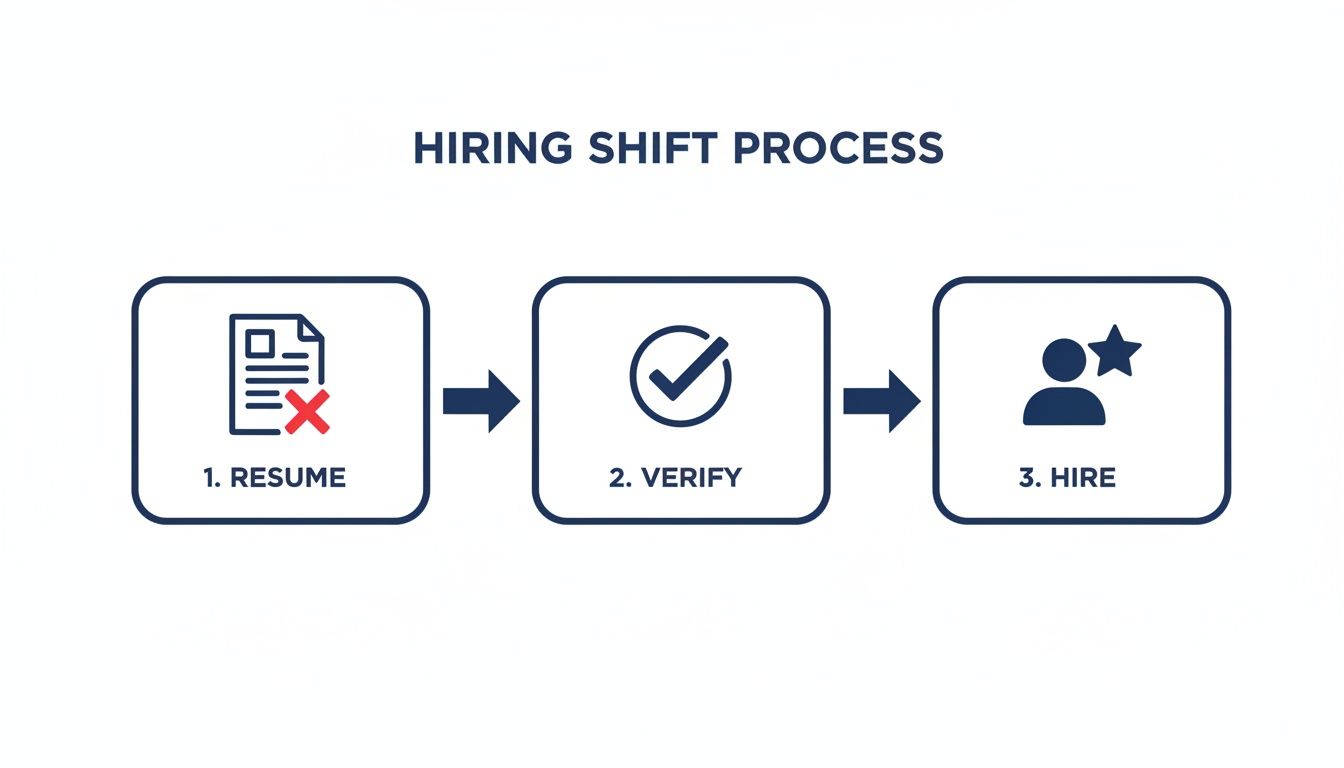
This simple visual illustrates the core of a modern hiring approach. You move from guessing based on a document to verifying skills, which is a sound way to make a confident decision.
Move From Job Descriptions to Success Profiles
With a clear map of your process, it's time to redefine what you're looking for. Many job descriptions are long lists of vague corporate-speak and "must-have" qualifications that don't always predict performance.
Consider building a Success Profile instead. This is a strategic alignment tool created with the hiring manager, focused on outcomes rather than just credentials.
A Success Profile answers one simple question: "What will this person need to achieve in their first six to twelve months to be considered a great hire?"
This shifts the conversation from "We need someone with 5+ years of experience" to "We need someone who can build a go-to-market strategy that grows leads by 15% in two quarters." Suddenly, you’re focused on the actual problems this person needs to solve.
For a Senior Software Engineer, a powerful outcome might be:
- Refactor our legacy payment module to reduce latency by 20% within the first 90 days.
This outcome-based approach becomes your guide. It informs every assessment you design and every interview question you ask, ensuring your entire process is built to find the person who can deliver those results. When you know what success looks like, you can build a hiring process to find it.
Cohesyve
See what candidates can do before you interview them
Cohesyve turns a job description into a role-specific assessment with a scoring rubric. Each candidate gets a different version, so questions cannot be shared. Ten candidates free, no card.
Replace Guesswork with Verifiable Skill Assessments
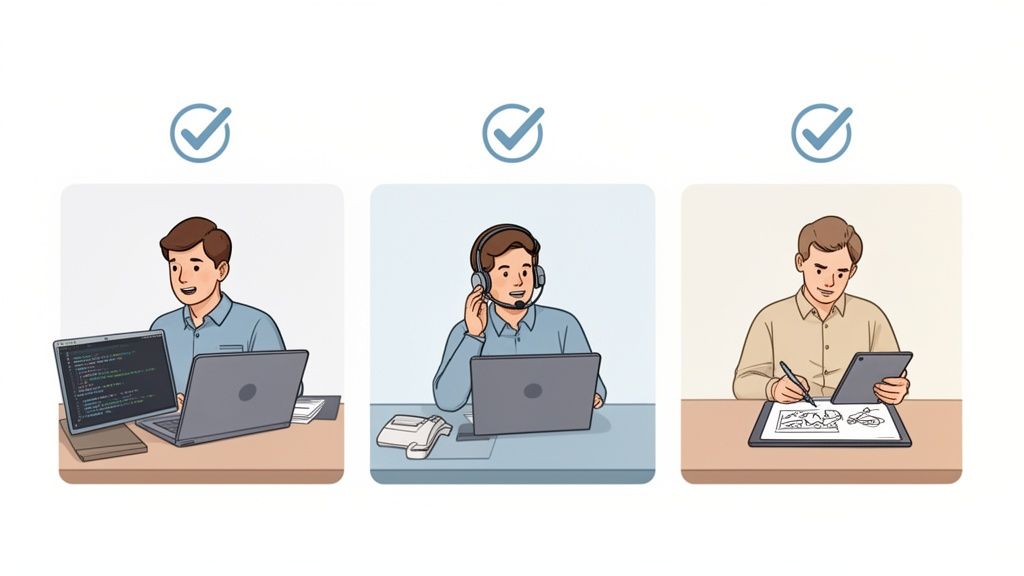
This is where you can make a significant impact. It’s time to move from only reviewing resumes to seeing skills in action. Instead of taking a candidate’s word for it, you can create an environment where they can show you what they can do.
This is a core component of a modern, effective hiring process. The idea is to create role-specific challenges that feel like a day on the job, not a generic quiz. When done well, you not only evaluate someone’s abilities but also give them an authentic preview of the work, helping them decide if the role is a good fit.
Designing Assessments That Reflect Reality
Generic, off-the-shelf tests might indicate general skills like "critical thinking," but they may not reveal if a candidate can solve your specific problems. A great assessment is tied directly to the Success Profile you’ve already defined.
So, what does this look like in practice?
- For a Consultant: Instead of a brain teaser, present a sanitized but real client problem your team has faced. Ask them to outline their diagnostic process and initial recommendations.
- For a Developer: Instead of only abstract algorithm challenges, give them a small piece of code from a legacy project and ask them to refactor it. This reflects a task they might actually perform.
- For a Sales Rep: Instead of the "sell me this pen" cliché, a voice role-play where they handle a common objection from one of your real-life customer personas can be far more revealing.
These kinds of work samples provide concrete evidence. They measure practical skills, on-the-spot judgment, and communication style—things a resume can only allude to.
A key shift you can make is moving from a guesser to an evidence-collector. See how people think and solve problems in a context that matters to your business.
You’re asking candidates to demonstrate their skills in the present moment, which can be a stronger predictor of future success than just hearing them recount past accomplishments. You want to see how they work, not just listen to stories about it.
The Role of Technology in Skill Verification
Designing custom assessments for every role might sound like a lot of work, and it can be if done manually. This is where the right technology can be beneficial.
Modern assessment platforms can help you generate unique, adaptive challenges based on the core competencies of your role. Some tools can even create distinct questions for every candidate, which helps eliminate the problem of leaked answers and ensures a fair playing field.
This is becoming more common. According to a 2023 Gartner survey, 81% of HR leaders report their organizations now use skills data in their talent strategies. This aligns with the broader trend toward skills-based hiring, as more leaders prioritize proven ability over credentials.
Moving Beyond Simple Right or Wrong Answers
One of the limitations of some traditional tests is the focus on binary outcomes: right or wrong. In many professional jobs, the best work happens in the gray areas. Success isn't always about finding a single "correct" answer; it's about the reasoning, judgment, and trade-offs made along the way.
This is why assessments that capture subjective reasoning are so valuable. They let you see a candidate's thought process as they navigate a complex problem. This is particularly useful for leadership, strategy, and client-facing roles where solid judgment is paramount. For a deeper look at this, you can learn more about the benefits of pre-employment skills testing and how to implement it.
By complementing resume reviews with verifiable skills assessments, you’re doing more than just improving a process. You’re building a system that is fairer, more accurate, and more respectful of everyone's time. This allows you to move past large shortlists and engage directly with a handful of top contenders who have already demonstrated they can do the job.
Design Structured Interviews That Predict Performance
Once you’ve confirmed a candidate has the skills for the job, the purpose of the interview shifts. It's no longer just a high-stakes quiz to find holes in their resume. Instead, it becomes a genuine conversation.
This is your opportunity to explore how they think, collaborate, and tackle challenges. It's about seeing if their approach to work aligns with your team's culture. But to do this effectively, you should move beyond the "let's just have a chat" method. The key to making interviews a more reliable signal is structure.
Moving Beyond ‘Gut Feel’ to Real Evidence
We’ve all been there. You have a great conversation with a candidate, and your gut tells you they’re "the one." But that feeling can sometimes be misleading. Unstructured interviews can be susceptible to unconscious bias, where we naturally lean toward people who remind us of ourselves or simply tell a compelling story.
Relying on "gut feel" alone can increase the risk of making a hiring mistake.
The solution is a structured interview. It’s a system where every candidate for a role is asked the same core set of questions, in the same order. This consistency levels the playing field, letting you compare candidates based on a standard set of criteria.
By standardizing your questions, you shift the focus from a candidate's personality to their actual past behaviors and problem-solving abilities. This makes your hiring decisions more objective, defensible, and more likely to predict future success.
This disciplined approach is a powerful tool for building a hiring process that is both fair and effective.
Asking Questions That Uncover How People Really Work
The most insightful interview questions don't ask people to guess what they would do. They ask for real stories about what they have done. These are called behavioral questions, and they often start with prompts like, "Tell me about a time when..." or "Walk me through a situation where..."
The idea is simple: past performance is a reliable predictor of future performance. You're gathering concrete evidence of how someone has navigated real-world challenges.
Here are a few examples tied to key capabilities:
- Problem-Solving: "Tell me about a time you faced a complex problem with no clear solution. What steps did you take to understand the issue, and what was the outcome?"
- Collaboration: "Describe a situation where you had a significant disagreement with a colleague on a project. How did you handle it, and what was the resolution?"
- Adaptability: "Walk me through a project where the goals or requirements changed unexpectedly. How did you adjust your approach?"
These questions prompt candidates to share specific details, not just buzzwords. You get a much clearer picture of their capabilities than you could with a simple, "Are you a good collaborator?"
Training Your Team for Objective Interviews
A great set of questions is only half the battle. Your interviewers are the gatekeepers, and they need training to ensure the process works as intended. Without it, even the most structured system can be influenced by individual bias.
Focus your training on these key pillars:
- Explain the "Why": Start by explaining why you’re using structured interviews. When the team understands the goal is to reduce bias and make smarter hires, they’ll be more committed to the process.
- Provide a Scoring Guide: Give interviewers a simple scoring rubric for each question. This helps them evaluate answers against the role's "Success Profile," not their personal preferences. Using a pre-built guide like an interview scoring rubric template is a great way to get started.
- Teach Effective Note-Taking: Show interviewers how to capture key phrases and specific examples from a candidate’s story. These notes are valuable during the final hiring discussion, helping the team compare hard evidence instead of fuzzy memories.
By combining skills tests with structured, behavioral interviews, you get the best of both worlds. You have the objective data to confirm someone can do the job and the human insight to know they’ll thrive on your team.
Turn Your Hiring Process Into a Positive Candidate Experience

In a competitive talent market, your hiring process is one of your most visible marketing channels. It's often the first real interaction a professional has with your brand. A clunky, slow, or impersonal experience can damage your reputation.
The best people often have options. If your process feels like a black hole where applications disappear and communication is sparse, they may not wait around. The key to fixing this isn't about flashy perks; it's about treating every candidate with respect. This means building a journey that feels transparent, communicative, and professional.
The good news? It all comes down to getting the fundamentals right: communication, clarity, and speed.
The Power of Keeping People in the Loop
Silence can kill engagement. When someone invests time and energy to apply to your company, they deserve to know where they stand. Even a simple, automated email acknowledging their application or providing a quick timeline update can make a difference.
A significant number of candidates report accepting a job offer only to ghost the company on day one. This disconnect often stems from a disengaging hiring process that made them feel undervalued from the start.
A respectful process treats candidates as partners in a mutual discovery. Keeping them informed at every stage—even when delivering bad news—builds goodwill and protects your employer brand.
Remember the long game. The candidate you turn down today could be your next customer, a strategic partner, or a fit for another role down the line. A positive experience ensures they walk away with a good impression of your company, no matter the outcome.
Simple Fixes for a Better Candidate Journey
You don’t need to reinvent the wheel to make a big impact. It’s about small, intentional shifts that show you respect people's time. Here are a few things you can do right now:
- Write Job Ads for Humans: Ditch robotic corporate-speak. Your job ad should clearly explain the mission of the role, the problems the person will solve, and what makes your culture unique. This sets the right expectations from the start.
- Promise a Timeline and Keep It: At the beginning of the process, give candidates a clear roadmap. Let them know the key stages and your target timeline for decisions. If things get delayed, a quick, proactive email is all it takes to maintain trust.
- Give Feedback That Matters: For candidates who make it to later stages, a generic rejection email is a missed opportunity. A single, constructive piece of feedback can turn a rejection into a moment of growth and goodwill.
- Make Assessments a Two-Way Street: When you ask someone to complete a skills test, they’re showing you what they can do. You owe it to them to make the experience engaging and relevant. The best assessments give candidates a preview of the work they’d be doing, making it valuable for them, too.
How a Great Experience Widens Your Talent Pool
This is where the approach becomes especially powerful. Shifting to a skills-first hiring method doesn’t just help you find better people—it naturally creates a superior candidate experience and can broaden your sourcing net.
When you stop automatically filtering people out with resume scanners, you open the doors to a more diverse, often-overlooked talent pool. You start finding great people who learned their craft through bootcamps, apprenticeships, or on-the-job training.
This creates a positive cycle. A fair and respectful process attracts a more diverse group of applicants, and a skills-based evaluation gives every one of them a legitimate chance to prove their worth. This is how you stop just filling roles and start building a talent pipeline that’s not only deep but also rich with unique perspectives and experiences.
Track the Right KPIs and Continuously Improve Your Process
There's an old saying: what gets measured gets managed. You’ve put in the work to build a skills-first hiring process, but your job isn't over when the first candidate accepts an offer. A great hiring system isn't something you build once and walk away from; it's a living part of your company that needs ongoing attention and refinement.
Think of it like a new engine. You need a dashboard that tells you how fast you're going, how efficient your fuel consumption is, and if anything is overheating. Data provides that dashboard, turning your feelings about hiring into concrete insights you can act on.
Moving Beyond Vanity Metrics
Many companies get hung up on metrics like the number of applicants per role. But a flood of 500 applications means little if 495 of them are unqualified. That’s just noise, not a signal of success. It's time to stop chasing volume and start tracking what actually impacts the business: quality, speed, and the experience you provide.
Here are the metrics that can truly move the needle:
- Time-to-Hire: This is the clock running from the moment a job goes live to when a candidate signs their offer letter. If this number starts creeping up, it’s a red flag. It tells you there’s a bottleneck somewhere—perhaps approvals are slow, or you have too many interview stages.
- Offer Acceptance Rate: A simple but powerful metric. What percentage of the offers you extend are actually accepted? If this number drops, it's a warning sign. It could mean your compensation is off-market, your process is taking too long, or something about the final stages is leaving a bad impression.
- Candidate Satisfaction (CSAT): Don't be afraid to ask for feedback. Send a quick survey to everyone who goes through your process, especially those you turn down. Asking them to rate their experience gives you a direct, unfiltered look at how your brand is perceived.
The One Metric to Rule Them All
While all these data points are important, there’s one that sits above the rest. It's the ultimate indicator of whether your entire system is working: Quality-of-Hire.
This KPI cuts through everything else and answers the most critical question: "Are the people we're hiring actually successful here?"
Quality-of-Hire connects your hiring efforts to real business outcomes. It measures a new employee's contribution to the company after they've had time to ramp up, typically assessed at the 90- or 180-day mark.
So, how do you measure something that seems so subjective? You blend hard data with human feedback. A common starting point is to combine a new hire's first performance review score with their direct manager's satisfaction rating.
The real insight comes when you connect this outcome back to your process. By linking a new hire’s performance to their original assessment scores and interview feedback, you can start to see which signals in your hiring process truly predict long-term success. This is how you demonstrate the value of your work. If you're ready to go deeper, we've broken down how to define and use quality of hire metrics to take your strategy to the next level.
Build a Simple Hiring Dashboard
You don't need a complex analytics platform to get started. A simple spreadsheet is one of the most powerful tools you can have.
Set up a basic dashboard to track your key metrics for each role you fill. It can be as simple as this:
| Metric | Role A: Marketing Manager | Role B: Software Engineer |
|---|---|---|
| Time-to-Hire | 42 days | 55 days |
| Offer Acceptance Rate | 100% (1 of 1) | 50% (1 of 2) |
| Quality-of-Hire (90-day) | 4.5 / 5 | TBD |
| Candidate Satisfaction | 8.2 / 10 | 7.1 / 10 |
When you review this data every quarter, a story will start to emerge. You might discover that your engineering roles consistently have a higher time-to-hire and lower candidate satisfaction. Or maybe you'll see that a low offer acceptance rate for a sales role corresponds with a specific hiring manager.
These aren't just numbers; they are your roadmap for improvement, pointing you directly to the parts of your process that need a tune-up. This is how you build a hiring function that doesn't just fill seats, but consistently brings in people who will build your company's future.
Common Questions (and Straight Answers) on Revamping Your Hiring
Whenever I talk to teams about moving to a skills-first hiring model, the same few questions always come up. It makes sense. Shifting away from long-held traditions can feel like a large undertaking, but it doesn't have to be.
One of the biggest hurdles is just figuring out where to start. My advice? Don't try to boil the ocean. Pick one role—just one—that's a high priority. Sit down with that hiring manager and build a Success Profile that defines what a great hire actually does in their first year, not just what’s on their resume. From there, create a single, straightforward work-sample test that mirrors a key part of the job.
Winning Over the Skeptics
Another challenge I hear about is internal resistance. You may have managers who are used to the old ways and are hesitant to change. The trick is to speak their language. Frame the conversation around the results they care about: getting better people in the door, faster.
Don't just talk about it—show them the numbers. Present data on how many hours are being spent screening resumes or conducting interviews that lead nowhere. Then, propose a simple pilot program for one of their open roles.
Once a manager sees for themselves that a short, well-designed assessment can surface three outstanding finalists who have already proven they can do the job, the benefits become clear. It’s the difference between a long, subjective process and a short, evidence-based one. The method often sells itself.
Proving the ROI
Finally, you have to measure the impact. The single most powerful metric you can track here is Quality-of-Hire. It’s the ultimate proof point.
It's simpler than you think. About 90 days after a new person starts, send their manager a quick survey: "On a scale of 1 to 10, how successful has this new hire been?" Then, you take that score and see how it lines up with their performance on the skills assessment they took during the interview process.
When you can draw a straight line from high assessment scores to your top-performing employees, you’ve built an undeniable business case. You're no longer just tweaking a process; you're building a reliable engine for hiring great talent.
Ready to replace guesswork with evidence? Cohesyve’s platform helps you create role-specific skill assessments that identify top performers with confidence. See how it works.