Let’s face it, we’ve all been swayed by a candidate's charm. Relying on "gut feelings" during interviews is a common habit, but it’s a gamble that doesn't always pay off. An interview scoring rubric template is a straightforward way to improve that process. It’s a structured tool that helps you trade subjective impressions for measurable data, ensuring every candidate is measured against the same standard.
This change is a practical step toward building a hiring process that’s fair, consistent, and—most importantly—defensible.
Moving Beyond Gut Feelings in Hiring
We’ve all walked out of an interview room with a strong feeling about someone. Maybe they were charismatic, told a great story, or just seemed like a person you’d enjoy working with. But what happens a week later when you’re trying to recall why you liked them so much? This is a common challenge with unstructured, "gut-feel" hiring.
These traditional interviews often rely on memory and subjective impressions, which can be unreliable. Research has shown that without a structured process, interviewers may form judgments in the first few minutes and spend the rest of the time looking for evidence to confirm their initial bias.
The Real Cost of Inconsistent Hiring
When you rely on instinct, you don’t just get inconsistent feelings—you get inconsistent results that can be costly. If every interviewer is using their own mental model to evaluate candidates, you're not comparing apples to apples. One person might focus on technical skills, while another is won over by a candidate's communication style. The result is often confusing and contradictory feedback.
This lack of a unified standard can lead to:
- Hiring mistakes: The cost of a bad hire can be significant. It’s often estimated at 30% of the employee’s first-year salary when you factor in recruitment fees, training time, and lost productivity.
- Hidden biases: Unconscious biases, like affinity bias (where we favor people who remind us of ourselves) or the halo effect (letting one strong trait influence our judgment on everything else), can thrive in unstructured interviews.
- A poor candidate experience: Candidates can tell when a process is disorganized. When questions feel random and the criteria are unclear, they may walk away feeling the process was unfair, which can damage your employer brand.
An unstructured interview is not a reliable predictor of on-the-job performance. Studies have shown their predictive validity is low, meaning those "good vibes" have little correlation with how well someone will actually perform.
Introducing a More Strategic Approach
This is where an interview scoring rubric makes a difference. It’s not about removing the human element from hiring; it’s about giving that human element a reliable framework. A rubric encourages your hiring team to define what "good" looks like for a specific role before speaking to a candidate.
By outlining core competencies and providing a clear scale for rating them, you turn a debate over vague feelings into a data-driven conversation. Instead of arguing about who "felt" right, your team can point to concrete evidence gathered during the interview. To see how this shift works, you can dive into the fundamentals of HR data analytics in our detailed guide.
Ultimately, this helps everyone focus on what truly matters: a candidate’s demonstrated ability to succeed in the job. It's a foundational step toward building a hiring process that consistently brings in qualified performers.
Building Your Foundational Rubric Template
Creating an interview scoring rubric from scratch might seem daunting, but it doesn't have to be an overly complicated process. Think of it as drawing a map for your hiring team. Your destination is a great new hire, and the rubric is the tool that helps everyone follow the same path.
Everything starts with a document you already have: the job description. A good JD is more than a list of tasks; it's a blueprint for what success looks like in the role. Your first move is to pull the core competencies you need from that document.
You're looking for a mix of hard skills (like “Python programming” or “financial modeling”) and soft skills (like “Communication” or “Problem-Solving”). It’s best to keep your list focused. Aim for 5-7 core competencies. Any more than that, and you might overwhelm your interviewers, making the rubric more of a burden than a guide.
Without a structured approach, hiring can rely on gut feelings and inconsistent feedback, which is how hiring mistakes can happen.
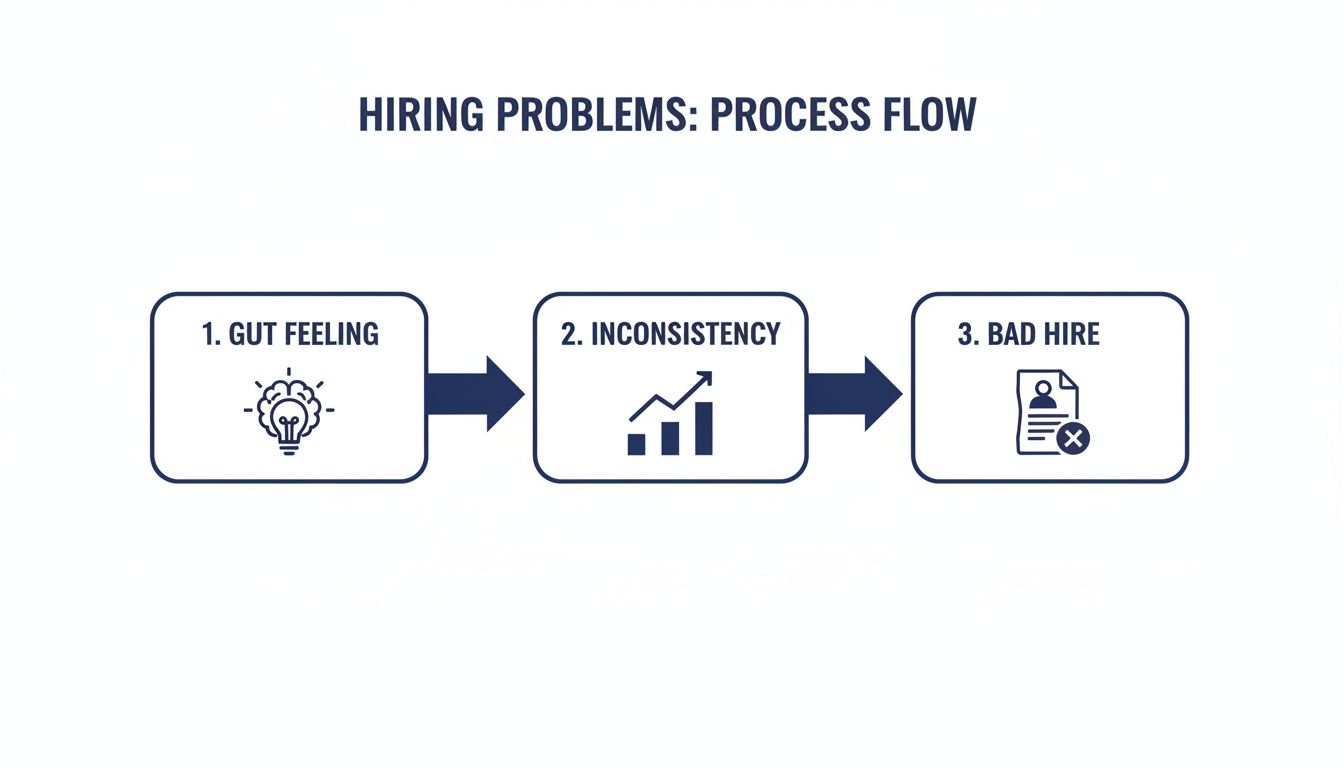
This visual is a good reminder of why we need to move past unstructured interviews. A rubric is your defense against inconsistency and bias.
Defining What Good Looks Like
Once you’ve identified your core competencies, you need to define what separates a weak answer from a strong one. This is where your scoring scale comes into play. A simple 1-to-5 scale is a good place to start—it offers enough detail to be meaningful without becoming too complex to use in a live conversation.
The useful part, though, is in anchoring each number on that scale with clear, behavioral descriptions. This is what helps stop a score from being subjective. Instead of a vague "5 - Excellent," you define what "excellent" actually looks like for that specific skill.
Example Scoring Scale for "Problem-Solving"
- 1 (Poor): Fails to understand the problem or offers no viable solution.
- 2 (Fair): Identifies the surface-level issue but struggles to propose a clear plan.
- 3 (Good): Clearly articulates the problem and proposes a logical, workable solution.
- 4 (Very Good): Not only solves the problem but also considers potential risks and edge cases.
- 5 (Exceptional): Presents a creative and efficient solution, explaining the trade-offs of their approach and anticipating future challenges.
These descriptions create a shared language for your hiring team. A "4" from one interviewer now means the same thing as a "4" from another, turning subjective opinions into an evidence-based assessment.
Adding Weight to What Matters Most
Not all skills are created equal. For a Senior Software Engineer, “Technical Architecture” is likely more critical than “Client Communication.” This is where weighting can be helpful. By assigning more importance to the non-negotiable skills, you ensure your final decision is anchored to what truly drives success in the role.
A simple multiplier system (e.g., 1x, 1.5x, 2x) works well. This gives candidates who excel in the most critical areas the credit they deserve, even if they’re just average in a lower-priority competency.
The data is supportive. Meta-analyses covering over 86,000 hires show that structured interviews with rubrics have a performance prediction validity of 0.44 to 0.51. That’s more than double the 0.20 to 0.25 from informal chats. This isn't just about a template; it's about turning interviews into a more effective process that can help fill roles up to 50% faster. You can explore more of the science behind this in this detailed analysis on Metaview.
With these pieces in place—defined competencies, a clear scoring scale, and smart weighting—you have a versatile rubric template. It’s a foundational tool that you can now adapt for any role in your organization. Some skill verification platforms can even generate rubrics from your job description, helping ensure your process is aligned from the start.
Cohesyve
See what candidates can do before you interview them
Cohesyve turns a job description into a role-specific assessment with a scoring rubric. Each candidate gets a different version, so questions cannot be shared. Ten candidates free, no card.
How to Tailor Your Rubric for Any Role
Your foundational interview rubric is a great starting point. But its full potential is realized when you customize it for the specific role you’re hiring for. After all, the qualities that make an excellent senior engineer are different from what defines a strong marketing leader.
A generic rubric might tell you if a candidate is a good communicator, but it won’t reveal if they can articulate complex technical trade-offs to a non-technical audience. This is where tailoring comes in—it’s how you sharpen your hiring lens to see what truly matters.
From Vague Ideas to Concrete Behaviors
This is the step where you translate broad competencies into the specific, role-relevant behaviors that can predict success on the job. You're not just looking for a "good problem-solver"; you're looking for someone who excels at the exact kind of problems they’ll face from day one.
Let’s take a classic competency: "Problem-Solving." By itself, it can be too vague. What does it actually look like in practice for different roles?
- For a Software Developer, it might be debugging a bug in a legacy system or architecting a feature that can scale to millions of users.
- For a Product Manager, it's about sifting through user feedback to solve the most critical customer pain point.
- For a Marketing Manager, problem-solving means digging into campaign data to figure out why a conversion funnel is underperforming and then fixing it.
The core skill is the same, but the evidence you need to see is completely different.
I’ve seen this happen time and again: teams keep competencies too broad, and interviewers fall back on "gut feelings." Defining specific behavioral indicators is what keeps your process objective and anchored in evidence.
To help you get started, here is a look at how core competencies can be adapted for a few different functions.
Sample Competencies Across Different Roles
This table shows how to adapt core competencies for specific job functions, helping you tailor your interview scoring rubric template effectively.
| Role | Core Competency | Example Scoring Criteria (Behavioral Indicator) |
|---|---|---|
| Software Engineer | Technical Craftsmanship | Writes clean, well-tested, and maintainable code; proactively addresses technical debt. |
| Product Manager | Customer Empathy | Can articulate user needs clearly and uses customer insights to justify product decisions. |
| Marketing Manager | Data-Driven Strategy | Uses metrics like CTR, CPL, and ROAS to diagnose campaign issues and propose optimizations. |
| Finance Analyst | Attention to Detail | Builds financial models that are accurate, easy to follow, and free of formulaic errors. |
As you can see, the key is to connect a general skill to a tangible, on-the-job behavior. This simple shift makes your rubric more powerful.
Let’s Build One: A Technical Role Example
Let’s put this into practice for a Senior Software Engineer role. We'll take our general competencies and give them a sharp, technical focus.
Role: Senior Software Engineer Adapted Competencies:
- Technical Architecture & Design: Can they design systems that are robust, scalable, and built for the future?
- Code Quality & Craftsmanship: Is their code clean, maintainable, and well-tested?
- Collaborative Problem-Solving: How do they work with peers to navigate tough technical roadblocks?
- Mentorship & Influence: Do they actively work to make the engineers around them better?
For a competency like Technical Architecture & Design, you might ask, "Walk me through the process of designing a system for [insert relevant problem]. What trade-offs did you consider?"
Here’s how a simple scoring scale could bring this to life:
- 1 (Needs Development): Proposes a solution that isn’t scalable or misses key requirements entirely.
- 3 (Meets Expectations): Designs a solid, functional solution that meets the immediate needs of the project.
- 5 (Exceptional): Presents multiple architectural options, clearly explains the trade-offs (e.g., cost vs. performance), and anticipates future scaling challenges.
See the difference? An exceptional candidate doesn't just give the "right" answer; they demonstrate a depth of thinking. That’s the kind of nuance a well-tailored rubric helps you uncover.
Switching Gears: A Marketing Role Example
Now, let's pivot completely to a non-technical role: a Digital Marketing Manager. The skills and evidence we’re looking for will shift dramatically.
Role: Digital Marketing Manager Adapted Competencies:
- Data-Driven Campaign Strategy: Can they use data to not only build but also optimize campaigns?
- Cross-Channel Fluency: Do they understand how channels like SEO, PPC, and email work together?
- Brand Storytelling: Can they craft compelling narratives that connect with an audience?
- Project Management & Execution: Are they organized enough to deliver campaigns on time and within budget?
For Data-Driven Campaign Strategy, a great question is, "Tell me about a time a campaign was underperforming. How did you use data to diagnose the issue, and what did you do to turn it around?"
A strong answer won't be vague. It will be packed with specific metrics (CTR, CPL, ROAS), mention the tools used for analysis, and clearly describe the A/B tests or other adjustments they made. This is how you separate the candidates who say they're "data-driven" from those who actually are.
If you need more inspiration, our guide on crafting better skills-based interview questions is a great resource.
When you take the time to customize your rubric, you’re turning a simple checklist into a high-precision tool. It’s a good way to ensure your interviews are fair, consistent, and effective at finding the right person for the job.
Training Your Team to Score Consistently
You’ve built a thoughtful interview scoring rubric. But a rubric is only as effective as the team using it. If ten different interviewers all have a slightly different idea of what a "4" looks like, you haven't solved for bias—you've just given it a new set of numbers.
This is where the real work begins. Getting everyone on the same page, a process called interviewer calibration, is what turns a good rubric into an effective hiring tool.
Think of it like coaching a sports team. You can have the best playbook, but if every player interprets it differently, you’re headed for chaos. Calibration is your practice session. It’s where you align the team and ensure everyone knows what a winning performance looks like.
Running Effective Calibration Sessions
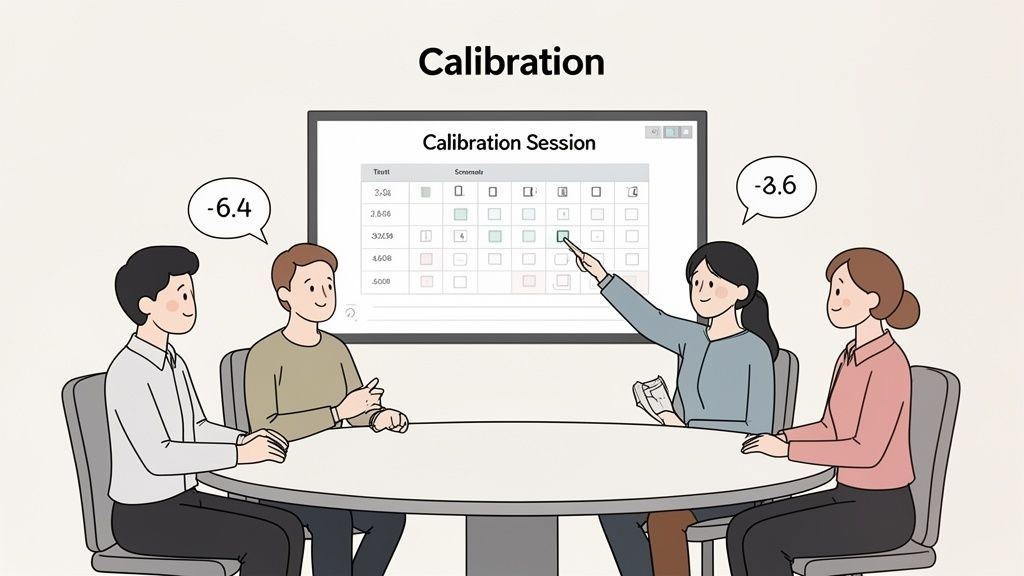
The heart of consistent scoring is the calibration session. This is a dedicated meeting where the interview panel practices using the rubric before a single candidate walks through the door. It's a low-stakes environment to work through disagreements and build a shared understanding.
The most effective sessions are hands-on workshops. Don't just talk about the rubric; use it. Find a pre-recorded interview, use a written case study, or even have a team member role-play as a candidate.
Here’s a simple flow that works well:
- Review the Evidence: Everyone watches, reads, or listens to the exact same candidate performance.
- Score in Silence: Each person fills out their rubric independently. No discussion yet.
- Share Scores: Go around the room and have everyone share their scores for one competency at a time.
- Discuss the Gaps: When you see a "5" and a "3" for the same skill, that's where the productive conversation happens. Ask those interviewers to defend their scores by pointing to specific evidence from the candidate’s response.
You'll hear things like, "I gave a 5 for problem-solving because their idea was creative," countered by, "I gave a 3 because that creative solution wouldn't scale technically." Neither person is wrong, but that conversation is critical. It forces the team to define precisely what "excellent" means for this role.
Defending Against Unconscious Bias
Even with a good rubric and a calibrated team, our brains have mental shortcuts that can lead us astray. Think of your rubric as a structural defense against bias, but you still need to train your interviewers to spot these common traps in their own thinking.
The goal is not to pretend we're perfectly objective. It's to make our biases visible so we can actively manage them.
Studies on interviewer effectiveness have shown that making interviewers aware of common biases can improve their ability to stick to the rubric's criteria. That awareness is a crucial step toward fairer evaluations.
Here are a few of the usual suspects to put on your team's radar:
- The Halo/Horns Effect: This is when one impressive (halo) or disappointing (horns) trait colors your perception of everything else. For example, a candidate went to a well-known university, so you might unconsciously inflate their communication score, even if their answers were just okay.
- Similarity Bias: It’s human nature to connect with people who remind us of ourselves. If an interviewer discovers a shared hobby, they might unknowingly score that candidate higher across the board.
- Confirmation Bias: We all do this. You form a judgment in the first five minutes and then spend the rest of the interview looking for evidence to prove your initial feeling right.
A rubric is your best defense. It forces a pause. Instead of just writing "great culture fit," the interviewer has to find concrete evidence to justify a "5" on the collaboration scale. This deliberate act short-circuits many gut feelings and demands proof over perception. It’s how you build a process where every candidate is judged on their skills and abilities.
Integrating the Rubric into Your Hiring Workflow
You’ve done the hard work of building a rubric and getting your team aligned. Now comes the moment of truth: making it a part of your hiring process. A good interview scoring rubric template is only useful if it's used. The goal is to make using it second nature for everyone involved.
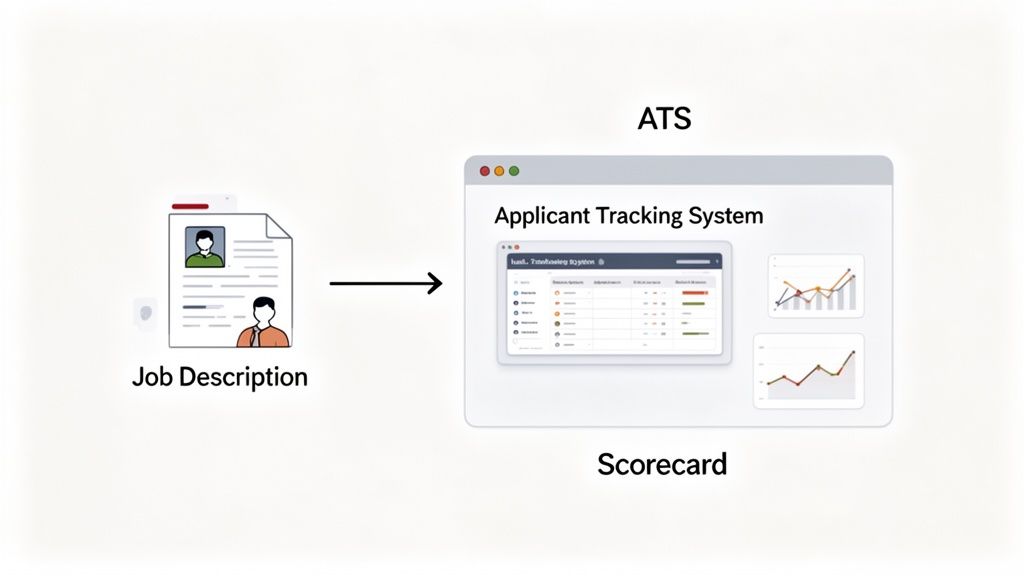
This is where your tech stack can help. Your Applicant Tracking System (ATS) isn't just a place to store résumés; it can be the command center for your recruitment operation. Most modern ATS platforms have scorecard features that allow you to embed your rubric right into the candidate’s profile.
Embedding Scorecards in Your ATS
Bringing your rubric directly into your ATS can transform hiring. For one, it makes life easier for your interviewers. They no longer have to juggle a separate spreadsheet, which lets them focus on the candidate instead of the paperwork.
It also centralizes all your feedback. This means no more chasing down interviewers for their notes or trying to decode conflicting opinions from different email threads. Everything lives in one place, creating a clean, defensible record for every hiring decision.
Most systems let you build out custom scorecards for different roles.
- Build role-specific templates: This is where you upload the tailored rubrics you designed for engineering, marketing, finance, and other departments.
- Assign them automatically: Set up a simple workflow. When a candidate for a specific job is moved to the "Interview" stage, the correct scorecard should automatically appear.
- Make it mandatory: This is key. Configure your ATS to require a completed scorecard before an interviewer can submit their final recommendation. It's a gentle nudge that ensures consistency and turns your rubric from a suggestion into standard procedure.
Automating for Speed and Precision
Embedding a static template is a huge step, but automation can be pushed even further. Some hiring platforms can now analyze your job description and automatically generate a role-specific skills assessment and a corresponding scorecard. This creates alignment from the first screen to the final offer.
For example, you post a job for a Data Scientist. The platform could identify core competencies like "Statistical Modeling," "Python (Pandas, NumPy)," and "Data Visualization." It could then build a short assessment with real-world problems and, at the same time, create a scoring rubric for your team based on those exact skills.
This approach helps counter the habit of spending just a few seconds skimming a résumé. Instead, you're focused on verified skills from day one.
The real benefit here is consistency. When your automated screening and your human interviews are measuring the same things, you build a unified evaluation. It’s a strong defense against bias and helps ensure your final decision is based on a complete picture of what a candidate can do.
Analyzing the Data to Get Smarter
Your rubric’s job isn’t over once you’ve made a hire. The scores you’ve collected are data that can help you sharpen your hiring strategy over time. This is how you close the loop and create a system that learns.
Once a new hire has been with the company for six months or a year, look at their original interview scores.
- Did your highest-scoring candidates become your top performers? If so, your rubric is likely predicting success well.
- Are some of your top performers the same people who only scored "okay" in their interviews? That’s a signal that your rubric might be overweighting the wrong skills or missing a key attribute.
This kind of analysis is valuable. It helps you validate your process and make data-driven tweaks. Maybe you find that "Communication" is a better predictor of sales success than you initially thought, so you increase its weight on the next version of the rubric. To dive deeper, you can explore a variety of candidate assessment tools that can enrich this process.
By continuously reviewing and refining, your interview scoring rubric template stops being a static document. It becomes a dynamic system that gets smarter with every hire you make.
Common Questions About Interview Rubrics
Even with a good rubric in hand, you might run into some questions. Rolling out a structured interview process is a journey, and it's normal for questions to come up along the way.
Let's walk through some of the most common hurdles hiring managers face.
How Do We Score for Culture Fit Without Being Biased?
This is a big one. For years, "culture fit" has sometimes been used as a screen for unconscious bias, leading teams to hire people who all think and act alike. A practical approach is to stop trying to score "culture fit" directly.
Instead, get specific. Pinpoint the observable behaviors that align with your company's core values.
- Does your company value collaboration? Great. Create a competency called "Teamwork." Then, score candidates on how they talk about sharing credit, navigating disagreements, or communicating in a group.
- Is proactivity important? Then score them on "Initiative." Look for real-world examples of them identifying a problem and solving it without being asked.
This shift—from a vague "vibe" to a concrete skill—encourages everyone to base their feedback on evidence. It’s how you can build a team with diverse viewpoints that are all guided by shared principles.
What Is the Ideal Number of Criteria for a Rubric?
When you first start, it can be tempting to measure everything. But an overstuffed rubric can be ignored. In practice, it's good to land somewhere between 5 and 7 core competencies.
Fewer than five might oversimplify a complex role, making it hard to distinguish good candidates from great ones. But more than seven can create noise. It's difficult to listen, ask sharp follow-ups, and score ten different things in the middle of a conversation.
A focused rubric forces you to have the tough conversations upfront: what are the absolute, make-or-break skills for this job? Stick to those, and your hiring decisions will be sharper.
How Do I Get Buy-In from Skeptical Interviewers?
You’ll almost always have a few holdouts—the interviewers who prefer their informal "just a chat" style. Forcing a new process on them can lead to resistance. A better way is to show them how a rubric makes their lives easier.
Frame it as a solution to their biggest headaches. Explain that it:
- Ends long post-interview debates by giving everyone a shared language.
- Acts as a second brain, helping them remember details from back-to-back calls.
- Makes their decisions defensible and grounded in clear, consistent data.
My advice? Start small. Pilot your new interview scoring rubric template on a single, important role. Once the hiring team sees how it leads to a faster, more confident, and less biased decision, they’ll be more likely to support rolling it out elsewhere.
At Cohesyve, we believe hiring decisions are best made by knowing a candidate’s true abilities. Our platform moves beyond résumé guesswork with dynamic, role-specific skill verification, making sure your interviews are reserved for people who have already proven they can do the job. See how it works.