You're probably here because you've sat through interviews that sounded good but told you very little. The candidate had energy. They spoke confidently. Everyone left saying, “seems smart.” Then actual work started, and the signal fell apart.
That's the problem case study interviews are trying to solve.
A well-run case interview gives you something a resume and a conversational interview often can't. It lets you watch a candidate think through a business problem in real time. Not in theory. Not from a polished story about past work. In the moment, with incomplete information, tradeoffs, and pressure to make a recommendation.
For hiring managers, that makes the format useful. It also makes it easy to misuse. Many teams inherit a consulting-style case process without asking the more important question: does this case reflect the work the person will do here?
So What Is a Case Study Interview Anyway
A case study interview is a structured interview where you give a candidate a business problem and ask them to work through it out loud. The point isn't to catch them on trivia. The point is to see how they approach ambiguity, organize information, make assumptions, and communicate a decision.
Consider a chef's trial shift. You wouldn't hire a chef based only on their ability to describe recipes. You'd want to see how they handle ingredients, timing, and adjustments when something goes wrong. A case interview works the same way. It's an audition for judgment.
It's less about the answer than the path
Candidates often assume there's a hidden correct answer. New interviewers sometimes assume that too. In practice, the strongest signal usually comes from the reasoning, not the final number.
That lines up with Management Consulted's explanation of case interview reasoning, which notes that approximately 70% of case interview success depends on demonstrating clear reasoning rather than achieving mathematically perfect answers.
Practical rule: If your interviewer notes say “smart answer” but not “clear process,” you probably didn't learn enough.
What you're really observing
In a good session, you're watching for a few simple things:
- Can they turn a fuzzy prompt into a structured problem? Real work rarely arrives neatly packaged.
- Can they make sensible assumptions out loud? That matters when data is incomplete.
- Can they stay consistent? A candidate who changes logic halfway through without noticing creates risk on the job.
- Can they explain their thinking clearly? Insight that can't be communicated won't move a team.
This is why the phrase what is a case study interview is easier to answer from a hiring perspective than from a candidate-prep perspective. It's a live simulation of how someone thinks when the path isn't obvious.
That's also why a case interview should feel collaborative, not adversarial. You're not trying to “beat” the candidate. You're trying to create enough realism to see how they'd behave in the role.
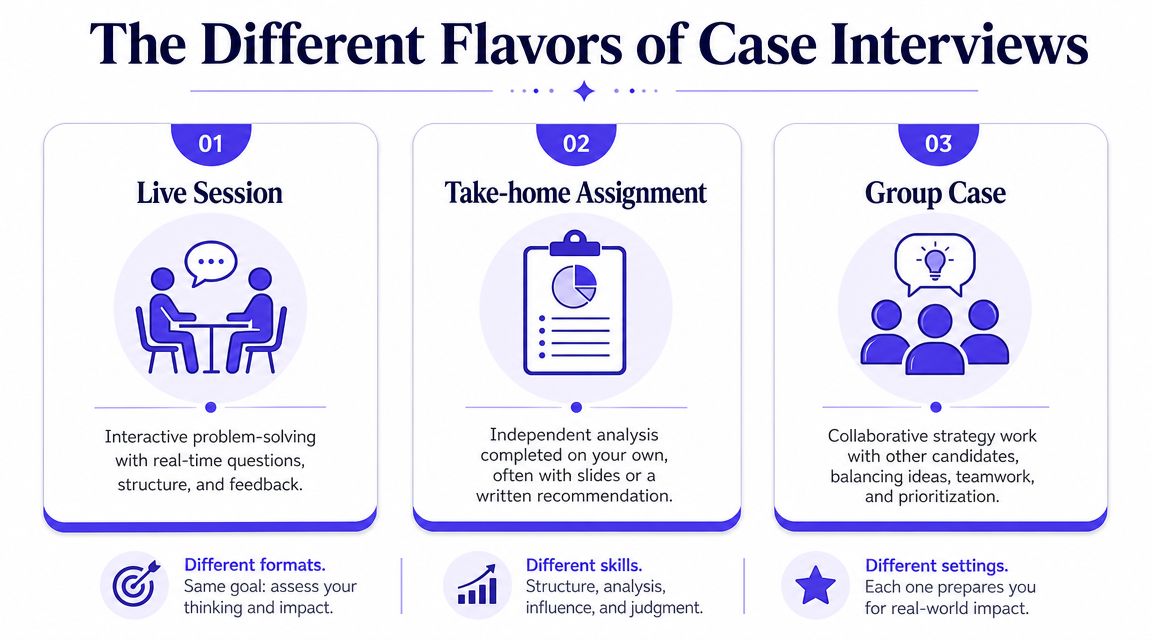
The Different Flavors of Case Interviews
Not all case interviews look the same. Hiring teams often say “we use cases” when they mean very different things. That matters because the format changes what you learn.
Live case
This is the classic consulting format. You present a scenario, the candidate asks clarifying questions, structures the problem, works through some analysis, and gives a recommendation.
It's strong when the job requires live communication, quick prioritization, and the ability to reason in front of others. It's weaker if you need to evaluate depth of craftsmanship that normally happens with time, research, or tools.
Take-home assignment
A take-home case asks the candidate to analyze a problem independently, then usually present their thinking later. This gives you a cleaner view of how they write, organize information, and produce work without the time pressure of a live room.
The tradeoff is realism. Some roles require live judgment with incomplete data. A polished deck created over several hours tells you something useful, but not the same thing.
Group case
A group case places several candidates together and asks them to solve or discuss a shared business problem. This format can reveal facilitation, listening, influence, and collaboration.
It can also create noise. Strong individual thinkers may disappear behind louder peers, and some candidates perform differently in a group than they do in the actual role.
Case study interview formats at a glance
| Format | Primary Skills Assessed | Best For | Potential Downside |
|---|---|---|---|
| Live Session | Real-time structuring, communication, judgment under pressure | Consulting, strategy, analytics, stakeholder-heavy roles | Can reward confidence more than depth if poorly scored |
| Take-home Assignment | Independent analysis, written communication, diligence, synthesis | Roles where thoughtful output matters more than rapid response | Harder to separate the candidate's work from outside help |
| Group Case | Collaboration, influence, listening, prioritization in a team setting | Roles with workshops, client meetings, cross-functional discussion | Group dynamics can distort individual signal |
Match the format to the work
If the person's job will involve fast executive conversations, a live case makes sense. If they'll spend more time building analyses and presenting recommendations later, a take-home may fit better. If they'll facilitate cross-functional problem solving, a group exercise can add value.
For teams that want examples before designing their own, this collection of consulting case interview examples is a practical place to compare formats and prompts.
The best format isn't the one that feels hardest. It's the one that best mirrors the real decisions the person will make.
Cohesyve
See what candidates can do before you interview them
Cohesyve turns a job description into a role-specific assessment with a scoring rubric. Each candidate gets a different version, so questions cannot be shared. Ten candidates free, no card.
What Employers and Candidates Both Want to Achieve
Employers and candidates often walk into a case interview wanting different things. The best hiring processes recognize that both sides are trying to answer a fit question.
For the employer, the question is simple: can this person handle the kind of ambiguity our work creates?
For the candidate, the question is just as important: is this the kind of problem-solving environment I want to join?
What employers are actually testing
When interviewers use case interviews well, they're usually assessing a mix of structured thinking, numeracy, business judgment, and communication. That sounds broad, but it becomes concrete when you listen to how a candidate handles assumptions.
According to CaseBasix on the business statistics candidates should recognize, interviewers assess three core competencies: whether candidates recognize realistic business numbers, can translate vague problems into structured assumptions, and maintain internal consistency across calculations. The same resource notes examples such as mature industry growth typically ranging from 2% to 5% annually and gross margins often ranging from 30% to 60%.
That's useful because it shows what “business judgment” often means in practice. Not encyclopedic knowledge. Sensible ranges, defensible assumptions, and logic that holds together.
What candidates hope to prove
A good candidate doesn't just want to survive the exercise. They want a chance to show strengths that a resume can't carry on its own.
That includes:
- Their thinking style: Do they bring order to messy information?
- Their working style: Are they collaborative, rigid, calm, or scattered?
- Their judgment: Can they make a recommendation without pretending certainty?
- Their fit: Does the kind of problem you give them feel like work they'd enjoy?
The significance of strong interview design is evident. Generic prompts can feel like theater. Role-relevant prompts feel like a preview.
If your team is refining the broader process, HypeScribe interview best practices offers useful guidance on keeping interviews structured and fair without making them robotic.
Why this matters for hiring design
When both sides treat the case as a working session, the interview improves. Candidates relax just enough to show how they think. Interviewers stop chasing polished buzzwords and start looking for evidence.
That's also why many teams now compare cases with other assessment methods, including work sample tests for hiring. In many roles, the closer the assessment is to the actual job, the better the signal.
Deconstructing a Typical Case Interview Structure
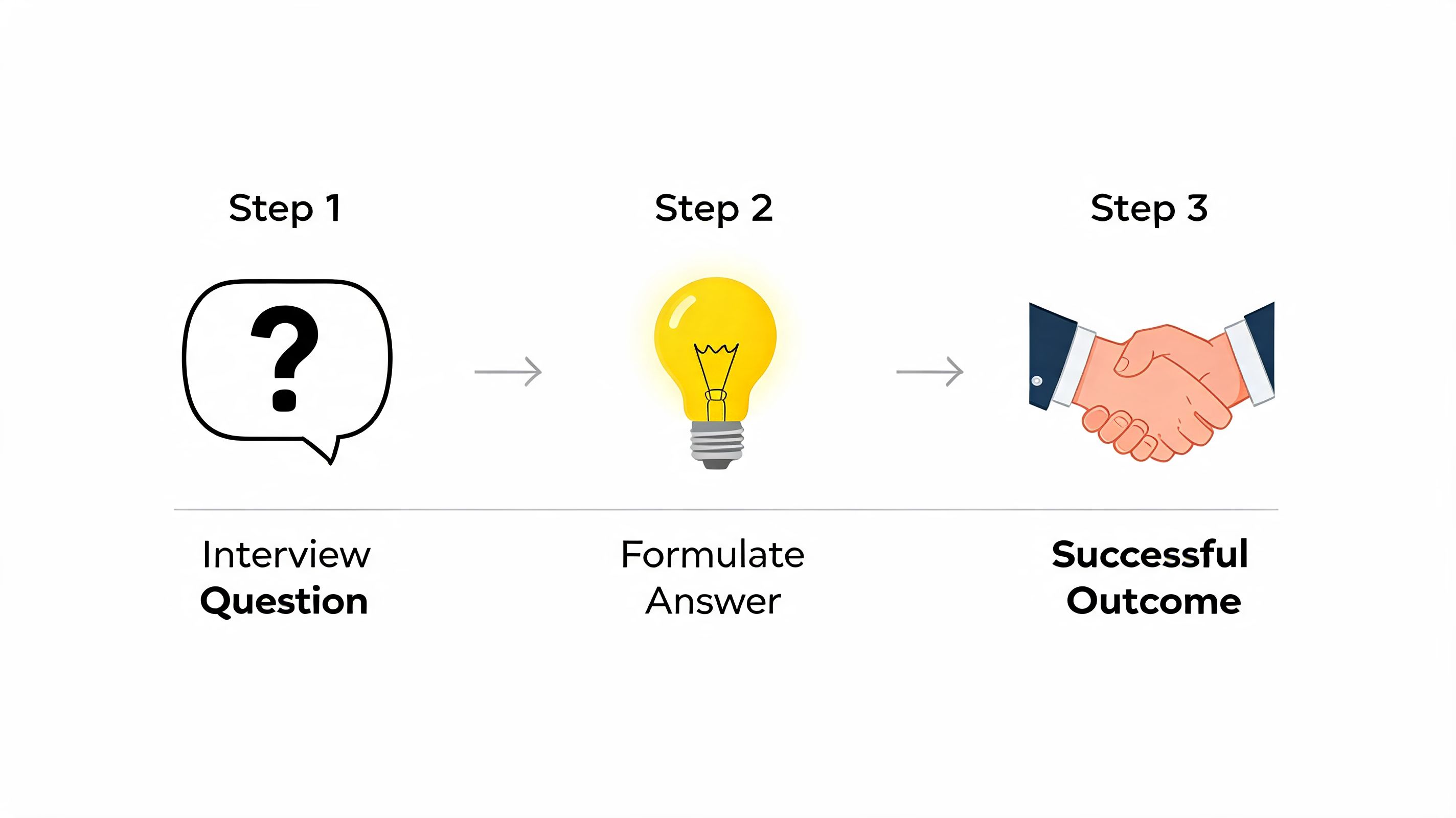
Most case interviews follow a recognizable flow. If you're new to running them, it helps to think of the conversation in stages rather than as one long test.
The prompt
You start by presenting a business problem. Keep it short, concrete, and relevant.
A simple example: “Our app's user engagement has dropped. How would you investigate what's happening, and what would you recommend?”
At this stage, you're not looking for instant brilliance. You're looking for whether the candidate pauses, frames the problem, and resists the urge to blurt out a fix.
Clarifying questions
Good candidates usually ask a few questions before building a structure. They may ask what “engagement” means in this context, when the drop started, whether the issue affects all users or a segment, and what business outcome matters most.
This part often reveals maturity. Weak candidates rush. Stronger candidates narrow the target.
A candidate who asks better questions usually gives you a better recommendation later.
Structuring the problem
This is the heart of the exercise. The candidate should break the problem into logical parts that don't overlap and don't leave obvious gaps.
A widely used principle here is MECE, short for Mutually Exclusive, Collectively Exhaustive. The Dartmouth case interview guidelines note that candidates who use MECE frameworks achieve 90%+ interviewer alignment in top-tier evaluations. The same guidance explains that in a common profitability case, the structure often starts with Revenue = Price × Volume and Costs = Fixed + Variable.
For an engagement problem, the candidate might separate the issue into user segments, product experience, acquisition quality, and external factors. What matters is that the buckets are clear and useful, not that they memorize a famous framework.
Analysis and synthesis
Once the structure is on the page, you can introduce data, constraints, or follow-up questions. At this point, you see whether the candidate can move from outline to insight.
A useful midway check is simple: are they just collecting facts, or are they forming and testing hypotheses?
Here's a short walkthrough worth watching if you want to see the flow in action:
The recommendation
The session should end with a recommendation that is clear, prioritized, and tied to the analysis. Not a data dump. Not a hedge-filled monologue.
A strong ending usually has three parts:
- The answer
- The reasons
- The risks or next steps
That final step matters because real work rarely ends at “therefore.” It ends with a decision and a plan.
How to Evaluate Case Performance Fairly and Consistently
The biggest mistake interviewers make isn't giving a hard case. It's scoring a case by vibe.
“I liked them.”
“They seemed sharp.”
“They reminded me of someone on our team.”
Those reactions are human. They're also unreliable if they aren't tied to a rubric.
Build a scorecard before the interview starts
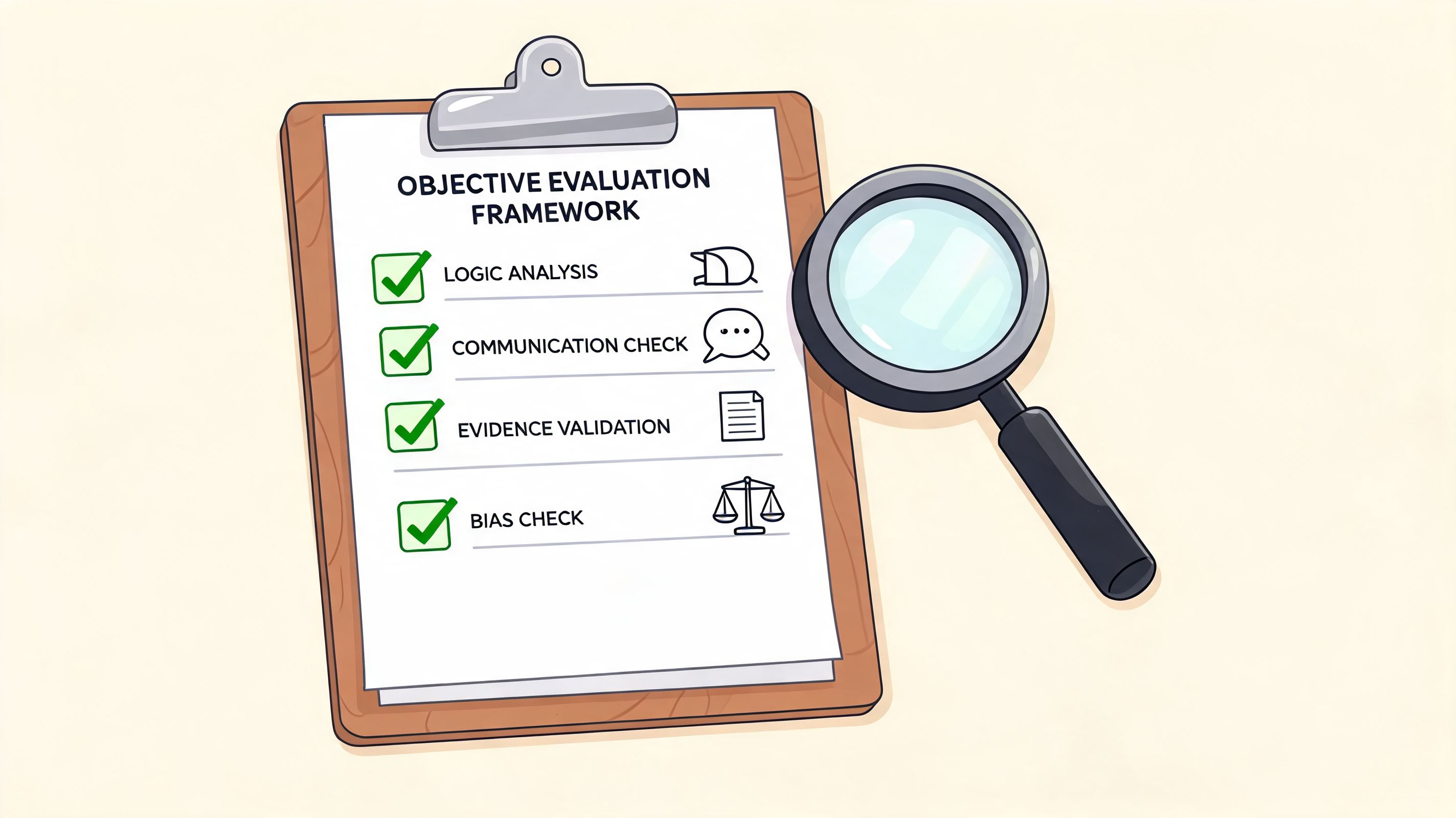
The simplest way to improve fairness is to define what “good” looks like in advance. Your rubric doesn't need to be elaborate. It just needs to separate the skills you care about.
A practical rubric often includes:
Problem structuring
Can they create a logical path through the problem?Quantitative reasoning
Can they work through numbers cleanly and notice whether an output makes sense?Business judgment
Do they make realistic assumptions and sensible tradeoffs?Communication
Can they explain their logic in a way others can follow?Adaptability
How do they respond when new information changes the direction?
Use role-specific lenses
A strategy hire and a technology consulting hire shouldn't be judged with exactly the same emphasis. In technology consulting cases, one standard lens is People-Process-Technology, or PPT. As described in this technology consulting case interview framework video, candidates may also be asked to quantify impact, such as calculating the Net Present Value of a tech investment and targeting greater than 15% Internal Rate of Return in their recommendation.
That doesn't mean every interviewer needs to become a finance instructor. It means your scoring should reflect the kind of reasoning the role needs.
Hiring note: Score the path separately from the polish. Some candidates think well before they sound impressive. Your rubric should catch that.
Keep interviewers aligned
If multiple interviewers run cases, calibration matters. Give everyone the same prompt, the same evaluation categories, and examples of what weak, acceptable, and strong performance looks like.
If you need a starting point, this interview scoring rubric template is useful for turning “gut feel” into something your team can compare across candidates.
The recommendation itself should never carry the whole score. Two candidates can reach different conclusions and still show excellent judgment. What matters more is whether each recommendation follows from the reasoning that came before it.
Common Case Interview Pitfalls and How to Sidestep Them
Case interviews can fail even when everyone involved is smart and well-intentioned. The usual issue isn't effort. It's design.
Pitfalls on the employer side
Hiring teams often create noise without realizing it. Common examples include:
- Vague prompts: If the question is too fuzzy, you may be measuring guesswork rather than reasoning.
- Leading the candidate: Some interviewers rescue candidates with hints until the final answer sounds better than the process was.
- Inconsistent difficulty: If each interviewer improvises a different case, candidate comparisons become shaky.
- Unclear scoring: Without a rubric, confidence and speaking style can outweigh substance.
These problems get even worse in remote settings, where interruption patterns, lag, and note-taking habits can affect the flow. Teams interviewing virtually may find it helpful to review how to master remote job interviews, especially when adapting live exercises for video calls.
Pitfalls on the candidate side
Candidates also create predictable failure modes, and recognizing them helps interviewers separate nerves from genuine weak signal.
Watch for these patterns:
- Jumping to solutions too fast: They recommend price cuts, product changes, or hiring plans before diagnosing the problem.
- Messy structure: Their buckets overlap, or they miss a major branch of the issue.
- Math without meaning: They calculate correctly but never explain what the number implies.
- No recommendation: They end with observations rather than a decision.
The uncomfortable question
There's a bigger issue underneath all of this. Case interviews are widely used, but some research suggests they may not predict on-the-job consulting performance, creating a validity gap for organizations that invest heavily in them. That critique is summarized in this deep dive on case interview predictive validity.
That doesn't mean you should throw out every case. It does mean you should stop treating the traditional format as automatically sufficient.
If an assessment feels impressive but doesn't reflect the job closely enough, you may be rewarding interview skill more than work skill.
The fix isn't abandonment. It's better design.
Designing Effective Case Interviews for the Modern Era
The strongest hiring teams don't ask whether they should use a case interview. They ask what kind of case is worth using.
A modern case should look less like a recycled consulting puzzle and more like a realistic slice of the job. If you're hiring for operations, give an operations problem. If you're hiring for finance, make the candidate prioritize tradeoffs a finance partner would encounter. If you're hiring for product strategy, use customer behavior, constraints, and ambiguity that resemble your environment.

What better looks like
The most useful case interviews share a few traits:
Role-specific
The task mirrors real decisions from the job rather than generic brainteasers.Adaptive
Follow-up questions change based on what the candidate says, so you can test depth instead of rehearsed patterns.Consistent
Every candidate gets the same scoring logic, even if the exact path differs.Fair
The exercise measures judgment and communication without relying on insider prep.
This shift matters because traditional cases are easy to game once they become familiar. Candidates can learn stock frameworks, memorize phrases, and practice performance. That preparation isn't bad. But if your hiring goal is practical ability, you need assessments that are harder to fake.
Keep the human part, modernize the design
There's still real value in hearing someone think out loud. The answer isn't to replace human interviews with static tests. It's to bring more relevance, consistency, and skill verification into the process.
That usually means combining a live conversation with a work sample or role-specific scenario. It also means designing cases from the job backward, not from old interview habits forward.
When teams do that, the case interview becomes what it should have been all along: not a ritual, but evidence.
If you want a faster way to create role-specific assessments without relying on recycled prompts or static question banks, Cohesyve helps teams build adaptive skill verification from the job description itself. It's a practical way to keep the human interview while making the evidence behind it much stronger.