Staring at a mountain of resumes can feel like trying to pick a winner based on stats alone. You see what candidates have done, but can you be sure they can do the job when it counts? This is where a pre-employment skills assessment comes in. Think of it as a practical, structured tryout that measures a candidate's real-world abilities before you make an offer.
It provides objective information on their competence, something a polished resume simply can’t provide.
Moving Beyond Resumes to Predict Real Performance
For decades, hiring has leaned heavily on resumes and interviews. But both of these tools share a fundamental flaw: they tell you what a candidate has done in the past, not what they can do for you right now. A well-written resume can list impressive roles and accomplishments, but it rarely offers hard evidence of a person’s current skill level.
Imagine you're hiring an airline pilot. Would you base your decision solely on their flight log? The log shows where they’ve been and how many hours they’ve flown—much like a resume. It’s useful, but it doesn't tell you how they’d handle unexpected turbulence or a critical system failure in the moment.
A flight simulator, on the other hand, puts their skills to the test in a high-stakes, real-world scenario. It gives you objective, measurable data on their ability to perform under pressure. A pre-employment skills assessment is your flight simulator for hiring.
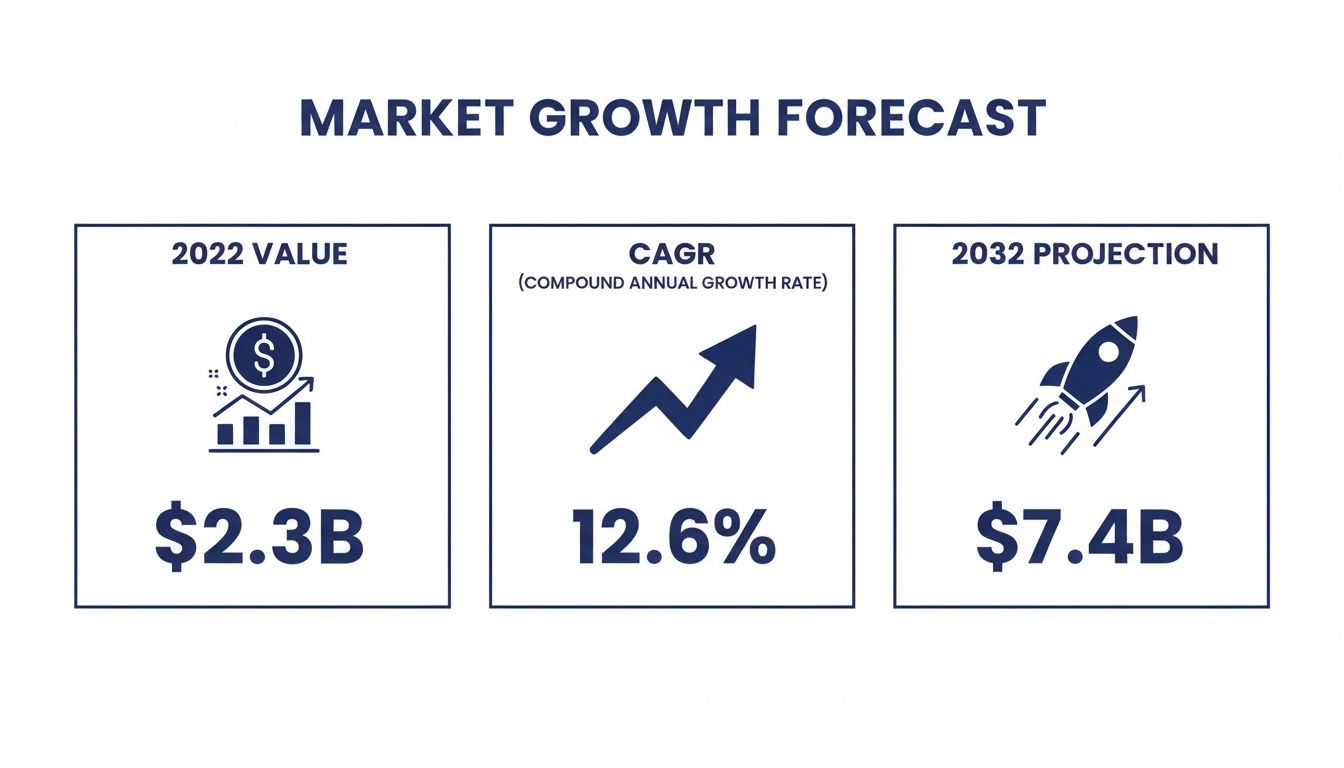
This data-first approach is becoming a new standard. The global market for these tools is on track to hit $7.4 billion by 2032, a clear sign that businesses are shifting toward hiring methods that prioritize verifiable skills. This growth is especially strong in fields like engineering, finance, and marketing, where companies need more reliable ways to find capable candidates. Find out more about the candidate skills assessment market.
From Guesswork to Confidence
When you focus on tangible abilities, you build a hiring process that's more predictable and efficient. Instead of guessing which candidate has the right skills, you get clear evidence. This shift helps you:
- Spot top talent faster: You can quickly identify applicants who have the practical skills to hit the ground running, even if their resume isn't perfectly polished.
- Reduce your screening time: Spend less time manually sifting through applications and more time engaging with a pre-vetted shortlist of high-potential candidates.
- Make objective decisions: Base your choices on performance data rather than gut feelings or subjective impressions, creating a fairer evaluation for everyone.
Moving away from resume-only evaluations is key to predicting on-the-job performance. While skills tests are a huge part of this, tools like automated resume screening software can also help manage high application volumes. In the end, weaving skills verification into your process creates a more reliable path to finding people who will thrive in the role.
The Measurable Impact of Skills-Based Hiring
It's one thing to talk about skills-based hiring in theory, but the practical impact is what matters. Shifting to a skills-first mindset isn't just about improving the hiring process; it’s a strategic decision with clear, measurable returns that affect your team's strength and your company's bottom line.
Consider that the cost of a bad hire can be up to two to three times that person's annual salary when you factor in lost productivity, recruiting costs, and training time. Skills assessments are a strong defense against that risk. They confirm a candidate can do the job before they join the team, which leads to a more engaged and effective team from day one.
The market is adapting to this approach. The growth in skills assessment tools tells a story of businesses moving away from guesswork and toward objective proof of ability.
This trend isn't just a blip; it's a fundamental shift in how companies build their teams.
Better Retention, Faster Hiring
So, what does this look like in practice? For starters, a significant drop in employee turnover. Companies that use skills-based hiring have seen their turnover rates fall by an average of 39%. That's a huge win. When you hire people for roles that match their proven skills, they feel more competent, find more satisfaction in their work, and are more likely to stay.
The momentum is clear. In 2023, 73% of businesses reported using skills-based hiring, a significant jump from just 56% the year before. And the reason is simple: it gets results. A solid 78% of employers now see role-specific tests as reliable predictors of future job performance.
This approach also opens doors, creating a more equitable playing field. For example, 75% of Black employees and 73% of Asian and Arab workers have found new opportunities through skills-first hiring.
By focusing on what candidates can do rather than just what their resume says they've done, you build a more resilient, skilled, and diverse team. It transforms hiring from a game of chance into a more predictable process.
To see just how different the outcomes are, let's compare the old way with the new.
Skills Assessment vs. Traditional Resume Screening
This table breaks down the practical differences between a hiring process built on skills verification and one that relies on resumes and interviews alone.
| Metric | Traditional Resume Screening | Skills Assessment Approach |
|---|---|---|
| Predictive Accuracy | Low; past titles don't guarantee current skills. | High; directly measures job-relevant abilities. |
| Hiring Bias | High; prone to unconscious bias from names, schools, etc. | Low; focuses on objective, standardized skill data. |
| Candidate Experience | Can feel impersonal and arbitrary. | Fair and transparent; candidates show what they know. |
| Time to Hire | Slower; requires manually screening high volumes of resumes. | Faster; automates shortlisting of qualified candidates. |
| Employee Retention | Lower; poor skill matches lead to higher turnover. | Higher; strong skill alignment boosts job satisfaction. |
| Team Performance | Inconsistent; depends on interviewers' subjective judgment. | Stronger; new hires are proven to be capable from day one. |
As you can see, the data tells a clear story. The skills-based model consistently outperforms the traditional approach across the metrics that matter most.
Ultimately, a pre-employment skills assessment is more than just another screening tool. It's an investment in quality, efficiency, and fairness that pays for itself over time. You can learn more about this modern approach in our guide on what skills-based hiring really means. By grounding your decisions in objective data, you not only hire better people faster but also build a stronger foundation for long-term success.
Cohesyve
See what candidates can do before you interview them
Cohesyve turns your job description into a role-specific assessment with a scoring rubric. Each candidate gets a different version, so questions cannot be shared. Ten candidates free, no card.
Choosing the Right Assessment for Your Role
You wouldn’t use a hammer to drive a screw, so why use a generic quiz to evaluate a highly specialized professional? The most effective skills assessments are the ones that mirror what someone will actually be doing day-to-day on the job. Picking the right format is critical for getting an accurate picture of a candidate's real-world abilities.
Think of it like casting for a movie. You don’t just ask an actor about their past performances—you give them a script and hold an audition. Your assessment should be that audition, giving candidates a genuine chance to show you what they can do.
This means for most roles, we have to move beyond simple multiple-choice questions. While they can be useful for checking foundational knowledge, they rarely reveal how a person applies that knowledge to solve a complex problem.
Matching the Test to the Task
The key is to break down the job into its core functions and then pick an assessment that simulates those tasks. To accurately predict performance, you need a clear understanding of the role's competencies, like the specific SEO specialist job requirements, before you can think about testing for them.
Here’s a look at how you can align assessment types with different roles:
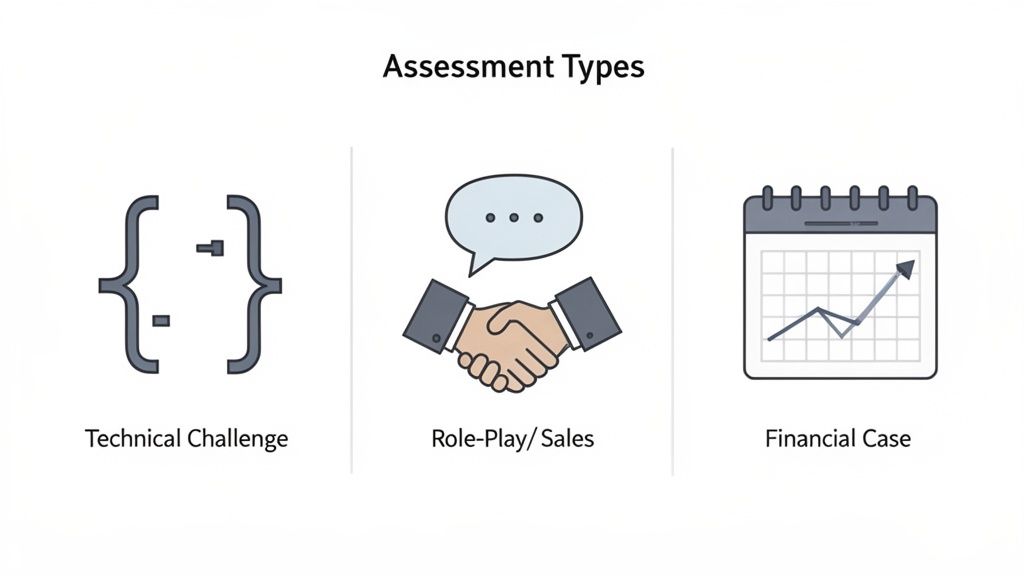
For Technical Roles: A software engineer should face a live coding challenge, not a quiz on programming syntax. This is the only way to see their problem-solving process, their coding style, and their ability to produce clean, efficient code.
For Sales and Customer Service: A simulated role-play is often best. Present a scenario—like handling an upset customer or pitching a product to a hesitant client—and watch how they handle it. You'll get immediate insight into their communication skills, empathy, and ability to perform under pressure.
For Marketing and Strategy: A case study is a useful tool. Give them a business problem and ask for a brief strategic plan. This shows you how they think analytically and whether they can connect marketing ideas to business outcomes.
For Finance and Analytics: A financial modeling or data analysis exercise is essential. Hand over a dataset and ask them to build a forecast or pull out key trends. This directly tests their quantitative skills and their attention to detail.
The goal is always job relevance. A well-designed, role-specific pre employment skills assessment feels less like an exam and more like a preview of the job. This not only improves the candidate experience but gives you more reliable data to base your decisions on.
Beyond Hard Skills
While technical talent is important, many jobs depend on cognitive and behavioral traits. A cognitive assessment, for instance, can measure critical thinking and learning agility. These are useful predictors of success, especially for entry-level roles where the ability to learn quickly is more important than existing knowledge.
Behavioral assessments give you a window into a candidate’s work style, how they communicate, and how they might fit with your team's culture. For example, conscientiousness has been shown to be one of the most consistent personality predictors of performance across almost every type of job.
By combining different types of assessments, you can build a more complete, three-dimensional view of each candidate. You can explore a range of pre-employment assessment tools to find the right combination for your needs. The best strategies often use a blend of hard-skill simulations and well-chosen cognitive or behavioral tests to build a complete profile.
Designing Assessments That Are Fair, Effective, and Trustworthy
Crafting a skills test that predicts on-the-job performance while being fair to every candidate is a balancing act. The goal is to create an experience that feels less like a pop quiz and more like a preview of the job itself. That means every question and task needs to tie directly back to the core duties of the role.
The credibility of any assessment comes down to its validity—does it actually measure what it's supposed to measure? For example, a valid test for a data analyst wouldn't just ask about obscure SQL syntax. Instead, it would provide a real-world dataset and ask them to pull out meaningful insights. This focus on job-relevant tasks isn't just better for accuracy; it's also important for legal defensibility.
When you ground your assessments in the actual functions of the job, you also take a big step toward reducing unconscious bias. By standardizing what you’re looking for, you shift the focus from gut feelings and subjective impressions to objective data on what a candidate can do.
Maintaining Integrity in a Digital World
In today's remote hiring world, ensuring candidates aren't gaming the system is a major concern for any pre employment skills assessment. The old approach of pulling questions from a static bank is no longer sufficient. It’s too easy for candidates to find answer keys online, which undermines the point of the test.
A more modern approach involves dynamically generating a unique challenge for every candidate who takes the test.
Think of it like a video game that creates a new, procedurally generated level for each player. Everyone faces a challenge of equivalent difficulty that tests the same core abilities, but the specific problems they solve are completely different. This makes it very difficult to cheat by looking up answers.
This method helps level the playing field, ensuring the results you get reflect a candidate's real problem-solving skills, not just their ability to use a search engine.
Key Principles for Fair Assessment Design
To build an assessment process that works well and earns the trust of your candidates, it helps to stick to a few foundational principles. Following these guidelines ensures your process is not only accurate but also respectful of everyone's time and talent.
- Job Relevance is Key: Every task should mirror a real-world challenge someone would encounter in the role. This not only gives you more predictive data but also creates a better experience for the candidate.
- Transparency Builds Trust: Be upfront about why you’re using an assessment and what skills it measures. When candidates understand the "why" behind the test, they're more likely to engage earnestly and see the process as fair.
- Accessibility Matters: Make sure your assessment platform is usable for all candidates, including those who rely on assistive technologies. This commitment is key to supporting your diversity and inclusion goals and widening your talent pool.
By keeping these elements at the core of your strategy, you can design a pre employment skills assessment that’s more than just a screening tool—it becomes a powerful indicator of a candidate's future success.
Integrating Assessments into Your Hiring Workflow
Adopting a new tool shouldn't add more complexity to your process. The point of weaving a skills assessment into your hiring workflow is to add clarity and efficiency.
A common question is: when should we send the test? There are two common points, and the right one for you depends on the problem you're trying to solve.
Finding the Right Placement
One strategy is to send the assessment right after someone submits their initial application. Think of this as an automated first-pass filter. It's helpful for high-volume roles where sifting through hundreds of resumes would take your team days. You can narrow a large applicant pool down to a qualified shortlist, saving hours and letting your team focus on engaging with top-tier talent.
Another popular approach is to introduce the assessment after an initial phone screen but before the first in-depth interview. This keeps your funnel open at the start, but it also helps ensure that only the most promising candidates move on to time-consuming interviews with your hiring managers. It's a respectful way to verify skills before committing everyone's valuable time.
The key is to see assessments not as a barrier, but as a bridge. They connect you with candidates who have proven they can do the job, allowing you to skip the guesswork and move to meaningful conversations.
The process becomes even smoother when your assessment platform plugs directly into your Applicant Tracking System (ATS). Seamless integration means you can trigger tests, review scores, and rank candidates all within the system your team already uses. No more toggling between tabs or manually transferring data. You can learn more about the fundamentals of a solid assessment process in our introductory guide on what is a pre-employment assessment.
This kind of streamlined workflow is a major reason for the industry's growth: one market estimate puts pre-employment assessment tools at about $2.7 billion by 2032, growing about 9% a year. Discover more insights about the pre-employment tools market.
Hiring is Shifting from Pedigree to Proof
The traditional way of hiring is changing. For decades, we’ve relied on proxies—like college degrees, job titles, and years of experience—to guess if someone could do the job. The conversation is now changing to focus on a more direct question: what can a candidate actually do?
This move toward skill-centric hiring isn't just a trend. It's a fundamental shift, a smarter way to build teams in a world where real-world capabilities matter more than a polished resume.
We're no longer just scanning for keywords. Modern hiring tools now let us verify practical skills in a way that’s fair, scalable, and tied directly to the demands of the role. It’s about building a system where proven ability becomes the most valuable currency a candidate can possess.
The future of hiring is less about where someone has been and more about where they can go. We're moving from a world of pedigree to one of potential, where objective proof of skill opens doors for talented people, regardless of their background.
How AI Sharpens, Not Replaces, Human Insight
Artificial intelligence is a big part of this transition, but not to replace recruiters with algorithms. It's to give them better tools. AI handles much of the heavy lifting of initial screening, freeing up hiring managers to focus on what humans do best: connecting with great candidates.
Think of it like this: AI can sift through a mountain of applications and assessment results to pinpoint the top candidates who have demonstrated the right skills. This saves recruiters from manual review, allowing them to invest their time in meaningful conversations with a pre-qualified pool of talent.
By pairing the speed and objectivity of AI with the nuance of human judgment, companies are creating a hiring process that’s both more efficient and more equitable. It’s a smarter approach that ensures the best person for the job is found because of what they can do, leading to stronger teams and fairer opportunities for everyone. At the heart of this strategy is a well-designed pre employment skills assessment.
Frequently Asked Questions
Jumping into skills assessments can bring up a few common questions. Let's walk through some practical answers to give you clarity and confidence as you add them to your hiring process.
Are Pre-Employment Skills Assessments Legal?
Yes, as long as you use them correctly. The main point is to make sure your assessment is job-relevant and non-discriminatory. The U.S. Equal Employment Opportunity Commission (EEOC) is clear: any tool you use to screen candidates must be a valid predictor of on-the-job performance and be used consistently for everyone.
This means you can’t just pull a generic quiz off the shelf. The tasks in your assessment need to directly reflect the actual duties someone would perform in the role. Stick to that principle, and you'll keep your process fair, effective, and legally sound.
Will Candidates Actually Take These Tests?
You might be surprised. Many candidates, especially those with non-traditional backgrounds, welcome the chance to show what they can do instead of just talking about it. Research shows a 94% majority of job seekers want feedback on their performance, and a well-designed skills test can feel more objective than a purely conversational interview.
The key to getting high completion rates—often reaching 95% on modern platforms—is the candidate experience. You need to make sure the assessment is:
- Relevant: The tasks are a direct preview of the job.
- Respectful of their time: Keep it concise, ideally under 30 minutes.
- Transparent: Be upfront about why you’re using the assessment and what it measures.
How Do We Prevent Cheating on Remote Assessments?
That’s a valid concern, and it’s why older methods no longer work well. If you’re using a static list of questions, you can assume the answers are online. That defeats the purpose.
The best defense against cheating is a system that dynamically generates a unique set of challenges for every candidate. This way, everyone is tested on the same core skills at an equivalent difficulty, but the specific problems they solve are entirely different. Cheating becomes almost impossible because there are no answer keys to find.
This approach ensures the results you get are a true signal of someone's ability to think on their feet, not just their ability to use a search engine. When you need to know what a candidate can really do, this is the most reliable way.
Ready to stop guessing based on resumes and start hiring based on proven skills? Cohesyve uses AI to instantly create custom, role-specific assessments that measure what truly matters. See how you can identify top performers and hire with confidence. Get started with Cohesyve.