Let's talk about hiring. For a long time, the process has relied on guesswork. A pre-employment assessment is a practical, standardized way to see what a candidate can actually do—their skills, their knowledge, their working style—before you think about an offer letter.
Think of it like this: a resume is a candidate's highlight reel, full of past roles and claims. An assessment? That's the audition. It’s where you see if they can truly perform.
Going Beyond the Resume With Pre-Employment Assessments
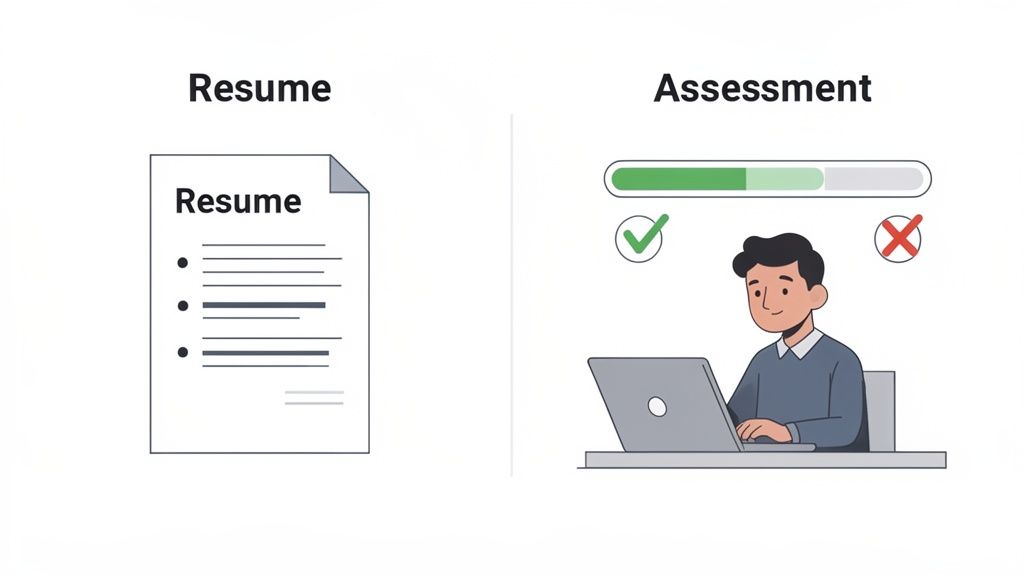
For decades, the hiring playbook was simple: collect resumes, conduct interviews, and trust your gut. But this traditional method is like trying to judge a chef's talent by only reading their menu. It tells you what they say they can cook, but it doesn't tell you how the food actually tastes. A pre-employment assessment, on the other hand, is the taste test. You get direct evidence of their abilities.
This move toward data-informed hiring isn't just a trend; it's a fundamental shift in how companies build effective teams. Global Growth Insights values the market for pre-employment assessment tools at about USD 1.2 billion in 2023 and expects it to reach about USD 2.7 billion by 2032, growing 8.9% a year. Among the reasons it gives are employers' demand for data-driven hiring decisions and the spread of remote hiring, where candidates have to be assessed without meeting anyone in person. You can find more insights on this market growth at Global Growth Insights.
Why the Shift Is Happening
The push toward assessments solves many of the common headaches recruiters and hiring managers face. At its core, it's about adding objectivity into a process that has often been subjective.
By using a standardized evaluation, companies can:
- Verify claimed skills: No more taking a candidate's word for it. You can confirm that the "expert in Python" listed on their resume can actually write clean code.
- Reduce unconscious bias: When you focus on measurable, job-relevant skills, you create a level playing field where talent from all backgrounds can demonstrate their abilities.
- Improve the quality of hires: You start the interview process with people who have already proven they can handle the core responsibilities of the job.
Let's take a quick look at how the two approaches compare.
Resume vs. Assessment At a Glance
| Metric | Traditional Resume | Pre-Employment Assessment |
|---|---|---|
| Data Type | Self-reported, often embellished | Objective, verified data |
| Predictive Power | Low; poor indicator of job success | High; strong correlation with performance |
| Bias Potential | High; influenced by names, schools, etc. | Low; focuses on skills and abilities |
| Candidate Insight | A summary of past experiences | A demonstration of current capabilities |
| Efficiency | Time-consuming to screen and verify | Quickly filters candidates based on merit |
The table makes it clear: while resumes tell a story, assessments deliver the facts.
In essence, a pre-employment assessment isn't about replacing human judgment. It's about equipping it with better data, so your hiring conversations begin with a shortlist of candidates who are already proven to be capable.
Ultimately, these tools help you move from hiring on a hunch to hiring with confidence. When you can verify skills from the get-go, you build stronger teams and make smarter, evidence-based decisions that pay off long-term.
Exploring the Different Types of Pre-Employment Assessments
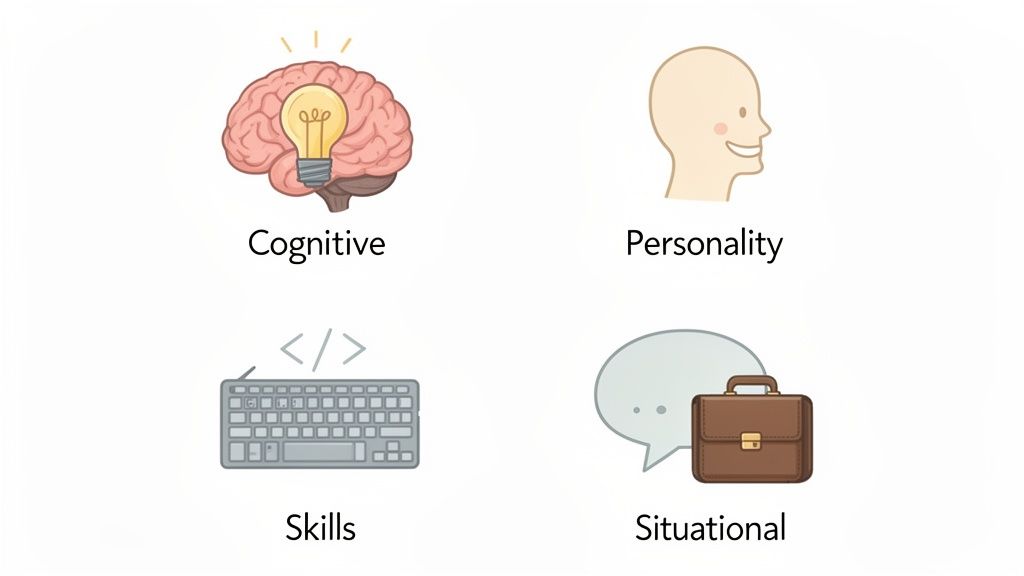
Think of pre-employment assessments as a specialized toolkit. You wouldn't use a hammer to turn a screw, and you wouldn't give the same test to a software engineer and a sales director. It's all about picking the right tool for the job.
Not all assessments are created equal. They're designed to measure different things—from how a candidate thinks on their feet to the practical skills they bring to the table. Let’s break down the main categories so you can build a hiring process that gathers the right information without fatiguing your applicants.
Cognitive Ability Tests: How Candidates Think
Cognitive ability tests are all about measuring a candidate's mental processing skills. They get into areas like problem-solving, critical thinking, and how quickly someone can learn new things. Essentially, they give you a glimpse into how well a candidate connects ideas and processes information.
These tests are useful for roles that demand quick thinking and adaptability. A good example is the deductive reasoning skills test, which shows you how well someone can draw logical conclusions. Instead of just testing what a candidate already knows, these assessments help predict how well they’ll learn and grow once they’re on the job.
Skills Tests: What Candidates Can Do
While cognitive tests look at potential, skills tests get straight to the point: what can this person actually do right now? They are direct, practical, and highly relevant to the day-to-day tasks of the role. This is where a candidate proves they have the necessary skills.
For a developer, that might mean a coding challenge. For a content writer, it could be an exercise to improve a poorly written article. The goal is simple: confirm the hard skills listed on their resume are accurate.
These role-specific tests are some of the strongest predictors of on-the-job performance. They cut through the theory and give you objective proof of a candidate’s practical abilities.
This direct approach is valuable. It gives you a clear signal on whether a candidate can start contributing from day one, which is important for technical or highly specialized positions.
Personality and Behavioral Tests: How Candidates Work
Technical skills are just one piece of the puzzle. Personality and behavioral assessments offer a window into a candidate's work style, their motivations, and how they interact with others. They help you answer important questions:
- How do they handle pressure when a deadline is looming?
- Are they a natural collaborator or do they work best independently?
- What’s their typical approach for solving problems within a team?
The point isn't to find one "right" personality. It's about understanding how a candidate might fit into your existing team dynamics and contribute to your company culture. In fact, research consistently shows that conscientiousness is one of the personality traits most strongly correlated with success across almost any job.
Situational Judgment Tests: How Candidates React
Situational Judgment Tests (SJTs) are the bridge between personality and practical skills. They work by presenting candidates with realistic workplace scenarios and asking them to choose the best course of action from a list of options.
For instance, a candidate for a customer service role might be given a scenario with an unhappy client. This kind of assessment isn't about right or wrong answers; it’s about understanding their judgment, problem-solving instincts, and emotional intelligence in a real-world context. You get to see their priorities in action.
Cohesyve
See what candidates can do before you interview them
Cohesyve turns your job description into a role-specific assessment with a scoring rubric. Each candidate gets a different version, so questions cannot be shared. Ten candidates free, no card.
Why Companies Use Assessments for Hiring
Adding another step to your hiring process might sound like more work, but it can actually save you time, money, and future headaches. That’s the value of pre-employment assessments. They aren't about creating barriers; they're about building a smarter, more efficient path to the right people.
Instead of getting lost in a sea of resumes, assessments help you pinpoint the candidates who can actually do the job. They swap gut feelings for data, making sure your interview time is spent with a handful of proven, capable individuals. It's all about making confident decisions right from the start.
Reduce Bias and Improve Fairness
One of the biggest benefits of a well-designed assessment is its ability to reduce unconscious bias. Resumes can unintentionally trigger biases based on names, universities, or even former employers. Assessments can cut through that noise.
They create a level playing field where skills are what matter. When every applicant takes the same standardized test, you give qualified candidates from all backgrounds an equal opportunity to show you what they can do.
An objective pre-employment assessment isn't just a filter; it's a bridge. It connects talented people to opportunities they might have otherwise missed, building a more diverse and capable workforce.
This focus on merit means the best person for the role is chosen based on their actual abilities, not on subjective first impressions or how well their resume hits certain keywords.
Lower Costs and Improve Retention
Hiring is expensive, and a bad hire costs more than the salary you paid them. You also pay for the recruiting and onboarding time, for work that has to be redone, and then for a second search to replace the person. Assessments reduce that risk by confirming someone has the right skills before you make an offer.
This financial benefit doesn't stop at the hiring stage; it also pays off in retention. When you hire people who are a good fit for the role from day one, they're more likely to be engaged, productive, and to stay with the company. This helps break the costly cycle of high turnover and constant recruiting.
Here's a quick look at how these benefits translate into tangible results.
The ROI of Effective Assessments
This table breaks down the key benefits of using assessments and their potential impact on common hiring and business metrics.
| Benefit | Impact on Hiring Process | Business Outcome |
|---|---|---|
| Improved Quality of Hire | Identifies top performers by measuring job-critical skills, not just resume keywords. | Potential for higher employee performance and productivity. |
| Reduced Hiring Costs | Lowers cost-per-hire by reducing time spent on unqualified candidates and shortening the hiring cycle. | Can lead to average cost-per-hire savings. |
| Increased Retention | Ensures better role alignment, leading to higher job satisfaction and lower turnover. | Can reduce employee turnover in the first year. |
| Reduced Unconscious Bias | Provides objective, data-driven insights, creating a fairer evaluation process. | Can lead to an increase in workforce diversity. |
Ultimately, investing a small amount in a quality assessment is like insurance against the expense and disruption of a bad hire. It’s a strategic decision that helps you build a stronger, more resilient team.
How to Integrate Assessments into Your Hiring Workflow
Figuring out where to place an assessment in your hiring process shouldn’t feel like a major overhaul. Think of it less like building a new wing on your house and more like installing a smart lock—it's a simple upgrade that adds security and makes everything run a little smoother. The goal is to slide it into your existing workflow where it helps the most, without creating friction.
The biggest question is always when to send it. There are two good options, and each has its own strategic advantage. Sending it right after someone applies is great for quickly sifting through a large volume of applicants. Alternatively, sending it after a quick resume scan but before the first interview lets you test a more focused, promising group.
Finding the Right Timing
The best time to test really comes down to the role itself and how many applications you're expecting.
- Top-of-Funnel (Post-Application): This is your best bet for high-volume roles that attract hundreds, if not thousands, of applicants. The assessment acts as an automated first filter, saving your recruiters an enormous amount of time. It ensures that only candidates who meet a baseline skill level make it to the next stage.
- Mid-Funnel (Pre-Interview): For more senior or specialized roles, this approach is more considerate of the candidate's time. You’ve already flagged them as a potential fit based on their experience, and the assessment is there to confirm their skills before you both invest time in an interview. This leads to much more productive, data-driven conversations.
Communicating Clearly with Candidates
How you talk about the assessment is just as important as when you send it. If you just send off a link without context, it can feel like a surprise pop quiz, and you risk losing great candidates. Frame it as a genuine opportunity for them to showcase their skills.
A well-designed pre employment assessment is a chance for candidates to show off practical skills that a resume can't capture. When you present it that way, you build trust and improve the candidate experience.
When you send that invitation email, make sure you cover these three points:
- The Purpose: Give a simple "why." Something like, "This helps us get a clearer picture of your practical skills."
- The Time Commitment: Be upfront and give an honest estimate of how long it will take.
- The Next Steps: Tell them what to expect after they complete it.
This kind of clear, respectful communication can improve your completion rates. At the end of the day, assessment data is there to help you build a stronger, more qualified shortlist for interviews. It’s not about replacing human judgment—it's about making sure your interviews are spent with the most promising people. To see how innovative companies are building fairer and more efficient hiring processes, check out the resources at Cohesyve.
The Evolution to Modern AI-Driven Skill Verification
The old way of testing candidates had its limitations. For decades, many companies relied on static, multiple-choice tests pulled from large, unchanging question banks. While easy to administer, this model had a weakness: the questions were often generic, sometimes found online with a quick search, and rarely measured the practical skills someone actually needs to do the job well.
This is where the new wave of skill verification platforms is making a difference. Instead of recycling the same questions, these systems use AI to build dynamic, role-specific assessments from scratch. They can analyze the core duties of a job description and then automatically design a custom evaluation that tests for the exact abilities you’re looking for.
This isn't just a minor upgrade; it's a response to a growing market. The global pre-employment assessment industry was valued at roughly USD 1.5 billion in 2023 and is expected to hit USD 3.2 billion by 2032. Why the growth? Because companies are realizing that while a traditional resume predicts job success only about 14% of the time, a solid skills test can increase that number significantly.
Creating Authentic Skill Signals
The real benefit of this modern approach is its ability to measure skills in a way that feels authentic. These AI-driven platforms go beyond simple memorization and instead focus on how a candidate performs job-related tasks.
This creates a much more engaging and realistic experience for applicants through formats like:
- Interactive coding sandboxes where developers can build and run code.
- Voice role-plays that let sales or customer service candidates navigate realistic scenarios.
- Case study simulations for consultants and analysts to show how they think strategically.
This is a critical step in the hiring process, fitting in right after the initial application but before you invest time in face-to-face interviews.
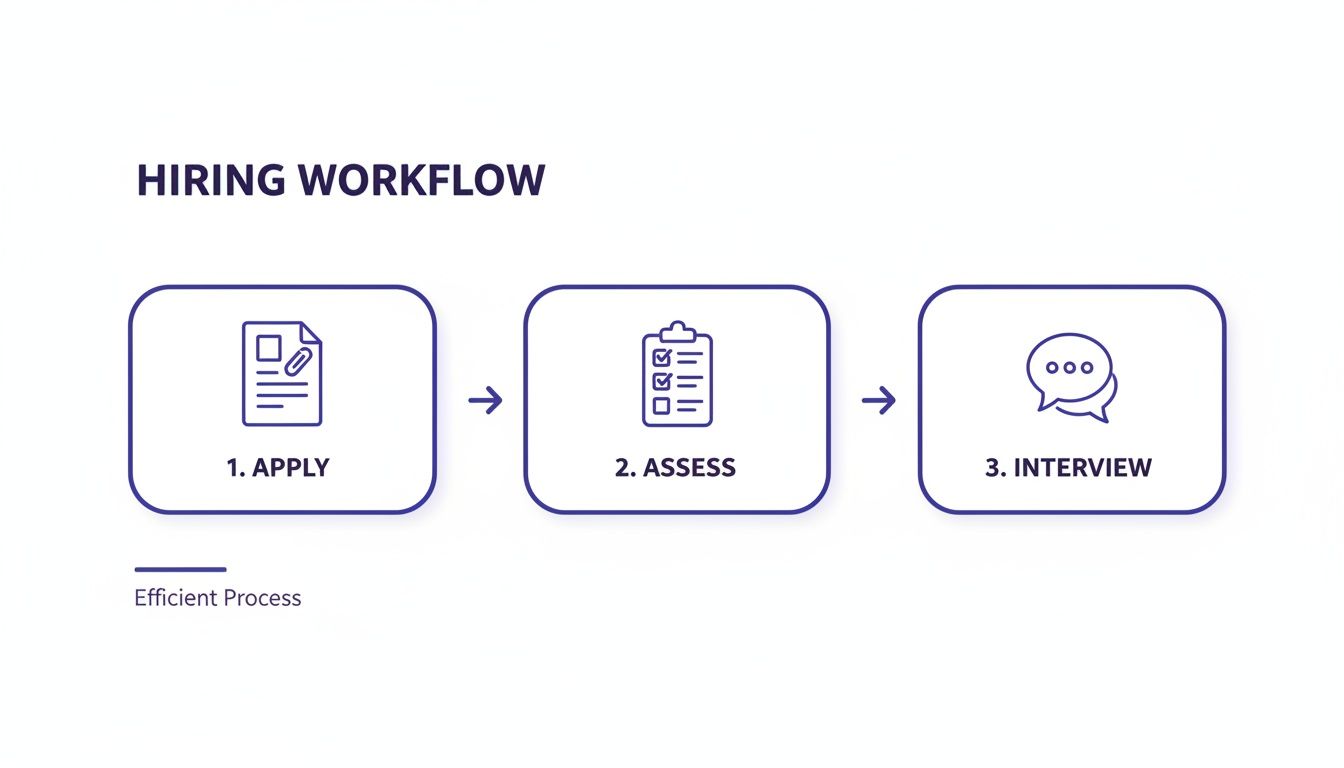
As you can see, assessments act as a data-driven filter between a pile of resumes and a shortlist of qualified people worth talking to.
Why Unique Questions Matter
When a platform generates a unique set of questions for every candidate, cheating becomes much more difficult. More importantly, it ensures the evaluation is a genuine test of a person's problem-solving skills, not just their ability to memorize answers. This gives hiring teams objective, reliable data to pinpoint top performers who have already proven they can do the work.
This shift from static testing to dynamic skill verification allows teams to stop guessing and start seeing. It replaces subjective resume screening with objective proof of a candidate’s capabilities.
To get a better sense of how this works in practice, it’s worth checking out platforms like Parakeet AI's innovative platform. This approach helps teams build a stronger, more efficient hiring engine that surfaces the right talent with confidence.
Common Questions About Pre Employment Assessments
Even as more companies bring data into their hiring decisions, a lot of questions still come up. It's normal to wonder how a pre employment assessment actually fits into the real world, from keeping things fair to making sure candidates actually complete them.
Let's walk through some of the most common questions from hiring managers and recruiters. The goal isn't to add a complicated step to your hiring process. It's about making what you already do smarter and more effective, so you can spend your time with the people most likely to succeed.
Are Pre Employment Assessments Fair And Unbiased?
This is an important question. The short answer is: they can be one of your best tools for reducing bias, but only if they’re built the right way.
A good assessment shifts the focus from subjective things—like a person's name, the school they went to, or their background—to objective, measurable skills. It creates a standardized benchmark, so everyone is measured against the same criteria.
But the assessment has to be directly relevant to the job. A generic, off-the-shelf test that has nothing to do with the day-to-day tasks could introduce new biases. That’s why it’s important to use assessments that are validated for fairness and specifically designed to measure the skills needed for success in that particular role.
How Do We Get Candidates to Complete the Assessments?
If you’re seeing high drop-off rates, it’s usually a sign that something is amiss with the assessment experience, not the candidates. If a test is excessively long, seems unrelated to the job, or is just a clunky, frustrating experience, you can't blame someone for abandoning it. In fact, over 60% of job seekers have admitted to quitting a hiring process because the assessments were confusing or took too long.
Getting people to the finish line really comes down to clear communication and respect for their time.
- Explain the "Why": Let candidates know this isn't just another hoop to jump through. Frame it as their chance to show off practical skills that a resume can't capture.
- Keep It Reasonable: No one wants to spend an hour on a screening test. Aim for a focused assessment that takes between 15 and 30 minutes.
- Make It Easy: A smooth, mobile-friendly platform isn't a "nice-to-have" anymore; it's a must.
When candidates see the assessment as a fair and relevant part of the conversation, they're much more likely to engage with it.
Can Pre Employment Assessments Replace Interviews?
No, and they shouldn't. Assessments are meant to make your interviews better, not eliminate them.
Think of them as a screening tool. They help you sift through a large pool of applicants and find that small group of highly qualified people who have already demonstrated they have the core skills for the job.
An assessment tells you the "what"—what a candidate is capable of doing. The interview reveals the "how"—how they solve problems, communicate their ideas, and work with a team.
The interview is still where you dig into personality, collaboration style, and how someone might fit into your team's culture. By using assessments upfront, you ensure that those crucial human conversations are more meaningful because you're already talking to people you know are technically qualified.
How Much Do Pre Employment Assessments Cost?
The price can vary quite a bit. Some platforms use traditional subscription models with large annual contracts, which can be difficult for companies whose hiring needs fluctuate. Others charge a fee for every test, which sounds flexible but can get expensive when you're hiring for high-volume roles.
Fortunately, the industry is shifting toward more flexible pricing. Pay-as-you-go models are becoming more common, letting you pay only for what you actually use. This makes skill testing accessible for businesses of all sizes.
When you compare the small cost of an assessment with what a bad hire costs, the value becomes clear.
Ready to move beyond resume guesswork and start verifying skills with confidence? Cohesyve’s AI-driven platform designs custom, role-specific assessments in seconds, helping you identify top performers who have proven they can do the job. Discover how you can hire smarter and faster.
Article created using Outrank