In an era with many digital hiring tools, the in-person interview remains a distinctly human step in the hiring process. Its purpose has evolved. It’s no longer just for confirming resume bullet points; it’s about observing skills in action, assessing judgment, and discovering a mutual fit. The most effective interviews are carefully designed experiences, not casual conversations.
Recent studies confirm that structured interviews, combining behavioral questions with practical, role-specific assessments, are up to twice as predictive of on-the-job performance as traditional, unstructured chats. This guide offers a collection of practical in person interview tips for both hiring managers and candidates who want to make every minute count. We will move beyond the handshake to explore how to prepare, what to ask, and how to evaluate with precision.
You will learn how to build a fair and insightful process that reveals a candidate’s capabilities, leading to better hiring outcomes for your team and a more rewarding experience for everyone involved. Let’s explore how to turn your interviews from a formality into a useful evaluation tool.
1. Prepare Structured, Role-Specific Questions Based on Job Requirements
To turn an interview from a simple conversation into a predictive tool, it's best to move beyond generic questions. Instead, build a structured interview process where every question is deliberately tied to the core competencies and daily responsibilities of the role. This methodical approach ensures every candidate is evaluated against the same, relevant criteria, which helps reduce interviewer bias and increases the accuracy of your hiring decisions.
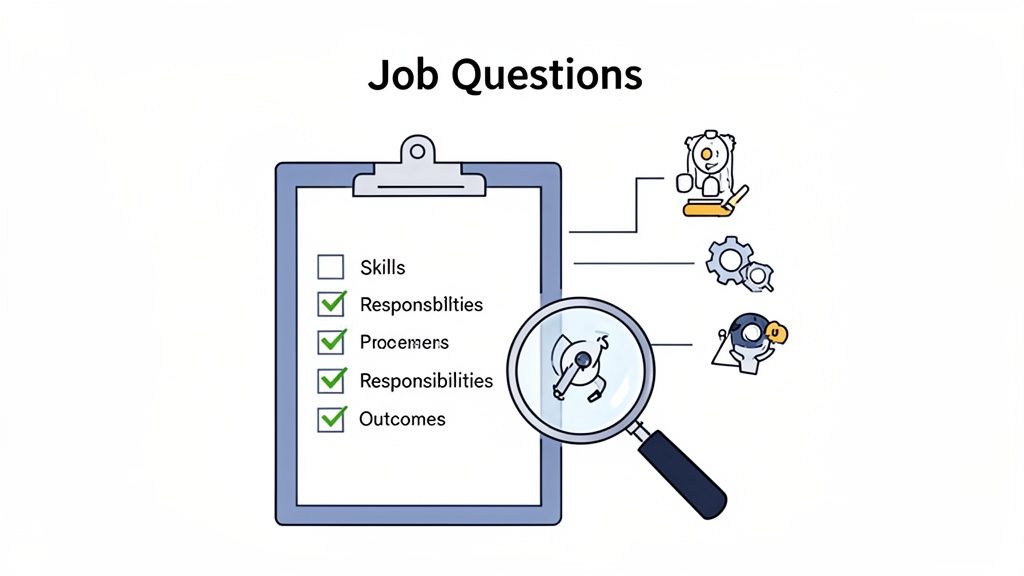
This method provides a consistent framework for evaluation, which is a key part of effective in-person interview tips. When you ask every marketing candidate to outline a go-to-market strategy for a hypothetical product, you can directly compare their strategic thinking, creativity, and market awareness. Likewise, asking every engineering candidate to describe how they would debug a critical production issue reveals their problem-solving process and technical depth under pressure.
Putting It Into Practice
- Identify Core Competencies: Before writing a single question, extract 5-7 essential skills and traits from the job description. These are your evaluation pillars.
- Create Situational Questions: Design questions that place the candidate in realistic work scenarios. For a finance role, ask: "Walk me through how you would build a financial model for a new subscription service, and what key assumptions you would challenge."
- Benchmark Against Top Performers: Consider the abilities of your best employees in a similar role. Frame questions to find out if candidates possess those same successful traits and skills.
- Document and Standardize: To ensure consistency across interviews, it's helpful to document these structured questions. Learning how to write SOPs that your team will actually use can turn your question sets into a reliable, repeatable process for your entire hiring team. For more inspiration on what to ask, explore these skills-based interview questions.
2. Master Active Listening and Strategic Note-Taking During the Interview
Some of the most useful in-person interview tips focus on what you do when you aren't talking. By fully concentrating on a candidate's responses, you move beyond surface-level answers to understand the substance underneath. Active listening isn't just about hearing words; it's about interpreting intent, observing non-verbal cues, and asking clarifying questions that peel back the layers of a candidate’s experience. Combined with strategic note-taking, this practice allows you to capture concrete evidence of their skills and behaviors, not just vague impressions.
This approach is about creating space for the candidate to reveal their capabilities. For instance, when a candidate says, “I improved team efficiency,” an active listener follows up with, “That’s interesting. Can you walk me through the specific process changes you made and how you measured that improvement?” This transforms a generic claim into a detailed account of their problem-solving and analytical skills. Observing how a candidate handles ambiguity in their response also provides a window into their thought process and communication style.
Putting It Into Practice
- Apply the 80/20 Rule: Aim for the candidate to speak for 80% of the interview. Your role is to guide the conversation, not dominate it.
- Pause Before Responding: After a candidate finishes speaking, wait 2-3 seconds before you reply. This small pause often encourages them to elaborate further on their thoughts without additional prompting.
- Focus Notes on Evidence: Instead of writing "good communicator," jot down specific examples: "Clearly articulated the Q3 marketing plan's three-part structure and backed each point with data." This focuses your evaluation on demonstrated behaviors.
- Use Open-Ended Prompts: Employ phrases like "Tell me more about that" or "How did you approach that situation?" to encourage deeper exploration without leading the candidate to a desired answer.
- Validate Your Impressions: After the interview, compare your notes against any pre-screening assessment data or initial screening call notes. This helps you confirm or challenge your in-person perceptions with objective evidence of their skills.
Cohesyve
Practise this before it counts
Run the same kind of AI job simulation employers use and get a scored report on where you stand. 5 free assessments a month, no card required.
3. Evaluate Practical Problem-Solving and Validate Assessment Results
The true measure of a candidate’s ability isn’t what they say they can do, but what they actually do when faced with a realistic challenge. An in-person interview is an ideal setting to move beyond theory and observe practical problem-solving in real-time. This involves presenting candidates with role-relevant scenarios while using pre-interview assessment data as a conversational starting point, not a final verdict. This approach validates skills and uncovers how candidates think, communicate, and collaborate under pressure.
This combined method offers a more complete picture. For instance, a software engineer's assessment may show strong coding skills, but watching them work through a bug in your actual codebase reveals their communication style and debugging logic. Conversely, if a candidate struggled with an assessment but explains their reasoning eloquently during a live problem-solving session, it may point to issues with the assessment's clarity rather than a lack of skill. This is one of the more effective in-person interview tips for getting a holistic view of a candidate.
Putting It Into Practice
- Use Real-World Problems: Move beyond textbook examples. Present a challenge your team has recently faced. For a product manager, you might ask for their approach to a real feature trade-off decision your company made.
- Validate Assessment Results: Review pre-interview assessment data beforehand. Ask candidates to walk you through the choices they made and explain their reasoning. This turns a score into a conversation about their thought process.
- Observe the Process, Not Just the Answer: The goal isn't just to see if they get the "right" answer. Pay attention to the clarifying questions they ask, how they structure their approach, and how they handle constraints.
- Provide Realistic Tools: Allow candidates to use the tools they would normally have on the job, like a whiteboard or their preferred IDE. This creates a more authentic and less stressful environment for demonstrating their skills.
4. Assess Communication and Collaboration Skills in Context
Technical skills are only one part of the equation; how a candidate communicates ideas, handles feedback, and works with others is often a more powerful predictor of long-term success. An in-person interview provides a unique opportunity to move beyond hypothetical questions and observe these interpersonal dynamics firsthand. Creating scenarios that require active communication and collaboration reveals a candidate's working style, not just their prepared answers.
This approach turns the interview from a Q&A session into a live, interactive work sample. When you ask a marketing candidate to explain a new product to a non-technical customer, you directly observe their ability to simplify complexity and build rapport. Similarly, asking a developer to walk you through a technical diagram and then offering constructive feedback on their explanation shows you their clarity of thought and receptiveness to new ideas, which are vital for team synergy.
Putting It Into Practice
- Explain a Complex Concept: Ask the candidate to explain a technical topic from their field to someone completely unfamiliar with it. This tests their ability to translate complex information and empathize with their audience.
- Introduce Intentional Ambiguity: Present an incomplete problem or a vague project brief. Observe how they react. Do they ask clarifying questions, make assumptions, or shut down? This reveals how they handle uncertainty.
- Simulate Disagreement: Ask about a time they disagreed with a manager or colleague. Pay close attention to the language they use and the process they describe for reaching a resolution.
- Use Peer Interviewers: Involve a future teammate in the interview process. This not only provides a different perspective on the candidate's collaborative style but also shows the candidate what their future team interactions might look like.
5. Prepare Your Interview Environment and Remove Distractions
The physical environment of an interview sends a message about your company's culture and professionalism. Creating a space that is professional, private, and free from distractions allows both the candidate and the interviewer to focus completely on the conversation and evaluation at hand. A well-prepared setting signals respect for the candidate's time and is a fundamental component of effective in person interview tips.
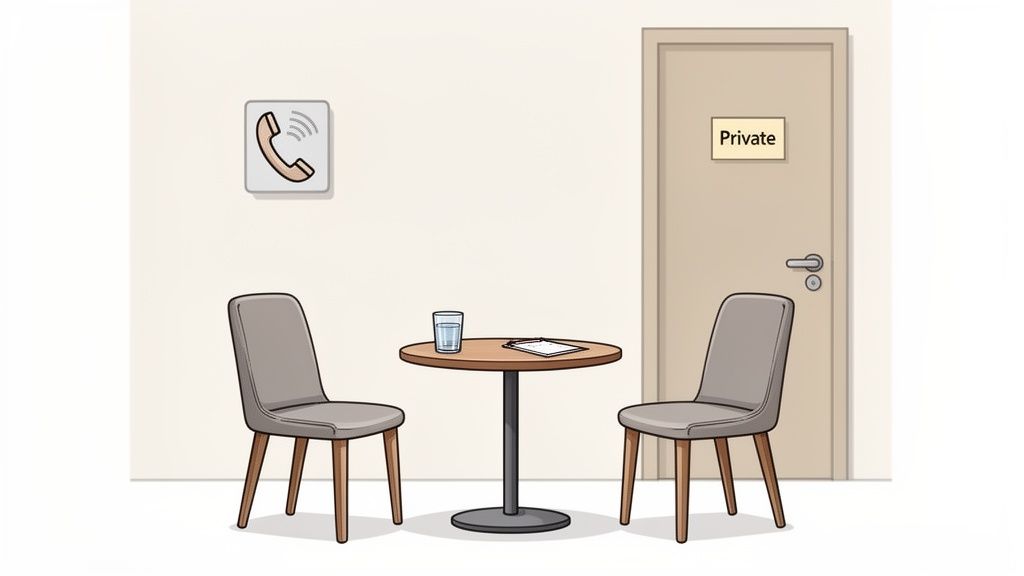
This attention to detail ensures the focus remains on assessing the candidate's abilities, not on navigating logistical hiccups. For example, some companies have dedicated quiet rooms with clear signage and comfortable seating specifically for this purpose. A thoughtful environment minimizes candidate anxiety and enables them to perform at their best, giving you a more accurate read on their potential fit within your team.
Putting It Into Practice
- Secure a Neutral Space: Reserve a quiet conference room away from high-traffic areas. Ensure it is clean, has comfortable seating, and includes essentials like water for the candidate.
- Confirm Logistics in Advance: Send the candidate an email confirming the interview time, location, building access instructions, and parking details. This small step removes unnecessary stress on the day of the interview.
- Arrive Prepared and Punctual: The interviewer should arrive early to set up the room. Have all necessary materials, such as the candidate's resume, assessment results, and prepared questions, ready to go before the candidate walks in.
- Eliminate All Distractions: Put away phones, close email tabs, and silence notifications. Dedicating your full, uninterrupted attention to the candidate demonstrates that you value their time and the interview process itself.
6. Use Behavioral Questions to Uncover Decision-Making and Judgment
Past performance can be a strong indicator of future success. Behavioral questions move beyond hypotheticals, asking candidates to describe specific past experiences to reveal their thought processes, problem-solving abilities, and how they react under pressure. This approach provides concrete evidence of a candidate’s judgment, accountability, and capacity for growth, which is one of the more reliable in-person interview tips you can implement.
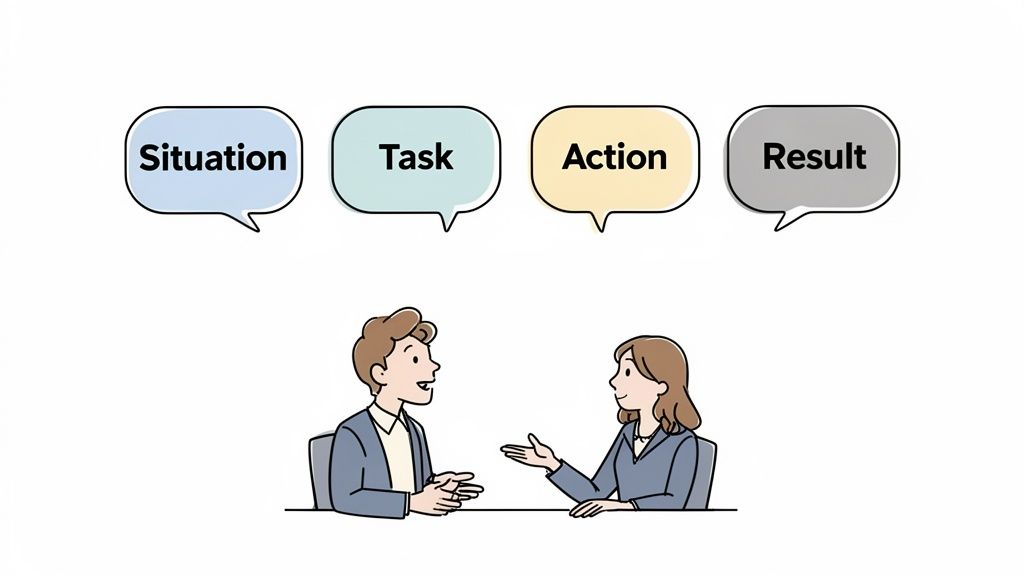
When you ask a candidate to detail a significant failure, their answer can reveal their level of self-awareness and commitment to learning. Similarly, asking an engineering candidate about the most complex technical bug they've faced shows their methodical approach to diagnosis and resolution. These stories are often more revealing than canned answers, providing a window into how a candidate operates in a professional environment.
Putting It Into Practice
- Structure with STAR: Guide candidates to frame their answers using the Situation, Task, Action, Result (STAR) method. This creates a clear narrative, making it easier to assess the context and outcome of their actions.
- Probe for Judgment: Don't just accept the story at face value. Follow up with questions like, "Why did you choose that specific approach?" or "What were the trade-offs you considered?" This exposes their decision-making calculus.
- Assess Growth Mindset: A key question is, "Tell me about a time you made a mistake or a project failed. What did you learn from it?" Their response can measure accountability and their ability to grow from setbacks.
- Validate Teamwork Claims: Listen for inconsistencies between claimed teamwork ("we accomplished…") and the actions described. If they only mention their own contributions, probe further: "What was your specific role, and how did your colleagues contribute?"
7. Maintain Consistency and Calibration Across Multiple Interviewers and Candidates
To make a more objective hiring decision, it helps to minimize the "gut feeling" variable that arises when multiple interviewers use different evaluation methods. A calibrated, consistent process ensures that every candidate is measured against the same evidence-based standards, regardless of who is in the room. This approach turns a series of disconnected conversations into a unified, fair assessment, making your final decision more defensible and accurate.
This structured process is one of the most important in-person interview tips for teams. For instance, when hiring a project manager, you can have one interviewer assess their stakeholder communication skills, a second evaluate their risk management approach, and a third focus on their technical proficiency with project tools. By assigning specific competencies, you gather deep, specialized evidence instead of broad, overlapping opinions, leading to a much richer candidate profile.
Putting It Into Practice
- Brief All Interviewers: Before the first interview, hold a pre-briefing session. Ensure every interviewer understands the role's core competencies, the questions they are responsible for, and the specific behaviors to look for.
- Use a Standardized Scorecard: Move beyond vague 1-5 scales. Implement a scorecard with behavioral anchors that describe what poor, good, and great answers look like for each competency. This is where an effective interview scoring rubric template becomes indispensable.
- Assign Competency Ownership: Have different interviewers assess distinct competencies to deepen the evaluation and prevent groupthink. This creates a comprehensive view of the candidate's abilities.
- Conduct Structured Debriefs: After the interviews, hold a debrief where each interviewer presents evidence-based ratings from their scorecard, not just their general impressions. The discussion should focus on "What did you see?" rather than "Did you like them?"
- Document Everything: Record all evidence and decision-making rationale within your Applicant Tracking System (ATS). This creates an audit trail for accountability and helps refine your process for future roles.
8. Assess Cultural Fit and Values Alignment Without Discriminatory Bias
Evaluating cultural fit should not be a subjective gut feeling. True alignment comes from assessing a candidate’s values and work styles against the core, observable behaviors that drive success at your company. This moves beyond the vague "seems like us" bias and creates an objective framework for finding team members who will add to your culture, not just replicate it.
This evidence-based approach is one of the more crucial in-person interview tips for building a diverse and high-performing team. Instead of asking if a candidate "seems like a company person," you ask for concrete examples of how they handled a cross-team project. This reveals their collaborative spirit and communication style in action, not just their ability to give the "right" answer. For a startup role that demands ownership, ask about a time they took on an initiative that fell outside their direct job description to gauge their proactivity.
Putting It Into Practice
- Define Your Core Values: Identify 3-5 non-negotiable company values (e.g., accountability, collaboration, innovation) and translate them into expected behaviors.
- Ask Behavioral and Situational Questions: Frame questions around these values. For example, to assess a growth mindset, ask: "Describe a time you received difficult feedback. How did you process it and what did you do next?"
- Use a Diverse Interview Panel: Involve interviewers from different backgrounds, teams, and tenures. This provides multiple perspectives and helps reduce the risk of homogeneity bias, where interviewers favor candidates who are similar to themselves.
- Document Observations, Not Feelings: Train interviewers to record specific, observable behaviors and statements rather than subjective impressions. Instead of "good cultural fit," write "Candidate provided a detailed example of mentoring a junior colleague, aligning with our value of mentorship." Understanding and avoiding biased judgments is key; you can learn more about the common pitfalls and legal risks associated with workplace discrimination to refine your process.
9. Close the Interview with Clear Next Steps and a Compelling Offer
The final moments of an interview are just as critical as the first impression. A weak, ambiguous closing like "we'll be in touch" can undermine the rapport you've built, leaving strong candidates feeling uncertain and disengaged. Instead, end every interview with a clear, compelling summary that reinforces their value and outlines exactly what comes next. This professional courtesy is a key part of effective in-person interview tips and improves the candidate experience.
This structured approach turns the interview's conclusion from an awkward goodbye into a strategic opportunity. By providing a specific timeline and expressing genuine interest, you keep top contenders excited about the opportunity. When a candidate knows you’ll decide by Friday and what the next stage entails, they are more likely to stay engaged with your process rather than accepting a competing offer. This clarity respects their time and demonstrates that your organization is decisive and well-managed.
Putting It Into Practice
- Provide a Specific Timeline: Always give a clear timeframe for your decision and subsequent communication. For example: "We are concluding interviews this week and will be in touch with our decision by Tuesday of next week."
- Outline the Process: Explain what happens next if they move forward. Mention any further steps, like a final team interview or a skills assessment, to manage expectations.
- Articulate Your Interest: If the candidate is a strong fit, say so. Expressing enthusiasm makes them feel valued. A simple, "Your experience with [specific skill] aligns perfectly with what we're looking for," goes a long way.
- Invite Final Questions: Always conclude by asking, "Do you have any final questions for us?" This final check-in ensures they leave without any lingering doubts and shows you value their perspective.
- Confirm Contact Details: Before they leave, double-check their preferred method of contact and confirm their details are correct to ensure smooth follow-up communication.
10. Conduct Post-Interview Debrief Promptly with Structured Decision Framework
The value of a well-executed in-person interview can be lost if your team’s observations aren't captured and synthesized quickly. A post-interview debrief, held immediately while impressions are fresh, turns subjective feelings into a structured, evidence-based decision. This process ensures that hiring choices are defensible, consistent, and directly tied to the established performance criteria for the role.
By using a structured framework, you move from "I liked this candidate" to "This candidate demonstrated strong problem-solving skills when they detailed their debugging process, which aligns with our top performance benchmark." It brings discipline to the final, and most critical, step of the interview process. This is one of the more important in-person interview tips for making fair and accurate hiring decisions, as it forces a comparison of evidence against the job requirements, not just a comparison between candidates.
Putting It Into Practice
- Schedule Promptly: Book the debrief session within four hours of the final interview. This urgency is key to capturing detailed, accurate recollections before memories fade.
- Use a Scorecard: Arm each interviewer with a standardized scorecard listing the core competencies. They should rate each one and provide specific behavioral examples from the interview to justify their rating. For example, under "Communication," a note might read: "Clearly articulated the project's financial impact to a non-technical stakeholder."
- Share Observations First: Begin the debrief by having each interviewer share their scores and evidence without initial discussion. This prevents groupthink and ensures all independent perspectives are heard before a consensus is formed.
- Make a Clear Recommendation: The goal is a definitive decision: move forward, do not move forward, or move forward with specific conditions (e.g., a follow-up reference check). Document the final decision and any significant dissenting opinions.
- Align with Assessment Data: Compare the qualitative observations from the interview with quantitative data from pre-interview assessments, like those from Cohesyve. This alignment helps validate interview impressions and identify any discrepancies between perceived skills and validated abilities.
10-Point In-Person Interview Tips Comparison
| Interview Practice | Implementation complexity | Resource requirements | Expected outcomes | Ideal use cases | Key advantages |
|---|---|---|---|---|---|
| Prepare Structured, Role-Specific Questions Based on Job Requirements | Moderate — design and mapping effort | HR/SME time, templates, job analysis | Consistent, comparable candidate data; higher predictive validity | Mid/senior hires, roles with clear competency models, high-volume screening | Objective comparisons; compliance-ready; focused on job-critical skills |
| Master Active Listening and Strategic Note-Taking During the Interview | Low–Moderate — training and discipline | Interviewer coaching, time for focused notes | Rich behavioral evidence; improved follow-ups and judgment | Final interviews, fit & communication assessments | Captures nuance; supports adaptive questioning; reduces first-impression bias |
| Evaluate Practical Problem-Solving and Validate Assessment Results | High — scenario design and alignment with assessments | Domain experts, tailored scenarios, prep time | Strong indicator of on-the-job performance; validated assessment insights | Technical, senior, or hands-on roles requiring applied skills | Tests applied reasoning; verifies assessment claims; differentiates performers |
| Assess Communication and Collaboration Skills in Context | Moderate — requires structured prompts/panels | Skilled interviewers, role-plays or panels, observation rubrics | Clear view of interpersonal dynamics and teamwork potential | Client-facing, cross-functional, leadership roles | Reveals real interaction style; predictive of team integration |
| Prepare Your Interview Environment and Remove Distractions | Low — logistical setup | Facilities coordination, tech checks, scheduling | Better candidate focus and experience; fewer interruptions | All interview types (in-person and remote) | Improves performance, professionalism, and candidate perception |
| Use Behavioral Questions to Uncover Decision-Making and Judgment | Moderate — question library and probing technique | Interviewer training in STAR, calibrated probes | Evidence of past behavior, judgment, and learning orientation | Roles needing accountability, judgment, and growth mindset | Predictive of future behavior; yields concrete examples for decisions |
| Maintain Consistency and Calibration Across Multiple Interviewers and Candidates | High — coordination and framework enforcement | Training, shared scorecards, scheduled calibration meetings | Fair, defensible hiring decisions with reduced individual bias | Multi-interviewer panels, cross-functional hiring, sensitive roles | Multiple perspectives; standardized scoring; legal defensibility |
| Assess Cultural Fit and Values Alignment Without Discriminatory Bias | Moderate — define values and behavioral anchors | Training, diverse panels, behavior-based rubrics | Better retention and team cohesion while preserving diversity | Teams emphasizing culture, retention, and inclusive hiring | Role-relevant values assessment; supports diverse hires when structured |
| Close the Interview with Clear Next Steps and a Compelling Offer | Low — consistent closing process | Communication scripts, hiring manager alignment | Higher candidate engagement and lower dropout rates | Competitive markets, high-demand candidates, final-stage interviews | Improves acceptance rates; leaves positive impression; reduces ghosting |
| Conduct Post-Interview Debrief Promptly with Structured Decision Framework | Moderate — scheduling and scorecard use | Time for timely debriefs, scorecards, decision rules | Faster, evidence-based hiring decisions; fewer errors | Multi-interviewer processes, roles needing quick consensus | Keeps observations fresh; supports defensible, repeatable decisions |
From Conversation to Confirmation: Making Your Next Hire Count
The journey from a promising application to a confirmed hire is one of the most critical processes in an organization. Moving beyond generic questions and unstructured chats is the first step toward building a team that not only meets expectations but exceeds them. The in-person interview, when executed with precision and purpose, becomes the final, crucial checkpoint in this journey. It's where data-driven insights meet human connection.
We've explored how to structure your conversations, from preparing role-specific questions and mastering active listening to evaluating practical problem-solving skills in real-time. The emphasis has consistently been on creating a fair, consistent, and revealing experience for both the candidate and the interviewer. Remember, the goal isn't to trip someone up; it's to create an environment where their true capabilities can shine. An effective interview process is built on a foundation of validated skills, allowing the conversation to focus on what truly matters: judgment, communication, and mutual alignment.
Key Takeaways for Stronger Interviews
To improve your hiring outcomes, focus on these core principles:
- Structure is Your Ally: Consistency isn't about being rigid; it's about being fair. Using structured questions, consistent scoring rubrics, and calibrated interview panels removes unconscious bias and ensures every candidate is evaluated on the same merit-based criteria.
- Validate, Then Converse: Some of the most useful in person interview tips revolve around one central idea: verify technical skills before the conversation. When you already have objective proof of a candidate's ability to perform the job’s core tasks, the interview can shift from a technical quiz to a strategic discussion about collaboration, approach, and cultural contribution.
- The Experience Matters: From the moment a candidate arrives to the final handshake, every interaction shapes their perception of your company. A well-organized, respectful, and transparent process not only helps you make better decisions but also turns every candidate, hired or not, into an advocate for your brand.
Ultimately, mastering the in-person interview is an ongoing discipline. To continuously refine your hiring strategy and ensure each hire adds significant value, implementing robust strategies for recruiting process improvement is essential. By combining the human-centric tips outlined here with objective, role-specific assessments, you can move from guesswork to certainty. The most authentic and productive conversations happen when the technical basics are already confirmed, freeing you to discover the person behind the resume.
Ready to ensure your in-person interviews are built on a foundation of proven skills? Cohesyve provides role-specific assessments that give you objective data on a candidate's abilities before the final conversation. See how our platform can help you focus your interviews on what matters most by visiting Cohesyve.