
A hiring manager leans back after the final interview and says, “I just have a really good feeling about this one.”
Most talent teams have lived through what happens next. The candidate was polished, easy to talk to, and had a strangely reassuring overlap of hobbies, schools, or former employers with the panel. Everyone leaves the room upbeat. A few months later, the glow is gone. Delivery slips, collaboration feels harder than expected, and the team starts rewriting the story it told itself in the interview.
That’s the problem with vibe-based hiring. It feels efficient in the moment because it skips the discipline. It creates confusion later because nobody can point to the actual evidence behind the decision.
A structured interview guide fixes that by replacing loose conversation with a repeatable system. Every candidate gets the same job-relevant questions, in the same order, scored against the same criteria. According to Criteria Corp’s guide to structured interviews, structured interviews are two times more predictive of job performance than unstructured interviews. That’s not a small process tweak. It’s a different standard for what good hiring looks like.
The catch is that structured interviewing takes work up front. You have to define success, write strong questions, train interviewers, and hold people to the rubric. But once a team makes that shift, hiring gets calmer. Decisions get easier to defend. Bias has less room to creep in. If you need a broader refresher on how to conduct effective interviews, that’s a useful companion to the more tactical work of building the guide itself.
Moving Beyond 'Good Vibes' in Hiring
A lot of broken hiring systems don’t look broken at first. They look friendly.
The panel chats. Someone “clicks” with a candidate. Another interviewer likes their energy. A hiring manager decides the person will “figure it out.” Then the debrief turns into a pile of impressions that are impossible to compare. One interviewer asked about execution. Another asked about career goals. A third spent half the meeting talking about the company. Everyone leaves with notes, but not much evidence.
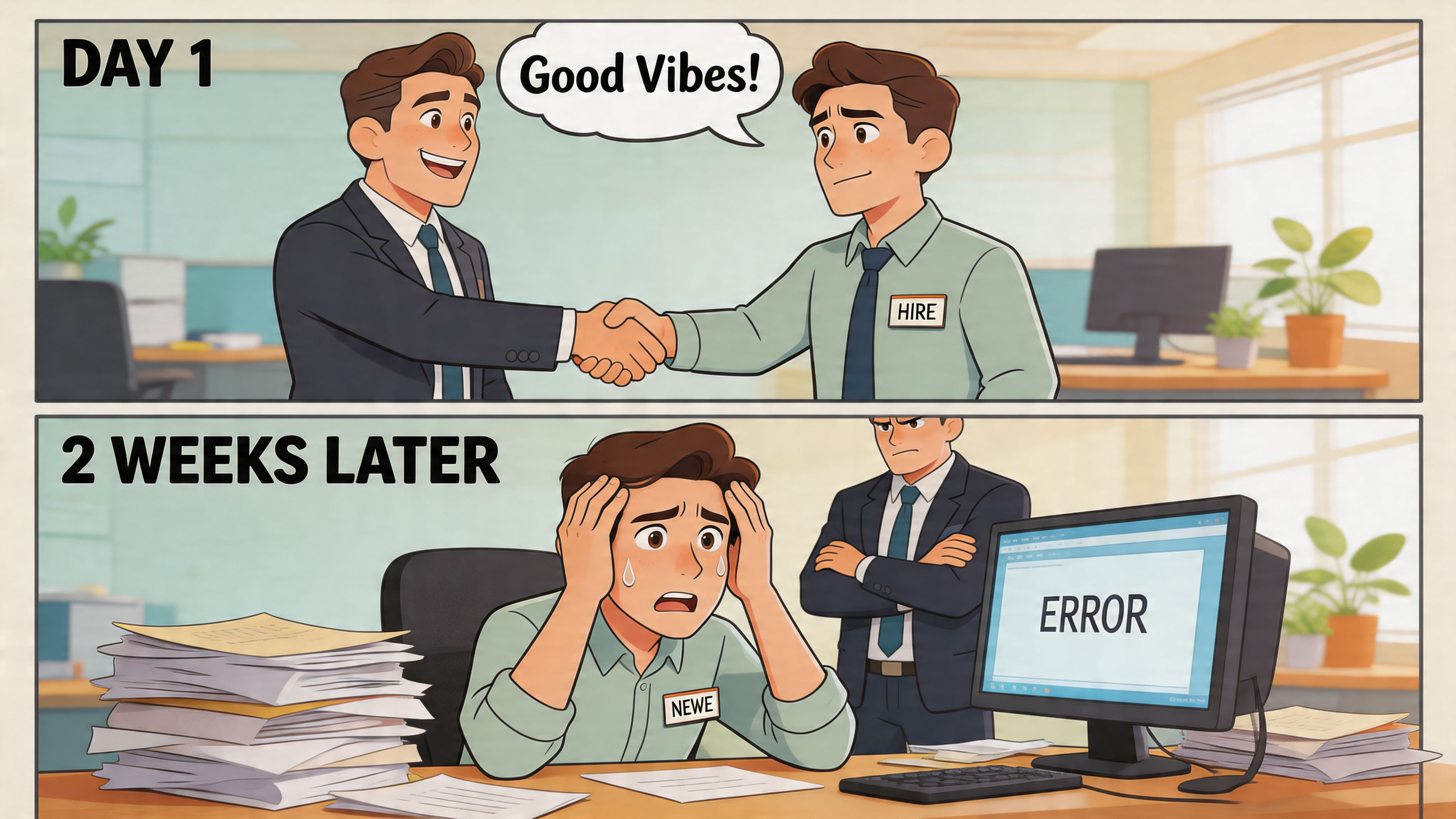
A structured interview guide changes the operating model. It says, clearly, “We are here to assess fit for the role, not chemistry with the room.” Candidates answer the same core questions. Interviewers score answers against pre-defined standards. That makes comparison possible and drift much harder to justify.
What a structured interview guide actually is
At its simplest, a structured interview guide is a hiring document with four essentials:
- A defined list of competencies tied to the job
- A fixed set of questions mapped to those competencies
- A scoring rubric that describes what weak, solid, and strong answers look like
- A consistent interview flow so candidates go through the same process
That consistency matters for quality and fairness. It also matters if you’re trying to reduce the impact of assumptions that sneak into open-ended hiring conversations. Teams working on that problem usually benefit from tightening interview structure and also understanding where bias enters the process in the first place. This breakdown of unconscious bias in recruitment is a useful companion to the guide-building work.
Good interviewers can still be inconsistent interviewers if the process asks them to improvise too much.
What changes when you stop winging it
The biggest shift isn’t the scorecard. It’s the mindset.
You stop asking, “Did I like this person?” and start asking, “What did they show me that predicts success here?” You stop rewarding polished generalities and start looking for evidence. You stop confusing confidence with competence.
That’s why structured hiring holds up so much better under pressure. When recruiters are moving fast, when hiring managers are overloaded, and when multiple stakeholders want input, a shared guide keeps the process from turning into a personality contest.
Defining What Success Actually Looks Like
Most interview guides go wrong before the first question is written.
The issue usually starts with a fuzzy job description. “Strong communicator.” “Strategic thinker.” “Team player.” Those phrases read nicely in a posting, but they don’t tell an interviewer what to listen for. If success isn’t defined in observable terms, the interview becomes a search for whatever feels impressive in the moment.
A better starting point is job analysis. The strongest structured interview processes break a role into 5-8 core competencies, according to this structured interview methodology guide. The same source reports that this approach can double predictive validity (r=0.51 vs. r=0.26 for unstructured) while also increasing job performance correlation and reducing bias in diverse hiring.
Turn the role into a success blueprint
A structured interview guide should sit on top of a simple question: what does excellent performance look like in this specific job?
Start with the work, not the wish list. Pull together the hiring manager, someone strong in the role today, and one partner from a closely connected function. Review what the person will need to do in the first stretch of the job. Ignore vanity requirements that sound senior but don’t drive performance.
Then group the work into competencies. Not generic traits. Real patterns of behavior that show up on the job.
For example:
Data analyst
- Analytical rigor for evaluating evidence without jumping to conclusions
- Stakeholder translation for explaining findings in plain language
- Prioritization for handling conflicting requests and deadlines
Sales lead
- Strategic communication for tailoring the message to different buyers
- Pipeline judgment for qualifying where to invest time
- Coaching ability for lifting team performance through feedback
Engineering manager
- Execution planning for sequencing work across a team
- Technical judgment for making sound trade-offs
- Talent development for raising the bar through hiring and coaching
Write competencies so they can be assessed
A competency should be specific enough that two interviewers can recognize it in the same answer.
Weak version: “Leadership”
Better version: “Drives clarity, assigns ownership, and keeps work moving when priorities conflict”
Weak version: “Problem solving”
Better version: “Breaks ambiguous problems into workable parts, tests assumptions, and chooses a practical path”
That wording matters because it becomes the backbone of your guide. It informs the questions, the probes, and the rating scale. If the competency is vague, everything downstream gets vague too.
Practical rule: If a competency can’t be observed in a candidate’s example, it’s too abstract to score.
Separate must-haves from nice-to-haves
Many teams tend to overload the guide. They try to assess everything. The result is a bloated interview that measures nothing well.
Keep the interview focused on the competencies that predict success. A role may involve many skills, but only a smaller set should shape the structured interview. Some qualities are better checked elsewhere through work samples, references, or technical assessments.
A simple filter helps:
- Does this competency show up in top performers?
- Would weakness here create real problems in the role?
- Can an interviewer assess it through evidence, not intuition?
If the answer isn’t consistently yes, don’t make it central to the guide.
Use the first stretch of the job as your anchor
One practical way to avoid overengineering is to define success around the first major phase of the role. That forces sharper thinking.
Ask the hiring manager:
- What decisions will this person need to make early?
- Where do new hires tend to struggle?
- What does strong performance look like in the first stretch of the role?
- Which behaviors separate someone who ramps well from someone who stalls?
That conversation usually produces a cleaner competency set than a recycled job description ever will. And once that foundation is solid, the interview guide starts to do what it should do. It stops being a script and becomes a tool for making better decisions.
Cohesyve
See what candidates can do before you interview them
Cohesyve turns your job description into a role-specific assessment with a scoring rubric. Each candidate gets a different version, so questions cannot be shared. Ten candidates free, no card.
Crafting Questions That Reveal True Ability
A structured interview guide lives or dies on the quality of its questions.
Bad questions invite polished opinions. Good questions force evidence. That’s the dividing line.
When an interviewer asks, “How do you handle pressure?” most candidates can produce a smooth answer. It sounds thoughtful, but it doesn’t prove much. Ask, “Tell me about a time when priorities changed suddenly and you had to reset a plan,” and now the candidate has to give you something you can evaluate.
Ask for proof, not philosophy
Behavioral questions work because they pull candidates into real situations. Instead of letting them describe what they value, they have to show what they did.
A useful formula looks like this:
- Start with the competency
- Name a situation where it appears
- Ask for a specific past example
- Listen for action, judgment, and outcome
That’s why “Tell me about a time when…” remains such a strong opener. It grounds the conversation in behavior rather than aspiration. If you want a broad set of prompts to adapt, this collection of common behavioral interview questions is a solid reference point.
Here’s how that looks in practice:
For stakeholder management
“Tell me about a time when you had to align people who wanted different outcomes.”For problem solving
“Tell me about a time when the obvious solution turned out to be the wrong one.”For ownership
“Tell me about a time when something important was slipping and you stepped in before being asked.”
Don’t confuse hypotheticals with evidence
Hypothetical questions aren’t useless, but they’re weaker when used as the core of the interview. “What would you do if a customer escalated an issue?” often produces a clean, idealized answer. You hear the candidate’s theory of themselves, not necessarily their pattern under pressure.
Behavioral questions are better for the main guide because they reveal trade-offs, constraints, and judgment in the messy conditions people work in.
That doesn’t mean you have to ban every follow-up. It means your follow-ups should clarify the candidate’s example, not lead them toward a stronger answer.
Use probes like:
- What was your role in that decision?
- How did you decide between those options?
- What happened next?
- What would your manager or teammate say you handled well, or poorly?
Avoid rescuing prompts like “Anything else?” or “Can you give a better example?” Those usually create noise, not signal.
Build a scoring rubric before you interview anyone
This is the part teams skip, then regret.
A 5-point behavioral scale with anchored examples gives interviewers a shared standard. According to Cangrade’s overview of structured interview guides, structured guides with detailed rubrics can produce a 75% reduction in gender/race disparities and 30% higher first-year retention. The same source notes that these guides typically rely on 5-point behavioral scales where each score is tied to a concrete level of performance.
Without anchors, a 4 from one interviewer might mean “excellent,” while a 4 from another means “fine.” With anchors, the panel has a common language.
Here’s a simple example.
Sample Scoring Rubric for "Problem Solving" Competency
| Score | Behavioral Anchor (What the candidate's story demonstrates) |
|---|---|
| 1 | Jumps to conclusions, gives a vague example, and can’t explain how the decision was made. |
| 2 | Identifies the issue but relies heavily on others to define the solution or next step. |
| 3 | Breaks the problem down clearly, takes reasonable action, and delivers an acceptable result. |
| 4 | Spots key patterns, weighs options well, and chooses a strong solution with clear reasoning. |
| 5 | Handles ambiguity with structure, tests assumptions, adapts when new facts emerge, and shows judgment that improved the outcome in a meaningful way. |
Map each question to one competency
One common mistake is writing “big” questions that try to assess everything at once. That sounds efficient, but it creates scoring chaos. A candidate gives one story, and now the panel is trying to score communication, leadership, ownership, judgment, and technical depth all at once.
Keep the mapping clean. One primary competency per question. If a secondary signal appears, note it, but don’t score the question against five separate ideas.
A practical question set often looks like this:
| Question | Primary competency | What interviewers should listen for |
|---|---|---|
| Tell me about a time when you inherited a messy problem and had to bring structure to it. | Problem solving | How the candidate framed the problem, created order, and made decisions |
| Tell me about a time when you had to persuade a skeptical stakeholder. | Communication | Clarity, adaptation to audience, and ability to handle resistance |
| Tell me about a time when something you owned went off track. | Ownership | Accountability, recovery actions, and learning |
For more examples you can adapt by role, this guide to structured interview questions examples is a practical resource.
A strong rubric doesn’t make interviews robotic. It makes judgment visible.
What good answers usually have in common
Interviewers often ask what they should listen for besides the words themselves. In most roles, strong answers have a few consistent qualities:
- Specificity instead of general claims
- Clear ownership instead of fuzzy team language
- Reasoning that explains why the candidate chose one path over another
- Reflection that shows learning, not just storytelling polish
Candidates don’t need a perfect outcome to score well. Sometimes the most revealing answers come from situations that were difficult or imperfect. What matters is whether the candidate can explain their thinking and demonstrate sound judgment.
Training Your Team for Consistent Evaluation
A well-built structured interview guide can still fail in the hands of an untrained panel.
This happens all the time. A company invests real effort in the questions and scorecards, then tosses them into the process with a quick note that says, “Please use the rubric.” One interviewer follows it closely. Another wings it. A third scores everybody high because they don’t want to be the tough grader. By the end of the week, the process looks structured on paper and chaotic in practice.
Training is where fairness becomes real
Interviewers need more than the document. They need shared judgment.
Good training covers three things. First, people need to understand why the process is structured in the first place. Second, they need practice interpreting the competencies and anchors consistently. Third, they need guardrails for follow-up questions, note-taking, and debrief behavior.
That usually means walking the panel through sample answers and asking each person to score independently before discussing. You learn very quickly where the gaps are. One interviewer may reward confidence. Another may over-penalize brevity. A third may be reading far too much into surface polish.
Watch for the usual human traps
Interviewers don’t need to be careless to be inconsistent. They just need to be human.
A few patterns show up again and again:
Confirmation bias
An interviewer forms a view early and spends the rest of the conversation collecting proof for it.Halo and horns effects
One impressive trait lifts everything else, or one weak moment drags everything down.Similarity bias
The panel feels more comfortable with candidates who mirror their own background or communication style.Fatigue drift
Standards loosen or tighten depending on where the candidate lands in the day.
A structured interview guide helps, but only if the panel is trained to notice these patterns while using it.
The score should reflect the answer given, not the interviewer’s emotional reaction to the answer.
Calibration matters more than most teams think
The best panels don’t just compare notes. They calibrate.
That means each interviewer scores independently first. Then the group discusses differences by referring back to the rubric and the candidate’s evidence. If one interviewer gives a 5 and another gives a 2, the conversation should focus on what the candidate demonstrated, not who had the stronger personality in the room.
Useful calibration habits include:
- Score before discussion so early opinions don’t anchor the group
- Cite evidence from the answer instead of relying on summaries like “strong presence”
- Revisit examples periodically so the panel doesn’t drift over time
- Refresh interviewers before major hiring sprints when volume goes up and shortcuts creep back in
A few hours spent here prevents a lot of expensive confusion later. Teams that skip training often think the guide didn’t work. In reality, the guide was fine. The operating discipline around it wasn’t.
Integrating Assessments for Deeper Skill Verification
Behavioral interviews are excellent at surfacing judgment, communication, ownership, and pattern recognition from past work. They are less reliable when a team needs proof of current skill.
That gap gets wider in high-volume hiring and technical roles. A candidate can tell a convincing story about solving complex problems and still struggle when asked to practically solve one. A strong structured interview guide should account for that by pairing conversation with verification.

The old answer was usually a static test. A coding challenge copied from a shared bank. A generic case study. A take-home that had been circulating online for months. Those tools can still be useful, but they come with an obvious weakness now. Candidates can prepare for the exact prompt, share answers, or use AI tools to reverse-engineer their way through it.
That doesn't make structure the problem. The U.S. State Department's resource guide for hiring managers on structured interviews puts the case for it plainly: structured interviews are twice as effective as unstructured ones at predicting job performance. The fix is to keep the structure and stop reusing the prompts.
Why static question banks are getting weaker
Static assessments age badly. Once candidates know the format, some will optimize for the test instead of the job.
That doesn’t mean every candidate is acting in bad faith. It means the process is no longer asking fresh questions. If the same challenge appears repeatedly, candidates can rehearse highly specific answers that look like competence from a distance.
A more durable model uses adaptive assessment design. The structure remains consistent, but the actual challenge changes by role, level, and sometimes by candidate response. That makes the process harder to game without making it less fair.
What modern skill verification looks like
The strongest hiring systems now blend two layers:
- Structured interview questions for evidence of past behavior and judgment
- Role-specific assessments for direct proof of present capability
That second layer can take different forms depending on the role:
- Subjective reasoning prompts for roles that require judgment under ambiguity
- Case-based exercises for consulting, finance, and strategy hiring
- Coding challenges that test actual implementation choices, not trivia
- Voice role-plays for sales, support, and client-facing jobs
- Adaptive multiple-choice assessments when teams need scalable screening with tighter control
If you want a practical overview of where these fit, this guide on skill assessments is worth reviewing.
A useful walkthrough sits below.
Keep the human interview. Upgrade the evidence
The mistake isn’t using interviews. The mistake is asking interviews to do everything.
A hiring team should still meet the candidate, hear how they think, and evaluate how they communicate. But if the role depends on practical ability, the process should also require the candidate to demonstrate that ability in a format aligned to real work.
One approach some teams use is a front-loaded assessment that narrows the field before live interviews begin. Another is a mid-funnel assessment placed between recruiter screen and final panel. The right sequence depends on volume, role complexity, and candidate market.
Cohesyve is one example of this newer model. It analyzes a job description and generates role-specific assessments with adaptive questions rather than relying on a static bank. In practice, that means teams can verify skill in formats like case prompts, coding challenges, and voice role-plays before the final structured interview debrief.
If every candidate gets the same fixed test, the process is standardized. If every candidate gets a role-relevant challenge with consistent scoring logic, the process is standardized and harder to game.
Where this changes the interview guide itself
Modernizing the structured interview guide doesn’t mean throwing the guide away. It means designing it as part of a system.
The guide should show:
- Which competencies are best assessed in conversation
- Which skills need direct verification
- What evidence interviewers will receive before the final round
- How assessment results will inform follow-up questions without replacing them
For example, if a candidate performs strongly on a reasoning exercise but weakly in stakeholder communication, the final interview can probe that tension. If a candidate gives excellent leadership stories but shows weak execution in a job-relevant simulation, the team has a clearer trade-off to discuss.
That’s a much better hiring conversation than debating who seemed most confident on Zoom.
How to Scale and Refine Your Hiring Process
Most hiring teams treat interview design like a project. Build the guide, train the panel, launch the process, move on.
That’s where quality starts to slide. Roles change. Interviewers drift. Questions lose sharpness. What worked well at launch becomes a stale routine six months later.
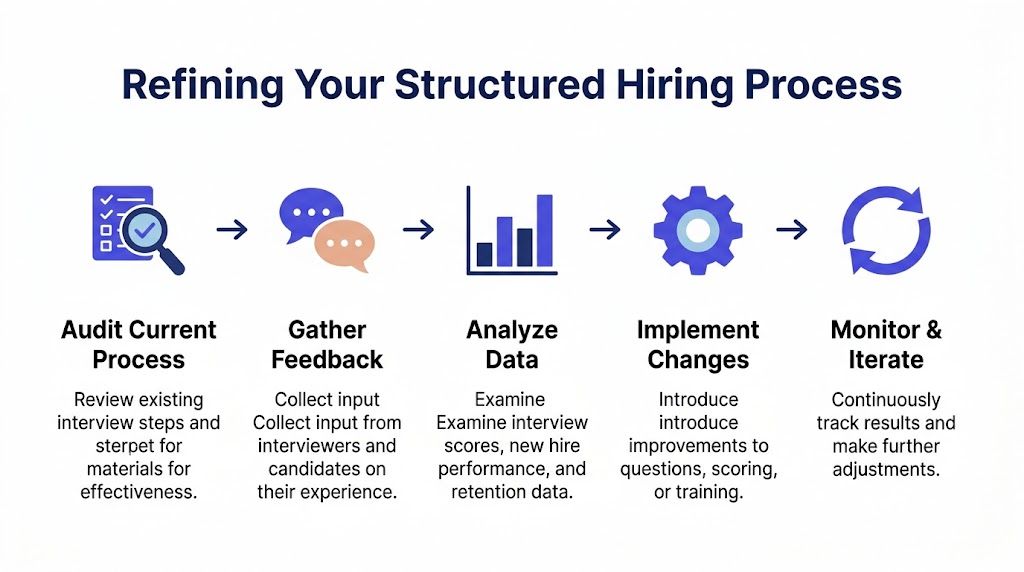
According to the claim summarized in the referenced OPM guide, a Harvard Business Review analysis found that 62% of structured interview processes degrade by 25% in effectiveness after 6 months without audits. The same source notes key metrics such as inter-rater reliability (aiming for >0.8) and predictive validity (r>0.5), and states that teams that run these audits can cut bad hires by up to 35%.
Audit the process, not just the candidates
A strong structured interview guide should be reviewed on a regular rhythm. Not because the whole system needs reinvention every quarter, but because small process drift compounds quickly.
Useful audit questions include:
- Are interviewers scoring the same answer in similar ways?
- Are high-scoring candidates performing well after hire?
- Are some questions producing weak signal or repetitive answers?
- Are there stages where strong candidates are dropping out for avoidable reasons?
You don’t need a perfect analytics stack to start. A basic spreadsheet, a reliable ATS export, and disciplined scorecards already give many organizations more insight than they’re currently using.
Watch the metrics that tell you something real
Not every hiring metric is useful. Time-to-hire matters operationally, but it doesn’t tell you whether your structured interview guide is doing its job.
The measures worth paying attention to are the ones that connect interview performance to hiring quality.
A practical review usually focuses on:
| Metric | What it tells you | What to do if it looks off |
|---|---|---|
| Inter-rater reliability | Whether interviewers are applying the rubric consistently | Recalibrate the panel and review sample answers together |
| Predictive validity | Whether strong interview scores align with strong on-the-job performance | Revisit the competencies and retire weak questions |
| Pass-through patterns | Whether candidates move through stages evenly and fairly | Check for unclear rubrics, overloaded stages, or role mismatch |
| Quality of debrief notes | Whether decisions are evidence-based or impression-based | Coach interviewers to reference examples and anchors directly |
Refine in small, controlled steps
Teams sometimes respond to a weak hiring quarter by rewriting the entire guide. That usually creates new confusion.
A better approach is controlled iteration. Change one question that isn’t producing useful signal. Tighten one anchor that interviewers interpret too loosely. Retrain one panel before a hiring sprint and compare note quality after. Small adjustments are easier to evaluate and much easier to adopt.
A healthy process often looks like this:
- Review score distributions and look for unusual clustering
- Compare interview scores with later performance signals
- Collect interviewer feedback on weak or repetitive questions
- Update the guide carefully instead of all at once
- Monitor the next hiring cycle to see whether the change improved signal
The interview guide should get better as your company learns what success actually looks like in the role.
Scale by standardizing judgment, not by removing it
A distinct approach marks mature talent teams. They don’t automate the whole decision. They standardize the evidence that feeds the decision.
That means your process can grow across departments without becoming generic. A finance team can use a different competency model from engineering. A support team can assess communication in more practical ways than a product team. The shared discipline is not identical questions everywhere. It’s the consistent logic behind how jobs are analyzed, how evidence is gathered, and how scores are interpreted.
When that logic is stable, hiring gets faster without getting sloppier. That’s the point of scale.
Start Hiring for What Matters
A strong structured interview guide doesn’t remove human judgment. It puts human judgment on a better foundation.
That foundation is simple. Define success clearly. Ask questions that pull real evidence to the surface. Train interviewers to score consistently. Verify skills where conversation alone isn’t enough. Then keep refining the system as the business grows.
There is upfront effort in all of this. No experienced talent leader should pretend otherwise. Writing rubrics, calibrating panels, and improving assessments takes time. But the alternative is also expensive. You spend that time later in backchannel debate, weak hires, avoidable bias, and replacement searches that shouldn’t have been necessary in the first place.
The most useful shift is cultural. Teams stop rewarding whoever interviews well in the loosest sense and start hiring for demonstrated ability, sound judgment, and role fit. That’s better for the company, and it’s better for candidates too. People deserve a fair process that measures what matters.
If you want to add skill verification to your structured interview process without replacing the human conversation, Cohesyve is worth a look. It creates role-specific assessments from a job description, uses adaptive questions instead of static banks, and helps teams move from résumé guesswork to evidence they can use in hiring decisions.