Modern hiring marks a shift away from guessing a candidate's potential to verifying their skills. The idea is to lean on evidence-based methods, like work-sample tests, instead of traditional signals like resumes and unstructured interviews, which have proven to be unreliable for predicting who will succeed in a role.
Moving Beyond Resumes in Modern Hiring
For decades, the hiring playbook has been built around one document: the resume. We’ve been trained to scan for keywords, past employers, and specific degrees, then hope our feeling in an interview points us to the right person. But this approach is often inconsistent.
Let’s try an analogy. You probably wouldn't hire a pilot just by reading their resume. It doesn't matter how well it's written or how many prestigious flight schools they list. You would want to see them in a flight simulator. You’d need to observe them handling turbulence, communicating with air traffic control, and landing the plane safely.
The core idea behind modern hiring is that simple: stop reviewing past accomplishments and start verifying present abilities. It’s about building a process that proves a candidate can do the job before you hire them.
The Problem with Guesswork
When we rely on resumes and unstructured interviews, we're introducing a lot of subjectivity into the hiring process. These methods can be influenced by unconscious bias and often end up measuring how well someone presents themselves, not how competent they are. This can lead to inconsistent results and hiring mistakes. The traditional way is built on assumptions, not evidence.
A modern, evidence-based approach flips this model. Instead of trying to predict success from a piece of paper, it seeks to observe it directly through practical, role-specific challenges. This is the cornerstone of a skills-first hiring strategy, which places a candidate's proven abilities front and center. If you're curious to dig deeper, you can explore our complete guide on what skills-based hiring is and why it matters.
This doesn't mean experience is worthless. It just means that experience isn't the same thing as ability.
Take a look at how these two philosophies stack up.
Traditional vs. Modern Hiring Approaches
| Hiring Aspect | Traditional Approach (Resume-First) | Modern Approach (Skills-First) |
|---|---|---|
| Primary Focus | Credentials, past job titles, years of experience | Demonstrable skills and on-the-job capabilities |
| Initial Screening | Keyword scanning on resumes and cover letters | Performance on work-sample or technical assessments |
| Bias Potential | High; susceptible to name, school, and gender bias | Lower; objective evaluation of skill reduces bias |
| Predictive Accuracy | Low; poor correlation with job performance | High; strong correlation with on-the-job success |
| Candidate Experience | Often long, vague, and feels like a "black box" | Engaging, relevant, and provides clarity on expectations |
| Talent Pool | Limited to candidates with conventional career paths | Expanded to include talent from all backgrounds |
By focusing on what someone can do, not just what they've done, you create a more equitable and effective hiring system. This method lets you spot talented individuals from any background, whether their career path looks "normal" or not.
The result? A stronger, more diverse team and a hiring process that delivers quality results. When you verify skills upfront, you make every step that follows—from interviews to onboarding—sharper and more valuable.
Mapping Your Modern Hiring Funnel
To build a hiring process that works, you first need a map. Let's trace the journey, from the moment you realize you need someone new to the day your top choice accepts your offer. When you visualize this as a funnel, you can see how each stage flows into the next, helping you spot bottlenecks and smooth out the path for every candidate.
A modern hiring funnel isn’t just a series of hoops for people to jump through. It's a framework designed to filter for genuine skill and potential. It helps ensure you invest your time with people who are right for the role.
This diagram captures the essence of this evolution—the move away from traditional guesswork and toward a smarter, evidence-based way of verifying skills.
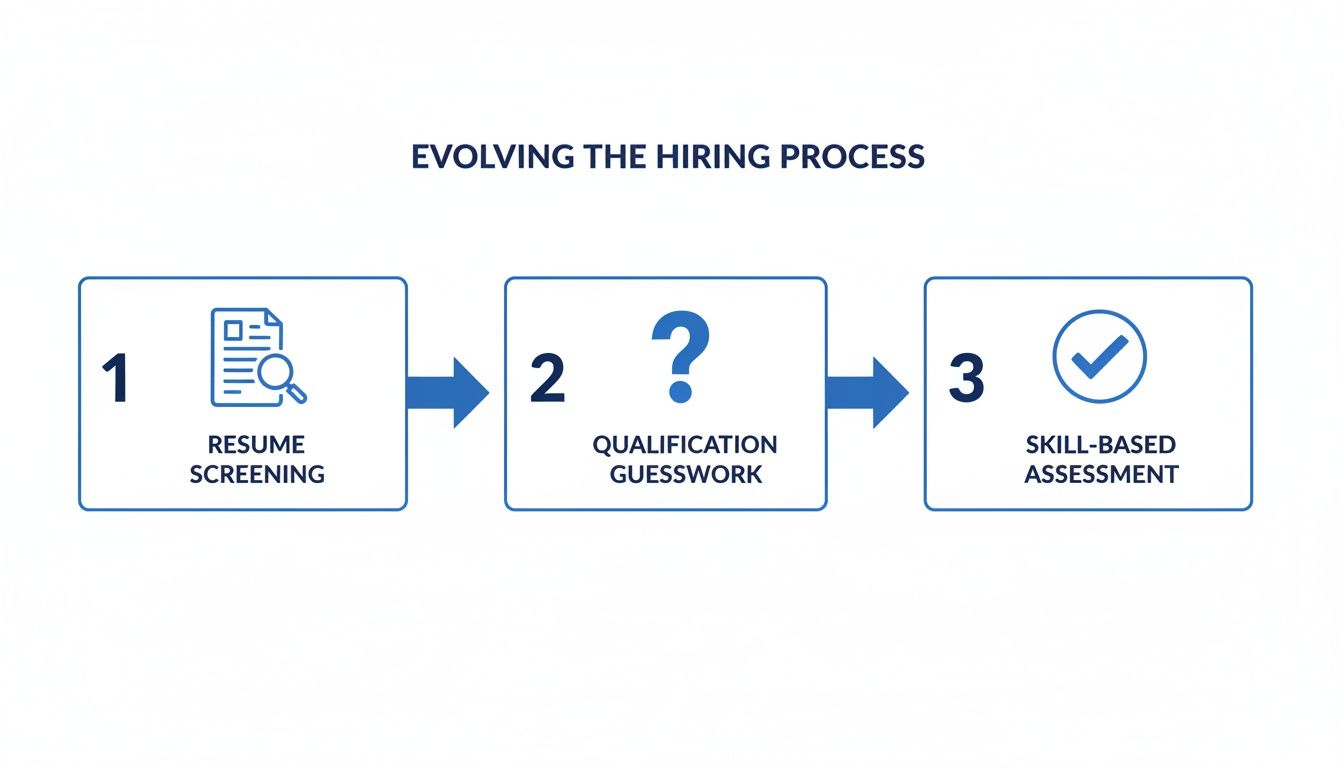
The core idea is simple: by placing skill tests early in the process, you shift from a subjective guessing game to an objective evaluation of what a candidate can actually do. That one change is the bedrock of a modern hiring funnel.
Stage 1: Role Definition
Everything begins here. Before you write a single word of a job description, you need clarity on what success looks like for this position. This means going beyond a simple list of responsibilities. You need to define the core skills and key outcomes this person will own.
One common mistake is dusting off an old job description. Instead, talk to the team, key stakeholders, and even high-performers in similar roles to build a profile of your ideal candidate that is both realistic and compelling.
Stage 2: Sourcing and Attraction
With a sharp role definition in hand, you can now focus on finding the right people. Sourcing isn’t about just posting a job and hoping for the best. It’s an active search for talent across a spectrum of channels.
- Inbound Channels: These are your magnets. They include job boards, your own career page, and social media posts that draw in people who are actively looking for a new role.
- Outbound Channels: This is where you go on the hunt. It involves proactively reaching out to passive candidates—talented people who aren't looking but might be open to a great opportunity—on platforms like LinkedIn or by attending industry events.
- Referrals: Don't underestimate the power of your team's network. Employee referrals often deliver high-quality candidates who have already been vouched for by someone you trust.
Your goal here is to cast a wide, but targeted, net. You want to attract a diverse pool of candidates who have the foundational skills you’re looking for, regardless of their background or resume.
Stage 3: Screening and Assessment
This is where the modern hiring funnel comes to life. Instead of reviewing hundreds of resumes, you use this stage to verify skills at the beginning. The mission is to quickly and objectively identify the candidates who can do the job.
The most effective way to screen is to move beyond the resume and assess practical abilities with work-sample tests or role-specific challenges. This step improves the quality of candidates who advance to the interview stage.
This approach respects everyone’s time. Candidates get a fair shot to prove their competence, and you get to focus your energy on a small, curated group of qualified individuals. It turns screening from a tedious chore into a powerful signal for quality.
Stage 4: Interviewing and Evaluation
By the time a candidate reaches the interview stage, you should already have an indication that they possess the technical skills to succeed. The interviews are now about confirming that and digging deeper into other crucial areas.
This is your chance to use structured interviews, where every candidate is asked the same core set of questions. This discipline helps reduce unconscious bias and makes your evaluations more direct and fair. Use this time to explore things that are harder to measure with a test, like collaboration, communication style, and their approach to solving problems.
Stage 5: Offer and Onboarding
You've found your person. The final stage is about sealing the deal and setting your new hire up for a good start. A competitive offer is important, but so is the experience of receiving it. A slow, disorganized offer process can make even an excited candidate second-guess their decision.
And remember, the moment the offer is accepted, the hiring process transitions into onboarding. A great onboarding experience validates the candidate’s choice and accelerates their journey to becoming a productive and engaged member of your team. This final handoff is crucial for long-term retention.
Cohesyve
See what candidates can do before you interview them
Cohesyve turns your job description into a role-specific assessment with a scoring rubric. Each candidate gets a different version, so questions cannot be shared. Ten candidates free, no card.
Designing Assessments That Truly Verify Skills
This is where theory meets practice. If you want to verify skills instead of guessing at them, your assessments need to mirror the actual, day-to-day challenges of the job.
It’s a simple truth: the best way to see if someone can do the work is to watch them do the work.
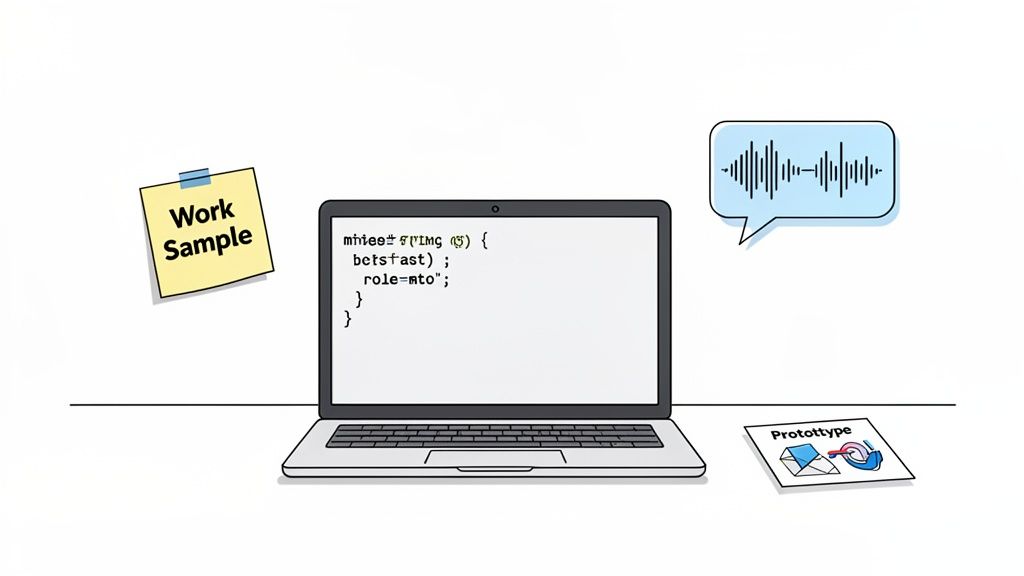
Think about it like this: you can ask a chef to describe an incredible meal, and they might paint a beautiful picture with words. But you won't know if they can cook until you taste the food. Work-sample tests and role-specific challenges are how you "taste the food" in your hiring process. They provide a clear signal of a candidate’s competence.
From Theory to Task
The secret to a powerful assessment is relevance. A generic brain teaser or a list of multiple-choice questions won't tell you if a marketing candidate can craft a compelling campaign. The goal is to design a challenge that feels like a real task they’d encounter in their first few months.
This looks different for every role. An effective hiring assessment is never one-size-fits-all.
- For a Software Engineer: Instead of an abstract whiteboard algorithm, consider giving them a small, self-contained coding project. Ask them to fix a bug in a real code snippet or build a tiny feature.
- For a Sales Development Rep: A voice role-play where they leave a voicemail for a fictional prospect can be more revealing than asking them to list "top sales techniques."
- For a Financial Analyst: Give them a sample dataset and ask them to build a simple forecast model in a spreadsheet. This tests not just their technical skill, but their ability to pull insights from numbers.
- For a Marketing Manager: Present a brief business scenario and ask them to outline a go-to-market plan. This puts their strategic thinking and communication skills on display in a practical context.
These kinds of challenges do more than just test skills. They give candidates a realistic preview of the job, which helps them decide if the role is a good fit for them, too.
Making Assessments Dynamic and Fair
One of the classic challenges with assessments has been the reliance on static question banks. Candidates could sometimes find answers online, and the questions would quickly become stale. Modern tools are making a difference here.
For example, some systems can help create dynamic assessments where every candidate receives a unique yet equivalent challenge. Imagine a tool that can analyze a job description and generate a relevant case study or a fresh set of data for an analyst to review. This helps ensure the test is fair and minimizes the potential for cheating.
The goal isn’t to make the test harder; it’s to make it more authentic. When each challenge is fresh and tailored to the core requirements of the role, you get a cleaner signal of a candidate’s true capabilities.
This approach helps level the playing field. It shifts the focus from who has the most polished resume to who has the best real-world skills. To dig deeper into this, check out our guide on how to design a great pre-employment skills assessment.
Measuring What Matters Most
Of course, not all skills have a simple right-or-wrong answer. Many roles, especially in fields like consulting or leadership, hinge on subjective reasoning, judgment, and clear communication. A good assessment strategy has to account for this.
This is where you can get creative. Consider incorporating prompts that require a thoughtful written response or even a short video explanation. For a consultant role, you could present a complex business problem and ask them to outline their approach. You aren’t grading for one "correct" solution; you're evaluating the clarity of their logic, their problem-solving framework, and how well they communicate a recommendation.
By blending different types of challenges—some that test hard skills and others that evaluate softer abilities—you build a more complete picture of a candidate's potential. This evidence-based approach makes your final hiring decision less of a gamble and more of an informed choice.
How AI Is Changing the Game for Quality Hiring
Let's clear the air about AI in hiring. This isn't about letting algorithms make the final decision or replacing human connection. It’s about giving your team better tools.
Think of it as a recruiter's assistant—one that can process information at scale. This assistant can take a complex job description, understand its core requirements, and help craft a relevant, hands-on skill assessment. This alone can save hours your team might otherwise spend brainstorming questions or building challenges from scratch.
We're not just talking about generic quizzes. Some AI tools can help build custom, role-specific tests that feel like a real day on the job. This focus on practical skills sets a stronger, more reliable foundation for your hiring process.
Assessments That Think and Adapt
One advancement here is adaptive testing. Picture this: a candidate starts an assessment. If they’re performing well, the system can serve up a more complex problem to see how deep their expertise runs.
On the other hand, if someone is struggling, the AI can adjust the difficulty to find their foundational knowledge level. This can provide a more nuanced picture of their abilities than a static, one-size-fits-all test ever could. It’s a more respectful and insightful experience for everyone.
The goal of AI isn't to replace judgment; it's to sharpen it. By automating some of the heavy lifting of skill verification, we free up hiring managers to focus their energy on a small, pre-vetted group of qualified people.
This automated shortlisting can have a big impact on speed. Instead of reviewing hundreds of resumes, your team can start meaningful conversations with candidates who have already demonstrated they have the skills. You can dive deeper into this with our guide on AI-powered recruitment tools.
Putting the Hiring Cycle on Fast-Forward
When you automate initial screening and assessment design, the impact on your timeline can be significant. This isn't just about shaving off a few days; it’s about gaining a competitive edge in a tight talent market.
Some companies using these modern tools report seeing two to three times faster times-to-hire. And they're not just hiring faster—they're hiring better, bringing in people who are a stronger fit from day one. You can explore data behind these shifts and learn about the key hiring trends expected to shape 2026.
This efficiency creates a positive ripple effect:
- Lifting the Administrative Weight: Recruiters are freed from tedious manual work to focus on building relationships and selling your company’s vision.
- A Better Candidate Journey: Top performers often appreciate a process that respects their time and lets them demonstrate their real skills. It's fast, transparent, and engaging.
- Higher Quality Conversations: Every interview is more productive because you’re only speaking with people who have already proven their technical competence.
The message is clear. AI can be a great partner for a modern hiring team. It can handle the data and the scale, delivering a clear signal of skill with speed. This allows your people to focus on the distinctly human side of recruiting—assessing cultural fit, building rapport, and convincing the best candidate to say "yes."
Thinking Globally About Your Talent Pool
In a world where work happens anywhere, your next great hire might not be in your city. They might not even be in your country. Looking beyond your local borders for talent isn't just a trend; it’s a strategic move to find the best people for the job. Talent is everywhere, and your hiring process needs to be ready to find it.
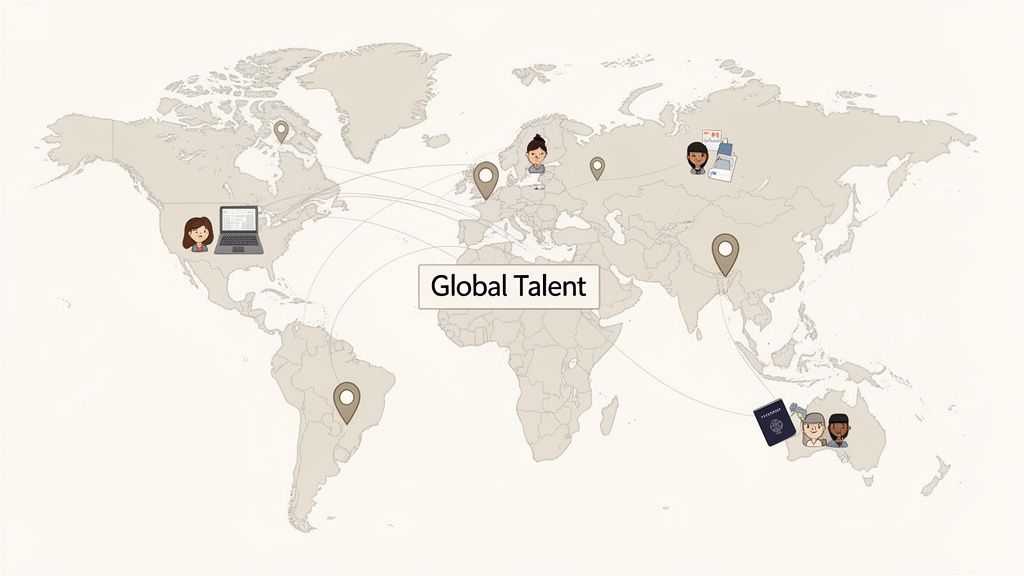
Opening your search to the world unlocks a massive pool of skilled candidates. But it also means you have to get smart about different economic climates and job markets. A recruiting playbook that works well in North America might not be as effective in Southeast Asia. The trick is to be intentional about where you look.
Following the Flow of Talent
So, where should you start? A good leading indicator is hiring optimism. When local employers are feeling confident and actively hiring, it’s a sign of a healthy, vibrant talent market where skilled professionals may be looking for their next move.
While the global outlook is generally positive, some regions are particularly active. For Q1 2026, the worldwide seasonally-adjusted Net Employment Outlook (NEO) is a solid +24%, but that number doesn’t tell the whole story. The real energy is in the Asia-Pacific region, which boasts a +30% NEO. Digging deeper, you'll find India posting the strongest outlook in the region. This kind of data can provide a map, pointing to where you might focus your sourcing. You can get more data by checking out global employment insights on NPAWorldwide.
When you target these high-confidence markets, you're not just casting a wider net—you're fishing in a well-stocked pond.
Building a Borderless Hiring Process
Of course, deciding to hire globally and actually doing it are two different things. To make it work, you need a process grounded in fairness and accessibility. Every candidate deserves an equal shot to show what they can do, no matter where they live or what their background is.
When you shift to a skills-first hiring model, geography becomes secondary. The most important question is no longer "Where are you from?" but "What can you do?"
This means adopting tools—and a mindset—that embrace a diverse, international group of applicants.
- Multi-Language Support: The entire journey, from the moment someone applies to their final assessment, should ideally be available in their native language. It’s a sign of respect that removes a point of friction.
- Culturally Neutral Assessments: A good skill challenge should be stripped of any cultural references or idioms that could cause confusion. The test should be about the skill, and only the skill.
- Asynchronous Communication: Time zones are a real-world barrier. A process that lets people complete assessments on their own time is essential for creating an experience that feels inclusive and modern.
The best way to bring this all together is by building your hiring process around objective skill verification. When you evaluate every candidate with the same consistent, role-specific challenge, you create a genuinely level playing field. It’s what allows a talented developer from Brazil to compete head-to-head with one from Berlin based purely on their ability. This doesn't just widen your talent pool—it makes your hiring fundamentally fairer and more effective.
A Practical Roadmap to Better Hiring
Great ideas are one thing, but execution is what builds a great hiring process. Shifting to a skills-first model might sound like a big undertaking, but it's a journey you can start today. The key is to break it down.
This isn't about tearing everything down and starting from scratch. It’s a phased approach designed to build momentum, win over your team, and deliver tangible results.
Phase 1: Audit Your Current Process
Before you can build something better, you need an honest look at where you are right now. Get your team together and map out your entire hiring funnel, from the moment a job is posted to the day an offer is signed.
Ask the tough questions. How many hours are recruiters spending on resume screening? What’s our drop-off rate between the first call and the final interview? Your audit will shine a light on the biggest bottlenecks—and often, that's the time spent on candidates who aren't a fit.
Phase 2: Secure Stakeholder Buy-In
Armed with data from your audit, you can build a story for change. Go to your key stakeholders—your head of engineering, your CFO, your CEO—with a clear problem and a practical solution.
Frame it in their language. Don't just talk about "better hiring." Talk about the cost of a bad hire (which the U.S. Department of Labor estimates can be up to 30% of the employee's first-year earnings) or the opportunity cost of leaving a critical role open. Show them how verifying skills upfront can reduce time-to-hire and boost their team's output. Your goal isn’t to overhaul the company; it's to get a green light for a small experiment.
Phase 3: Pilot a Skills-First Assessment
This is where the theory becomes reality. Forget trying to change everything at once. Pick one important, hard-to-fill role for your pilot program.
Partner with the hiring manager to pinpoint the must-have skills for that job. Then, create a short, practical assessment that reflects a real-world task a person in that role would perform. Invite every applicant who meets the basic criteria to take this assessment before a time-consuming interview is scheduled.
Starting with a single pilot creates a low-risk sandbox to prove the concept. You’ll see, almost immediately, how focusing on verified skills produces a shortlist of candidates who aren't just qualified on paper—they're genuinely capable.
Phase 4: Measure and Integrate
Once your pilot role is filled, it’s time to show your work. Compare the results directly against your old process. The metrics will speak for themselves.
- Time-to-Fill: How much faster was this hire compared to your historical average?
- Quality-of-Hire: Six months in, how is the new hire performing? Get direct, honest feedback from their manager.
- Offer Acceptance Rate: Did the best candidates seem more engaged throughout the process?
With positive results in hand, you can begin weaving this into your daily workflow. The best assessment platforms connect with the Applicant Tracking System (ATS) you already use, making it feel like a natural extension of your team’s process, not another tool to manage.
Phase 5: Scale and Optimize
You've got a successful pilot under your belt and a smooth integration. Now, you have the proof and the blueprint to scale this across the organization. Start rolling out the skills-first model to other teams, perhaps one department at a time.
Remember, this isn’t a one-and-done project. It’s a continuous cycle of improvement. Always be gathering feedback from hiring managers and candidates to refine your assessments and perfect your approach. You’re not just adding a new step; you’re adopting a better way to think about talent.
Answering Your Top Questions About Modern Hiring
Making the move to a skills-first hiring model is a big step, and it's natural to have questions. It represents a shift in how we think about finding great people, but getting started is easier than you might imagine.
Let's tackle some of the most common questions from leaders who are ready to make this change.
How Can We Start Using Skill Assessments if Our Budget Is Tight?
You don't need a huge budget to get started. The smartest approach is to think small and prove the concept.
Pick one critical role to start with. Maybe it's a position that's difficult to fill or one where a bad hire would be especially costly. Run a pilot program for just that role.
Look for a platform that offers a pay-as-you-go model. This lets you test the waters without a long-term commitment. By tracking the immediate impact on your time-to-hire and the improved quality of your candidate shortlist, you'll build a business case from a single success story. The ROI becomes clear when you consider the cost of one bad hire can easily exceed the cost of assessing dozens of candidates the right way.
Will We Scare Off Good Candidates with an Assessment?
That’s a common fear, but in our experience, the opposite can happen. A well-designed assessment shows candidates you're serious about their skills and you respect their time. Top talent is often tired of vague interviews and processes that rely on resume buzzwords; they appreciate the chance to show you what they can do.
When an assessment truly reflects the job and feels like a meaningful challenge, it acts as a magnet for the best people. It filters for candidates who are confident in their abilities and excited about the work—exactly who you want to talk to.
How Do We Make Sure AI-Powered Hiring Is Fair?
This is, without a doubt, a very important question. Ensuring fairness isn't just a goal; it's a necessity. The key is to use technology for its greatest strength: objectively measuring skills while being blind to everything else.
When you focus exclusively on a candidate's ability to solve problems they'd face in the role, you're actively removing many of the unconscious human biases that can plague traditional resume screens and interviews.
Think of it as leveling the playing field by design. A modern assessment platform can create a unique, yet equally difficult, challenge for every applicant. This helps ensure that every evaluation is based on merit. It's a significant step toward fairer hiring.
Ready to stop guessing and start knowing? Cohesyve helps you hire with confidence by replacing resume screening with dynamic, role-specific skill assessments. Discover how you can rank every candidate against one rubric, and see how one customer cut its time to hire by 50%.