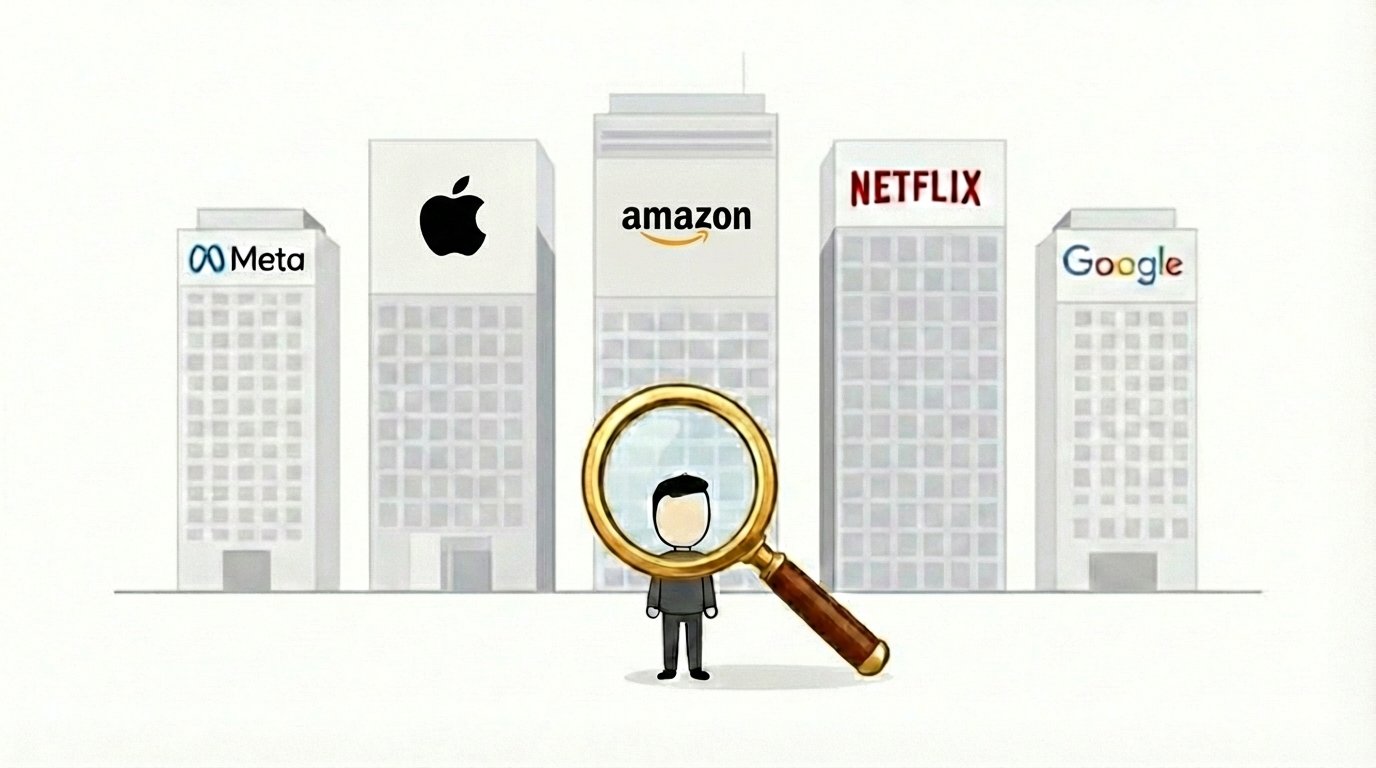
You’ve probably heard the term FAANG thrown around. It’s the acronym for five well-known American tech companies: Meta (formerly Facebook), Amazon, Apple, Netflix, and Google (now part of Alphabet). The term was coined in 2013 and became a shorthand for tracking these influential tech firms.
What Does FAANG Mean for Hiring Today
While the term started with investors, its meaning has expanded into the tech world, particularly recruiting. Today, "FAANG" represents a high standard for talent. It’s a benchmark and a set of hiring practices that have influenced the industry.
These companies grew by focusing on innovation, which required a different approach to building teams. They needed to find people who could solve complex problems and adapt quickly. This led to the rigorous, multi-stage interview processes that are now common in the tech industry, designed to identify practical skills over credentials.
The FAANG Hiring Philosophy
At its core, the FAANG approach is about reducing hiring mistakes by evaluating a candidate’s real-world skills and thought processes. It’s based on a few key ideas:
Skills First, Resume Second: They often prioritize what you can do over where you've worked before.
A Series of Interviews: Candidates typically go through multiple, structured rounds, each focusing on a different competency—from technical knowledge to handling pressure.
Hiring for Potential: They look for people with the capacity to learn and grow into future roles.
This isn't just about creating a challenging process. It's a deliberate strategy to ensure that new hires contribute to the overall talent level of the company.
Understanding how these companies attract and vet talent can be useful for any organization aiming to build a strong team. These principles can serve as a playbook for companies of any size, providing a framework for identifying skilled individuals. In this guide, we'll explore that playbook.
How FAANG Companies Redefined the Talent Market
The growth of FAANG companies created a significant shift in the talent market, driven by their economic scale. As these companies expanded, they developed a strong demand for skilled engineers, data scientists, and product managers. This wasn’t a gradual change; it redefined the standards for attracting top talent.
They weren't just hiring; they were attracting a significant portion of the top talent pool. This became a core business strategy, fueling their innovation and market position. This created a feedback loop: market leadership generated profits, which funded competitive compensation packages. That, in turn, attracted the talent needed to develop new products, reinforcing their market standing.
A Surge That Changed Everything
The numbers behind this growth are notable. Consider the five-year period from the end of 2014 to the end of 2019. At the start of this period, these five companies represented 7.4% of the S&P 500's total market value. Five years later, that figure had grown to 14.4%.
Let’s put that into perspective.
FAANG vs S&P 500 Growth (2014-2019)
| Metric | FAANG Companies | S&P 500 Index |
|---|---|---|
| Combined Market Cap Growth | 178.5% | 45.5% |
| Share of S&P 500 Market Cap | From 7.4% to 14.4% | N/A |
As you can see, FAANG's growth outpaced the broader market significantly during this period. This financial performance translated directly into hiring capability. With substantial resources, they could offer compensation, equity, and benefits that were highly competitive. For more detail, you can explore the data on this historic market performance.
This created a new dynamic for other companies. To compete for talent, many organizations began to adopt similar hiring philosophies. It prompted the rest of the industry to rethink how they found, evaluated, and hired the people they needed.
The Ripple Effect on Hiring Standards
An immediate consequence was a rise in hiring standards across the tech industry. As other companies observed the success of FAANG, they began to adopt elements of their playbook. The intensive, multi-stage, skills-focused interview process became more common.
A strong resume was no longer always enough. Companies started looking for demonstrated problem-solving skills, systems thinking, and adaptability. This raised the bar for candidates and encouraged hiring teams to become more rigorous and data-informed. The takeaway was clear: finding and retaining top talent was not just an HR function but a key part of business strategy.
Cohesyve
Practise this before it counts
Run the same kind of AI job simulation employers use and get a scored report on where you stand. 5 free assessments a month, no card required.
Deconstructing the FAANG Interview Process
The FAANG interview process has a reputation for being demanding, but it's not about trick questions. It’s a structured system designed to measure specific capabilities at each stage.
Think of it less as a test and more as a series of practical exercises. The goal is to see how you approach problems, perform under pressure, and collaborate when the solution isn't straightforward.
The process usually starts with a screening call from a recruiter to discuss your background, experience, and role fit. After that, it moves into technical rounds. These interviews aren't just about finding the right answer; they're about explaining your thought process. Interviewers want to see you break down large, ambiguous problems into smaller, manageable parts.
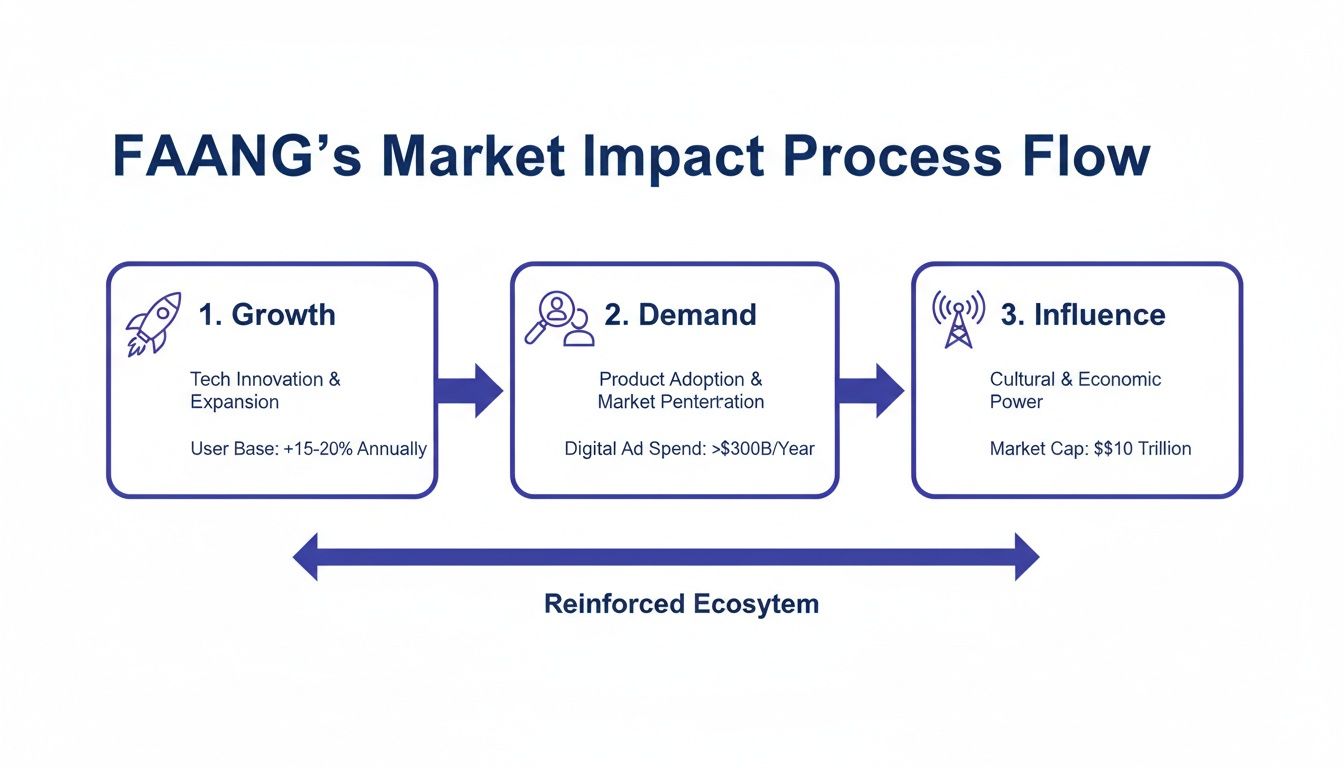
Market position creates a feedback loop where the need for skilled talent continually reinforces high hiring standards.
The Stages of Evaluation
After the initial screens, the process unfolds into several distinct phases. Each one acts as a filter designed to test a different aspect of your skill set. Given the thoroughness of these rounds, many candidates prepare using resources like expert tips for technical interviews.
A typical FAANG interview loop might include:
Technical Phone Screen: An early-stage filter, often focused on core data structures and algorithms. It's a check to see if you have the foundational knowledge for the role.
On-Site (or Virtual) Loop: This is a series of 4-6 interviews in a single day, covering a wide range of topics. This is the core of the evaluation.
System Design Round: This assesses your ability to think at scale. You might be asked to design a complex system—like a news feed or a ride-sharing service—and explain your architectural choices and trade-offs.
Behavioral Interview: This is a structured evaluation of your past performance, collaboration style, and problem-solving approach. The questions are designed to understand how you've handled conflict, navigated failure, and contributed to success in previous roles.
The goal is to collect multiple, independent data points on each candidate. A strong performance in one interview can't mask a significant weakness in another. This creates a more comprehensive and objective view of a candidate's abilities.
The Final Gatekeeper
Even after a successful on-site loop, the process isn't over. Feedback from all interviewers is compiled and reviewed by a hiring committee. This committee is typically made up of senior employees who did not interview the candidate.
Their job is to make the final hiring decision. This step is designed to reduce individual bias and ensure that every candidate who receives an offer meets a consistent, company-wide standard.
This structured framework allows these companies to look beyond a résumé and evaluate people based on their verifiable skills and potential. For a deeper look at the kinds of problems you might face, check out this guide on software engineer interview questions.
The Core Skills That Define FAANG-Level Talent
What’s the difference between a good engineer and one who thrives at a top tech company? While strong technical skills are essential, they are often just the starting point.
These companies are often hiring for the long term. They aren’t just filling a current role; they’re considering what a candidate could contribute in two, five, or ten years.
It’s less about memorizing answers and more about demonstrating how you think. They look for a combination of technical depth and the practical skills needed to succeed in a fast-paced environment. They're often looking for adaptable problem-solvers.
The Systems-Thinking Mindset
This is a key attribute. The most effective engineers at companies like Google or Meta don't just fix the immediate bug; they understand the entire system it connects to. This is systems thinking—the ability to see the broader context and understand how different components interact.
They ask questions like, "If we change this API, what downstream services might be affected?" or "What are the long-term scalability implications of choosing this database?"
At their scale, a seemingly small code change can have a significant impact. A candidate who only sees their part of the codebase might be a risk.
Consider this analogy: one mechanic can change a flat tire. Another understands how that tire's pressure affects the suspension, fuel economy, and the car's handling. Both are mechanics, but you would prefer the second one to design your next car.
Thriving in Ambiguity
FAANG companies often work on novel problems with no existing solutions. They need people who can take an undefined problem and create a path forward.
In an interview, you may be presented with a large, open-ended challenge rather than a neatly defined problem.
Your task isn't to guess the "right" answer. It's to demonstrate your process for handling ambiguity:
You ask clarifying questions to define the problem's scope.
You state your assumptions clearly.
You break the large problem down into smaller, manageable parts.
You discuss the pros and cons of different approaches.
This shows you can create structure from uncertainty, a valuable skill when building products for a large user base.
Data-Driven Communication
How you communicate your ideas is as important as the ideas themselves. At companies like Amazon or Apple, decisions are often backed by data.
"Because I think it's a better design" is less persuasive than a data-supported argument.
A FAANG-level engineer might say, "I recommend Option A. Our tests showed it produced a 5% lift in user engagement and cut our average latency by 30ms compared to Option B."
The difference is the use of evidence. They look for people who can not only build things but can also persuade a team by backing their ideas with data.
Adopting FAANG Principles Without a FAANG Budget
It’s easy to look at the hiring resources of FAANG companies and feel they are out of reach. However, the core principles of their approach can be adapted by any organization.
You don't need their budget. You just need to adopt their mindset.
The FAANG approach is centered on one main idea: shifting from trusting credentials to verifying skills. It’s less about where a candidate went to school and more about what they can actually do.
That’s an idea any company can implement. The goal isn't to copy their process exactly, but to capture its spirit and build a more objective way to hire, regardless of your size.
Focus on What Truly Matters: Skills
The most valuable lesson from FAANG is their focus on verifying skills. They create opportunities in the hiring process for candidates to demonstrate they can do the work, moving beyond resume keywords.
Think of it this way: you wouldn't hire a chef based solely on their resume. You'd ask them to cook. Tech companies apply this same logic to their roles, and it's a strategy that can be effective for any business.
This means designing a process that measures the skills that actually drive success in a role. It helps create a level playing field where tangible ability, not pedigree, is the primary factor. For smaller companies, finding the best HR software for startups can be a good first step in building these efficient systems.
An expensive hiring mistake is not just overpaying, but hiring someone who can't perform the job effectively. A skill-first approach is a good way to mitigate that risk, saving time and resources.
Instead of a multi-stage interview process, you can distill the approach to its essential elements.
Practical Steps to Emulate FAANG Hiring
You don't need a large HR department to improve your hiring process. It's about being more intentional in how you evaluate candidates.
Here are a few practical ways to incorporate skill verification into your hiring:
Use Dynamic Assessments: Instead of generic take-home projects, use assessments that simulate real-world challenges—a mini case study for a marketer or a coding challenge that reflects an actual task for a developer.
Structure Your Interviews: Move away from unstructured chats. Use a consistent set of role-specific questions for every candidate. This allows for a more direct comparison and reduces bias.
Use Situational Judgment Tests (SJTs): Present candidates with realistic workplace scenarios. Asking "What would you do here?" provides insight into their problem-solving skills and practical judgment.
These methods don't require a FAANG-sized budget, but they help you make more objective, evidence-based hiring decisions. By prioritizing proof over prestige, you can build a team with the skills needed to succeed.
Curious how to put this into practice? Read our guide on designing an effective pre-employment skills assessment.
Why Skill-First Hiring Is the Future
When looking at the FAANG companies, the real takeaway for talent teams isn't about becoming the next Google. It’s about understanding the core principle that contributed to their success.
That principle is a consistent focus on identifying and verifying what a person can actually do.
They shifted from relying on proxies for talent—like a degree or a former employer—to measuring on-the-job capability. This focus on verifiable skills is the true legacy of FAANG hiring. The good news is that this mindset is no longer exclusive to Silicon Valley.
Making Skill Verification Accessible to Everyone
Today, modern assessment tools make this level of precision accessible to any company. You don't need a FAANG-sized budget to build a hiring process that simulates real-world challenges, objectively measures core competencies, and allows top performers to stand out based on proven ability.
This skill-first model is more than a trend; it's a move toward more competitive hiring.
It’s more accurate: It evaluates the practical skills needed for the job, not just keywords on a resume.
It’s more equitable: It creates a level playing field where talent from any background can demonstrate their abilities.
It’s more effective: It helps reduce the risk and cost of a bad hire.
The goal isn't just to fill an open role. It’s to build a team so capable that it becomes a competitive advantage. Focusing on verifiable skills is the most direct way to achieve that.
The Lasting Impact of FAANG Principles
The influence of FAANG continues to shape the market and candidate expectations. Even in fluctuating markets, their performance can set a standard. In 2024, for example, several FAANG stocks performed well, outgaining the S&P 500's 24% rise.
Amazon saw its stock rise by 48%, driven by its e-commerce and AWS segments. Alphabet's shares also climbed due to growth in its digital ad and cloud businesses. You can learn more about the 2024 FAANG stock performance on nasdaq.com. This financial performance reinforces their ability to attract talent, keeping hiring standards high across the industry.
The lesson is that the future belongs to organizations that move beyond outdated hiring methods. By adopting a more accurate, fair, and effective skill-first model, you can build a team that doesn't just keep up—it innovates. If you want to learn more, check out our guide on what is skills-based hiring.
Ready to stop guessing and start verifying? Cohesyve helps you measure real-world skills with dynamic, role-specific assessments. See how it works at https://www.cohesyve.com.