Hiring is about finding the best person for the job, but research shows that our definition of 'best' is often subjective and clouded by unconscious bias. Despite intentions to be fair, various overt and subtle examples of discrimination can appear in hiring processes. This leads companies to miss out on talent and perpetuates inequality in the workplace.
This isn't about pointing fingers; it's about building smarter, more effective teams. This article breaks down 10 common forms of discrimination, not just as legal risks, but as strategic blind spots that weaken your talent pipeline. We’ll move past abstract concepts and look into specific, real-world scenarios backed by data to help you recognize how bias manifests, from the initial resume screen to the final interview.
You won't just learn to spot the problems. We will provide concrete steps to engineer a more objective, skill-first hiring process. By focusing on what matters—a candidate's ability to do the job—you can identify genuine potential, build a more diverse and capable workforce, and achieve better business outcomes. It’s time to move from simply talking about fairness to actively designing it into your talent acquisition strategy.
1. Resume-Based Bias and Screening Discrimination
Resume-based bias is one of the most common yet subtle examples of discrimination in hiring. It happens when recruiters or hiring managers make subconscious judgments based on information on a resume, such as a candidate's name, school, or employment gaps, rather than their actual skills. This unconscious bias can lead to qualified candidates being overlooked before they have a chance to prove their capabilities.
For instance, a study by the National Bureau of Economic Research found that resumes with white-sounding names received nearly 50% more callbacks than those with Black-sounding names, despite having identical qualifications. This shows how easily implicit biases can affect a fair hiring process from the start.
Strategic Analysis and Tactical Solutions
To combat these biases, talent teams can shift their focus from resume signals to verified skills. Traditional screening relies on proxies for talent, such as a degree from a prestigious university or a linear career path. This practice can penalize candidates from non-traditional backgrounds, such as bootcamp graduates, career changers, or caregivers returning to the workforce.
Key Insight: The resume is a record of past opportunities, not a direct measure of present capabilities. Over-reliance on it can favor those who have already had access to elite networks and institutions.
Actionable Takeaways for Talent Teams
Creating an equitable screening process requires a structured approach. Here are practical steps to reduce resume-based discrimination:
- Implement Blind Screening: Use software or a manual process to remove names, addresses, and graduation years from resumes. This helps evaluators to focus purely on experience and qualifications.
- Use Skills-Based Assessments: Instead of guessing a candidate's competence from their resume, measure it directly. Skills assessments provide objective data on a candidate’s ability to perform the core functions of the job. You can learn more about creating a skills-based hiring process and how it creates fairer outcomes.
- Standardize Evaluation Rubrics: Develop a clear, consistent scorecard for every role. This ensures every candidate is judged by the same criteria, reducing the influence of personal bias.
By adopting these methods, your team can build a more objective, fair, and effective hiring engine that identifies top talent, regardless of their background.
2. Age Discrimination in Hiring
Age discrimination is a persistent barrier in the hiring process, manifesting as one of the most common examples of discrimination. It occurs when employers make decisions based on stereotypes about a candidate's age rather than their individual merit. This affects both older workers, often over 40, who may be perceived as less adaptable or tech-savvy, and younger candidates dismissed as inexperienced.
This form of bias is often embedded in job descriptions and screening practices. For example, a posting seeking "digital natives" or recruiters filtering out candidates with over 20 years of experience as "overqualified" can be violations of fair hiring principles. These practices may sideline pools of qualified talent, violating laws like the Age Discrimination in Employment Act (ADEA) in the US.
Strategic Analysis and Tactical Solutions
To move beyond age-based assumptions, hiring teams can dismantle processes that use age as a proxy for capability. The number of years in a field is a poor indicator of current skills or future potential. A senior engineer with decades of experience might be dismissed for not knowing a new framework, even if their deep knowledge of core principles makes them a more valuable problem-solver.
Key Insight: A candidate's timeline, whether it's a graduation date or years of experience, is a record of their history, not a measure of their present ability to innovate and contribute. Judging potential based on chronology can perpetuate ageism and weaken the talent pool.
Actionable Takeaways for Talent Teams
Building a multi-generational workforce requires intentional, structured changes to your hiring process. Here are actionable steps to eliminate age bias:
- Anonymize Chronological Data: Remove graduation dates and other age-related markers from resumes during initial screening. This helps evaluators to focus on skills and achievements rather than making assumptions based on a candidate's career length.
- Focus on Problem-Solving, Not Timelines: Design interview questions and technical challenges that assess current problem-solving skills and adaptability. Instead of asking about years using a specific tool, present a real-world problem and evaluate their approach.
- Implement Objective Skills Testing: Use role-specific skills assessments that measure a candidate's actual ability to perform job tasks. This provides objective, comparable data on who is most qualified, regardless of their age or the specific technologies listed on their resume.
Cohesyve
Practise this before it counts
Run the same kind of AI job simulation employers use and get a scored report on where you stand. 5 free assessments a month, no card required.
3. Gender and Sex-Based Discrimination
Gender and sex-based discrimination remains one of the most pervasive examples of discrimination, occurring when hiring decisions are influenced by a candidate's gender identity, gender expression, or sex. This bias often manifests as a preference for men in technical or leadership roles and women in support roles, while creating significant barriers for non-binary and transgender candidates. This can be as subtle as asking a female candidate about her family plans while asking a male candidate about his career ambitions.
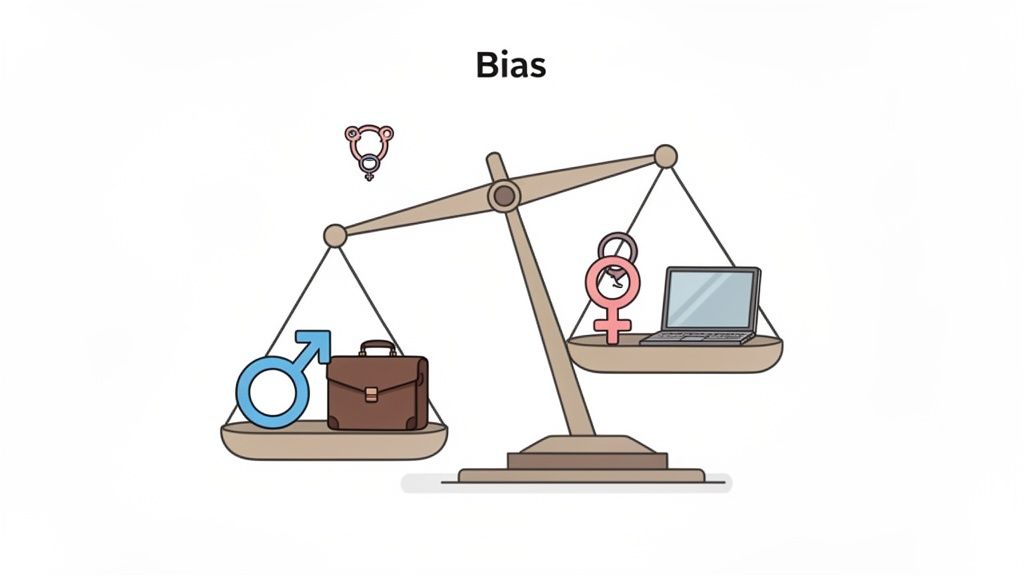
For example, multiple studies have shown that identical resumes receive different callback rates based on gender, particularly in STEM fields where women are often underrepresented. Likewise, job descriptions filled with gender-coded language like "ninja" or "rockstar" have been found to attract fewer female applicants, shrinking the talent pool before the first resume is even reviewed.
Strategic Analysis and Tactical Solutions
To dismantle these biases, organizations can critically examine how they define and evaluate role requirements. Gender stereotypes create invisible guardrails that can guide recruiters toward a "traditional" fit, such as assuming a woman is better suited for a collaborative support role or that a man possesses more natural leadership authority. These assumptions are not just unfair; they can be factually incorrect and limit access to top talent.
Key Insight: Gendered assumptions can be shortcuts that mask a lack of objective evaluation criteria. Focusing on a candidate's verified skills, not their perceived gender alignment with a role, is one way to build a more meritocratic team.
Actionable Takeaways for Talent Teams
Building a gender-equitable hiring process requires intentional and structured interventions. Here are practical steps to mitigate gender and sex-based discrimination:
- Audit Job Descriptions: Use tools to scan job descriptions for gender-coded language and replace it with neutral, outcome-oriented terms that focus on what the person in the role will achieve.
- Structure Interview Questions: Create a standardized set of questions that are asked of every candidate for a role. This prevents interviewers from defaulting to stereotype-based questions about topics like family or commitment, ensuring everyone is evaluated on the same criteria. You can discover more about diversity hiring practices that create more inclusive environments.
- Implement Skills-Based Assessments: Evaluate candidates on their actual ability to perform job tasks through technical tests or work sample projects. This provides objective data on capability that is independent of gender stereotypes and interviewer bias.
4. Racial and Ethnic Discrimination
Racial and ethnic discrimination remains one of the most persistent examples of discrimination in the workplace. This form of bias occurs when hiring decisions are influenced by a candidate's race, color, or national origin, rather than their qualifications. It can manifest at every stage of the hiring process, from initial screening to interviews and promotion considerations.
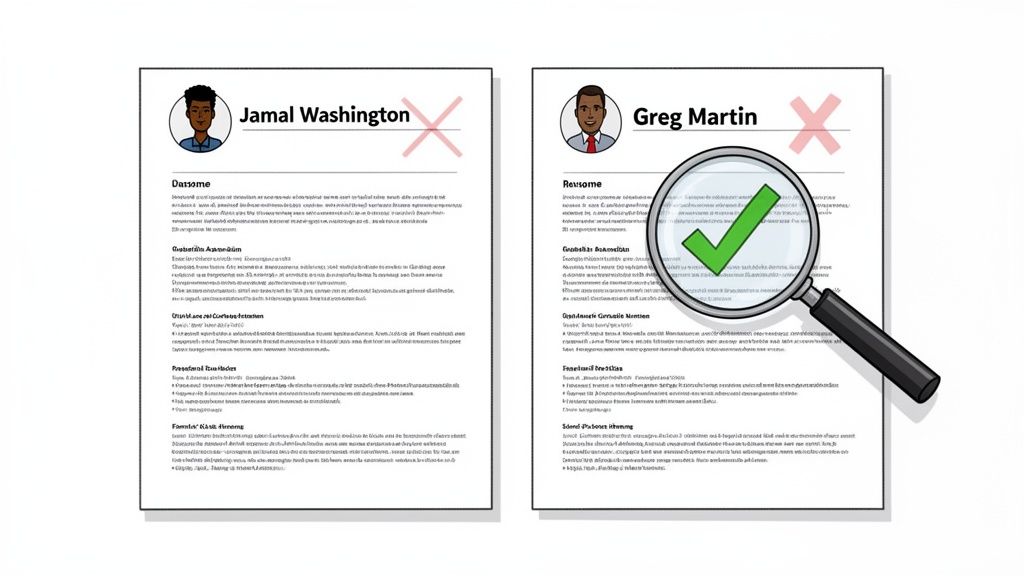
Research consistently reveals stark disparities. For instance, landmark studies have shown that resumes with names perceived as belonging to ethnic minorities receive far fewer callbacks than identical resumes with white-sounding names. This bias extends to interviews, where candidates with accents might be unfairly marked down for "communication skills" or asked inappropriate questions about their background.
Strategic Analysis and Tactical Solutions
To counter racial and ethnic bias, teams can build a hiring process rooted in objectivity and verifiable skill. Subjective evaluations based on "culture fit" or gut feelings often serve as a veil for unconscious prejudice, favoring candidates who look and sound like the existing team. This approach not only excludes qualified talent but also undermines diversity initiatives.
Key Insight: True meritocracy is not achieved by hoping for unbiased minds, but by designing an unbiased system. When objective evidence of skill replaces subjective impressions, you create a fair playing field where all candidates can demonstrate their true abilities.
Actionable Takeaways for Talent Teams
Building an equitable and inclusive hiring framework requires intentional, structured practices. Here are concrete steps to mitigate racial and ethnic discrimination:
- Standardize Interview Processes: Develop a structured set of job-relevant questions that are asked of every candidate. This ensures evaluations are based on consistent criteria, not personal biases or how comfortable an interviewer feels.
- Ensure Diverse Hiring Panels: Involve at least two or three interviewers from different backgrounds on every panel. This broadens the perspectives used in evaluation and helps check individual biases that might otherwise go unnoticed.
- Train Teams on Inclusive Hiring: Educate hiring managers and interviewers on recognizing microaggressions and unconscious bias. This training provides the language and awareness needed to create a more welcoming and fair candidate experience.
- Focus on Skills-Based Assessments: Use assessments that measure a candidate's actual ability to perform job tasks. This shifts the focus from demographic signals on a resume to direct, objective proof of competence, forming a core part of an effective affirmative action plan.
5. Disability Discrimination
Disability discrimination is one of the more direct examples of discrimination, occurring when candidates are unfairly judged based on a physical disability, mental health condition, neurodivergence, or chronic illness. In hiring, it manifests as assumptions about an individual's capabilities, a failure to provide reasonable accommodations, or inaccessible application processes that create barriers for qualified talent. This form of bias wrongfully excludes skilled individuals before they have a chance to demonstrate their competence.
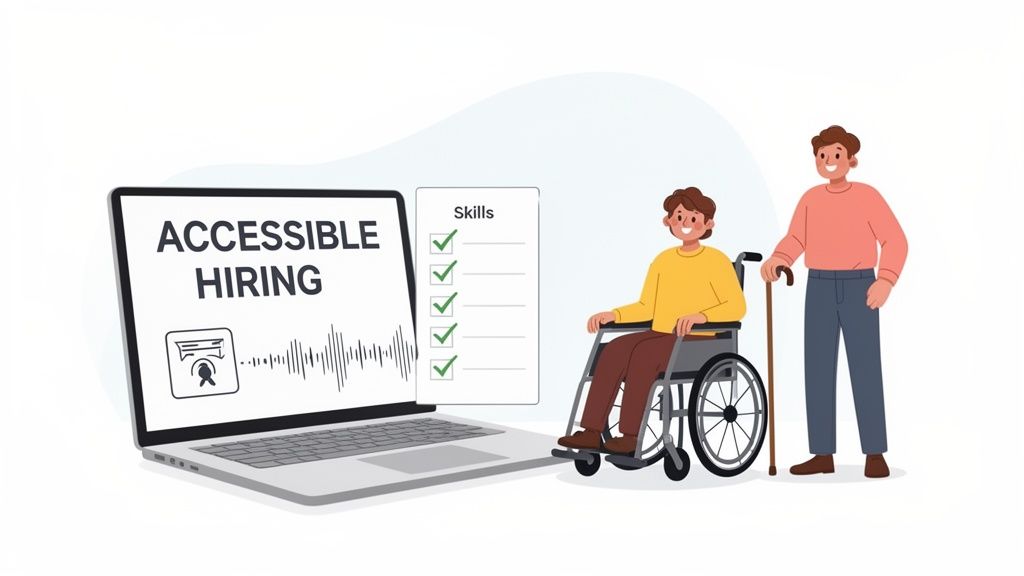
For example, a deaf software engineer with a strong GitHub portfolio may be screened out due to communication assumptions, or a candidate with ADHD might be misjudged as 'not focused' in a traditional interview. These biases are not only illegal under laws like the Americans with Disabilities Act (ADA) but also rob companies of valuable, often highly resilient, problem-solvers.
Strategic Analysis and Tactical Solutions
To build an inclusive hiring process, talent teams can proactively dismantle barriers rather than reactively addressing them. The conventional approach often places the burden on the candidate to disclose a disability and request accommodation. A truly equitable system designs accessibility into every stage, from the initial application to the final interview. This means focusing on what a candidate can do, not what you assume they can't.
Key Insight: An accessible hiring process is a better hiring process for everyone. Designing for accessibility improves clarity, structure, and objectivity, which benefits all candidates and helps identify the best talent, regardless of physical or neurological differences.
Actionable Takeaways for Talent Teams
Creating a disability-inclusive hiring environment requires intentional design and consistent execution. Here are practical steps to make your process more accessible and fair:
- Ensure All Touchpoints Are Accessible: Audit your career pages, application forms, and interview platforms. Use alt text for images, ensure compatibility with screen readers, and provide captioning options for all video content.
- Focus on Essential Job Functions: Shift from making assumptions to verifying skills. Instead of asking about a candidate's health, ask, "Can you perform the essential functions of this job with or without reasonable accommodation?"
- Standardize Interviews and Assessments: Use structured interviews focused on job-specific competencies, not social comfort. Allow candidates to complete skills assessments with accommodations, ensuring you measure ability, not their adaptation to a non-inclusive environment.
- Actively Recruit from Disability Networks: Partner with organizations and communities that support professionals with disabilities and neurodivergent individuals to broaden your talent pool.
6. Socioeconomic and Educational Background Discrimination
This form of bias is a pervasive barrier in hiring, occurring when a candidate's socioeconomic status or educational pedigree unfairly influences an employment decision. It is one of the more subtle examples of discrimination, creating obstacles for first-generation students, individuals from low-income families, and those with non-traditional educational backgrounds. This bias favors candidates with prestigious degrees or private school credentials over those with proven skills from different paths.
For example, a self-taught developer with a superior portfolio might be dismissed in favor of a university graduate with a less impressive skill set but a more recognized degree. Similarly, a candidate who worked paying jobs through college instead of taking unpaid internships might be seen as lacking "relevant experience," a judgment that ignores the economic realities many face.
Strategic Analysis and Tactical Solutions
To build a truly meritocratic hiring process, organizations can dismantle credential-based gatekeeping. Relying on proxies like school reputation or a linear academic path reinforces socioeconomic divides. It incorrectly assumes that a prestigious education is the only indicator of future performance, systematically undervaluing practical experience, self-driven learning, and raw talent.
Key Insight: A candidate's educational institution reflects their past access to resources and networks, not their current ability to solve problems and create value. Focusing on pedigree over proficiency means you risk overlooking highly capable individuals who simply took a different path.
Actionable Takeaways for Talent Teams
Creating a fair evaluation process requires moving beyond outdated signals of achievement. Here are practical steps to reduce socioeconomic and educational discrimination:
- Prioritize Skills-Based Assessments: Evaluate candidates on what they can actually do, not where they studied. Use practical coding challenges, work-sample tests, or case studies to get objective data on their job-relevant competencies.
- Anonymize Educational History: During the initial screening phase, remove or redact school names and graduation dates from resumes. This simple action forces evaluators to concentrate on a candidate's experience and skills.
- Design an Accessible Interview Process: Acknowledge that not all candidates can take multiple days off for interviews. Offer flexible scheduling, remote options, and avoid unpaid work assignments that create a financial burden.
7. Religious Discrimination
Religious discrimination occurs when applicants or employees are treated unfavorably because of their sincerely held religious beliefs. This form of bias, a clear violation of Title VII, can manifest in assumptions about a candidate's commitment, appearance, or availability. It is one of the more direct examples of discrimination that can derail an otherwise fair hiring process.
For instance, a hiring manager might incorrectly assume a candidate observing the Sabbath is less dedicated or that an individual wearing a hijab or turban might not "fit" the company culture. These judgments are often based on stereotypes rather than a candidate’s actual skills and qualifications, leading to the exclusion of talented individuals.
Strategic Analysis and Tactical Solutions
To combat religious bias, hiring teams can separate a candidate's religious practices from their professional capabilities. The core issue is often a failure to provide reasonable accommodation, which is a legal and ethical requirement. Instead of making assumptions about availability or practices, the focus should be on a candidate's ability to meet the core responsibilities of the job.
Key Insight: A candidate's religious expression or need for accommodation is not an indicator of their job performance or commitment. Proactive and respectful dialogue about scheduling and job requirements ensures fairness and compliance while preventing the loss of great talent.
Actionable Takeaways for Talent Teams
Building an inclusive process that respects all faiths requires intentional design. Here are practical steps to mitigate religious discrimination:
- Standardize Interview Questions: Focus all questions on job-specific competencies and requirements. Avoid any inquiries about a candidate’s religious affiliation, holidays they observe, or their place of worship.
- Train Teams on Reasonable Accommodation: Educate hiring managers and interviewers on their legal obligation to provide reasonable accommodations for religious practices, such as flexible scheduling for prayer times or exceptions to dress codes.
- Use Skills-Based Assessments: Evaluate candidates directly on their ability to perform the job's tasks. This provides objective data on competence that is completely independent of a person's religious background or appearance, ensuring the most qualified person is identified.
8. Pregnancy and Family Status Discrimination
Bias based on pregnancy, potential parenthood, or family status is a damaging and illegal form of workplace prejudice. This type of discrimination occurs when employers make assumptions about an individual's commitment, availability, or capabilities due to their status as a parent, caregiver, or someone who might have children in the future. These are potent examples of discrimination because they penalize employees for their personal life choices and family responsibilities.
For example, asking a candidate, "Do you plan to have children?" directly links their family plans to their job prospects, which is a clear violation of the Pregnancy Discrimination Act. Similarly, passing over a mother of two for a promotion in favor of an external hire with the same qualifications suggests a biased belief that her caregiving duties will interfere with her performance.
Strategic Analysis and Tactical Solutions
This form of discrimination often stems from outdated stereotypes about working parents, particularly mothers. It assumes that caregiving responsibilities automatically diminish an employee's dedication or ambition. This mindset causes companies to lose out on exceptional talent, as they incorrectly screen out candidates who have employment gaps for child-rearing or assume men with family duties are less committed.
Key Insight: A candidate’s family status or caregiving responsibilities are not indicators of their professional capability or drive. Focusing on these personal attributes instead of verified skills perpetuates inequality and weakens the talent pool by sidelining dedicated, high-performing individuals.
Actionable Takeaways for Talent Teams
Creating a work environment that is supportive of parents and caregivers requires intentional policies and interviewer training. Here are practical steps to prevent family status discrimination:
- Standardize Interview Questions: Train all interviewers to avoid any questions about marital status, children, family plans, or childcare arrangements. All queries should be strictly related to the job and the candidate's professional abilities.
- Evaluate Employment Gaps Objectively: Instead of viewing a career gap for caregiving as a negative, focus on the skills and experiences gained. Many parents returning to the workforce bring renewed focus and valuable life skills, such as time management and problem-solving.
- Use Structured Skills Assessments: Implement objective evaluations where every candidate performs the same job-related tasks. This ensures that hiring and promotion decisions are based on demonstrated competence, not on assumptions about a person's life outside of work.
9. Appearance and Lookism Discrimination
Appearance-based discrimination, or "lookism," is another subtle but damaging form of bias that occurs when hiring decisions are influenced by a candidate's physical appearance. This includes factors like weight, height, clothing, hairstyle, and conventional attractiveness. These judgments often manifest as assumptions about a person’s professionalism, competence, or "cultural fit," making it one of the more insidious examples of discrimination.
For example, a tall male candidate might be perceived as having more "leadership presence," or a candidate with a non-traditional hairstyle might be unfairly rejected for not matching a conservative company image. In video interviews, unconscious bias can lead evaluators to focus more on a candidate's attractiveness than the substance of their answers, undermining the evaluation process.
Strategic Analysis and Tactical Solutions
To counter lookism, teams can actively separate a candidate’s appearance from their professional capabilities. The core problem is that appearance-based judgments are shortcuts for assessing qualities like discipline or leadership, but they are unreliable proxies. A candidate’s weight reveals nothing about their work ethic, just as their height says nothing about their strategic thinking.
Key Insight: Appearance is not a skill. Relying on it for hiring decisions rewards conformity and penalizes individuality, which actively works against building a diverse and dynamic workforce. True "fit" is about shared values and capabilities, not a uniform look.
Actionable Takeaways for Talent Teams
Building a process that is resilient to appearance bias requires intentional design. Here are practical steps to create a more equitable evaluation environment:
- Standardize Interview Questions: Focus interview discussions strictly on competencies and past performance. Use a structured rubric so that every candidate is evaluated on the same job-relevant criteria, not subjective impressions.
- Use Audio-Only Screening: For initial screening calls, consider using phone calls or audio-only settings in video conferencing tools. This removes visual data points and forces interviewers to focus solely on what the candidate says.
- Implement Skills-Based Assessments: The most direct way to measure capability is through objective, job-related tests. Skills assessments provide concrete evidence of a candidate’s ability to perform the role’s core tasks, making appearance-based biases irrelevant.
10. Availability and Non-Traditional Work History Discrimination
Bias against non-linear career paths represents a significant and often overlooked example of discrimination. This occurs when hiring teams undervalue or outright dismiss candidates due to career gaps, frequent job changes, or a history of part-time or freelance work. This prejudice disproportionately affects parents returning to work, caregivers, career changers, and individuals with health-related interruptions, effectively penalizing them for life circumstances rather than assessing their current abilities.
For example, a freelance developer with a strong portfolio might be dismissed for "inconsistent employment," or a parent re-entering the workforce after a five-year gap might be assumed to be "out of touch." Similarly, a skilled contractor with a decade of relevant project experience could be rejected for appearing "unstable" on paper. These judgments ignore the valuable skills and resilience gained through non-traditional work experiences.
Strategic Analysis and Tactical Solutions
To overcome this bias, organizations can re-evaluate how they measure a candidate's potential. The conventional emphasis on a steady, linear career "progression" is an outdated proxy for competence and commitment. It incorrectly assumes that only a traditional, full-time employment history can produce a qualified professional, thereby excluding a vast and diverse talent pool.
Key Insight: A candidate's career timeline is a record of their journey, not a definitive measure of their current capabilities. Focusing on career gaps or employment format overlooks the real question: Can they do the job effectively right now?
Actionable Takeaways for Talent Teams
Building a hiring process that values skill over stability requires a deliberate shift in evaluation methods. Here are practical steps to mitigate work history discrimination:
- Prioritize Skills Over Timelines: Focus evaluations on demonstrated skills, not the chronology of a resume. Value portfolio work, freelance projects, and contract experience equally with traditional employment roles.
- Use Practical Skills Assessments: Implement assessments that mirror real-world job tasks. This provides objective proof of a candidate’s current abilities, making their career path's structure irrelevant.
- Contextualize Career Gaps: Train interviewers to understand the context behind gaps or transitions without judgment. Frame questions around skills gained during those periods, such as project management skills honed while managing a family.
- Update Evaluation Rubrics: Remove criteria related to "job stability" or "linear progression." Instead, define success by the specific accomplishments and competencies required for the role.
By adopting these practices, your team can access a broader talent pool and build a more inclusive, resilient, and skilled workforce.
Comparison of 10 Discrimination Examples
| Bias Type | Implementation Complexity | Resource Requirements | Expected Outcomes | Ideal Use Cases | Key Advantages |
|---|---|---|---|---|---|
| Resume-Based Bias and Screening Discrimination | Moderate — process changes and blind screening | Low–Medium — anonymization tools, skills-assessment platform, recruiter training | Fewer false negatives; more diverse candidate pools at screening stage | High-volume screening; entry-to-mid level hires with transferable skills | Reveals skill over signals; reduces credential noise |
| Age Discrimination in Hiring | Moderate — remove age signals and redesign interviews | Low–Medium — assessment tools, training, structured rubrics | Inclusion of experienced and early-career candidates; lower legal risk | Senior hires, mid-career roles, upskilling/transition hiring | Access to deep experience and mentorship potential |
| Gender and Sex-Based Discrimination | High — cultural change, structured processes | Medium–High — bias training, diverse panels, blind technical assessments | Increased gender balance in technical/leadership roles; fairer evaluations | STEM and leadership hiring, promotion pipelines | Reduces stereotype-driven decisions; improves retention |
| Racial and Ethnic Discrimination | High — systemic changes and anonymized workflows | Medium–High — blind screening, multilingual assessments, diverse panels | Greater racial/ethnic representation; reduced name/accent penalties | Mass hiring, public-facing and technical roles | Mitigates systemic barriers; broadens talent pool |
| Disability Discrimination | High — accessibility and accommodation integration | High — accessible platforms, captioning, alt text, policy updates | More candidates able to demonstrate ability; legal compliance | Roles requiring alternative formats; inclusion initiatives | Enables neurodiverse and disabled talent to compete fairly |
| Socioeconomic and Educational Background Discrimination | Moderate — credential-blind evaluation and outreach | Low–Medium — skills assessments, outreach to nontraditional channels | Higher socioeconomic diversity; recognition of nontraditional paths | Early-career hiring, bootcamp and self-taught candidate sourcing | Captures high-potential nontraditional candidates |
| Religious Discrimination | Low–Moderate — scheduling and question guidance | Low — policy updates, flexible/asynchronous assessment options | Reduced scheduling barriers; fairer consideration across observances | Global teams, roles with varied schedules | Accommodates observance needs without changing assessment quality |
| Pregnancy and Family Status Discrimination | Low–Moderate — remove family questions, offer flexibility | Low — asynchronous assessments, interviewer training | Better access for caregivers; fewer biased rejections | Roles suited to flexible or asynchronous evaluation | Supports caregivers; focuses hiring on capability |
| Appearance and Lookism Discrimination | Low — remove photos and reduce video reliance | Low — process rules, alternative interview formats (audio-only) | Reduced superficial screening; competency-focused evaluations | Any role where appearance is irrelevant to performance | Eliminates appearance-based filtering early in process |
| Availability and Non-Traditional Work History Discrimination | Moderate — value portfolios and contextual review | Low–Medium — portfolio assessment tools, recruiter training | Fairer evaluation of freelancers, career-changers, gap returns | Hiring for contract, freelance, or career-transition roles | Recognizes diverse experience timelines and practical work |
From Awareness to Action: Building a Hiring Process That Wins on Merit
The journey through these diverse examples of discrimination reveals a consistent truth: bias often operates silently, embedded in the systems we trust to find the best people. From resumes that favor certain names to interview questions that penalize parents, the common thread is a reliance on proxies for skill rather than direct evidence of capability. These shortcuts—university prestige, a linear career path, or subjective "culture fit"—are not just legally risky; they are inefficient. They shrink your talent pool, filter out non-traditional candidates, and can lead to weaker, more homogenous teams.
Recognizing these patterns is the first step. However, awareness alone does not create change. The real work begins when we shift our hiring philosophy from "who a candidate appears to be" to "what a candidate can actually do." This is not about removing the human element from hiring. Instead, it is about arming your team with objective data to make smarter, fairer decisions.
Key Takeaways: From Flawed Proxies to Verified Skill
Across all the examples discussed, from ageism to appearance bias, the core problem is the same. Hiring teams often have to make high-stakes decisions with incomplete, sometimes misleading, information. The resume is a self-reported marketing document, and the traditional interview can be a poor predictor of on-the-job performance.
A powerful countermeasure is to re-engineer your process around skills verification. By integrating structured, role-specific assessments early in the funnel, you establish a merit-based foundation.
Strategic Insight: When you test for skills first, you anchor the entire hiring process to objective evidence of competence. Biases related to a candidate’s name, age, gender, or background become secondary because you already have proof of their ability.
This approach can create a positive cascade effect:
- Wider Talent Funnel: You can confidently evaluate candidates from all backgrounds, including those without a typical resume, knowing you have a reliable way to measure their skills.
- Reduced Legal Risk: A standardized, skills-focused process is inherently more defensible. Decisions are based on documented performance, not subjective feelings.
- Improved Hiring Outcomes: Teams built on verified ability, not perceived pedigree, often perform better. They can bring a richer diversity of thought and experience, leading to better problem-solving and business results.
Your Action Plan for Building an Equitable Hiring Engine
Moving from theory to practice requires concrete, tactical changes. The goal is to systematically replace biased proxies with objective measures of skill at critical stages of your hiring process.
Here are practical steps your talent team can begin implementing today:
- Audit Your "Must-Haves": Scrutinize your job descriptions. Are you asking for a "degree from a top-tier university" when what you really need is someone who can code proficiently in Python? Replace pedigree requirements with skill-based outcomes.
- Implement Blind Screening: If you must use resumes for initial screening, use software or a manual process to redact names, graduation years, and addresses to minimize unconscious bias.
- Introduce a Skills Assessment Early: One of the most impactful changes you can make is to place a work-sample test or skills challenge right after the initial application. This ensures that every candidate who moves forward has passed a baseline of proven ability.
- Standardize Your Interviews: Move away from unstructured, "tell me about yourself" conversations. Use a structured interview format where every candidate is asked the same set of job-related questions and is scored using a consistent rubric.
Mastering this skills-first approach is more than just a compliance exercise; it is a competitive advantage. In a market where top talent is scarce, you cannot afford to overlook brilliant candidates because their resumes don't fit a preconceived mold. By building a process that identifies and celebrates skill above all else, you are not just mitigating examples of discrimination—you are building a more resilient, high-performing organization that is positioned to win.
Ready to replace guesswork with certainty in your hiring process? Cohesyve provides a platform for creating and deploying role-specific skills assessments that give you objective proof of a candidate’s abilities. See how our skills verification approach helps you build fairer, more effective teams by visiting Cohesyve.