Think about building a championship team for a moment. You wouldn’t stack your roster with only quarterbacks, right? You need defenders who see the field differently, offensive players with unique strengths, and strategists who can anticipate the next play. That, in essence, is diversity hiring. It’s the intentional practice of building a team with a rich blend of backgrounds, experiences, and perspectives.
So, What Is Diversity Hiring, Really?
At its heart, diversity hiring represents a considered shift in how you approach building your company. It's moving away from a passive model of just filling an empty seat and embracing the proactive work of assembling a dynamic and effective team. This isn't about checking boxes or hitting quotas. It’s about building a workforce that reflects the diverse world we all live and work in.
This approach is grounded in a simple truth: talent is everywhere, but opportunity is not always distributed equally. By deliberately casting a wider net, you start to discover capable people who may have been overlooked by traditional hiring methods. It’s about creating an environment where skill, potential, and drive are what truly matter.
Moving Beyond the Obvious
When most people hear "diversity," they often think of visible characteristics like gender or ethnicity. While those are absolutely important, a meaningful approach to diversity hiring goes much deeper. It’s about embracing the full spectrum of what makes us human.
- Cognitive Diversity: This is the advantage of different thinking styles. It’s having analytical minds working alongside creative problem-solvers.
- Background Diversity: People bring their whole selves to work, including their unique life journeys, socioeconomic backgrounds, and educational paths.
- Demographic Diversity: This includes the visible and invisible markers of identity, such as age, race, religion, gender, and sexual orientation.
- Experiential Diversity: A mix of professional histories, from different industries to different functional roles, brings a wealth of knowledge.
A truly diverse team isn't just about different faces in the room; it's about different minds coming together. Meaningful progress happens when these unique viewpoints combine to spark new ideas and solve old problems in new ways.
Before we go further, let's clear up some common confusion. Diversity hiring is a specific strategy, and it’s helpful to see how it compares to the broader conversation around workplace culture. This table breaks it down.
Diversity Hiring At A Glance
| Core Principle | What It Is | What It Is Not |
|---|---|---|
| Focus | A proactive recruitment strategy to attract a wide range of candidates. | A guarantee of a diverse workplace; it's the first step. |
| Goal | To build a diverse talent pipeline and ensure fair evaluation for all. | A quota system or preferential treatment. |
| Method | Removing bias from sourcing, screening, and interviewing processes. | Lowering standards or hiring unqualified candidates. |
| Outcome | A richer pool of qualified candidates, leading to stronger, more innovative teams. | A one-time initiative; it requires ongoing commitment. |
As you can see, this is about opening doors, not ticking boxes. It’s a foundational piece of a much larger puzzle.
The Business Case for Intentional Hiring
Let’s be clear: building a diverse team isn't just a "nice-to-have" or a purely social mission. It is a sound business decision. The data consistently supports this.
Companies in the top quartile for ethnic diversity are 39% more likely to financially outperform their peers, according to McKinsey research. This advantage often comes from having teams that can solve problems more effectively because they see them from multiple angles and better understand a diverse customer base.
Furthermore, another study found that diverse leadership teams generate 45% of their revenue from innovation, while less diverse leadership teams attribute only 26% to it. If you want to build a creative engine that can keep up with the competition, the data is compelling. Intentionally building a team with different viewpoints directly fuels the innovation needed for growth. If you're curious about the numbers, you can explore more statistics on DEI in the workplace and see for yourself. It’s time to move from just hiring people to building a more capable organization.
Decoding The Language Of Inclusive Recruitment
In the world of talent, you’ll hear many terms—diversity hiring, inclusion, DEI, affirmative action. They’re often used interchangeably, but they represent distinct parts of the same goal. Getting the language right isn't just about semantics; it's about understanding the blueprint for building a truly dynamic organization.
Think of building a top-tier team as if you were creating a great meal. It all starts with the ingredients.
That’s Diversity Hiring: the active, intentional search for the widest possible range of talent for your organization. It’s about looking beyond the usual channels and finding capable people from different backgrounds, with varied experiences and fresh perspectives. This is the foundational step—stocking your talent pool with richness and variety.
But having a pantry full of quality ingredients doesn't guarantee a great dish. It's what you do with them that counts.
From Sourcing To Serving
This is where the recipe and technique come in, and where the other concepts find their role.
Inclusive Hiring: This is your cooking process—the thoughtful, fair method you use to prepare your dish. It ensures every candidate gets a genuine chance to demonstrate their skills. This means designing systems—like structured interviews or skills-based challenges—that evaluate every single candidate on what they can do, not on gut feelings or where they went to school.
DEI (Diversity, Equity, and Inclusion): This is the entire cookbook. It’s the philosophy and cultural framework guiding everything from preparation to presentation. DEI isn't just about who you hire; it’s about creating a workplace where everyone feels they belong (inclusion), has a fair opportunity to succeed and advance (equity), and can contribute their best ideas.
Affirmative Action: Think of this as a specific, legally-mandated recipe you might have to follow to correct a historical imbalance in your pantry. It’s a compliance-driven measure, a small but important part of the much bigger culinary world of DEI.
When you grasp these distinctions, you can move beyond simply meeting targets and start building a hiring process that genuinely works. Each concept naturally flows into the next, taking you from sourcing brilliant people to creating an environment where they can do their best work.
This is how that journey from a simple hiring goal to true strategic growth unfolds.
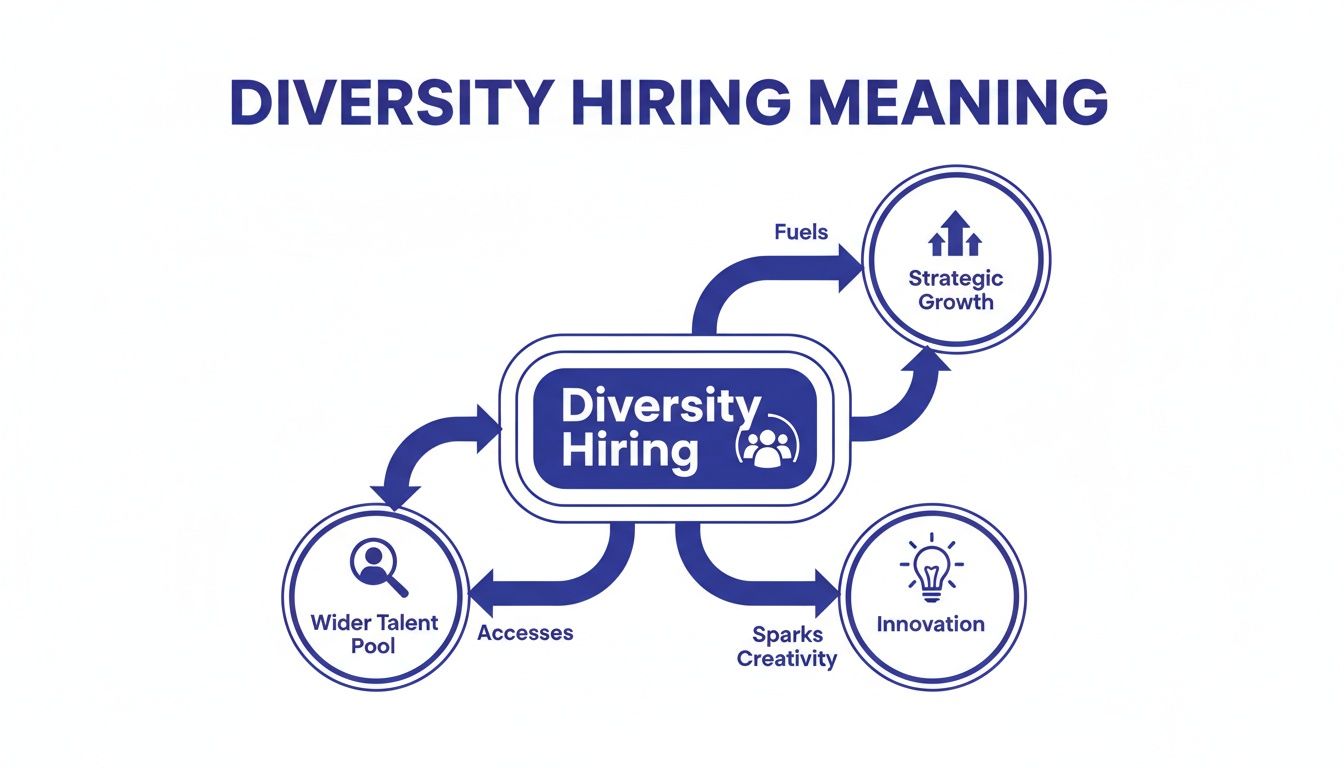
As you can see, diversity hiring isn't just an HR initiative. It’s a direct line to a bigger talent pool, increased innovation, and sustainable growth. It's a business strategy, plain and simple.
Understanding diversity hiring meaning is the starting point. The real value is unlocked when you build an inclusive process where every candidate, no matter their background, has the opportunity to show you what they're capable of.
Ultimately, all these terms point toward one simple truth: the best teams are built on fairness and merit. When you focus on objectively measuring skills, you naturally create a level playing field that attracts and keeps a diverse group of people.
A clear, unbiased process also builds trust. When candidates know they are being judged fairly, they are more likely to engage fully. If you want to dive deeper into how technology can help build that trust, check out our guide on what proctoring-enabled means and see how it helps ensure integrity for everyone involved.
Cohesyve
See what candidates can do before you interview them
Cohesyve turns a job description into a role-specific assessment with a scoring rubric. Each candidate gets a different version, so questions cannot be shared. Ten candidates free, no card.
Why Diverse Teams Are A Business Advantage
It's one thing to understand the textbook diversity hiring meaning, but the real impact comes when we shift from the what to the why. A diverse team isn’t just a collection of different faces; it’s a powerful blend of unique perspectives, problem-solving styles, and life experiences. This variety is what can turn a good team into a great one—a true business asset that fuels growth and resilience.
Think about it. When everyone on a team shares the same background, they’re likely to approach challenges from the same angle. That’s a recipe for blind spots. But introduce a mix of ages, cultures, and professional journeys, and you get something different. That team will see the world through multiple lenses, helping them spot untapped markets and understand a wider range of customer needs.
Beyond The Feel-Good Factor
Let's be clear: the business case for diversity is backed by data. Companies that embrace diversity don't just create better workplaces; they tend to see stronger financial results, spark more innovation, and build an employer brand that people are genuinely interested in. It’s a competitive edge.
For example, studies have shown that companies leading in gender diversity are 25% more likely to outperform their peers on profitability. That number gets even more impressive for ethnic and cultural diversity, jumping to 39%. This is no fluke. Diverse teams often make smarter, more well-rounded decisions, which helps them mitigate risks and uncover new ways to grow. You can discover more insights on 2026 DEI trends and see the data for yourself.
A Magnet For Top Talent
In a world where talented people have many options, a genuine commitment to diversity makes you stand out. A recent study found that 76% of employees and job seekers see a diverse workforce as an important factor when they're deciding where to work. The best people want to join companies where they know they’ll belong and their unique skills will be valued.
Building a diverse team sends a clear signal to the market: we are a forward-thinking company that values skill and perspective over outdated prototypes. This creates a positive cycle, attracting even more high-caliber talent.
This focus on creating an inclusive culture doesn’t just help you bring people in—it helps you keep them. When employees feel seen, heard, and respected, they are more engaged and committed. Their loyalty becomes a core part of the company's success. To see how this plays out in real-world scenarios, check out our in-depth look at the advantages of workforce diversity.
Ultimately, it all comes back to building a hiring process that’s fair and objective. When you make an effort to verify a candidate's actual skills for the job, you naturally reduce the impact of unconscious bias. This skills-first mindset is a direct path to building the capable teams that will propel your business forward.
Implementing A Skills-First Hiring Strategy
This is where the idea of diversity hiring transforms from a concept into a practical reality. To build teams that are truly diverse, many organizations are making a fundamental shift. They are moving away from focusing heavily on where someone went to school or the companies on their resume and toward what candidates can actually do.
Adopting a skills-first hiring approach is one of the most direct ways to find capable, often-overlooked talent that traditional methods can miss.
Imagine a hiring process where capability is prioritized over credentials. Instead of just pattern-matching resumes, you’re evaluating people on their real-world ability to solve the exact problems they'll face in the job. It’s a simple change in focus, but it can help level the playing field and make your entire process more objective and fair.
From Job Descriptions To Job Performance
The change starts with how you define the role itself. It's time to ditch the long, intimidating list of experiences and rewrite your job descriptions to focus on the core skills needed to succeed.
- Focus on Outcomes: Ask yourself, what does success in this role look like? Define the job by the results a person needs to produce, not the exact path they took to get here.
- List Only Essential Skills: Be honest about what’s a "must-have" versus a "nice-to-have." This one small tweak can encourage more women and candidates from non-traditional backgrounds to apply.
- Expand Your Sourcing: Actively search for talent in new places. Think about partnering with community groups and professional networks that serve underrepresented communities.
When you clarify which skills are truly non-negotiable, you naturally open the door to a wider and more qualified group of applicants. You start finding people with the right abilities, regardless of their background. If you’re ready to dig deeper into this, you can learn more about skills-based hiring in our dedicated article.
Verifying Skills With Practical Assessments
Once you’ve attracted a diverse group of candidates, the next challenge is to evaluate them fairly. This is where well-designed, role-specific assessments become a useful tool. Instead of relying only on how someone performs in an interview, you get to see them in action.
By testing for skills directly, you remove some of the guesswork and unconscious bias that can cloud judgment. You’re no longer asking if someone seems like they can do the job; you’re getting proof that they can.
Think about how this could work for your roles:
- For a Software Developer: Give them a coding challenge that reflects a task they’d actually encounter.
- For a Marketer: Present a short case study and ask them to outline a launch strategy for a new product.
- For a Sales Rep: Use a role-play where they have to navigate a common customer objection.
This approach measures what matters—practical ability—not just how polished someone is as an interviewer. It’s how you can uncover those hidden gems: the brilliant problem-solvers who might not have the perfect resume but have exactly the skills your team is missing.
And today’s technology is making this easier. With an AI adoption rate in hiring already at 44%, teams are saving up to 50% of their time by automating the creation and scoring of these practical tests. Platforms can now generate unique, role-specific assessments in over 100 languages, verifying real-world skills for a global talent pool and instantly showing you who the top performers are. As you can discover in these 2026 workplace insights, focusing on skills is a key way to overcome talent hurdles.
Ultimately, this skills-first mindset is meritocracy in action. It’s about making sure you hire the best person for the job, every single time.
Navigating The Common Pitfalls In Diversity Recruitment
Embarking on a diversity hiring initiative can be one of the most beneficial things you do for your organization. But it helps to have a clear-eyed view of where things can go wrong. Even with the best intentions, it's surprisingly easy to stumble into traps that can undermine your efforts and break trust.
One of the biggest pitfalls is tokenism. This is what happens when you hire someone from an underrepresented group to look diverse, instead of hiring them for the talent and perspective they bring to the table. It’s a superficial gesture that can place a heavy weight on one person to represent an entire community, breeding isolation instead of inclusion.
Beyond The Offer Letter
Getting a new hire through the door is just the first step. The real work begins after they arrive. If your new team members don't see a clear path for their own growth, or if they feel their ideas aren't truly valued, they won't stick around. Diversity without a culture of genuine inclusion creates a revolving door.
Building a diverse team is not just about opening the front door; it's about making sure the whole house is welcoming. True success is measured by who stays and grows, not just who gets hired.
This is exactly where a skills-first hiring strategy becomes a great ally. When your entire process—from the job post to the final interview—is focused on objectively measuring what a candidate can do, you can sidestep many of these common hazards.
- It dismantles tokenism: You’re hiring for proven abilities. It becomes clear that every person earned their place because of their skill.
- It counters bias: When you have objective proof of someone’s skills, it’s much harder for unconscious biases to influence the decision-making process.
- It builds a foundation for belonging: Starting the journey with a deep respect for a person's capability sends a powerful message: here, your contribution is what matters most. That’s the bedrock of a healthy, inclusive culture.
When you understand these risks, you can build a more thoughtful and resilient strategy. Focusing on skills isn't just about finding talent; it's about building a team that is not only diverse but highly capable and ready to succeed together.
Answering Your Questions About Diversity Hiring
As you start putting these ideas into practice, it's natural for some tough, real-world questions to surface. Moving from theory to action always brings up challenges, so let's walk through a few of the most common questions leaders ask when they begin this journey.
How Do We Measure The Success Of Our Efforts?
This is a big one. It’s easy to get fixated on representation numbers, but that’s like judging a chef by counting their ingredients instead of tasting the meal. The real proof is in your business results. The goal isn't just to look different; it's to see how bringing different minds together makes the whole organization better.
You need metrics that tell the full story:
- Innovation Rates: Are you seeing more ideas bubble up? Are new products or features getting to market faster? One study found that diverse teams can drive 45% more revenue from innovation.
- Employee Engagement: When you survey your teams, do people from every background feel like they truly belong? Do they feel their voice is heard and their contributions matter?
- Hiring Velocity: Are you filling open roles more quickly? A fair process that focuses on skills often widens your talent pool, giving you access to capable candidates you were missing before.
Isn't This The Opposite Of Merit-Based Hiring?
This question gets to the heart of a common fear, and the answer is an emphatic no. In fact, a thoughtful diversity hiring strategy, especially one built around skills, is the purest form of meritocracy.
Think about it: traditional hiring is often filled with things that have little to do with merit. We can rely on gut feelings, familiar-looking resumes, and unconscious biases that favor people who are like us.
When you use objective, role-specific assessments to see what a candidate can actually do, you strip away that noise. You get a clear signal of their true ability. It ensures the most capable person wins the job, period—regardless of their background, the university they attended, or how they interview.
It's a system where genuine talent and competence are the only things that count.
We're A Small Company, How Can We Start On A Budget?
You absolutely do not need a giant budget to make a difference. Many of the most powerful changes you can make are about process, not price tags. They’re about being more intentional.
Here’s where to start:
- Rewrite Your Job Descriptions: This is free and incredibly effective. Ditch the corporate jargon and the long list of “nice-to-have” qualifications. Focus only on the essential skills needed to do the job well, and you'll immediately attract a wider, more qualified group of applicants.
- Use Structured Interviews: Create one standard set of questions and a simple scoring rubric for every candidate interviewing for the same role. This simple step helps level the playing field and ensures everyone gets a fair evaluation.
- Verify One Key Skill: You don't need a massive testing platform. Even giving candidates a single, short, practical exercise can provide objective proof of their ability. This helps you make a confident decision based on real evidence.
At Cohesyve, we believe proving skills should be the heart of every hiring decision. Our platform helps you instantly create dynamic, role-specific assessments that verify what candidates can do, allowing you to move past resumes and focus on the top 5% of performers. Discover how you can hire faster and fairer with Cohesyve.