Enterprise assessment buying is different from small-team buying in three ways. The programme spans many roles, countries and languages. Procurement, legal and security each have a say. And at enterprise volume, a small bias in a test affects thousands of people, which puts validation and adverse-impact evidence at the top of the list.
This guide compares the platforms that position themselves for enterprise hiring, gives a verdict by use case, and lists the questions to put in an RFP.
Disclosure: Cohesyve publishes this guide and offers an Enterprise plan, which is listed in the comparison. Other vendors are described from their own public pages as of October 2026; pricing for all of them is by quote or on their sites.
Which pre-employment assessment platforms are built for enterprise?
SHL, HireVue, Harver, iMocha, Mercer Mettl and Hogan all position themselves for large organisations, and Criteria, Codility and HackerRank also sell to enterprise buyers. They differ mainly in what they measure and which hiring they are built around.
| Platform | Enterprise positioning (their words, summarised) | What it measures | Strongest use | Pricing |
|---|---|---|---|---|
| SHL | People science company serving talent acquisition and talent management | Cognitive (Verify), personality (OPQ), motivation, situational judgement, skills, call-centre and coding simulations, video interviews | One provider across graduate, volume, professional and leadership hiring | Check their site |
| HireVue | "Enterprise-grade" AI hiring platform; integrations with 45+ ATS platforms | Skills tests, game-based assessments, AI Interviewer, structured video interviews | High-volume hourly and early-careers hiring with video | Check their site |
| Harver | Volume hiring for BPO, contact centres and retail | Personality, cognitive, situational judgement, chat support simulation, language, pymetrics games | Contact centres and multi-site hourly hiring | Check their site |
| iMocha | Skills and work intelligence for enterprises; integrates with Workday, SAP SuccessFactors and Oracle | Role-based, coding, communication and domain tests; AI interviews | Organisations using one skills taxonomy for hiring and internal mobility | Check their site |
| Mercer Mettl | Validated assessments with AI-enabled insights; part of a global professional services firm | Psychometric, cognitive, coding in 20+ languages, AI-assisted proctoring | Campus, lateral and technical hiring with remote proctoring | Check their site |
| Hogan | Personality tests for hiring and development | Personality: what Hogan calls the "bright side, dark side and inside" | Leadership selection and development | Check their site |
| Codility / HackerRank | Technical assessment for engineering hiring at scale | Coding screens and live technical interviews | Engineering hiring | Check their site |
| Cohesyve (our product) | Enterprise plan for 10,000+ candidates a year with custom ATS and workflow integrations, a dedicated customer success manager and custom contracts | Job simulations generated from each job description; ranked shortlist | Professional and customer-facing roles where interview time is the constraint | Custom; plans start from $199/month |
Which enterprise platform fits which use case?
- A single provider across every level and region: SHL. Its catalogue covers graduate, volume, professional and leadership hiring, and it sells talent management products on the same science.
- Hourly and contact-centre volume: Harver or HireVue. Both pair assessment with automation, scheduling and video.
- Skills-based hiring tied to internal mobility: iMocha, which positions its assessments as one input into an enterprise skills profile.
- Campus programmes with remote proctoring: Mercer Mettl or HireVue, both of which name campus or early-careers hiring.
- Leadership and succession: Hogan, or SHL's leadership products.
- Engineering: Codility or HackerRank, alongside whichever platform runs the rest of the programme.
- Professional roles where managers spend too long interviewing: Cohesyve, whose job simulations return a ranked shortlist so interviews go to the strongest candidates.
Cohesyve
Reviewing the tools in your hiring process?
Cohesyve takes a job description, finds candidates, reaches out to them and runs an AI job simulation of the real work, then returns a ranked shortlist. If you are looking at tools, it is one to consider.
What should enterprises ask in an assessment RFP?
Ask questions that must be answered in writing with evidence, so the demo can focus on fit. These are the ones that separate vendors.
- Validation. Can you share the technical manual for each assessment we would use, with the criterion validity studies and the samples they used?
- Adverse impact. What are the pass rates by sex and ethnicity for this assessment, and how do you monitor them for our population once we go live?
- Bias audit. Do you have an independent bias audit for use in New York City, dated within the last year, and its public summary?
- EU AI Act. If we hire in the EU, what documentation will you provide for a high-risk system, and who is responsible for human oversight?
- Accommodations. Which adjustments can candidates request, such as extra time or screen-reader support, and how are they handled?
- Languages and norms. Which languages are available, and are norm groups local or global?
- Integration. Which ATS integrations are native, which require services, and what data flows back?
- Security and data. Where is candidate data stored, for how long, and how do we get it back when we leave?
- Integrity. How do you keep content from circulating at volume, and what does proctoring record?
- Commercials. What is the total cost at our volume for three years, including implementation, and what happens if volume rises 30%?
What compliance rules apply to enterprise assessments?
The main rules are anti-discrimination law, which applies to every assessment, and newer rules for automated tools.
- Adverse impact (US). The federal Uniform Guidelines on Employee Selection Procedures say a selection rate for any race, sex or ethnic group below four-fifths (80%) of the highest group's rate will generally be regarded as evidence of adverse impact. A test that shows it must be shown to be job-related.
- New York City Local Law 144. Enforced since 5 July 2023. An employer using an automated employment decision tool needs a bias audit within one year before use, a public summary of the results, and notice to candidates; city guidance says the notice must come 10 business days before use.
- EU AI Act. AI systems used for recruitment and selection are listed as high-risk in Annex III, which brings duties on risk management, documentation, transparency and human oversight. Check the current application dates with counsel.
This is a summary, not legal advice. Our post on AI hiring laws in 2026 covers more jurisdictions.
How should an enterprise roll out a new assessment?
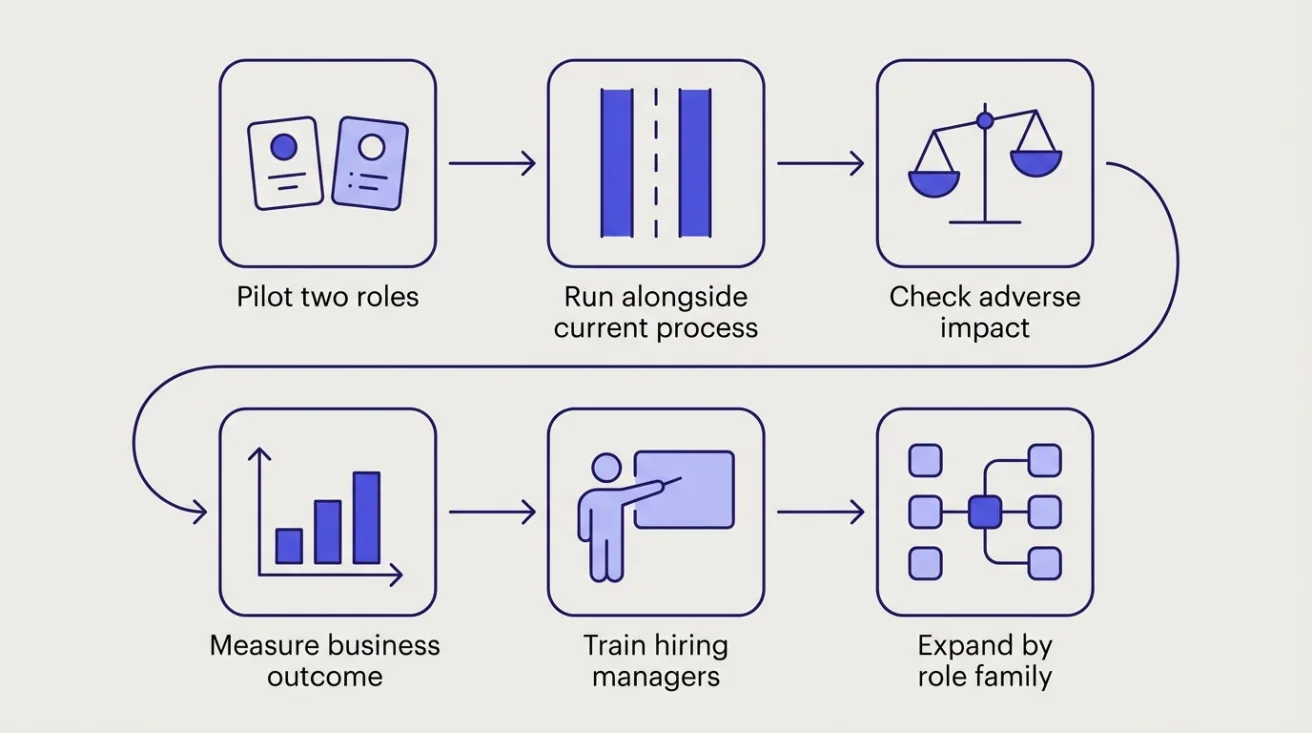
Roll out in stages, starting with two contrasting roles, and measure before expanding.
- Pilot one volume role and one professional role for at least one full hiring cycle each.
- Run the assessment alongside your current process for the first cohort, so you can compare its ranking with your recruiters' decisions.
- Check adverse impact on the pilot data before any automated cut-off goes live.
- Measure the business outcome: interviews per hire, time to offer, and early performance or retention for those hired.
- Train hiring managers to read results as evidence for the interview, with a structured interview for the final decision.
- Expand by role family, reusing what worked.
Common questions
Which assessment platform do Fortune 500 companies use? Several vendors publish customer claims: HireVue says 40% of the Fortune 100 are customers, and Hogan says 75% of the Fortune 500 trust it. Depending on the roles you hire for, you may need more than one platform, for example a psychometric provider plus a coding platform.
Is one platform for every role realistic? For cognitive and personality testing, yes. For skills, you may need a specialist alongside it for engineering, and sometimes one for contact centres.
How long does enterprise implementation take? It depends on integrations, languages and the number of roles. Ask each vendor for a dated plan for your scope, with named owners on both sides.
Do enterprise vendors publish prices? Rarely. Expect a quote based on volume, products and term. Our pricing guide explains the models so you can compare quotes.
Where can I compare more vendors? The main comparison covers 21 tools by category, and the high-volume guide goes deeper on hourly hiring.