High-volume hiring means filling many similar roles at once, or one role with hundreds or thousands of applicants: contact-centre agents, retail and warehouse staff, delivery drivers, graduate intakes, sales development cohorts. With that many applicants, recruiters cannot read every application, so good people wait, lose interest and take another offer.
A pre-employment assessment fixes this when it replaces the first manual review. This guide covers how to run volume screening, which platforms are built for it, and which fits which kind of volume. For the wider playbook, sourcing, referrals and campus programmes included, see our high-volume recruiting strategies.
Disclosure: Cohesyve publishes this guide and appears in the comparison. Other vendors are described from their own public positioning as of October 2026, and their pricing is on their sites.
How do you manage high-volume recruitment?
Manage high-volume recruitment by standardising the first three steps so that no human touches an application until it has passed an objective screen: a short assessment straight after applying, automatic scheduling for those who pass, and structured interviews for the shortlist.
In practice:
- Write down what predicts success in the role. For a contact-centre agent that might be written communication, calm handling of an annoyed customer and basic system use. Three or four things, no more.
- Pick one assessment that measures those things and send it automatically with the application confirmation.
- Set a clear threshold and let the tool move candidates above it to the next stage.
- Automate scheduling so a passing candidate can book an interview the same day.
- Use a structured interview with the same questions and a scoring rubric for everyone who reaches it. Our structured interview guide covers the method.
- Review the numbers weekly: completion rate by device, pass rate by group, time from application to interview, and how many interviews each hire takes.
How do you screen job applicants faster?
Screen job applicants faster by testing everyone first and reading CVs only for the people who pass. An assessment scores every applicant in parallel; a recruiter reading CVs scores them one at a time.
Three changes make the biggest difference:
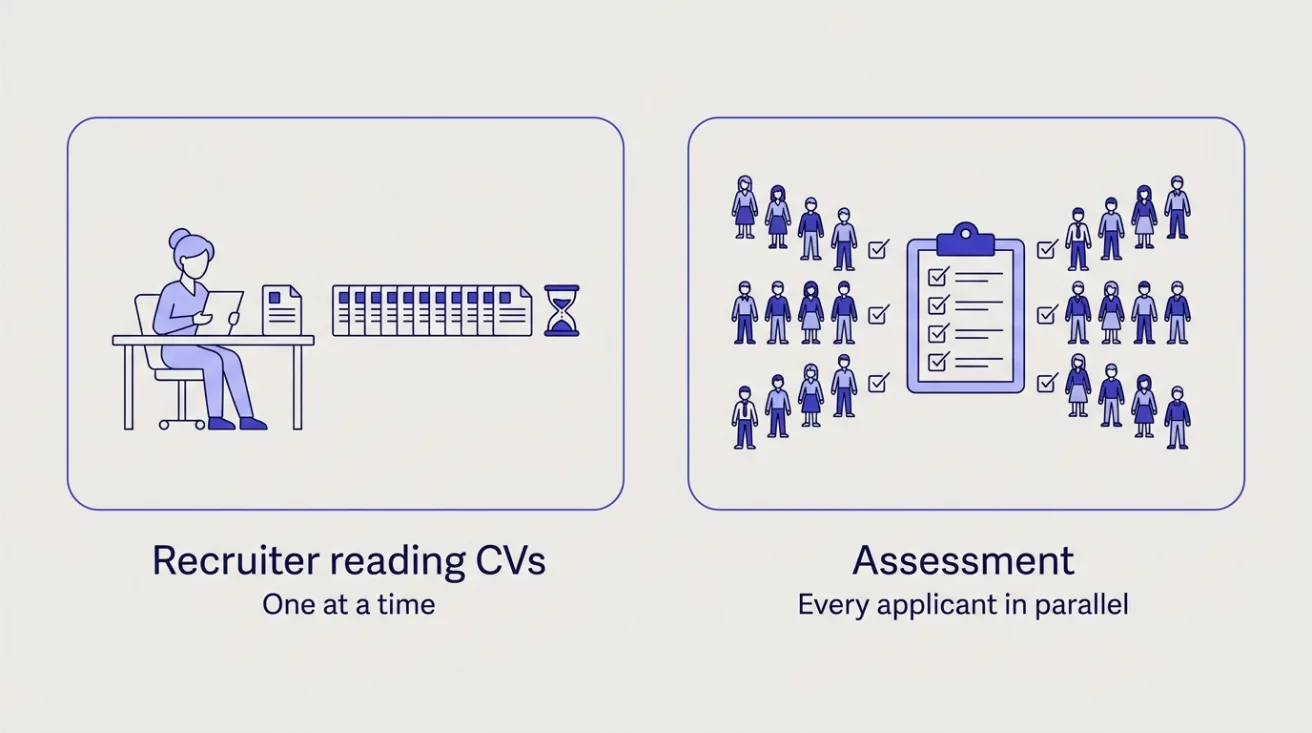
- Move the assessment to the top of the funnel. Many teams send it after a phone screen, which keeps the slowest step in place.
- Remove scheduling back-and-forth. Self-booking links or a conversational scheduling assistant let candidates book without a recruiter.
- Replace the phone screen with a recorded or automated interview for roles where communication is the main thing you check. See one-way video interviewing.
Our post on reducing time to hire covers the rest of the funnel.
Cohesyve
Test candidates on the work itself
Cohesyve builds an AI job simulation of the role from your job description, finds and contacts candidates for it and returns a ranked shortlist. Ten candidates free, no card.
Which assessment platforms are built for high-volume hiring?
Harver, HireVue, SHL and VidCruiter each describe a dedicated volume or hourly hiring offer. Criteria, Vervoe and Cohesyve are used at volume too, with different strengths.
| Platform | Volume positioning (their words, summarised) | What it assesses | Around the assessment | Pricing |
|---|---|---|---|---|
| Harver | "The top choice for volume hiring": BPO, contact centres, retail | Personality, cognitive ability, situational judgement, live chat support simulation, spoken language, pymetrics games | Workflow automation, scheduling, video interviews, reference checks | Check their site |
| HireVue | Enterprise platform with a dedicated hourly and high-volume solution | Skills tests, game-based assessments, AI Interviewer (voice) | Video interviews, scheduling, chat agent that matches candidates to roles | Check their site |
| SHL | Volume hiring solution for BPO, contact centres and retail | Cognitive, personality, situational judgement, call-centre simulations | Video interviews, graduate and professional hiring products | Check their site |
| VidCruiter | "Built for high-volume hiring": hourly, contact centres, public sector, RPO | Custom and prebuilt skills tests | Pre-recorded and live structured interviews, self-scheduling, reference checks | Check their site |
| Criteria | Assessments for small business to enterprise | Cognitive aptitude, personality, emotional intelligence, skills, game-based | Video interviewing, AI proctoring | Check their site |
| Vervoe | Skills assessments for enterprises, with emphasis on roles with many applicants | Job simulations in ticketing and CRM settings, spreadsheets, video, text | AI grading that learns from your team's grading | Check their site |
| Cohesyve (our product) | Job simulations and a ranked shortlist, sized to annual hiring volume | Simulations generated from your job description: customer calls and chats, spreadsheets, code | Can also source candidates and contact them; ATS integrations | Subscription from $199/month, plans up to 10,000+ candidates a year |
Conversational assistants such as Paradox (part of Workday since October 2025) and Fountain handle screening questions, scheduling and candidate messages for frontline hiring. They are a complement to an assessment, since their own sites describe screening for qualifications and scheduling, not skills testing.
Which high-volume platform fits your hiring?
The kind of volume matters more than the number.
- Hourly and frontline roles (retail, warehouse, hospitality): Harver or HireVue, with a scheduling assistant if your ATS does not book interviews itself. Candidates apply on phones, often between shifts, so mobile completion is the deciding factor.
- Contact centres and BPO: Harver or SHL, both of which offer simulations of support work and spoken-language assessment. Vervoe has a ticket-based customer service simulation, and Cohesyve runs chat and voice role-plays with an AI customer.
- Graduate and campus intakes: SHL, HireVue or Criteria, where cognitive and situational judgement tests are standard and the same assessment runs across thousands of applicants.
- Professional roles at volume (SDR cohorts, customer success, analysts): Vervoe or Cohesyve, where a simulation of the actual work separates applicants who look alike on paper.
- Technical roles at volume: HackerRank, Codility or CodeSignal; see the technical section of the main comparison.
- Public sector: VidCruiter or HireVue, which both name government hiring and structured interviewing.
What should a high-volume assessment look like?
A high-volume assessment should be short, completable on a phone, specific to the role and different enough between candidates that answers do not circulate.
Check these before you buy:
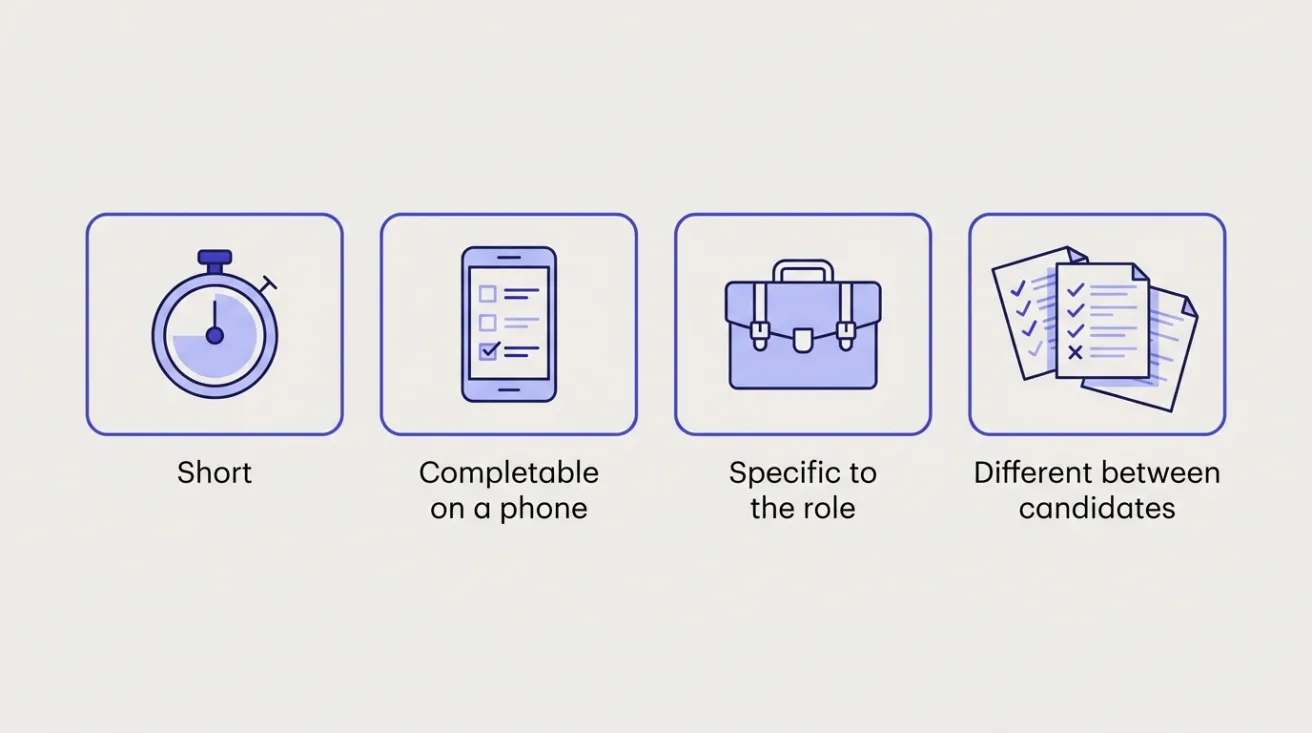
- Length and completion. Ask the vendor for completion rates on roles like yours, then run it on your own applicants. Every extra minute costs completions.
- Mobile experience. Take the assessment yourself on a phone, on mobile data.
- Content that does not leak. At volume, the same fixed test is shared online quickly. Ask how often content changes and whether candidates see different versions.
- Automatic decisions with a human check. Thresholds should move candidates on automatically, and someone should review a sample of rejections each week.
- Adverse impact monitoring. At volume, a small difference in pass rates between groups affects a lot of people. The US Uniform Guidelines treat a group's selection rate below four-fifths of the highest group's as evidence of adverse impact; your vendor should report it.
- Language support for every language your applicants speak.
- ATS integration that sends results and status changes back without exports.
How much do high-volume assessments cost?
Cost at volume depends on the pricing model more than the headline rate. Per-candidate or credit pricing rises with every applicant you test, which quietly pushes teams to test fewer people later in the funnel. Subscriptions sized to volume, or priced by headcount with unlimited assessments, keep the cost flat as applications rise.
Ask every vendor for the total annual cost at your real applicant volume, plus the cost if volume comes in 30% higher. Our pricing guide has a worksheet. Cohesyve's own plans are subscriptions from $199 a month; the Scale plan covers 5,000 to 10,000 candidates a year and Enterprise goes beyond that, and candidates filtered out before evaluation do not count towards the plan.
Common questions
What is high-volume hiring? Hiring many people into similar roles in a short period, or handling a very large number of applicants for a role. Retail, hospitality, logistics, contact centres and graduate programmes are the usual examples.
Should every applicant take the assessment? Yes, if it is short. Testing everyone is what makes screening fair and fast; filtering by CV first reintroduces the bottleneck and the bias you were trying to remove.
Can AI screen applicants without a human? The tool can score and rank, but keep a person reviewing rejections. Separately, rules such as New York City's Local Law 144 require a bias audit and candidate notice before you use an automated employment decision tool.
How do we keep candidates engaged at volume? Speed. Send the assessment immediately, tell candidates how long it takes, and give everyone a decision quickly. Our guide to improving candidate experience has more.
Which tools are best for 500 applicants to one role? Any of the platforms above will handle that number. Choose by role type: a simulation for professional roles, a short skills or cognitive test plus a recorded interview for hourly roles.