We’ve all been there. You find a resume that looks perfect on paper, only to have a conversation that falls flat. It's one of the most frustrating parts of hiring. Candidate assessment tools are designed to prevent that exact scenario.
Think of them as a practical audition for the job. Instead of just taking a candidate’s word for it, these platforms give you a way to measure their actual skills and predict how they'll perform before you even schedule the first call. It’s about replacing guesswork with data.
Moving Beyond Resumes to Measure Real Skills
Relying solely on resumes and cover letters feels increasingly out of touch. It’s like trying to pick a star athlete just by reading their stats—you see the numbers, but you miss the agility, the teamwork, and the grit they show on the field.
Resumes are self-reported highlight reels. They're polished, curated, and often tell you more about a person's writing skills than their ability to solve a complex problem on a tight deadline.
This disconnect between what a resume says and what a person can do is a significant challenge for hiring teams. A study from Leadership IQ revealed that 46% of new hires fail within their first 18 months. But here’s the key finding: only 11% of them failed because they lacked the right technical skills. The real reasons were things like coachability, emotional intelligence, and motivation—qualities a piece of paper will never capture.
A Shift to Verifiable Skills
This is where assessment tools make a difference. They represent a shift in thinking: from judging what candidates say they can do to measuring what they can actually do. These platforms provide a structured, objective way to see a candidate’s abilities in action.
Of course, to measure abilities accurately, you first need a solid grasp of understanding the difference between soft skills and hard skills, since you can't test for creativity the same way you test for coding proficiency.
By focusing on objective skills, these platforms level the playing field. They reduce the impact of unconscious bias that can creep in when screening resumes, allowing talented candidates from non-traditional backgrounds to shine based purely on their capabilities.
This move toward data-driven hiring is a notable industry shift. The global market for these tools is projected to exceed USD 8.35 billion by 2034, growing at a rate of 11.3% each year. That kind of growth suggests one thing: companies are actively looking for better ways to hire, especially as remote work makes it even harder to get a true feel for a candidate's skills.
Ultimately, using assessment tools isn't about creating another hoop for people to jump through. It's about building a more effective and fair hiring process that connects the right person to the right role based on what they can prove, not just what they profess.
Choosing the Right Assessment for the Job
The world of candidate assessment tools can seem complex, but you don't need a Ph.D. in psychometrics to figure it out. Think of it like a mechanic's toolbox—you wouldn't use a sledgehammer to fix a delicate watch. Different jobs demand different skills, and picking the right assessment is key to getting a clear, honest picture of a candidate's potential.
Just as a mechanic diagnoses an engine's problem before grabbing a wrench, you should start with the core skills needed for the role. This focused approach ensures you’re measuring what truly matters for on-the-job success, not just collecting random data points.
The Four Main Types of Assessment Tools
Let's break down the main categories you'll encounter. Most roles actually benefit from a combination of these, giving you a well-rounded view of a candidate's abilities from multiple angles.
- Cognitive Ability Tests: These measure a candidate's problem-solving skills, critical thinking, and how quickly they can pick up new information. They are good predictors of performance in complex roles that require sharp, analytical minds.
- Personality and Behavioral Tests: These assessments get into a candidate's work style, motivations, and how they interact with others. They help you see how someone might fit into your team culture and collaborate, which is important for long-term success.
- Hard Skills Tests: This is where you can see practical abilities. These tests directly measure a candidate's ability to perform specific tasks, whether it's writing code, analyzing a financial model, or running a digital marketing campaign. They verify the claims on a resume with hands-on challenges.
- Situational Judgment Tests (SJTs): These present candidates with realistic, work-related scenarios and ask them to choose the best course of action. SJTs are excellent for evaluating decision-making and professional judgment, especially for leadership or customer-facing roles.
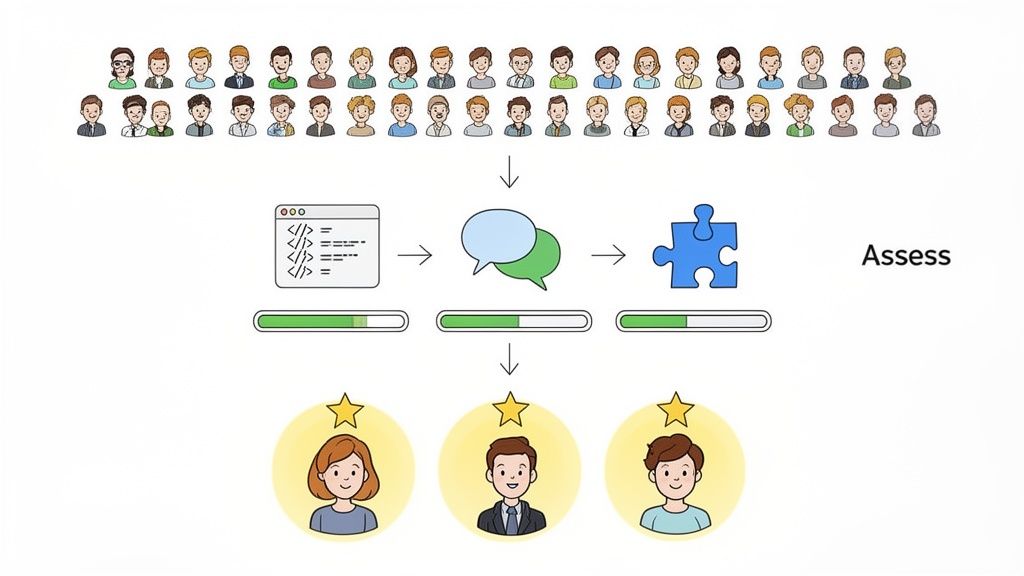
This diagram shows how modern assessments connect the initial evaluation to the underlying skills and the resulting data.
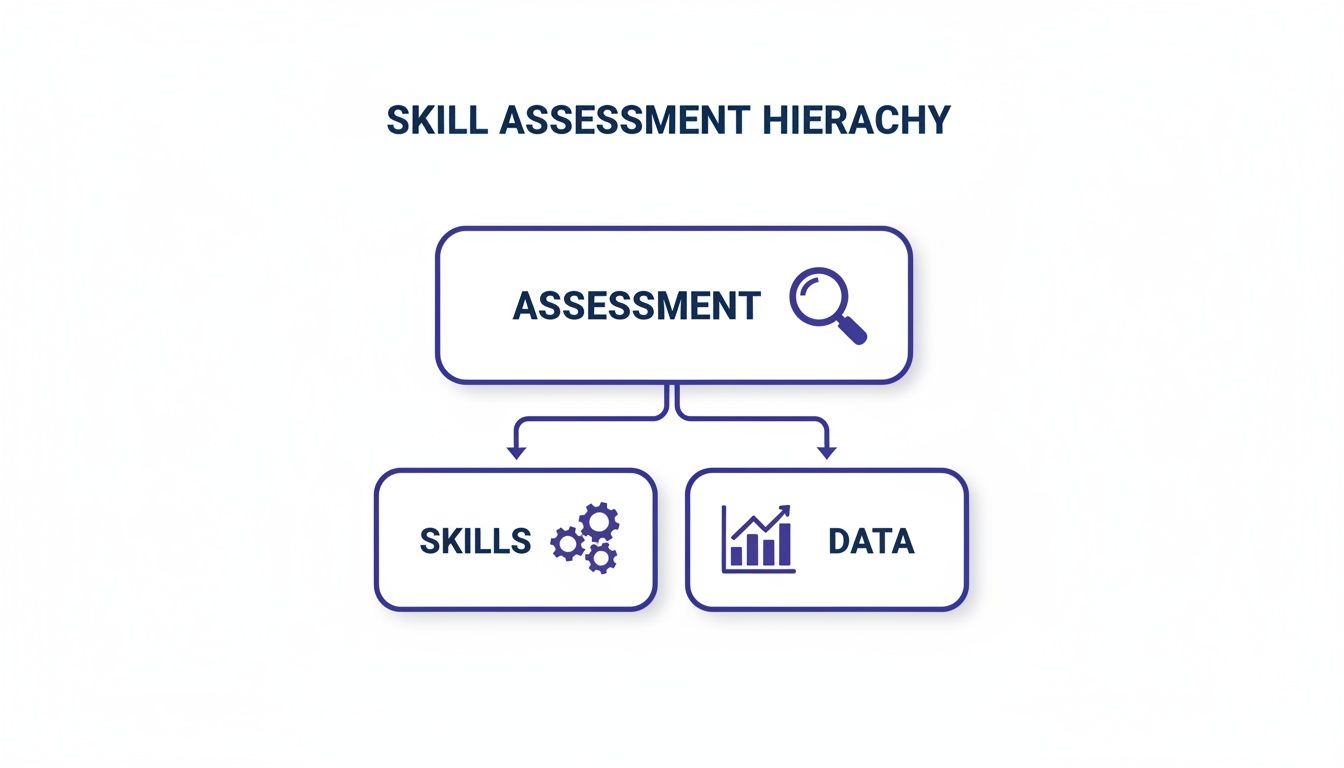
Ultimately, the goal is to use the assessment process to translate a candidate's skills into clear, actionable data for your hiring team.
Matching Assessments to Common Roles
So, how do you put this into practice? A software engineer role might lean heavily on a hard skills test with a coding challenge, while a sales director position would benefit more from a situational judgment test and a behavioral assessment.
The key is to start with the job description and pinpoint the "must-have" competencies. For a deeper dive, our complete guide on pre-employment assessment tools breaks this down even further.
A common mistake is using a generic, one-size-fits-all test for every single position. This approach often fails to measure the specific abilities that predict success in a particular role, leading to murky results and a poor candidate experience.
To help you get started, here's a quick-reference guide to help you choose the most effective assessment types for different job functions.
| Job Function | Primary Assessment Type | Why It Works | Example Task |
|---|---|---|---|
| Software Developer | Hard Skills Test | Directly verifies coding proficiency and problem-solving in a specific language. | Solve a real-world coding problem in Python or JavaScript. |
| Sales Representative | Behavioral & Situational | Assesses persuasive skills, resilience, and ability to handle customer objections. | Respond to a simulated angry customer email or a challenging negotiation scenario. |
| Project Manager | Cognitive & Situational | Measures planning, prioritization, and decision-making under pressure. | Create a project plan to address a scope change with a tight deadline. |
| Marketing Analyst | Hard Skills Test | Evaluates data analysis, interpretation, and proficiency with marketing tools. | Analyze a sample dataset to identify key trends and recommend a campaign strategy. |
Instead of a single test, a tailored combination provides a much richer, more accurate profile. For example, you might pair a cognitive test with a skills-based challenge to see not only if a candidate can do the work, but also how they think through complex problems. This multi-faceted approach helps build a complete picture of each applicant.
As you explore different platforms, it’s also smart to understand how they integrate with your existing workflow. This guide to Applicant Tracking Systems is a great resource, especially for smaller companies. By choosing the right tool for the job, you move from simply collecting scores to gathering meaningful insights that lead to better, more confident hiring decisions.
Cohesyve
See what candidates can do before you interview them
Cohesyve turns your job description into a role-specific assessment with a scoring rubric. Each candidate gets a different version, so questions cannot be shared. Ten candidates free, no card.
The Business Impact of Skill-Based Hiring
Let's move past the theory and talk about what really matters: the results. Adopting skill-based hiring isn't just an update to your process; it's a strategic move that can deliver tangible benefits. The logic is simple—when you base decisions on objective data, you hire better people, faster and more affordably.
We've all felt the pain of a bad hire. The U.S. Department of Labor estimates the cost can be as high as 30% of an employee's first-year salary. That number isn't just about recruitment agency fees. It’s the wasted training budget, the productivity that slows, and the impact on your team's morale.
Skill-based hiring addresses this problem directly. By verifying what a candidate can do before you hire them, you lower the risk of bringing on someone who looked great on paper but can't deliver. You can identify skill gaps before an offer letter is drafted, not three months into the job.
From Guesswork to Confidence
Let's paint a picture of how this works in the real world by comparing two familiar scenarios.
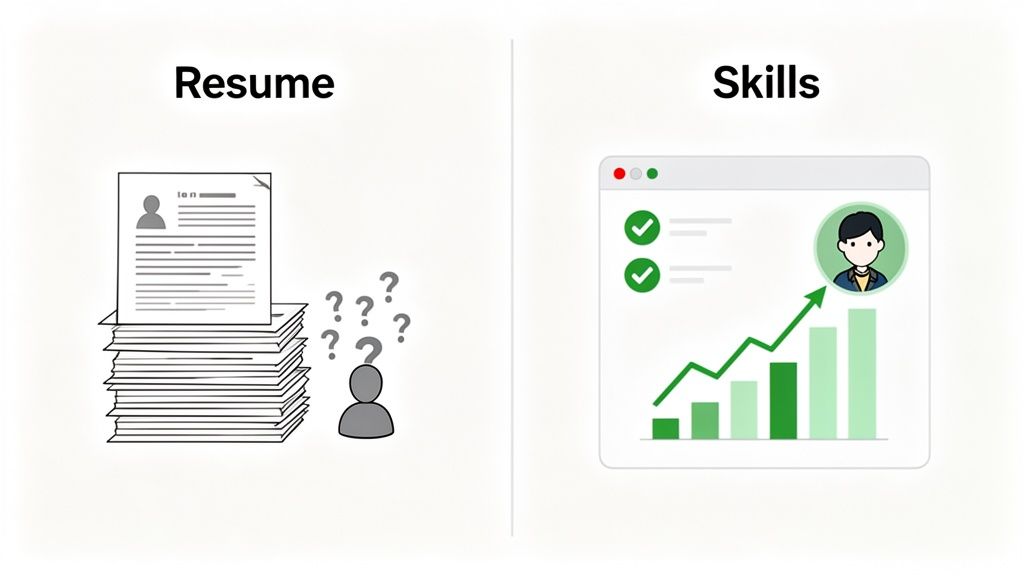
Scenario A: The Traditional Resume Slog A hiring manager has a stack of 100+ resumes. They spend hours trying to decode polished bullet points and guess who might be a good fit. They pull ten people for phone screens based on keywords and company names, then bring five in for interviews. The whole process is slow and relies almost entirely on gut instinct.
Scenario B: The Skill-Based Approach That same manager uses an assessment tool at the start. All 100+ applicants take a short, practical challenge that mimics a real task from the job. The system automatically surfaces the top performers. The manager can now skip the resume review and spend their valuable time talking to candidates who have already proven they have the right skills.
The difference is a fundamental change in the process. You go from a process of elimination based on proxies (like where someone went to college) to a process of selection based on proven ability. It’s faster, fairer, and a much better predictor of who will actually succeed in the role.
This data-first mindset doesn't just improve one hiring decision; it sends positive ripples across the entire company. It’s not surprising that around 70% of organizations using assessments report a noticeable improvement in the quality of their hires. That can directly translate to lower turnover—sometimes by as much as 25%.
The True ROI of Better Hiring
Beyond just dodging the cost of a bad hire, a skill-first approach creates lasting value for the business.
- Reduce Your Time-to-Hire: Automating the initial screening process clears a major bottleneck in recruiting. Some teams have filled roles up to 50% faster, letting them connect with top talent before a competitor does.
- Boost Employee Retention: When you hire people for a job that matches their skills, they tend to be more engaged, more productive, and more likely to stick around. This cuts down on the constant cycle of recruiting and retraining.
- Elevate Team Performance: Consistently hiring high-performers raises the bar for everyone. Strong new hires don't just do their own job well; they elevate the entire team's output and help build a culture of excellence.
By putting objective candidate assessment tools to work, you aren't just buying software. You're investing in a more predictable way to build the team that will drive your business forward.
If you’re ready to dig deeper, our guide on what is skills-based hiring is a fantastic place to start. The business case is compelling: better data gets you better people, and better people build better companies.
How to Select the Right Assessment Partner
Deciding to use candidate assessments is a big step, but finding the right partner to supply them is where the real work begins. The market is filled with options, and the "best" one really depends on what your team needs, the specific roles you're hiring for, and the impression you want to leave on applicants.
Think of it like choosing any other critical business system. The right platform becomes a strategic advantage, while the wrong one just adds friction and headaches. To help you cut through the marketing noise, let's break down the evaluation process into a few core questions. This will shift your focus from features to the real-world impact the tool will have on your hiring.
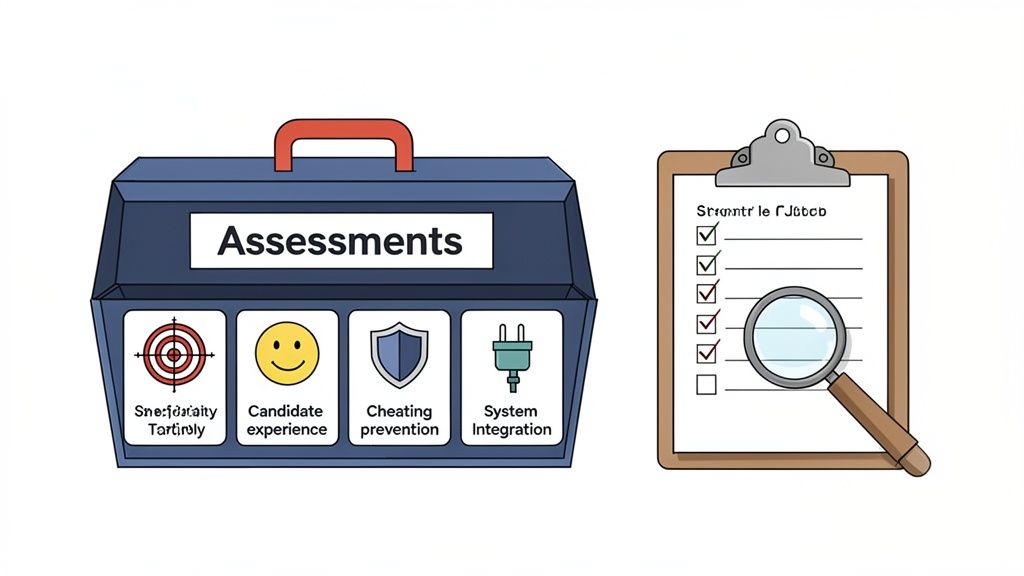
Are the Assessments Genuinely Role-Specific?
The most predictive assessments are the ones that actually mirror the work someone will be doing. A generic logic puzzle might tell you if a candidate is a quick thinker, but it won’t tell you if they can debug a complex piece of code or navigate a tough client negotiation. The goal here is to measure job-relevant skills, not just abstract intelligence.
When you're talking to a vendor, dig into their process:
- How are the assessments built? Are you just getting a pre-canned test from a library, or can they build custom challenges based on your job descriptions?
- Can it test for both hard and soft skills? A brilliant developer still needs to communicate with their team. The best tools can evaluate both technical abilities and collaborative skills through realistic simulations.
- Does the test feel like a real day on the job? The closer an assessment is to the actual work, the more you can trust the results.
What Is the Candidate Experience Like?
Don't forget that your assessment is one of the very first real interactions a candidate has with your company. A clunky, confusing, or very long test can cause top talent to drop out of your pipeline entirely. On the flip side, a smooth and engaging experience reinforces your brand as a great place to work.
Research shows that a positive candidate experience makes applicants 38% more likely to accept a job offer. Even candidates you don't hire are more likely to reapply or recommend your company to their network.
Take a hard look at how a platform treats the very people you’re trying to impress. Is the interface intuitive and mobile-friendly? Are the instructions clear? Platforms that give realistic time estimates and offer constructive feedback show that you respect the candidate's time, leaving a great impression no matter the outcome.
How Does the Platform Prevent Cheating?
With remote hiring now the norm, making sure your assessment results are legitimate is a significant concern. The last thing you want is to hire someone based on answers they just googled or had a friend complete for them.
Static, unchanging question banks are easy to game. The modern approach uses dynamic systems that create unique challenges for every single person. For example, some platforms generate adaptive questions in real time for each candidate. This makes it practically impossible to cheat by looking up answers, ensuring the results you see are a true reflection of that individual’s capabilities.
Does It Integrate With Your Existing Systems?
A new tool should make your team’s life easier, not add another login and more manual work. That's why seamless integration with your Applicant Tracking System (ATS) is a must-have.
When assessment scores and reports flow directly into your candidate profiles, you eliminate tedious data entry and give your entire hiring team instant visibility. This creates a single source of truth for every candidate, keeping everyone on the same page from the first screen to the final offer. Before you commit, ask potential partners about their pre-built integrations and API capabilities. Getting this right from the start will save you countless hours down the road.
Weaving Assessments into Your Hiring Process
Choosing a great candidate assessment tool is one thing, but making it work seamlessly within your hiring workflow is what makes a real impact. Think of it like buying a professional-grade oven for your restaurant. It’s got potential, but you still need the right recipe and a plan for how to use it. Simply dropping a new tool into a broken process won’t fix your hiring problems.
A thoughtful implementation plan is what turns that new technology into a genuine advantage. It’s about being deliberate and strategic, not just adding another hoop for candidates to jump through.
First, Define What "Good" Actually Looks Like
Before you can measure anything, you have to know what you’re measuring against. This means digging deeper than the generic bullet points on a job description. The goal is to pinpoint the non-negotiable skills and behaviors that truly separate a good hire from a great one.
A great place to start is by talking to your current top performers. Ask them what makes them successful. Is it their obsessive attention to detail? Their ability to stay cool under pressure? Or maybe it's their knack for explaining complex ideas in a simple, clear way?
These traits are your core competencies. They become the blueprint for your assessments. A well-designed test doesn't just ask random questions; it builds scenarios that specifically challenge these must-have skills. That way, you’re not just testing for general ability—you’re testing for the right ability for that specific role.
Place the Assessment Where It Makes the Most Sense
Timing is everything. Where you put the assessment in your hiring funnel can dramatically change its impact. There’s no single “right” answer here; the best spot depends entirely on the role and how many applicants you typically get.
Here are the two most common strategies:
- Top-of-Funnel (Early Screening): If you're hiring for high-volume roles like customer support or entry-level sales, you're likely getting hundreds of applications. Using an assessment right at the start is highly effective. It acts as an automated filter, bubbling up the most qualified people and saving your team from drowning in resumes.
- Mid-Funnel (After the First Chat): For more senior or highly specialized roles, it often makes more sense to use an assessment after an initial phone screen. This way, you’re investing the time for a deeper evaluation on a smaller, more qualified pool of candidates who have already shown genuine interest.
No matter which path you choose, the goal is the same: gather objective data at the most logical point to help you make smarter, faster decisions about who moves forward.
Be Clear and Upfront with Candidates
How you introduce the assessment sets the tone for the entire candidate experience. A little transparency goes a long way. Let people know why you're using a skills test and what it’s designed to measure.
Frame it as their opportunity to show you what they can do in a way a resume never could. Be clear about how long it will take and what they can expect. This simple act of communication shows you respect their time and can significantly boost your completion rates.
A common reason candidates drop off is uncertainty. When they feel like they’re being sent into a black box, they disengage. Clear communication turns the assessment from a hurdle into a fair and engaging part of the conversation.
Platforms that see high completion rates—often above 95%—are almost always the ones that create an intuitive and transparent experience for the candidate. It shows that when people understand the "why," they are more than willing to participate.
Use the Data to Inform, Not Dictate
Finally, remember that assessment results are a powerful data point, but they are still just one piece of the puzzle. The best hiring processes use this data to enrich human judgment, not replace it. To see how this works in practice, you can explore our guide on what is pre-employment assessment.
Use the results to enhance your interviews. For instance, if a developer scored very well on a coding challenge but a bit lower on a communication task, you know exactly what to dig into during your conversation. This allows you to ask targeted, insightful questions instead of generic ones.
By integrating assessments thoughtfully, you build a hiring process that is faster, fairer, and far more predictive. You stop guessing who might be the best candidate and start confidently identifying the person who has already proven they can do the job.
The Future of Hiring Is Both Smart and Human
The world of work is shifting, and how we find great people is changing right along with it. The future of talent evaluation isn’t a battle between smart technology and human insight. It’s about blending the two to create a process that’s more effective, fair, and intelligent.
Candidate assessment tools have come a long way from the multiple-choice quizzes of the past. The focus now is on dynamic, job-specific simulations that feel less like a test and more like a day on the job. Think of a marketing candidate adjusting a live campaign budget or a project manager navigating a simulated team conflict. That’s where the industry is today.
Letting Technology Do the Heavy Lifting
Artificial intelligence is what’s making much of this possible. Instead of using static question banks, modern platforms can generate unique, adaptive challenges for every applicant. This approach makes cheating nearly impossible and gives you a much clearer signal of a candidate’s true abilities.
This kind of technology is exceptionally good at handling the repetitive, time-consuming parts of hiring. It can screen hundreds of applicants, analyze performance data, and instantly show you the top performers who have already proven they can do the work.
This frees up your hiring managers and recruiters from the time spent sifting through resumes. Their time is too valuable for that. Instead, they can focus on what matters most: genuine, human-to-human connection.
When technology handles the objective skill check, your team can concentrate on the crucial human elements—like assessing cultural fit, understanding a candidate's ambitions, and seeing how they’d mesh with the team.
A Smarter, More Balanced Approach
This balanced approach means technology supports human judgment, not replaces it. It gives you the objective data you need to make a confident choice, while leaving room for the essential conversations that build great teams. The result is a process that's both more efficient and more personal.
The business case for this shift is clear. The AI-driven recruitment market is projected to hit USD 1,119.79 million by 2032, driven by companies adopting automated candidate screening and predictive hiring analytics. A bad hire is costly, making predictive assessments a worthwhile consideration. You can explore more on how AI is shaping the future of recruitment on einpresswire.com.
Ultimately, the future of hiring is about using smart tools to get to the right conversations, faster. It’s about combining the speed and precision of AI with the irreplaceable nuance of human connection to build stronger, more successful teams.
Got Questions? We’ve Got Answers.
Adopting any new tool in your hiring process is bound to bring up a few questions. It’s a smart move to think through the details. Here are some of the most common questions we hear from hiring teams about candidate assessment tools, along with some straight-up answers.
What Stops Candidates From Cheating?
This is a top concern, especially with remote hiring. The old way of doing things—using a static bank of questions—is easy to circumvent. The questions leak, answers get posted online, and suddenly you’re not testing skills anymore.
The solution is to avoid static tests. Modern platforms use dynamic assessments that create a unique set of challenges for every single candidate. Think of it like a deck of cards; everyone gets a different hand, but the game is the same. This makes it practically impossible to just memorize answers.
Don't These Tools Introduce More Bias?
It's a fair question, but a well-designed assessment does the exact opposite: it reduces bias.
When you rely only on resumes, unconscious bias can easily creep in. You might be swayed by a prestigious university name or a well-known previous employer, and overlook a talented candidate. Objective, skill-based tests cut through that noise. They focus entirely on one thing: can this person actually do the job? Everyone is measured against the same standard, creating a more level playing field.
When Is the Right Time to Send an Assessment?
The "when" really depends on your "why." There’s no single right answer, but here are two common approaches:
For High-Volume Roles: If you’re getting a large number of applications for a popular role, use an assessment right at the top of the funnel. It acts as an efficient filter, automatically surfacing the top 10-15% of your talent pool so your recruiters can focus their energy there.
For Senior or Niche Roles: Here, you might want to have a quick initial chat first. Once you’ve built a shortlist of a few promising candidates, you can send the assessment to get a much deeper look at their specific skills before bringing them in for final interviews.
Are Assessments Just for Coders?
No. While they started in the tech world for evaluating engineers, today’s assessment tools are far more flexible. They've evolved to measure a whole spectrum of professional skills through realistic, interactive scenarios.
For example, you can see how someone actually performs on the job by testing for:
- Sales Instinct: Put a candidate in a simulated call and see how they handle common objections.
- Communication Skills: Ask them to explain a complex topic to a non-expert in a short video.
- Problem-Solving: Give them a real-world business challenge and see how they think through it.
It's about measuring ability, not just credentials, no matter the role.
Ready to see how role-specific, adaptive assessments can transform your hiring process? Cohesyve builds custom challenges that reveal the true skills of your candidates. Learn more about our approach.