For corporate and tech jobs, Amazon hires in five stages: an online application, an online assessment for many roles, one or two phone screens, an interview loop that can include a Bar Raiser, and a decision. Amazon says the interview process takes three to six weeks on average, depending on your availability and your interviewers'. Hourly warehouse jobs follow a separate, shorter route, covered further down.
Amazon also says its process differs from role to role, so read this as the usual shape rather than a promise. Everything here comes from Amazon's own pages, linked as we go.
The stages at a glance
- Application on amazon.jobs.
- Online assessment, for many roles: work style questions, a job simulation or, for software engineers, coding problems.
- Phone screen: one or two, with a recruiter or someone from the hiring team.
- Interview loop: two to seven one-on-one interviews of 45 minutes to an hour each. One interviewer can be a Bar Raiser from another team.
- Decision: the hiring manager and the Bar Raiser decide after a debrief, and Amazon aims to tell you within five business days.
Stage 1: the application
Corporate and tech roles are listed on amazon.jobs. Four things from Amazon's application pages are worth knowing:
- No cover letters. Amazon doesn't accept them, so put the effort into your resume. A LinkedIn profile can stand in for a resume.
- Basic qualifications matter most. Amazon says preferred qualifications aren't required if you meet all the basic ones. Make each basic qualification easy to find on your resume, with evidence.
- Ten roles at a time. That's Amazon's limit on roles you're applying or interviewing for at once, and each role may have its own interview process.
- Silence usually means no. Amazon contacts only the people it's moving forward with. Your amazon.jobs account shows each application's status.
If you're picked for an interview, Amazon may ask for work samples, so put links to any public work on your resume.
Get some practice in before you apply to Amazon
Try an AI job simulation of the everyday work in roles like these and see where you lost marks. 3 free tests, no card.
Stage 2: the online assessment
Depending on the role, the assessment arrives during the application or by email afterwards. Amazon describes two common kinds:
- Work style assessments, usually 10 to 20 minutes: you choose which statements best describe how you work.
- Work sample simulations, usually 20 minutes to an hour: tasks from the job, such as reading a chart, answering a customer question or deciding how to resolve an issue.
Software engineers also get coding problems. Amazon recommends that software engineering applicants review its technical topics first, and says no advance preparation is needed for other roles. Many assessments are timed, some have deadlines, and Amazon says it can't extend a missed one.
Our guide to the Amazon online assessment covers each version, the rules and how to prepare.
Stage 3: the phone screen
Expect one or two phone interviews, held on a video meeting platform. Depending on the role, you'll speak to a recruiter, a potential peer or a senior leader from the hiring team. The questions are behavioral and based on the Leadership Principles, and for some roles they also cover the skills of the job. For tech roles, Amazon points you to its technical prep material at this stage.
Amazon's phone screening page asks you to find a quiet place with a computer, a reliable connection and a copy of your resume, and recommends a headset. Amazon aims to get back to you within two business days.
Stage 4: the interview loop
The loop is Amazon's name for the main round of interviews. You meet current employees one at a time, and each assesses a different part of your skills and experience. Amazon's page says to expect:
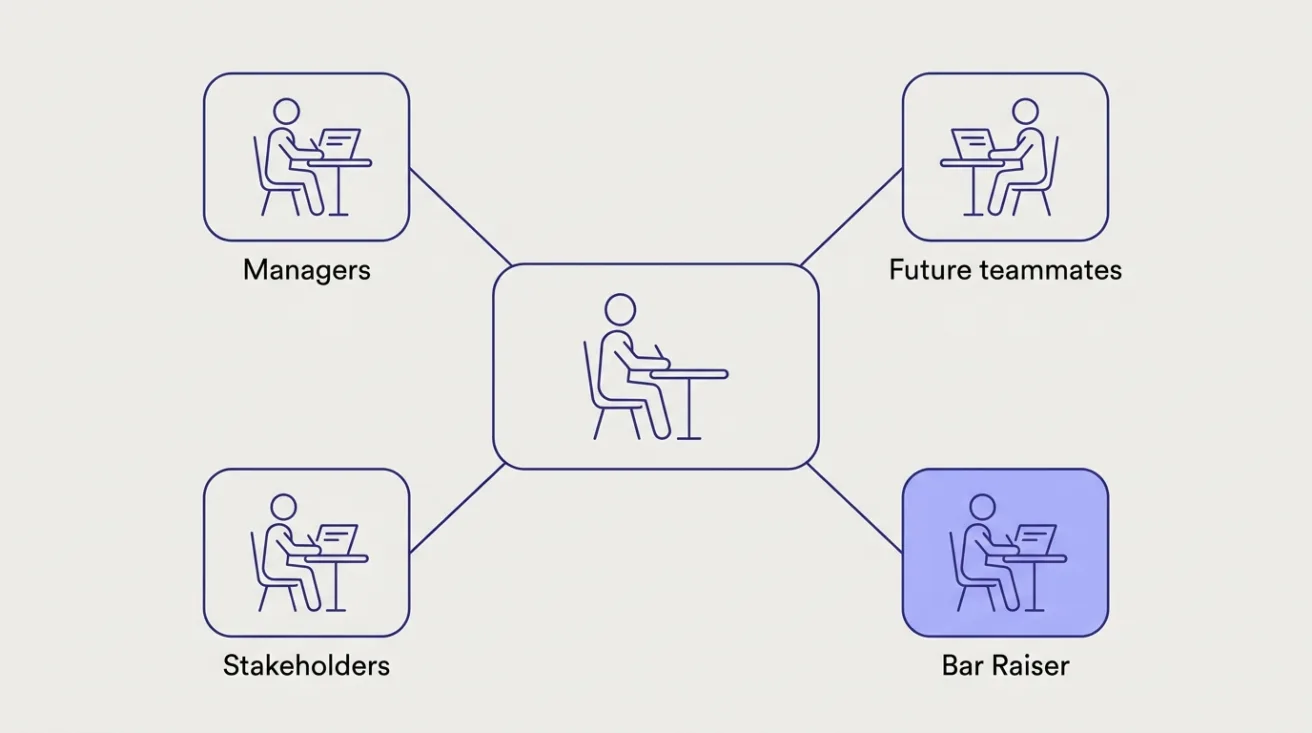
- Two to seven interviewers, who may include managers, future teammates, stakeholders and a Bar Raiser.
- About 45 minutes to an hour with each.
- Behavioral questions asking for real examples from your past, guided by the Leadership Principles. Amazon says it avoids brain teasers.
- Interviewers typing while you talk. They're taking notes for the rest of the panel.
- Time for your questions at the end, and often the question "Why Amazon?"
Interviews may be remote or in person. Amazon treats remote interviews the same as in-person ones and asks you to use video. In person, arrive 15 minutes early with government-issued photo ID. Casual dress is fine.
Some Zoom interviews are transcribed by AI, but only if you've opted in through your profile. Amazon says transcription is voluntary and your choice doesn't affect how you're evaluated. If you need an accommodation at any stage, tell your recruiter.
Extra steps for some roles
Your recruiter tells you in advance if any of these apply:
- A writing exercise. Amazon works from written narrative memos rather than slide decks, so some roles ask for a writing sample. Amazon's assessment FAQ asks for prose with few bullet points, submitted two days before your interview.
- A portfolio review or a tech talk, for certain roles.
- Coding and system design, for software roles. Amazon describes the SDE II loop as four 55-minute interviews, with at least one system design question and real code, not pseudocode.
- A prep call before the loop, offered for some roles, to explain the process.
What the Bar Raiser does
A Bar Raiser is an interviewer who typically sits on another team and acts as an objective third party. Bar Raisers are nominated and trained for the role on top of their day jobs. They assess you for the job and for long-term success at Amazon, not just for one team's urgent vacancy.
Amazon defines the bar plainly: every new hire should be better than half of the people already in similar roles. It also says it focuses on hiring well rather than hiring quickly.
You may read that the Bar Raiser has a veto. Amazon's own pages don't say so. They describe the Bar Raiser leading the debrief and making the final hiring decision together with the hiring manager.
What that means for you:
- Don't try to spot the Bar Raiser. Amazon advises treating every interviewer the same.
- Know your stories in depth. Amazon says it's the interviewer's job to draw out the details they need, so expect follow-up questions.
- Be ready to talk about failure. Amazon says not every story has to be a success; what matters is what you learned. One of its Bar Raisers adds: be honest about your mistakes and show what you changed afterwards.
Stage 5: the decision
After the loop, the interviewers share their feedback in a debrief, and the hiring manager and the Bar Raiser decide. Amazon aims to give you an update within five business days; if you've heard nothing by then, contact your recruiter. The same recruiter is your contact for the offer, the start date and the background check.
Two outcomes are worth knowing about:
- You passed, but the role was filled or closed. Amazon says to apply for similar roles, and that it keeps your resume and interview information on file. You may need further interviews.
- You weren't selected. Amazon's careers pages don't give a general waiting period before you reapply. For the SDE II online assessment, Amazon encourages candidates who don't progress to practice and reapply in six months.
Warehouse and other hourly roles
Hourly warehouse and fulfillment center jobs have their own site. In the US it's hiring.amazon.com, and the process is quite different:
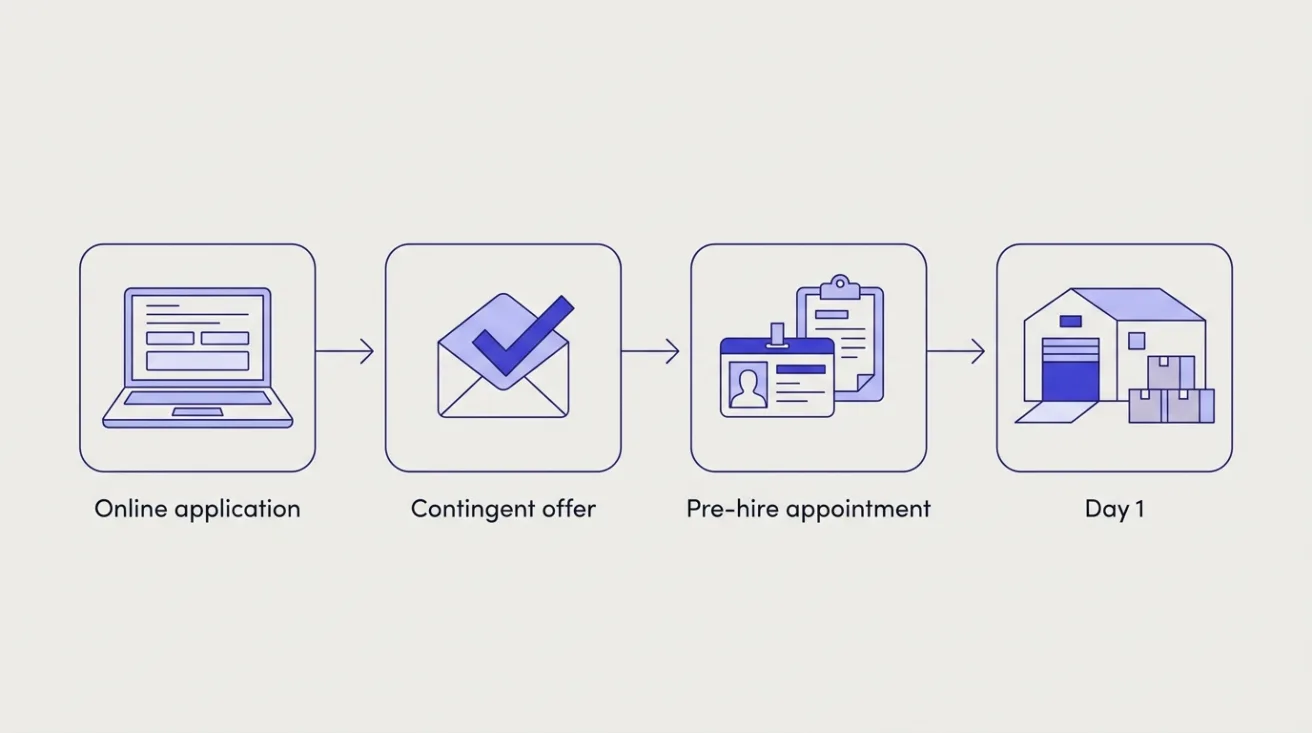
- No resume. You choose a job, location and shift, then complete the application within a three-hour limit. Some job types include a brief assessment.
- A contingent offer during the application, subject to a background check. Accept it promptly, or your preferred shift may go to someone else.
- An in-person pre-hire appointment, which is unpaid. You complete a drug test where it applies and the I-9 employment eligibility form, so bring the right ID.
- Day 1, once you've passed the screenings.
Other countries have their own hourly hiring sites, linked from Amazon's application FAQ. Customer service associate roles have their own route too: an online application of about an hour, with a work style assessment and a job simulation, then steps that vary by region, such as a language test or a phone screen.
What are the most common Amazon interview questions?
Most Amazon interview questions are behavioural questions tied to the Leadership Principles: "Tell me about a time when..." followed by follow-ups that dig into what you did. For tech roles, add coding and, at more senior levels, system design.
Amazon doesn't publish its actual questions, and it won't tell you which principles your interviewers will cover. The examples below are ours, written in the behavioural style Amazon describes, one or two per principle. Use them to build and test your story bank, not as a script of what you'll be asked.
| Leadership Principle | Example question (illustrative) | What a strong answer shows |
|---|---|---|
| Customer Obsession | Tell me about a time you went beyond what a customer asked for. | You started from what the customer needed and can show how they benefited. |
| Ownership | Tell me about a time you took on a problem that wasn't your responsibility. | You acted for the long term, beyond your own team, without being asked. |
| Invent and Simplify | Describe a process you made simpler. What did you remove? | A concrete change, why it was simpler, and the result. |
| Are Right, A Lot | Tell me about a decision you made with incomplete data. | How you weighed the evidence, sought other views and checked whether you were right. |
| Learn and Be Curious | What's something you taught yourself recently, and how did you use it at work? | Real curiosity, and learning that changed what you did. |
| Hire and Develop the Best | Tell me about someone you helped grow. | Specific coaching, and how the person's performance changed. |
| Insist on the Highest Standards | Tell me about a time you refused to accept work that wasn't good enough. | You raised the bar and fixed the cause, not just the symptom. |
| Think Big | Describe a time you proposed something much bigger than you were asked for. | A bold idea, how you got people behind it, and what happened. |
| Bias for Action | Tell me about a time you made a quick decision without all the information. | A calculated risk on a reversible decision, and what you'd do differently. |
| Frugality | Tell me about a time you delivered with fewer resources than you wanted. | How constraints pushed you to a resourceful solution. |
| Earn Trust | Tell me about a time you got critical feedback. What did you do with it? | You listened, didn't get defensive, and changed something. |
| Dive Deep | Tell me about a problem where the data didn't match what people were saying. | You went into the detail yourself and found the real cause. |
| Have Backbone; Disagree and Commit | Tell me about a time you disagreed with your manager. | You challenged respectfully with evidence, then committed fully once the call was made. |
| Deliver Results | Tell me about a goal you hit despite a serious setback. | The obstacle, the key inputs you focused on, and the measurable outcome. |
| Strive to be Earth's Best Employer | Tell me about something you did to make your team a better place to work. | A concrete action that made the team safer, fairer or more productive. |
| Success and Scale Bring Broad Responsibility | Tell me about a decision where you considered effects beyond your team or company. | You thought about wider consequences and left things better than you found them. |
Common general questions
Beyond the principle questions, expect a few you can prepare word for word:
- "Why Amazon?" Amazon's interview loop page says you'll often be asked this. Tie your answer to the team, the customers and a principle you genuinely work by.
- "Tell me about yourself." Two minutes: your current role, one or two achievements that match the job's basic qualifications, and why this role is the next step.
- "Tell me about a time you failed." Amazon says not every story has to be a success. Pick a real failure, own it and show what you changed.
- "What questions do you have for us?" Have two or three about the team's goals and how success is measured.
Amazon interview questions for software engineers
Software engineering loops add technical questions to the behavioural ones. Amazon describes the SDE II loop as including at least one system design question and coding in real code, not pseudocode. Expect data structures and algorithms problems in the coding rounds and, in system design, questions such as how you'd design a service that has to handle a lot of traffic. Every round can still include a Leadership Principle question, so prepare stories alongside practice problems.
How should you answer Amazon interview questions?
Pick one specific situation, explain it in STAR form, say "I" rather than "we", and finish with a measurable result and what you learned. Expect the interviewer to ask follow-up questions until they have the detail they need, so only use stories you know inside out. The preparation steps below show how to build them.
How to prepare for Amazon's interviews
Learn all 16 Leadership Principles
Amazon evaluates every candidate through its Leadership Principles:
- Customer Obsession
- Ownership
- Invent and Simplify
- Are Right, A Lot
- Learn and Be Curious
- Hire and Develop the Best
- Insist on the Highest Standards
- Think Big
- Bias for Action
- Frugality
- Earn Trust
- Dive Deep
- Have Backbone; Disagree and Commit
- Deliver Results
- Strive to be Earth's Best Employer
- Success and Scale Bring Broad Responsibility
Amazon won't say which principles your interviews will cover, and calls them all equally important. Some will matter more for a particular job, so read the posting for clues, but prepare for every one.
Build a story bank
One of Amazon's Bar Raisers suggests preparing one or two work stories for each principle. That's fewer stories than it sounds, because one good story usually covers several principles.
Take an invented example. You noticed that a supplier's invoices didn't match the delivery records, traced the gap to a pricing error, got it corrected and refunded, and added a monthly check so it couldn't happen again. That one story can answer questions on Dive Deep (you spotted the mismatch), Ownership (it wasn't your system), Insist on the Highest Standards (the check) and Deliver Results (the refund).
Pick recent stories, include at least two where things went wrong, and cover different strengths. Amazon's own tips: give one specific situation per answer, back it up with data where you can, and be honest.
Answer in STAR form
Amazon suggests the STAR method (Situation, Task, Action, Result) as one way to structure answers. Its advice: give just enough background, say "I" rather than "we", and end with the result and what you learned, with numbers if you have them. Our list of behavioral interview questions is a good bank to practice on.
Practice out loud
One of Amazon's Bar Raisers recommends practicing on your own, recording yourself, and then rehearsing with someone who will give you candid feedback. A well-run mock interview does exactly that. Prepare a real answer to "Why Amazon?" and a few questions you actually want answered.
Watch out for fake recruiters
Amazon says its recruiters never ask for bank details or an enrollment fee, and that neither Amazon nor its approved recruiting partners charge for employment. If anyone asks you to pay, report it.
Practicing the assessment stages
Interviews reward well-prepared stories. Assessments and work samples reward practice at doing the work against the clock. Cohesyve, which publishes this guide, runs practice job simulations for your role, with a scored report on where you lost marks. It isn't an Amazon test and doesn't use Amazon's questions.
Sources
Amazon's own pages, checked 3 October 2026:
- amazon.jobs: How we hire, online application, assessments, phone screening, interview loop, remote interview, Leadership Principles
- amazon.jobs FAQs: application, assessment, interview process, interview prep, general
- amazon.jobs role guides: SDE II interview prep, SDE II online assessment, customer service associates
- hiring.amazon.com: hiring process, application guide
- aboutamazon.com: Exploring Amazon's unique interview process (2019), What is an Amazon bar raiser? (2019), 8 interview tips from Amazon Bar Raisers (2024)