Standard interview questions often lead to rehearsed answers. They can tell you more about a candidate's preparation than their actual ability to handle the complexities of a real job. Prompts like “What’s your greatest weakness?” or “Where do you see yourself in five years?” are so predictable that candidates often have polished, generic responses ready. This can turn the interview into a performance rather than a genuine assessment of capability.
Research suggests that unstructured interviews, which often rely on these common prompts, have a relatively low predictive validity for job performance. To build a high-performing team, your process needs to dig deeper. It requires questions that reveal how a candidate thinks, solves problems, and learns from experience.
This guide provides a list of unique interview questions to ask candidates, each designed to uncover important skills. We'll explore questions that test systems thinking, trade-off reasoning, communication, and resilience. Moving beyond the script can shift your hiring process from a conversational guessing game to a more reliable assessment of on-the-job potential.
Asking the right questions is only part of the process. Understanding the overall strategy for guiding the conversation is also key. For a comprehensive guide on structuring your entire hiring discussion, explore these best practices on how to conduct effective interviews. Now, let’s get into the questions that will help you identify your next top performer.
1. The Behavioral Systems Question: 'Walk me through a significant professional failure and what systems you built to prevent it from happening again'
This question is an alternative to the classic "tell me about a time you failed" inquiry. Instead of just gauging a candidate's self-awareness, it probes their ability to translate lessons learned into operational improvements. It shifts the focus from a single past event to a future-oriented, problem-solving mindset, revealing if they can create lasting value from setbacks.
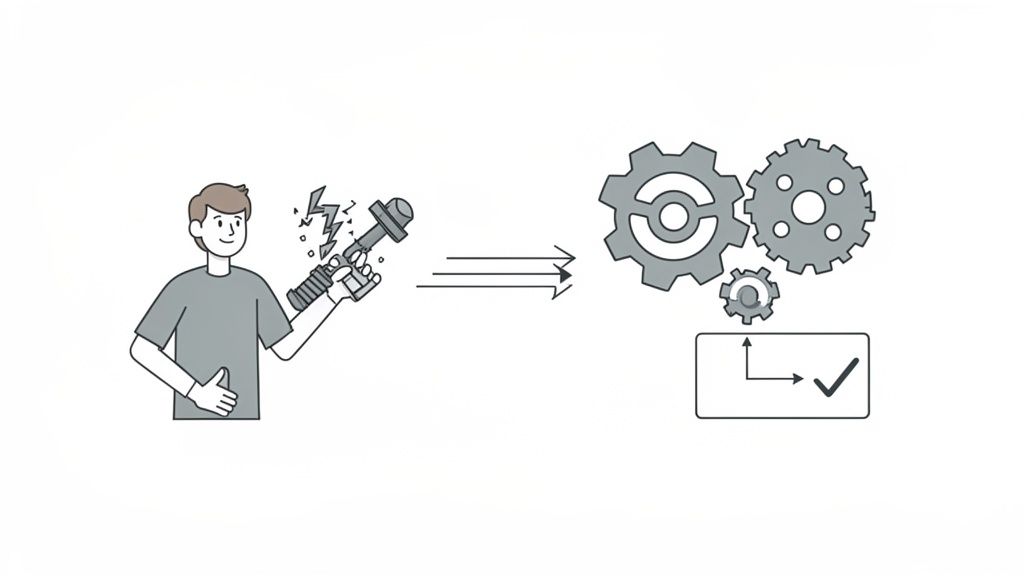
This is one of the more unique interview questions to ask candidates because it uncovers both emotional intelligence (owning a failure) and operational thinking (building a system to prevent it). It’s effective for roles that require strong judgment, process ownership, and a proactive approach to risk management, such as senior engineering, product management, or operations leadership.
What to Look For in an Answer
A strong response moves beyond a simple story and details the architecture of the solution. The candidate should be able to articulate both the what and the why behind their preventative system.
- Specificity and Root Cause Analysis: Do they clearly identify the core issue rather than just surface-level symptoms? A product manager might describe a failed feature launch and then explain how they instituted a new product discovery framework with mandatory user research checkpoints, rather than just saying "we do more research now."
- Accountability: Listen for the use of "I" when describing their role in both the failure and the solution. While teamwork is important ("we decided on the new process"), ownership is key. An answer that consistently uses "we" when discussing the problem but "I" for the solution can be a point for discussion.
- System Design: The "system" should be more than a one-time fix. An engineer describing a production outage should detail the new monitoring, alerting, and automated rollback procedures they helped implement, not just that they fixed the bug.
Actionable Follow-Up Questions
- "Who else did you need to convince to implement this new system, and how did you get their buy-in?" (Tests stakeholder management and influence)
- "How do you measure the success or failure of the system you put in place?" (Assesses data-driven thinking and impact)
- "What was the most difficult part of getting that new process adopted by the team?" (Reveals change management skills)
2. The Real-World Constraint Question: 'Given [specific constraint], how would you approach [domain-specific problem]?'
This question moves beyond abstract problem-solving and grounds the interview in reality. By introducing realistic constraints like tight budgets, aggressive deadlines, or technical debt, you encourage candidates to demonstrate practical judgment and trade-off analysis. It reveals how they operate when perfection isn't an option, which can be a better indicator of on-the-job performance than solving a theoretical puzzle.
This is one of the more insightful and unique interview questions to ask candidates because it can simulate the environment they will be working in. For a backend engineer, this might be: "Our system handles 100k requests/sec but scaling is blocked by a legacy component we can't rewrite for 6 months. How would you approach this?" This approach tests prioritization, resourcefulness, and strategic thinking under pressure, aligning well with the core principles of skills-based hiring.
What to Look For in an Answer
A strong candidate won't ignore the constraints. Instead, they will embrace them as a central part of the problem and build their solution around them.
- Explicit Acknowledgement: They should start by restating the constraints and confirming their understanding. For example, "Okay, so the hard limits are a two-week timeline and only myself to do the work. That means a perfect, fully automated solution is off the table."
- Trade-Off Reasoning: Look for clear articulation of what they are sacrificing to meet the constraints. A data scientist might say, "Given the two-week deadline, I'd prioritize a simpler model over a more complex one. We'll trade some potential accuracy for speed of implementation and interpretability."
- Phased or Scoped-Down Solutions: Good answers often involve a pragmatic, multi-phase plan. An operations leader facing a data error might propose an immediate manual fix to meet a deadline, followed by a plan for a root-cause analysis and a long-term automated solution.
Actionable Follow-Up Questions
- "What would be the first thing you'd do if we relaxed [a specific constraint]?" (Tests their understanding of how constraints dictate strategy)
- "What data or information would you need immediately to feel confident in your proposed plan?" (Assesses their diagnostic and information-gathering skills)
- "Who would you need to collaborate with to execute this, and what would you need from them?" (Reveals their understanding of cross-functional dependencies)
Cohesyve
See what candidates can do before you interview them
Cohesyve turns your job description into a role-specific assessment with a scoring rubric. Each candidate gets a different version, so questions cannot be shared. Ten candidates free, no card.
3. The Communication Translation Question: 'Explain [complex technical/business concept] to three different audiences'
This question tests a candidate's ability to do more than just know a complex topic; it assesses if they can effectively translate that knowledge for different levels of understanding. By asking a candidate to explain a concept to an executive, a peer, and a new hire, you gauge their communication flexibility, empathy, and depth of expertise. It's a direct window into how they'll handle cross-functional collaboration, mentorship, and stakeholder management.
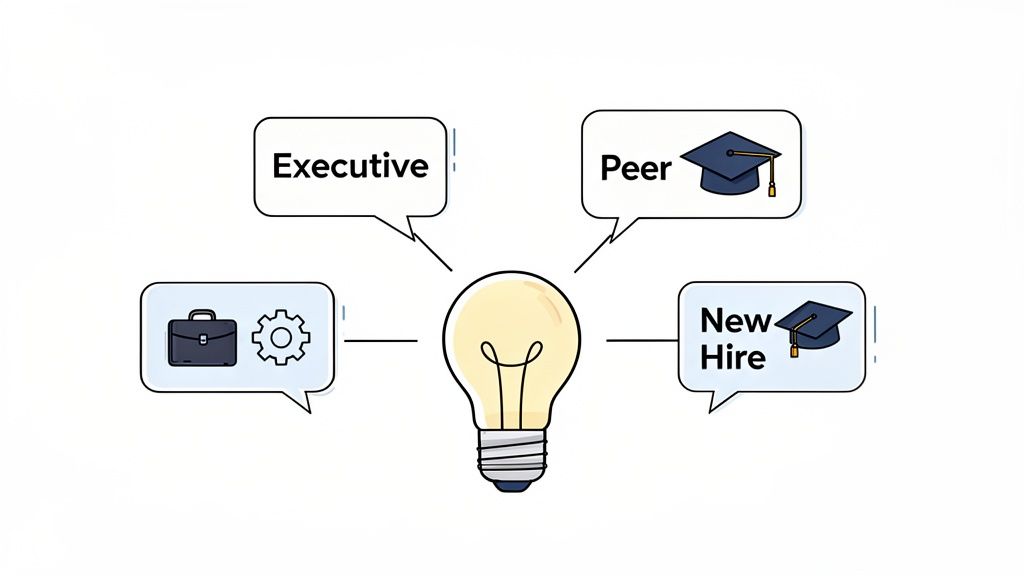
This is one of the more insightful and unique interview questions to ask candidates because understanding isn't just about knowing the details, but knowing which details to omit for a given audience. An engineer who can explain database indexing to a CFO in terms of cost savings and performance gains is as valuable as one who can debate the nuances of B-tree algorithms with a peer. This question is useful for senior roles, team leads, and anyone who needs to bridge the gap between technical and business teams.
What to Look For in an Answer
A great response demonstrates a clear, intentional shift in language, framing, and focus for each audience, while maintaining the core accuracy of the concept.
- Audience-Appropriate Framing: Does the candidate connect the concept to what each audience cares about? For a CFO, this means focusing on ROI, risk, or efficiency. For a peer, it's about technical implementation and trade-offs. For a new hire, it's about foundational principles.
- Jargon-Level Adjustment: Listen for their ability to strategically add or remove technical jargon. They should be able to simplify without being condescending and go into detail without being unclear. For example, explaining model overfitting to a product manager should focus on the user impact ("the model works on old data but fails on new customers") rather than the mathematical specifics.
- Core Concept Integrity: The simplification for a non-technical audience should not distort the fundamental truth of the concept. The core message must remain accurate across all three explanations, showing the candidate's understanding is robust.
Actionable Follow-Up Questions
- "What assumptions did you make about each of those audiences when you tailored your explanation?" (Reveals empathy and strategic thinking)
- "Which of those three explanations was the most difficult for you to prepare, and why?" (Uncovers self-awareness about communication strengths)
- "How would you confirm that the new hire actually understood your explanation?" (Assesses mentorship and feedback skills)
4. The Ambiguity Navigation Question: 'What questions would you ask before starting [vague, real-world project]?'
This question flips the script on traditional problem-solving interviews. Instead of giving a candidate a well-defined problem and asking for a solution, you present them with a vague, ambiguous, and incomplete brief that mirrors a real-world business challenge. The goal isn't to evaluate their final answer but to assess the quality of their clarifying questions and their process for defining the problem itself. It tests their critical thinking before their execution skills.
This approach is one of the more insightful unique interview questions to ask candidates because it reveals how they navigate uncertainty. Do they jump to a solution based on assumptions, or do they pause, probe, and gather context? It’s effective for roles that operate in complex environments with incomplete information, such as product managers, senior engineers, or data analysts. For instance, you might ask an engineering candidate, "We're rebuilding our search feature. What do you need to know before proposing an architecture?"
What to Look For in an Answer
A strong candidate resists the urge to provide an immediate solution. Instead, they become an investigator, using questions to build a solid foundation of understanding before proceeding.
- Structured Inquiry: Their questions should not be random. Look for a logical progression, starting with high-level business goals (e.g., "What is the primary business objective for this rebuild?") and moving to more specific constraints ("What are the performance and latency requirements? What’s the budget?").
- Stakeholder Awareness: Do they ask who the key stakeholders are? An excellent product manager might ask, "Whose input from sales, marketing, and support is critical before we begin?" This shows they understand the project's impact beyond the technical requirements.
- Prioritization and Scoping: A good response will include questions aimed at understanding priorities. For example, "What does success look like for this project in six months versus two years?" or "What are the absolute must-haves for the initial launch versus nice-to-haves?" This demonstrates a pragmatic and results-oriented mindset.
Actionable Follow-Up Questions
- "Of all the questions you just asked, which three are the most critical to get answered first, and why?" (Tests prioritization skills)
- "What is the single worst assumption someone could make when starting this project?" (Assesses risk awareness and foresight)
- "Let's assume you can't get answers to your most important questions. What would you do next?" (Reveals proactivity and resourcefulness)
5. The Tradeoff Reasoning Question: 'Tell me about a technology/approach you chose NOT to use and why that decision was right'
This question alters typical technical inquiries. Instead of asking what a candidate did use, it asks them to justify what they didn't use. This subtle shift moves the conversation from a simple recitation of tech stack experience to a deeper exploration of their decision-making framework, business acumen, and ability to weigh complex trade-offs. It helps separate architects from implementers.
This is one of the more unique interview questions to ask candidates because it assesses judgment over pure technical skill. An engineer's enthusiasm for a new framework is interesting, but their reasoned decision to reject it in favor of a more stable, practical solution for the business is valuable. This question is ideal for senior engineering, architecture, and product leadership roles where strategic technology choices have a significant impact on cost, maintenance, and scalability.
What to Look For in an Answer
A good answer demonstrates principled, not dogmatic, thinking. The candidate should be able to defend their decision by articulating the specific costs and benefits they evaluated, framed within the context of business or product goals.
- Contextual Reasoning: Do they connect their technical decision to business constraints? A strong answer sounds like: "We chose to build a responsive web app instead of a native one because our user data showed 95% of sessions were on desktop, and the faster time-to-market and lower maintenance overhead of a single codebase was a key business objective."
- Specific Trade-offs: Look for a clear "if-then" thought process. For example, a data scientist might say, "We opted against a complex deep learning model because the marginal 2% accuracy gain didn't justify the significant increase in inference latency and compute cost, which would have negatively impacted the user experience."
- Intellectual Humility: The best candidates acknowledge the strengths of the path not taken. They should be able to articulate the benefits of the rejected approach and explain why, on balance, those benefits were outweighed by the drawbacks for their specific situation.
Actionable Follow-Up Questions
- "Under what different circumstances would the approach you rejected have been the right choice?" (Tests flexibility and strategic thinking)
- "Who were the key stakeholders you had to convince, and what data did you use to make your case?" (Probes influence and communication skills)
- "What new information today might cause you to reconsider that decision?" (Reveals if they are open to evolving their viewpoint)
6. The Feedback Receptivity Question: 'Tell me about a time someone significantly changed your mind on something important'
This question is a useful tool for assessing intellectual humility, coachability, and collaboration. It bypasses the rehearsed "I welcome constructive criticism" answer and demands a specific story of personal evolution. Instead of asking how they handle feedback, it asks for proof that they can genuinely integrate it to the point of a fundamental perspective shift, revealing their capacity to learn and adapt.
This is one of the more insightful and unique interview questions to ask candidates because it can cut through ego. It helps identify individuals who prioritize the best idea over their own idea. This trait can be a predictor of success in fast-paced, collaborative environments where priorities and data can change rapidly, making it useful for roles in engineering, product, and leadership.
What to Look For in an Answer
A compelling response demonstrates vulnerability and a structured thought process. The candidate should be able to recount the story without defensiveness, focusing on the journey from their original stance to the new one.
- Genuine Perspective Shift: The change of mind should be significant, not trivial. A manager who initially believed in a top-down decision-making process but was convinced by their team's data that a decentralized model would yield better results is a strong example. They should articulate their original "why" and the new "why" with clarity.
- Credit and Respect: A great answer gives clear credit to the person or data that changed their mind. They should speak about the other party's viewpoint respectfully, indicating a healthy approach to disagreement. For example, "A junior engineer on my team presented an analysis I hadn't considered..."
- Logical, Not Just Emotional, Reasoning: The change should be rooted in logic, data, or a superior argument. An engineer explaining how they were convinced to use a different tech stack should be able to detail the technical trade-offs presented by their peer that ultimately won them over.
Actionable Follow-Up Questions
- "How did you verify the other perspective was actually correct before you adopted it?" (Tests critical thinking and learning rigor)
- "What would have happened if you hadn't changed your mind on that?" (Assesses their awareness of impact and consequences)
- "How has this experience changed how you approach similar situations today?" (Probes their ability to generalize lessons learned)
7. The Resource Scarcity Question: 'How would you accomplish [goal] with half the resources/team/budget you'd normally want?'
This question simulates the real-world pressures of a startup or high-growth environment where ambition often outpaces resources. It encourages candidates to move beyond ideal scenarios and demonstrate their ability to prioritize, solve problems creatively, and make strategic trade-offs under pressure. It's a direct test of a candidate's resourcefulness and business acumen.
This is one of the more insightful unique interview questions to ask candidates because it cuts through theoretical knowledge to reveal practical execution skills. It helps uncover who can innovate within constraints versus who might get stuck. This question is valuable for startups, scale-ups, and any team operating in a lean or fast-paced setting where doing more with less is a daily reality.
What to Look For in an Answer
A good answer isn't about simply "working harder" or cutting scope indiscriminately. It's a strategic exercise in prioritization, risk assessment, and creative problem-solving.
- Strategic Prioritization: Do they immediately start identifying the highest-impact activities and de-scoping lower-priority ones? A marketing candidate facing a 40% budget cut should be able to articulate why they'd focus on high-ROI organic channels like SEO while pausing expensive paid campaigns, and explain the data behind that decision.
- Creative Alternatives: The best candidates don't just subtract; they innovate. An engineering lead asked to build an MVP with half the team might propose using a low-code platform for the front-end or leveraging an existing open-source library to accelerate development, rather than just cutting features.
- Risk Acknowledgment: A realistic candidate will be transparent about the consequences. They should clearly state what breaks or what risks are introduced with this constrained approach. For example, "We can hit the sales target with half the team, but it means our lead response time will increase, and we risk brand perception if we can't service new accounts properly."
Actionable Follow-Up Questions
- "What is the first thing you would cut, and what is the last thing you would ever let go of?" (Tests their core value and priority-setting framework)
- "How would you communicate these necessary trade-offs to stakeholders or your team?" (Assesses communication, leadership, and expectation management)
- "What non-monetary resources could you leverage to help bridge the gap?" (Reveals creativity and ability to think outside the box)
8. The Curiosity-Driven Question: 'What's something you've learned recently that surprised you, and how did you apply it?'
This question is designed to assess a candidate's intellectual curiosity, their drive for continuous learning, and their ability to translate new knowledge into practical application. It moves beyond the generic "what are your hobbies?" or "how do you stay current?" by demanding a specific, recent example. This can reveal what genuinely captures a candidate's interest and whether they possess the initiative to turn insights into action.
As one of the more insightful unique interview questions to ask candidates, it can uncover a growth mindset in a way that direct questions often can't. A candidate who can articulate a learning-to-application loop demonstrates proactivity and an internal drive for improvement. This trait is valuable in fast-paced environments where roles and technologies constantly evolve, making it useful for engineering, product, data science, and operations roles.
What to Look For in an Answer
A strong response will connect a genuine interest to a tangible professional outcome. The candidate should be able to clearly articulate the "what," the "why," and the "how" of their recent learning experience.
- Recency and Specificity: The learning should be recent, not something from a college course years ago. A data scientist might mention taking a course on causal inference and immediately using it to challenge previously accepted correlations in a marketing model.
- The "Application" Bridge: The key is the connection between learning and doing. An operations leader who read about blameless postmortems and then describes how they successfully introduced them to their team's incident response process shows initiative.
- Source of Learning: Pay attention to where they learned the information. Was it from a conference, a technical blog, a book, a peer, or a formal course? This can offer clues about their preferred learning styles and how they engage with their professional community.
Actionable Follow-Up Questions
- "What would you do if you learned something new tomorrow that completely contradicted this?" (Tests intellectual humility and openness to change)
- "How did this new knowledge change your perspective on your previous way of doing things?" (Probes for self-reflection and critical thinking)
- "Who else on your team did you share this learning with, and what was their reaction?" (Assesses collaboration and knowledge-sharing habits)
9. The Failure Magnitude Question: 'What's the biggest scope failure you've recovered from, and what made recovery possible?'
This question advances beyond standard failure inquiries by focusing on two critical dimensions: scale and recovery. It’s designed to distinguish candidates who have only managed minor missteps from those who have navigated high-stakes situations and successfully steered projects back on course. The core of the question isn't the failure itself, but the resilience, strategic thinking, and leadership demonstrated during the recovery.
This is one of the more unique interview questions to ask candidates because it directly measures their crisis management capabilities and accountability under pressure. It reveals how they operate when the consequences are significant, making it useful for leadership, senior technical, or key operational roles where a single error can have a widespread impact.
What to Look For in an Answer
A compelling answer will be a narrative of accountability, problem-solving, and stakeholder management. The candidate should quantify the impact and clearly articulate the specific actions that enabled the recovery, moving beyond vague statements.
- Quantifiable Impact: Good candidates don’t shy away from the numbers. An engineer might say, "My code push caused a database migration that corrupted 48 hours of transactional data for 15% of our user base." This specificity shows they understand and own the full scope of the problem.
- Ownership of Recovery: Look for "I" and "we" used appropriately. For example, "I immediately assembled the incident response team and coordinated with eight different departments to rebuild historical data from backups." This shows leadership within a collaborative effort.
- Root Cause of Recovery: The candidate should pinpoint what made the recovery possible. Was it robust documentation, a well-rehearsed incident response plan, strong cross-functional relationships, or a specific technical choice? This reveals their understanding of organizational resilience.
Actionable Follow-Up Questions
- "Who was the most disappointed by this failure, and how did you personally work to rebuild their trust?" (Probes stakeholder management and empathy)
- "What's different about how you approach similar, high-stakes decisions now?" (Validates that they have implemented systemic learning)
- "What was the single most critical action that turned the situation around?" (Assesses their ability to prioritize under pressure)
10. The Preference Over Principle Question: 'Tell me about a time you disagreed with your manager/leader but went along anyway. How did you feel about that choice later?'
This is a nuanced evolution of the standard "tell me about a disagreement" prompt. It specifically targets situations where a candidate chose to defer, forcing them to reflect on their judgment and the line between healthy debate and organizational alignment. It reveals their understanding of when to push an issue of principle versus when to accept a difference in preference or strategy, a useful skill for navigating complex team dynamics.
This question uncovers a candidate's organizational savvy, emotional maturity, and ability to "disagree and commit." It’s particularly valuable for roles requiring influence without authority, such as project managers, senior individual contributors, and team leads, where knowing which battles to fight is as important as knowing how to fight them.
What to Look For in an Answer
A strong response will demonstrate introspection and learning, not just a justification of their actions. The candidate should be able to analyze the situation from multiple perspectives, including their manager’s, and articulate the long-term lesson.
- Nuanced Judgment: Do they distinguish between a disagreement over a core ethical principle versus a tactical difference of opinion? A good answer might sound like: "I advocated for more customer research before the feature launch but was overruled. The launch flopped. I learned that in that scenario, I should have escalated my concerns with more data earlier."
- Retrospective Wisdom: Look for genuine reflection on the outcome and their choice. An answer like, "I disagreed with the architecture choice, but my manager was new and I wanted her to succeed. In retrospect, I should have pushed harder on the technical debt risk," shows maturity and a forward-looking perspective.
- Emotional Integration: The "how did you feel" part is key. It probes whether they’ve truly processed the experience. An ideal answer acknowledges the initial frustration but focuses on the learning and how it shaped their future approach to professional disagreements.
Actionable Follow-Up Questions
- "If that exact situation happened again tomorrow, what, if anything, would you do differently?" (Tests whether they have internalized the lesson)
- "What was the impact of your decision to go along on your relationship with that manager?" (Assesses their understanding of professional capital)
- "How did that experience change your framework for when to push back versus when to align?" (Probes for the development of a durable mental model)
10 Unique Interview Questions: Comparison Matrix
| Question / Prompt | Implementation complexity | Resource requirements | Expected outcomes | Ideal use cases | Key advantages |
|---|---|---|---|---|---|
| The Behavioral Systems Question: "Walk me through your biggest professional failure and what systems you built to prevent it" | Moderate–High (needs deep probing) | Skilled interviewer time; follow-ups; examples | Reveals systems thinking, accountability, root-cause fixes | Engineering, Product, Operations, Data Science, Finance | Uncovers systemic learning; hard to game; predictive of retention |
| The Real-World Constraint Question: "Given [specific constraint], how would you approach [domain-specific problem]?" | Moderate (requires scenario design) | Well-defined job context; scoring rubric; prep time | Shows trade-off reasoning and pragmatic prioritization | Engineering, Data Science, Product, Consulting, Finance | Predictive of on-the-job decisions; measurable outcomes |
| The Communication Translation Question: "Explain [complex concept] to three different audiences" | Low–Moderate (structured prompt) | Multiple audience prompts; role-play or rubric | Measures clarity, audience-awareness, depth of knowledge | Cross-functional roles, Mentors, Leaders, Engineers | Predicts stakeholder effectiveness; easy to rubric |
| The Ambiguity Navigation Question: "What questions would you ask before starting [vague project]?" | Low–Moderate (requires interviewer restraint) | Ambiguous brief; time to observe clarifying questions | Assesses scoping, curiosity, risk identification | Product, Consulting, Engineering, Data Science, Ops | Predicts quality of solution framing and execution |
| The Tradeoff Reasoning Question: "Tell me about a technology/approach you chose NOT to use and why" | Moderate (needs probing for rationale) | Interview time; validation follow-ups | Reveals decision frameworks and opportunity-cost thinking | Senior Engineering, Product, Architecture, Data Science | Distinguishes principled choices; hard to fabricate |
| The Feedback Receptivity Question: "Tell me about a time someone changed your mind on something important" | Low (straightforward behavioral) | Interviewer follow-ups to validate authenticity | Shows intellectual humility, learning, openness | All functions; Leadership; Cross-functional roles | Predicts cultural fit and coachability |
| The Resource Scarcity Question: "How would you accomplish [goal] with half the resources?" | Moderate (needs clear constraints) | Precise constraint definitions; scoring; scenario prep | Measures resourcefulness, prioritization under scarcity | Startups, Growth-stage companies, Ops, Leadership | Identifies scrappiness and practical prioritization |
| The Curiosity-Driven Question: "What's something you've learned recently that surprised you, and how did you apply it?" | Low (open-ended) | Simple prompt; follow-up on application | Reveals continuous learning and applied curiosity | All functions; High-growth and technical roles | Exposes genuine interests and adaptability |
| The Failure Magnitude Question: "What's the biggest scope failure you've recovered from, and what made recovery possible?" | High (sensitive, deep probing) | Time for detailed narrative; careful behavioral probing | Shows resilience, crisis management, stakeholder recovery | Leadership, High-impact Engineering, Product, Sales, Ops | Predictive of crisis leadership and ownership |
| The Preference Over Principle Question: "Tell me about a time you disagreed with your manager but went along anyway" | Moderate (requires nuance probing) | Skilled interviewer to probe motives and hindsight | Evaluates judgment about deference vs. advocacy | Leadership development, Cross-functional, Managers | Reveals organizational awareness and emotional maturity |
From Asking Better Questions to Building a Better Process
Navigating the hiring process can feel like searching for a signal in noise. The questions we've explored, from assessing failure recovery to evaluating communication, are designed to boost that signal. They move beyond rehearsed answers and push candidates to reveal not just what they’ve done, but how they think, adapt, and learn.
These unique interview questions to ask candidates aren't about stumping someone with a clever "gotcha" moment. Instead, they serve as diagnostic tools. The Behavioral Systems Question uncovers a candidate's proactive approach to preventing future errors, while the Tradeoff Reasoning Question reveals their practical, real-world decision-making. Each one is a lens through which you can see a different facet of a candidate's professional character and competence.
Moving from Individual Questions to a Systemic Approach
The true value of these questions is realized when they become part of a deliberate, structured hiring process. A single great question in an unstructured interview is a good start, but a series of them, thoughtfully sequenced and consistently applied, is what can transform hiring from an art into a science.
Here are some takeaways to operationalize this approach:
- Focus on the "Why": For every question you ask, be clear on what signal you are trying to capture. Are you testing for resilience, strategic thinking, or humility? Defining the intent ensures your evaluation is purposeful.
- Consistency is Key: To compare candidates fairly, create a consistent experience. Use a standardized scorecard based on the signals you're looking for. This can minimize bias and help you make evidence-based decisions.
- Contextualize Everything: The most effective questions are grounded in reality. Adapt the scenarios and constraints to reflect the actual challenges the candidate would face in the role. This makes the exercise more engaging for them and the data more relevant for you.
Integrating Questions into a Modern Hiring Workflow
Rethinking your questions is the first step; rethinking your process is the next. Consider which questions are best suited for different stages. A question about navigating ambiguity might be a good fit for an initial asynchronous assessment, allowing you to see a candidate's thought process raw and unfiltered. In contrast, a question about receiving difficult feedback is often best reserved for a live conversation where nuance and empathy can be observed.
To master the art of selecting and asking unique interview questions, delve deeper into the foundational principles of how to ask better questions. Understanding the cognitive science behind inquiry can elevate your ability to craft and deliver questions that yield useful insights.
Ultimately, the goal is to build a hiring engine that reliably identifies the right people for your team. It's about moving past résumés and rehearsed answers to understand how a person thinks, solves problems, and collaborates. By embedding these more insightful, evidence-based questions into your process, you can start building the resilient, innovative, and capable team that will define your organization's future.
Ready to move beyond asking better questions to building a better evaluation process? Some companies use role-specific, interactive assessments at scale, giving every candidate a chance to showcase their real-world skills. See how you can build a hiring process that consistently identifies top performers by exploring Cohesyve.