In today's competitive market, traditional hiring methods based on resumes and gut feelings are falling short. The costs of a bad hire, from lost productivity to team disruption, can reach up to 2.5 times an employee's salary. Relying on pedigree and keywords often filters out high-potential candidates while letting poor fits through. The solution is not about working harder; it is about working smarter by adopting a more precise, fair, and evidence-based approach to hiring.
This guide breaks down 10 modern talent acquisition best practices that move beyond guesswork to build high-performing teams. We will explore how to shift from screening resumes to verifying actual skills, use technology to create fairer assessments, and leverage data to make confident, repeatable hiring decisions. These are not just theories; they are actionable strategies designed to help you identify and hire the right people, faster.
Inside, you will find practical steps for implementing a more effective hiring process, including:
- Skill-Based Hiring: Moving past resume keywords to assess what candidates can actually do.
- Adaptive Assessment Design: Creating dynamic tests that challenge candidates appropriately.
- Bias Reduction: Implementing fair and equitable evaluation practices.
- Data-Driven Decisions: Using metrics to refine your process and improve outcomes.
This article is a blueprint for transforming your talent acquisition strategy. Each section provides concrete examples, key performance indicators (KPIs), and clear implementation guidance to reduce bad hires and build the team your company needs to succeed. Let’s get started.
1. Skill-Based Hiring Over Resume Screening
Traditional resume screening often acts as a proxy for skill, relying on university prestige, previous company logos, and years of experience. This method can inadvertently filter out high-potential candidates who lack conventional credentials. One of the most impactful talent acquisition best practices is to shift focus from a candidate’s past (their resume) to their present capabilities (their skills).
Skill-based hiring prioritizes what a candidate can do over what they’ve done. It evaluates core competencies through practical assessments, ensuring the person selected has the demonstrated ability to excel in the role from day one. This approach not only improves predictive validity for job performance but also broadens the talent pool by including individuals from non-traditional backgrounds.
How to Implement Skill-Based Hiring:
- Map Critical Competencies: Begin by dissecting the job description to identify 3-5 non-negotiable, role-specific skills. For a Senior Software Engineer, this might be system design, API development, and database management. For a Financial Analyst, it could be financial modeling, data visualization, and discounted cash flow (DCF) analysis.
- Use Multi-Faceted Assessments: Triangulate a candidate's abilities using a mix of assessment formats. Combine a practical coding challenge with a case study presentation or a role-playing exercise to get a holistic view of their technical and soft skills.
- Establish Clear Benchmarks: Define what "good" looks like before you start evaluating candidates. Set clear, objective scoring rubrics for each assessment to minimize bias and ensure consistent evaluation across your interview panel. For example, a successful case study solution must identify at least 80% of key variables and propose two viable strategies.
Tech giants like Google and IBM have successfully adopted this model, de-emphasizing degree requirements to focus on proven skills. This strategy reduces bias and directly addresses talent shortages by uncovering hidden gems in the market. To get a more detailed look at the methodology, you can explore further resources on what is skills-based hiring and how it creates a more equitable and effective hiring process.
2. Adaptive and Dynamic Assessment Design
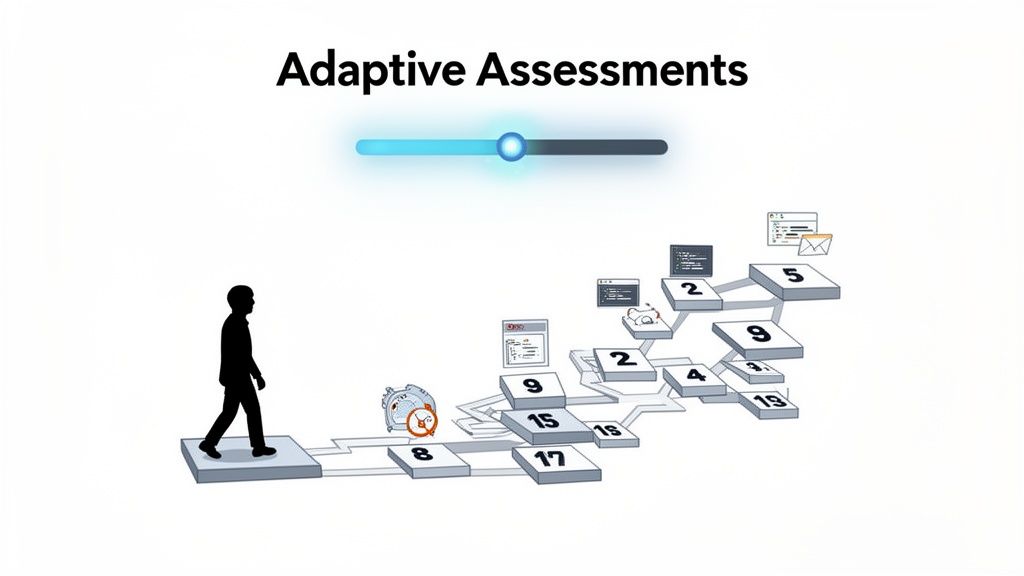
Static, one-size-fits-all assessments often fail to capture the true depth of a candidate's abilities. They can be too easy for top performers, leading to ceiling effects, or too difficult for others, causing unnecessary candidate drop-off. A more advanced talent acquisition best practice is to implement adaptive assessments that adjust in real-time based on a candidate’s responses.
This dynamic approach provides a personalized evaluation experience, calibrating question difficulty to accurately pinpoint a candidate's true skill level. Instead of a fixed test, the assessment becomes a responsive conversation that gathers more precise data in less time. This method not only improves measurement accuracy but also enhances the candidate experience by keeping them engaged with relevant, challenging questions.
How to Implement Adaptive and Dynamic Assessments:
- Define Skill Dimensions and Objectives: Before building any logic, clearly map the specific skills and proficiency levels you need to measure. For a Data Scientist role, this could mean defining separate adaptive paths for Python proficiency, statistical knowledge, and machine learning principles.
- Build a Calibrated Question Bank: Develop a large pool of questions tagged by skill and difficulty level. Use data from initial pilot tests or existing assessments to establish a baseline for question difficulty, which will feed the adaptive algorithm.
- Implement Adaptive Logic: Start with a question of medium difficulty. If the candidate answers correctly, the next question is harder; if they answer incorrectly, the next one is easier. This process, known as Computerized Adaptive Testing (CAT), efficiently hones in on their competency level.
- Monitor and Refine: Track metrics like average assessment duration, completion rates, and the correlation between assessment scores and on-the-job performance. Use this data to continually refine the adaptive algorithm and ensure the assessment remains challenging but fair.
Pioneered in standardized testing like the GMAT and GRE, this methodology is now being adopted by tech platforms. For example, some coding platforms adjust the difficulty of subsequent challenges based on a developer’s initial performance. Similarly, modern skill verification tools can auto-generate tailored questions from a job description, ensuring the assessment is both dynamic and highly relevant to the role. This approach ensures you are measuring potential with precision, not just administering a test.
Cohesyve
See what candidates can do before you interview them
Cohesyve turns your job description into a role-specific assessment with a scoring rubric. Each candidate gets a different version, so questions cannot be shared. Ten candidates free, no card.
3. Multi-Format Assessment Integration
Relying on a single assessment method, like a traditional interview or a multiple-choice quiz, captures only one dimension of a candidate’s potential. A more robust and predictive approach involves integrating multiple assessment formats. This talent acquisition best practice uses triangulation to create a holistic profile, evaluating distinct capabilities like technical skill, communication, judgment, and practical problem-solving.
This method provides a more complete picture of candidate suitability by combining different types of evidence. By layering assessments such as coding challenges, case studies, and role-playing exercises, you can see how a candidate thinks, communicates, and executes. This comprehensive view reduces the risk of making a hiring decision based on a single, potentially misleading, data point.

How to Implement Multi-Format Assessment Integration:
- Map Formats to Competencies: Start by linking specific assessment types to the core competencies of the role. For instance, use a coding challenge to test technical proficiency, a case study to evaluate strategic thinking, and a voice role-play to assess client communication skills.
- Weight Assessments by Criticality: Not all skills are equally important. Assign weights to each assessment based on its relevance to job performance. For a Sales Engineer, the technical demo (40%) might be weighted more heavily than the written proposal (30%) or behavioral interview (30%).
- Create Unified Scoring Frameworks: Develop a consistent, objective scoring rubric that applies across all assessment formats. This allows you to standardize evaluations and fairly compare candidates, even when they are assessed by different interviewers using different methods. For example, a "Communication" score could be derived from performance in a presentation, a role-play, and an interview.
Consulting firms like McKinsey have long used this model, combining case interviews, problem-solving tests, and personal experience interviews to build a complete candidate profile. Similarly, modern assessment platforms like Cohesyve allow teams to combine coding tasks, critiques of flawed work and voice role-plays in a single evaluation. This integrated approach ensures the candidate you hire is not just technically skilled but also a strong communicator and effective problem-solver.
4. Bias Reduction and Fair Assessment Practices
Even the most well-intentioned hiring managers are susceptible to unconscious bias, which can lead to homogenous teams and overlooking exceptional talent. One of the most critical talent acquisition best practices is to systematically engineer fairness into the hiring process. This means moving away from subjective "gut feelings" and toward structured, evidence-based evaluation methods that give every candidate an equitable opportunity.
Bias reduction isn't about ignoring differences; it's about ensuring that hiring decisions are based solely on a candidate's ability to perform the job. By implementing fair assessment practices, organizations can build more diverse, innovative, and high-performing teams. This approach mitigates legal risks associated with unfair hiring and strengthens the employer brand by demonstrating a genuine commitment to diversity, equity, and inclusion.

How to Implement Fair Assessment Practices:
- Standardize the Interview Process: Use structured interviews where every candidate for a specific role is asked the same set of predetermined questions. This ensures consistency and allows for a more direct, apple-to-apples comparison of responses against a pre-defined scoring rubric.
- Anonymize Initial Screenings: Remove identifying information such as names, photos, and university names from resumes and applications during the initial review phase. This "blind screening" technique forces evaluators to focus purely on skills and experience, reducing the influence of affinity or confirmation bias.
- Diversify the Hiring Panel: Involve a diverse group of interviewers in the evaluation process. Different perspectives and backgrounds can help identify and challenge potential biases within the panel, leading to more balanced and well-rounded hiring decisions. For example, a panel for a Product Manager role could include an engineer, a designer, and a current product leader.
- Conduct Regular Audits: Routinely analyze your hiring data to identify potential disparities. Track key metrics like pass-through rates and offer acceptance rates across different demographic groups. An adverse impact analysis can reveal systemic issues in your process that need to be addressed.
Companies like Unilever have successfully integrated these principles by using game-based assessments and video interviews that strip away demographic data, focusing evaluators on objective performance indicators. Similarly, many organizations now follow guidelines from the Society for Industrial-Organizational Psychology (SIOP) to validate their assessments and ensure they are fair and predictive of job success.
5. Speed-to-Quality Optimization Through Instant Ranking
In a competitive market, top candidates are often off the market in just 10 days. A slow hiring process not only loses high-potential talent but also signals inefficiency to applicants. One of the most critical talent acquisition best practices is to optimize for both speed and quality by using technology to identify top performers instantly, eliminating the manual, time-consuming review of shortlists.
This approach focuses on moving the strongest candidates forward immediately after they complete an assessment, based on pre-set performance benchmarks. By using tools that provide instant result ranking and analytics, hiring teams can make same-day decisions, significantly reduce time-to-hire, and keep top-tier candidates engaged by demonstrating momentum and respect for their time.
How to Implement Instant Ranking:
- Establish Performance Thresholds: Before sending assessments, define what constitutes a top performer. Set clear, objective scoring thresholds that automatically qualify a candidate for the next stage. For example, any candidate scoring above 85% on a technical assessment is immediately fast-tracked for a final interview.
- Automate Interview Scheduling: Connect your assessment platform to your scheduling tools. When a candidate meets the pre-defined threshold, an interview scheduling link can be triggered automatically. This removes administrative delays and capitalizes on the candidate's peak engagement.
- Enable Parallel Processing: Use instant ranking data to share top candidate profiles with the entire hiring team simultaneously. This allows interviewers, hiring managers, and recruiters to review results and prepare for next steps in parallel rather than in a slow, sequential process.
Companies like Stripe and Google have refined their processes to move exceptional candidates from assessment to offer with remarkable speed, preventing competitors from poaching their top choices. Modern platforms like Cohesyve enable this by providing the instant analytics needed to skip bloated shortlists and act decisively. This strategy ensures you maintain high assessment standards without sacrificing the agility required to secure the best talent.
6. Role-Specific Assessment Customization
Generic, off-the-shelf assessments often fail to capture the unique nuances and critical success factors of a specific role within your organization. This one-size-fits-all approach can lead to evaluating candidates on irrelevant criteria while overlooking the core competencies that truly predict success. Role-specific assessment customization is one of the most effective talent acquisition best practices because it aligns the evaluation process directly with the on-the-job reality of a position.
This practice involves deconstructing a role to its essential components and building an assessment that mirrors the actual challenges and tasks the new hire will face. Instead of asking a generic "problem-solving" question, you present a candidate with a real-world business scenario they would encounter in their first 90 days. This method provides a far more accurate signal of a candidate’s potential performance and ensures you’re hiring for the job that exists, not just the title on the job description.
How to Implement Role-Specific Assessment Customization:
- Conduct a Detailed Job Analysis: Go beyond the standard job description. Interview high-performing employees and hiring managers to understand the 3-5 critical activities that differentiate top performers from average ones. What problems do they solve daily? What tools do they use? What stakeholder interactions are most crucial?
- Weight Components by Importance: Not all skills are created equal for a given role. For a customer-facing Sales Engineer, communication and presentation skills might be weighted at 40%, while deep technical knowledge is 60%. For a backend developer on the same team, that ratio might be inverted to 10/90. Adjust your assessment scoring to reflect this reality.
- Involve Subject Matter Experts (SMEs): Partner with hiring managers and team leads to design and validate the assessment content. Their expertise ensures the scenarios are relevant, challenging, and accurately reflect the work. This collaboration also builds buy-in and confidence in the hiring process.
Companies like Accenture and IBM have long used this model to tailor evaluations for different consulting areas and engineering specialties, ensuring new hires have the precise skills needed for their specific team. This targeted approach significantly improves hiring accuracy by measuring what truly matters for performance in a particular context. To learn more about how this works in practice, explore platforms that facilitate auto-generated, role-specific assessments for a variety of functions.
7. Candidate Experience as a Competitive Differentiator
In a competitive market, how candidates feel during the hiring process directly impacts your ability to attract and secure top talent. A negative experience can deter high-quality applicants, damage your employer brand, and lead to offer rejections. Treating candidate experience as a core talent acquisition best practice means designing every interaction to be engaging, respectful, and reflective of your company’s values.
This approach transforms the hiring process from a one-sided evaluation into a mutual discovery. When candidates feel valued, they are more likely to accept an offer, refer others to your company, and maintain a positive brand impression, even if they aren't hired. A thoughtful process signals a healthy and organized company culture, making your organization a more attractive place to work.
How to Implement a Candidate-Centric Experience:
- Design Respectful and Relevant Assessments: Ensure assessments mirror the actual work they will be doing. Instead of abstract puzzles, use real-world problems. Keep assessments focused and to a reasonable length, typically 15-30 minutes, and optimize them for mobile devices, as many candidates will complete them on their phones.
- Prioritize Transparency and Communication: Send an immediate confirmation after an application is received and clearly outline the expected timeline for next steps. Provide constructive feedback to all candidates who participate in later-stage interviews, not just those who receive an offer. This simple act builds immense goodwill.
- Gather Feedback and Iterate: Treat your hiring process like a product. Actively solicit feedback from candidates about their experience, using surveys or informal check-ins. Use this data to identify friction points and continuously refine your process to be more efficient and engaging.
Companies like Stripe and Zapier are known for their meticulously designed, candidate-first hiring processes, which include providing detailed feedback and maintaining clear communication. Similarly, Unilever’s use of game-based assessments has been praised for boosting candidate engagement. To dive deeper into actionable strategies, explore further resources on how to improve candidate experience and create a process that wins over top talent.
8. ATS Integration and Workflow Compatibility
Disjointed hiring tools are a major source of friction in talent acquisition, creating data silos and requiring recruiters to perform manual, repetitive tasks. One of the most critical talent acquisition best practices for operational efficiency is ensuring new assessment tools seamlessly integrate with your existing Applicant Tracking System (ATS). This approach avoids creating parallel processes, centralizing all candidate data and actions within a single source of truth.
True integration means assessment results, candidate status, and communications are automatically synced, eliminating the need for manual data entry and context switching. It allows hiring teams to leverage the power of specialized assessments without disrupting the established workflows they already rely on. This cohesion streamlines the entire process, reduces the risk of human error, and provides a more unified view of the candidate journey.
How to Implement Seamless ATS Integration:
- Map and Audit Your Current Workflow: Before evaluating any new tool, document every step of your existing hiring process from application to offer. Identify key handoffs, communication points, and where assessment data needs to flow into the ATS. This map becomes your integration blueprint.
- Prioritize Tools with Robust APIs: Select assessment platforms and an ATS known for their strong third-party integration capabilities, like Greenhouse, Lever, or Workable. Look for pre-built integrations that require minimal setup and offer deep functionality, such as automatically updating a candidate's status based on their assessment score.
- Test and Train Thoroughly: Conduct a pilot program with a small group of recruiters and hiring managers to test the integration in a real-world scenario. Document the process, create training guides, and establish a clear contingency plan for manual workarounds in case the integration temporarily fails.
Platforms that prioritize workflow compatibility empower teams to adopt advanced assessments without overhauling their tech stack. To maximize the efficiency of your ATS and streamline your talent acquisition workflows, considering robust document management best practices can also ensure that all associated files are organized and accessible. This holistic approach to system management creates a more scalable and efficient hiring engine.
9. Measurement of Practical Ability and Job Readiness
Hiring for potential is a gamble; hiring for proven, practical ability is a strategic investment. While general intelligence and learning ability are valuable, they don't guarantee a candidate can perform the specific tasks required from day one. One of the most critical talent acquisition best practices is to directly measure a candidate's job readiness through realistic, hands-on assessments that mirror the actual work they will be doing.
This approach shifts the evaluation from "Could they learn to do this?" to "Can they do this right now?" It involves using job simulations and real-world problems to gauge a candidate's ability to immediately contribute, significantly reducing onboarding time and minimizing early-stage performance gaps. It’s the ultimate test of applied skill, offering a clear preview of a candidate's future performance.
How to Implement Practical Ability Measurement:
- Develop Work Sample Tests: Create assessments based on real problems your team has recently solved. For a DevOps Engineer, this could be a task to debug a faulty CI/CD pipeline configuration. For a Product Manager, it might be writing a brief and user stories for a hypothetical feature based on provided customer feedback.
- Use Realistic Job Previews: Go beyond simple coding challenges or case studies. Platforms like Cohesyve put candidates in job simulations built from the role, such as a spreadsheet to work through, an email to answer or a customer conversation. This allows you to observe how a candidate navigates a realistic problem and communicates their thought process, much as they would on the job.
- Establish Performance-Based Rubrics: Score candidates on their practical contribution, not just theoretical correctness. Your rubric should evaluate their problem-solving approach, efficiency, and the quality of their final output. Award partial credit for sound reasoning even if the final answer isn't perfect, as this reflects real-world troubleshooting.
Companies like Google and Deloitte have long relied on practical assessments, such as system design problems and consulting case interviews, to ensure new hires are job-ready. This methodology’s strength lies in its high predictive power. You can dive deeper into the science behind this with these content validity examples, which show how well an assessment represents actual job duties.
10. Data-Driven Decision Making and Hiring Metrics
Intuition and "gut feelings" have long played a role in hiring, but they are often unreliable and prone to bias. One of the most transformative talent acquisition best practices is shifting from subjective evaluation to data-driven decision-making. This approach uses quantitative metrics to measure, analyze, and optimize every stage of the hiring funnel, turning recruitment into a strategic, evidence-based function.
By tracking key performance indicators (KPIs), organizations can identify bottlenecks, validate the effectiveness of their assessment methods, and continuously improve their processes. This data-centric mindset moves hiring from an art to a science, ensuring that decisions are based on objective evidence rather than tradition or personal preference. It provides a clear, measurable link between recruiting activities and business outcomes like performance and retention.
How to Implement Data-Driven Hiring:
- Define and Track Core Metrics: Start by identifying the KPIs that matter most to your organization. Key metrics often include time-to-hire, cost-per-hire, offer acceptance rate, and source-of-hire effectiveness. For a more advanced analysis, track assessment pass rates and candidate drop-off points to identify friction in your process.
- Measure Quality of Hire: The ultimate test of any hiring process is the quality of the people it brings in. Establish a "quality of hire" metric by correlating pre-hire assessment data with post-hire performance reviews (at 90 days and one year), ramp-up time, and employee retention rates. This feedback loop validates which interview techniques actually predict on-the-job success.
- Conduct Regular Bias Audits: Use data to ensure equitable outcomes. Regularly analyze hiring funnel metrics across different demographic groups (e.g., gender, ethnicity) to identify and address any potential bias in sourcing, screening, or interviewing stages. This ensures your commitment to DEI is backed by measurable action.
Companies like Google and Slack have pioneered this approach, using people analytics to refine everything from job descriptions to interview questions. By grounding your strategy in solid data, you can build a more efficient, fair, and predictable talent acquisition engine. For a deeper dive, you can explore resources on how to leverage recruiting metrics to drive strategic improvements.
10-Point Talent Acquisition Best Practices Comparison
| Approach | Implementation complexity | Resource requirements | Expected outcomes | Ideal use cases | Key advantages |
|---|---|---|---|---|---|
| Skill-Based Hiring Over Resume Screening | Medium — requires redesign of evaluation criteria | Assessment design time, hiring team training, role analysis | Higher-quality hires, broader talent pipeline, reduced turnover | Roles where demonstrated tasks predict success; diversity initiatives | Predictive of performance; reduces resume bias; expands candidate pool |
| Adaptive and Dynamic Assessment Design | High — needs AI/ML and psychometric calibration | ML infrastructure, validation data, engineering and analytics | More precise measurement with shorter tests; improved candidate experience | High-volume technical screening; large-scale assessments | Personalized difficulty, better accuracy, reduced cheating risk |
| Multi-Format Assessment Integration | High — complex scoring and format coordination | Platform development, SME input, multiple rubrics and graders | Comprehensive view of candidates across skills and behaviors | Senior, cross-functional, or hybrid-skill roles | Triangulates hard and soft skills; more defensible hiring decisions |
| Bias Reduction and Fair Assessment Practices | Medium — continuous monitoring and iterative design | I/O expertise, analytics for audits, training for raters | More equitable outcomes, legal defensibility, improved diversity | Regulated industries; organizations pursuing diversity and fairness | Consistent evaluations; reduced adverse impact; stronger compliance |
| Speed-to-Quality Optimization Through Instant Ranking | Medium — requires validated scoring and fast workflows | Real-time analytics, integration with hiring calendars, responsive teams | Faster time-to-hire, higher engagement, quicker selection of top talent | Competitive hiring markets; high-demand roles where speed matters | Rapid identification of top performers; improved offer acceptance |
| Role-Specific Assessment Customization | Medium — role analysis and tailored item creation | SME involvement, job analysis tools, template maintenance | Higher predictive validity for role fit; fewer false positives | Specialized technical or function-specific positions | Direct alignment to job needs; more relevant evaluations |
| Candidate Experience as a Competitive Differentiator | Low–Medium — design and communication focus | UX/design investment, clear communications, feedback processes | Higher acceptance rates, positive employer brand, lower dropouts | Market-facing roles; talent-short environments; employer-branding focus | Better engagement; stronger word-of-mouth; improved data quality |
| ATS Integration and Workflow Compatibility | Medium — integration and testing work needed | Integration engineering, API support, ongoing maintenance | Reduced manual work, single source of truth, higher adoption | Organizations dependent on ATS and structured workflows | Seamless workflows; consolidated candidate data; easier reporting |
| Measurement of Practical Ability and Job Readiness | Medium — realistic scenario design and validation | SMEs, real-world tasks, longer assessment development | Faster time-to-productivity, fewer onboarding surprises | Roles needing immediate contribution (engineering, ops, support) | Strong prediction of day-one performance; actionable onboarding data |
| Data-Driven Decision Making and Hiring Metrics | High — analytics infrastructure and governance | Data engineers, analysts, tracking systems, privacy controls | Continuous process improvement, validated ROI, bottleneck insight | Scaling organizations; centers of excellence; process optimization | Objective insights; measurable impact; enables evidence-based changes |
From Best Practices to Better Hires
Navigating the complexities of modern hiring can feel like a challenging task, but the solution lies not in adding more steps, but in adding more precision. The ten talent acquisition best practices detailed in this guide share a unifying theme: a strategic shift away from subjective assumptions and toward objective evidence. Moving beyond resume-based screening to prioritize verified, practical skills is the foundational change that unlocks a more effective, equitable, and predictive hiring model.
This evolution improves your entire talent funnel. By integrating adaptive, role-specific assessments and using data-driven insights, you stop guessing and start knowing. You gain the ability to identify top performers based on what they can actually do, not just what their resume claims. This data-first approach systematically reduces unconscious bias, creating a level playing field where talent from all backgrounds can demonstrate their true capabilities.
Key Takeaways for Immediate Impact
Improving your hiring function is an ongoing process. To make these concepts tangible, focus on these critical takeaways:
- Evidence Over Inference: The single most impactful change you can make is to stop inferring ability from credentials and start measuring it directly. A candidate’s practical skill is the most reliable predictor of their future job performance.
- Experience is Non-Negotiable: A fast, fair, and transparent candidate experience is no longer a "nice-to-have." It is a competitive differentiator that directly impacts your employer brand and your ability to attract and close top-tier talent.
- Data is Your North Star: You cannot improve what you do not measure. Implementing key metrics like Time to Hire, Quality of Hire, and Assessment Pass-Through Rate provides the critical feedback loop needed for continuous optimization.
- Technology as an Enabler: The right technology, particularly your Applicant Tracking System and assessment platform, should remove friction, not create it. Seamless integrations are essential for maintaining momentum and ensuring a smooth workflow for both candidates and recruiters.
Your Actionable Roadmap to Hiring Excellence
Adopting these advanced talent acquisition best practices doesn't require a complete overhaul overnight. Instead, it's about making incremental, high-impact changes. Start by selecting one or two areas that represent your biggest challenges. Is it the sheer volume of unqualified applicants? Begin with implementing skill-based pre-screening assessments. Are you concerned about interview consistency? Focus on building structured interview kits and calibrating your hiring panels.
The ultimate goal is to build a resilient, scalable hiring engine. Such an engine not only fills open roles faster but also fills them with individuals who are poised to succeed, contribute meaningfully, and grow with your organization. By focusing on objective skills, fairness, and a superlative candidate experience, you build more than just a process; you build a sustainable competitive advantage. The result is a more diverse, more capable, and more engaged workforce ready to tackle the challenges of tomorrow.
Ready to transform your hiring process from a subjective art to a data-driven science? See how Cohesyve automates role-specific skill assessments to help you identify and hire top talent with confidence and precision. Explore our platform to see these talent acquisition best practices in action at Cohesyve.