The traditional interview often tests memory, not capability. Candidates tell you what they have done, but how do you know what they can do for your team when faced with new challenges? This is the gap that situational questions are designed to fill. By presenting realistic, role-specific scenarios, you move beyond rehearsed answers and observe a candidate's judgment, problem-solving abilities, and communication skills in action.
Past performance is not always a perfect predictor of future success, especially in dynamic environments. Effective situational interview questions examples prompt candidates to think on their feet, revealing how they approach ambiguity, conflict, and pressure. While the average hiring process can involve screening hundreds of resumes, a well-structured situational interview helps you focus on suitable candidates more quickly by assessing their practical competence.
This guide provides a look into 10 useful situational questions. For each one, we will break down what it measures, provide examples of strong and weak answers, and offer quick evaluation tips. The goal is to equip you with the tools to build a team that can confidently navigate tomorrow’s challenges, not just recount yesterday’s successes.
1. Handling a Missed Deadline Under Pressure
This common scenario is one of the most revealing situational interview questions examples because it gets directly to a candidate's sense of accountability, communication style, and problem-solving abilities. The question isn't just about failure; it's a window into resilience. You're assessing if a candidate defaults to excuses or proactively seeks solutions.
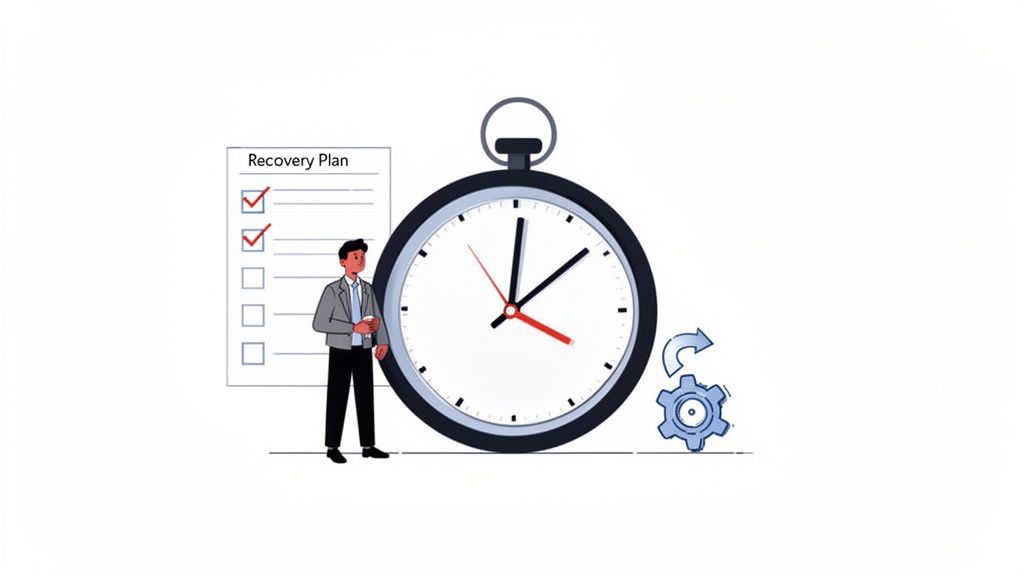
A strong response demonstrates immediate ownership and a clear communication plan. Instead of waiting for the deadline to pass, a prepared candidate would describe how they flagged the risk early, quantified the potential impact, and came to their manager with a proposed recovery plan. This approach is a core component of effective, skills-based hiring.
Strategic Insight: The best answers focus on mitigation and communication before the deadline is even missed. This shows foresight and a team-oriented mindset, shifting the focus from personal failure to collective problem-solving.
Evaluation Quick Tips
- Ownership vs. Blame: Does the candidate accept responsibility ("I misjudged the complexity") or deflect ("The other team was late")?
- Proactive Communication: Did they raise the alarm early or wait until it was too late?
- Solution-Oriented: Do they present a clear, actionable plan to get back on track?
- Learning: What steps would they take to prevent a recurrence?
A weak answer is vague, defensive, or lacks a concrete plan. A strong one provides a step-by-step account of taking control of a difficult situation.
2. Navigating Conflict with a Team Member or Peer
This scenario is one of the most effective situational interview questions examples for evaluating a candidate's interpersonal skills and emotional intelligence. Workplace disagreements are inevitable; what matters is how an individual handles them. This question reveals if a candidate escalates conflict, avoids it entirely, or approaches it constructively to find common ground and preserve relationships.
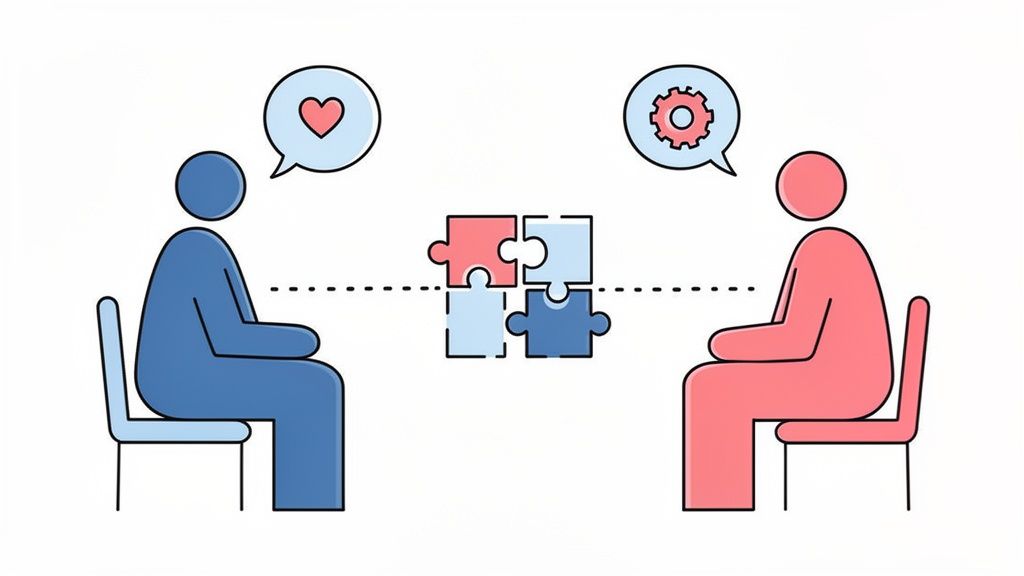
A strong answer centers on empathy and a desire to understand the other person's perspective before pushing for a solution. For instance, a candidate might describe a disagreement with a designer over creative direction, explaining how they scheduled a one-on-one to listen to the designer's rationale, connected it to shared project goals, and then proposed a compromise. This demonstrates a problem-solving mindset applied to people, not just tasks.
Strategic Insight: The best candidates separate the person from the problem. They don't make it personal ("You are wrong"). Instead, they focus on the shared objective ("How can we best achieve our goal?") and seek to understand the underlying interests driving the other person's position.
Evaluation Quick Tips
- Empathy vs. Ego: Does the candidate seek to understand the other person's viewpoint or just prove they were right?
- De-escalation: Do they describe actions that calmed the situation (e.g., taking the conversation offline) or fueled it?
- Professionalism: Did they maintain a respectful tone and focus on a professional resolution?
- Growth Mindset: Do they reflect on what they learned from the conflict, using phrases like "In hindsight..." or "I learned that..."?
A weak response focuses on being "right" or describes complaining to a manager without first trying to resolve the issue directly. A strong answer shows maturity, self-awareness, and a commitment to collaboration.
Cohesyve
See what candidates can do before you interview them
Cohesyve turns a job description into a role-specific assessment with a scoring rubric. Each candidate gets a different version, so questions cannot be shared. Ten candidates free, no card.
3. Managing Ambiguity in Requirements or Unclear Project Scope
This question is useful for roles where initiative and clarity are important, especially in fast-growing or innovative environments. It's one of the most practical situational interview questions examples because it simulates a common workplace reality: receiving a task with incomplete information. The goal is to see if a candidate freezes, makes risky assumptions, or proactively seeks to create structure.
A top candidate won't just ask for more details; they will frame their clarifying questions to show strategic thinking. For instance, an operations manager tasked with "improving efficiency" might ask about current baseline metrics, key business goals for the quarter, and acceptable trade-offs (e.g., cost vs. speed). This demonstrates an ability to define success criteria when none are provided. This approach evaluates a candidate's ability to perform job-critical tasks.
Strategic Insight: A superior response transforms the ambiguous request into a collaborative discovery process. The candidate demonstrates they are a partner in defining the problem, not just a passive recipient of instructions.
Evaluation Quick Tips
- Clarification vs. Assumption: Do they ask targeted questions to reduce ambiguity or charge ahead with unstated assumptions?
- Structure Creation: Can they propose a framework or a phased approach to tackle the vague objective?
- Proactive Framing: Do they connect the task to broader business goals ("To help me prioritize, what's the main outcome we're driving?")?
- Comfort Level: Do they appear energized by the challenge (an explorer) or frustrated by the lack of direction (anxious)?
A weak answer involves guessing what the manager wants or complaining about the lack of detail. A strong one outlines a clear, logical process for turning a fuzzy idea into an actionable plan.
4. Learning a New Technology or Skill Quickly Under Time Pressure
This question is a good indicator of a candidate's learning agility and growth mindset. It’s one of the most practical situational interview questions examples for modern roles, where tools and requirements change rapidly. You're looking for evidence of a structured, resourceful approach to self-improvement under a deadline, not just a claim that they are a "fast learner."
A strong answer moves beyond a simple "I learned it" and details the process of learning. For instance, a data analyst required to use a new BI tool might describe how they first reviewed the official documentation for core concepts, then found targeted tutorials for their specific reporting needs, and finally built a small-scale prototype to validate their understanding before applying it to the main project. A systematic approach like this can provide more reliable hiring signals.
Strategic Insight: The best candidates don't just consume information; they actively apply it. They break down the learning process into manageable steps, seek feedback, and iterate. This demonstrates resourcefulness and a commitment to genuine understanding, not just surface-level familiarity.
Evaluation Quick Tips
- Learning Method: Did they have a clear process (documentation, peers, trial-and-error) or was their approach haphazard?
- Resourcefulness: Do they describe how they identified and used the best resources available?
- Application: Did they apply the new skill to solve the actual problem at hand?
- Persistence: Do they mention overcoming a specific roadblock or point of confusion during the learning process?
A weak response is generic ("I watched some videos") and lacks specific details about the challenge. A strong answer provides a compelling narrative of methodical, rapid upskilling.
5. Prioritizing Multiple Competing Demands with Limited Resources
This is one of the most practical situational interview questions examples as it mirrors the daily reality of nearly every role, from an engineering manager balancing bug fixes and new features to a finance analyst juggling monthly close and strategic projects. It tests a candidate’s ability to apply a logical framework, manage stakeholder expectations, and make defensible trade-offs when resources are tight.

A strong answer moves beyond a simple "to-do list" mentality. The candidate should articulate a clear prioritization framework, considering factors like strategic impact, deadlines, and dependencies. They will also emphasize communication, explaining how they would negotiate expectations with stakeholders and provide transparency about what can and cannot be accomplished. This shows they can protect their focus while maintaining collaborative relationships.
Strategic Insight: Top candidates don't just prioritize their own work; they facilitate a prioritization conversation. They seek to understand the "why" behind each request, align their efforts with broader business goals, and make stakeholders feel like partners in the decision.
Evaluation Quick Tips
- Framework vs. Feeling: Do they use a clear model (e.g., impact/effort matrix, strategic alignment) or simply follow their gut?
- Stakeholder Management: Does their plan include communicating with and managing the expectations of those making requests?
- Clarity on Trade-offs: Can they clearly articulate what will be delayed or de-scoped as a result of their prioritization?
- Reasoning Quality: Is their decision-making process sound and logical, even if their final priority list differs from yours?
A weak response involves trying to do everything at once or prioritizing based on who shouted loudest. A strong one demonstrates a methodical, communicative, and strategic approach to managing workload.
6. Receiving and Acting on Critical Feedback or Criticism
This scenario is a key part of situational interview questions examples because it directly assesses a candidate's coachability, ego management, and capacity for growth. The question reveals if an individual views criticism as a personal attack or as a valuable opportunity to improve. It’s a good indicator of their learning orientation and resilience.
A strong response demonstrates a process of listening, understanding, and implementing change. For instance, a candidate might describe how a manager identified gaps in their sales pitch. A good answer would detail how they not only acknowledged the feedback but also sought to understand its root cause, practiced a new approach, and then followed up with their manager to show the results. This reflects a proactive, not a passive, stance on personal development.
Strategic Insight: The best answers show the candidate moving beyond simple agreement to genuine application. They connect the feedback to a specific action and a measurable outcome, proving they can translate guidance into tangible improvement.
Evaluation Quick Tips
- Receptiveness vs. Defensiveness: Do they embrace the feedback ("I realized they were right") or justify their original actions ("They didn't have the full context, but I adjusted anyway")?
- Understanding the 'Why': Did they seek to understand the reasoning behind the criticism?
- Concrete Action: Can they describe the specific steps they took to address the feedback?
- Demonstrated Change: What was the result of their action, and how did it improve their performance?
A weak answer is defensive or vague, offering platitudes about "valuing feedback" without a concrete example. A strong answer provides a clear narrative of receiving critique and turning it into a professional win.
7. Delivering Bad News or Disappointing Results to a Stakeholder
This scenario is one of the more challenging situational interview questions examples, as it reveals a candidate's emotional intelligence, integrity, and strategic communication skills. It measures their ability to deliver difficult news without eroding trust or damaging relationships. You're looking for someone who can manage stakeholder expectations and maintain credibility, even when results are disappointing.
A strong answer centers on timeliness, transparency, and a forward-looking plan. A top candidate would explain how they delivered the news promptly, took full ownership of the situation, and presented a clear analysis of what went wrong. They would also come prepared with specific, actionable steps to mitigate the impact and prevent a recurrence, reassuring the stakeholder that the problem is under control.
Strategic Insight: The most effective answers demonstrate that the candidate's primary goal is to preserve the relationship and solve the problem, not to save face. They frame the bad news with data, context, and a clear path forward, turning a negative event into a demonstration of responsible leadership.
Evaluation Quick Tips
- Timeliness & Honesty: Did they communicate immediately or wait, hoping the problem would disappear? Do they own the issue directly?
- Framing: Is the explanation focused on excuses ("The market shifted unexpectedly") or on solutions ("Here's what happened, and here's our plan to address it")?
- Mitigation Plan: Do they present concrete steps to manage the fallout and get back on track?
- Stakeholder Focus: How do they show they understand and are addressing the stakeholder's concerns and priorities?
Weak answers are defensive, vague, or shift blame. A strong response shows a candidate who confronts difficult realities with professionalism and a clear, accountable strategy.
8. Adapting Your Working Style or Approach Based on Team or Company Culture
This question gauges a candidate's adaptability, humility, and emotional intelligence. It’s a key part of many situational interview questions examples because it reveals how someone integrates into a new environment. You're looking for evidence of self-awareness and a willingness to adjust for the good of the team, rather than stubbornly imposing their old ways.
A strong answer describes a process of observation, listening, and intentional adjustment. For example, a candidate might detail how they moved from a fast-paced startup with informal communication to an enterprise that required detailed documentation and structured updates. They would explain why the new process existed and how they learned to embrace it to build trust.
Strategic Insight: The best candidates frame their adaptation as a learning experience, not a sacrifice. They show respect for existing norms by first seeking to understand them, demonstrating that they value team cohesion over personal preference.
Evaluation Quick Tips
- Observation vs. Imposition: Did they first observe and learn ("I noticed the team valued…") or try to change things immediately ("I told them a better way…")?
- Flexibility vs. Rigidity: Do they show an ability to change their habits and communication style, or do they express resentment about new processes?
- Learning Mindset: Does their story focus on what they discovered and how they grew from the experience?
- Humility: Can they acknowledge that their previous way wasn't the only correct way?
Weak answers are dismissive of the new culture ("It was all pointless bureaucracy") or show an inability to adapt. A strong response tells a story of thoughtful integration and professional growth.
9. Taking Initiative Beyond Role Scope Without Overstepping Authority
This question tests a delicate but important balance: ambition versus awareness. It's one of the most insightful situational interview questions examples for revealing a candidate's judgment, entrepreneurial spirit, and understanding of organizational dynamics. You're looking for someone who can identify and create value beyond their job description without causing disruption or undermining established processes.
A great answer describes an instance where the candidate spotted a gap or an opportunity, like an analyst building a valuable dashboard that wasn't requested or an engineer prototyping a process improvement. The key is how they did it. Top candidates will explain how they validated the need, kept relevant stakeholders informed, and ensured their initiative aligned with broader team goals, demonstrating a mature approach to proactive contribution.
Strategic Insight: The best candidates show they can "ask for forgiveness, not permission" wisely. They de-risk their initiative by starting small, gathering data to prove its value, and aligning it with company objectives before seeking formal sign-off. This demonstrates good judgment, not just boldness.
Evaluation Quick Tips
- Judgment vs. Recklessness: Did they consider the potential risks and get early buy-in, or did they operate in a silo?
- Stakeholder Alignment: How did they ensure their project wouldn't conflict with other priorities or step on toes?
- Impact-Driven: Was the initiative a "nice-to-have" or did it deliver measurable value to the team or business?
- Organizational Awareness: Does their story show an understanding of who needs to be informed and when?
A weak response might describe an initiative that created cleanup work for others or ignored clear procedural boundaries. A strong answer showcases a candidate who can expand their impact thoughtfully and effectively.
10. Handling Setbacks or Failures and Bouncing Back Productively
This question directly probes a candidate's resilience, grit, and growth mindset. How someone frames a significant failure is one of the most useful situational interview questions examples for understanding their character. It reveals whether they see setbacks as final judgments on their ability or as valuable, albeit painful, learning opportunities.
A strong answer will not only describe a meaningful failure but also detail the emotional and intellectual process of recovery. For example, a candidate might discuss missing a sales quota for the first time, explaining how they moved past the initial disappointment to analyze their pipeline, refine their outreach strategy, and ultimately exceed their next target. This demonstrates a productive response to adversity.
Strategic Insight: The substance of the failure is less important than the candidate's reflection on it. The best responses show a clear cause-and-effect relationship: "Because of X failure, I learned Y, and now I consistently do Z." This shows tangible growth.
Evaluation Quick Tips
- Honesty vs. Triviality: Did they choose a genuine, significant setback or a "humblebrag" failure ("I worked too hard")?
- Emotional Processing: Can they articulate how they felt and, more importantly, how they moved forward constructively?
- Actionable Learning: Do they describe specific, concrete changes they made to their process or behavior as a result?
- Growth Language: Listen for phrases like "I realized," "What I learned from that was," or "Next time, I will..." that signal a forward-looking perspective.
A weak answer is defensive, blames others, or fails to extract any meaningful lessons. A compelling one tells a story of personal accountability, recovery, and applied learning.
10 Situational Interview Scenarios — Comparison
| Scenario | Implementation complexity | Resource requirements | Expected outcomes | Ideal use cases | Key advantages |
|---|---|---|---|---|---|
| Handling a Missed Deadline Under Pressure | Medium — scenario with branching follow-ups | Low–Medium — interview prompts, short role-play | Ownership, corrective planning, timely communication | Engineering, operations, product delivery | Reveals accountability and crisis communication under stress |
| Navigating Conflict with a Team Member or Peer | Medium–High — requires realistic role-play | Medium — voice role-play or trained evaluators | Emotional intelligence, negotiation, relationship repair | Consulting, client-facing, cross-functional teams | Predicts team retention and leadership potential |
| Managing Ambiguity in Requirements or Unclear Scope | Medium — progressive ambiguity scenarios | Low–Medium — adaptive prompts or case studies | Clarification skills, initiative, scope definition | Startups, product, engineering, early-stage companies | Distinguishes proactive problem-solvers from passive responders |
| Learning a New Technology or Skill Quickly Under Time Pressure | Medium–High — may need practical tasks | Medium–High — coding/challenge environments, timeboxed tasks | Learning agility, resourcefulness, prioritized upskilling | Technical roles (engineering, data), fast-moving teams | Identifies self-directed learners and rapid adapters |
| Prioritizing Multiple Competing Demands with Limited Resources | Medium — realistic trade-off scenarios | Low–Medium — case studies and adaptive constraints | Prioritization rationale, stakeholder management, trade-off clarity | Management, operations, consulting, senior technical roles | Correlates with productivity and strategic decision-making |
| Receiving and Acting on Critical Feedback or Criticism | Low–Medium — feedback simulation or behavioral prompts | Low — interview questions or brief role-play | Coachability, emotional resilience, implemented change | Early-career hires, roles requiring development | Reveals growth mindset and likelihood to improve over time |
| Delivering Bad News or Disappointing Results to a Stakeholder | Medium — emotionally realistic role-play | Medium — simulated stakeholders, voice scenarios | Honesty, timing, mitigation planning, credibility maintenance | Client-facing roles, management, leadership | Assesses trustworthiness and leadership presence |
| Adapting Your Working Style or Approach Based on Team or Company Culture | Low–Medium — situational prompts and examples | Low — behavioral questions or short scenarios | Cultural fit, flexibility, observation and adjustment skills | Cross-industry hires, onboarding, team transitions | Predicts smoother integration and reduced onboarding friction |
| Taking Initiative Beyond Role Scope Without Overstepping Authority | Medium — judgment-based scenarios | Low–Medium — case studies, probing questions | Initiative balanced with stakeholder alignment and judgment | Startups, scale-ups, product and engineering roles | Identifies high-impact, entrepreneurial contributors |
| Handling Setbacks or Failures and Bouncing Back Productively | Low–Medium — behavioral examples with follow-ups | Low — interview time and adaptive prompts | Resilience, learning extraction, quicker recovery | High-failure-rate roles, startups, sales | Predicts persistence and constructive response to failure |
From Theory to Practice: Designing Your Own Situational Questions
We have walked through a collection of situational interview questions examples, from handling missed deadlines to navigating team conflict. These scenarios provide a solid blueprint, but their true strength is unlocked when you move from simply asking them to designing them with intent. Relying on the same static questions that every other company uses often yields rehearsed, generic answers. The goal is not just to see if a candidate can recite a good story, but to genuinely understand their problem-solving process and how they would perform in the specific context of your team and your challenges.
The most effective hiring managers and talent teams recognize this. They adapt these foundational questions to reflect the real-world complexities and ambiguities unique to the role they are filling. Instead of asking a generic question about prioritization, you can frame a scenario involving specific competing projects currently on your team’s roadmap. This shift from theoretical to practical is where you start to see authentic capability shine through.
Key Takeaways for Crafting Your Own Questions
To move beyond the examples and create your own impactful assessments, keep these core principles in mind:
- Context is Key: The best scenarios are directly tied to the job description and your company's current challenges. A question for a startup engineer facing rapid pivots will look very different from one for a project manager in a large, regulated enterprise.
- Focus on the "How," Not Just the "What": The candidate's final decision is only one part of the equation. A strong answer reveals the thought process behind it. Probe for the reasoning, the trade-offs they considered, and the data they would seek to make a better decision.
- Balance Structure and Spontaneity: While you should have a core set of competencies to test, allow yourself the flexibility to ask follow-up questions. If a candidate mentions collaborating with a difficult stakeholder, ask them to describe what made that stakeholder difficult and how they adjusted their communication style.
Ultimately, mastering situational questions is about shifting your interview process from a performance-based quiz to a genuine work simulation. You are not just hiring a resume; you are bringing a new problem-solver onto your team. The goal is to create an environment where you can see that person's mind at work. By thoughtfully designing your questions, you gather evidence of a candidate's skills, not just their ability to interview well. This approach gives you the confidence that you are making a hiring decision based on proven ability, setting your new hire and your team up for success from day one.
Ready to move beyond question banks and build skill-based assessments that predict on-the-job success? Cohesyve helps you automatically generate role-specific challenges, from situational judgment tests to real-world coding problems, so you can verify skills, not just résumés. See how you can reduce bad hires and close roles faster at Cohesyve.