Hiring decisions are increasingly complex, moving beyond resume keywords to focus on demonstrable skills. Aptitude tests offer a structured way to measure a candidate's potential, but their effectiveness depends on the questions asked. A generic test might tell you if someone is a good test-taker, but a well-designed assessment reveals if they can actually perform the job. The difference between a good hire and a great one often comes down to identifying core competencies early, which is where a strategic approach to assessment design becomes important.
This guide breaks down eight fundamental types of questions in aptitude test formats, providing examples, strategic analysis for recruiters, and actionable insights. We'll explore how to use each question type to evaluate specific competencies, from quantitative reasoning to situational judgment, helping you build assessments that genuinely predict on-the-job success. While candidates can learn how to improve test taking skills, your goal is to design tests that measure true capability, not just preparation. The objective isn't just to filter candidates, but to identify the top performers who possess the practical skills your team needs. Let's dive into the examples.
1. Multiple Choice Questions (MCQs)
Multiple Choice Questions (MCQs) are a common component of aptitude testing. They present candidates with a question and several possible answers, requiring them to select the most accurate one. This format is efficient for assessing a candidate's knowledge recall, comprehension, and analytical skills at scale, making it a useful tool for initial screening.
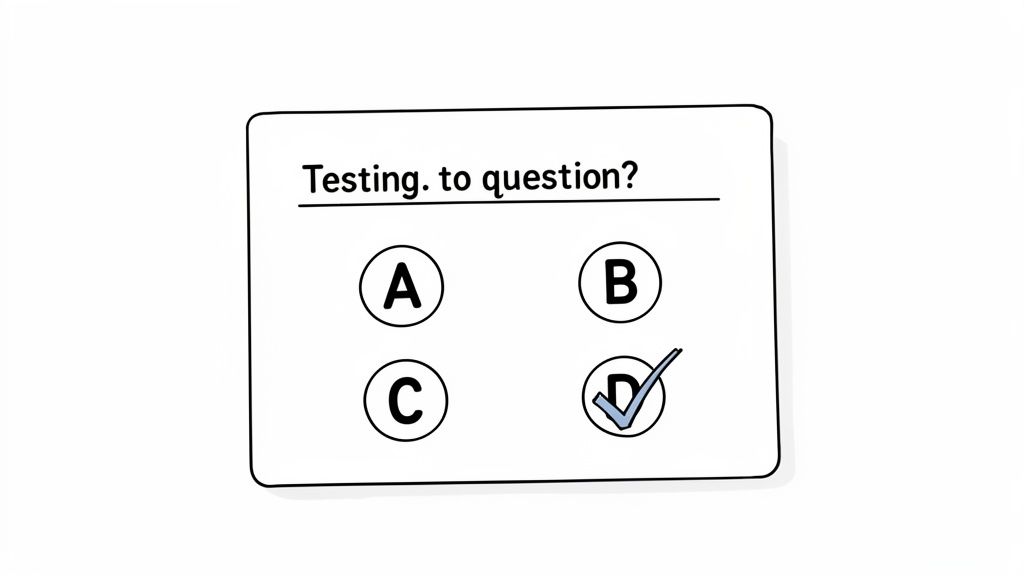
The strength of MCQs in a professional setting lies in their adaptability. For example, a software engineering assessment might use MCQs to test foundational knowledge of data structures, while a finance role screening could quiz candidates on core investment analysis concepts. The key is to move beyond simple memorization.
Strategic Application
Effective MCQs don't just ask for definitions; they present realistic scenarios. The design of the incorrect answers, or "distractors," is just as important as the correct one. Well-crafted distractors can reveal common misconceptions or gaps in a candidate's understanding, providing deeper insights than a simple right-or-wrong score.
Key Takeaway: The goal isn't just to see if a candidate can pick the right answer, but to understand why they might choose the wrong one. This helps identify subtle weaknesses in their foundational knowledge.
To make these questions in aptitude test even more effective, consider the following:
- Role-Specific Context: Frame questions within scenarios a candidate would actually encounter on the job.
- Adaptive Difficulty: Use platforms that can adjust question difficulty based on performance, challenging top candidates while still fairly assessing others.
- Beyond Memorization: Focus on questions that require the application of knowledge, not just its recall.
By integrating these strategies, MCQs become a useful component of any robust pre-employment assessment, helping you quickly and objectively filter for qualified individuals.
2. Quantitative Reasoning & Numerical Aptitude Questions
Quantitative Reasoning and Numerical Aptitude questions are designed to measure a candidate's ability to work with numbers, interpret data, and apply mathematical logic to solve problems. This goes beyond basic arithmetic; it assesses critical thinking under the pressure of data-driven scenarios, making it essential for roles where numbers tell the story.
Popularized by assessments like the McKinsey Problem Solving Test (PST) and the GMAT, these questions are a staple in finance, consulting, and data science. For a data analyst role, this could mean interpreting datasets to identify trends. For a finance position, it might involve calculating net present value or performing variance analysis. The core idea is to simulate the numerical challenges inherent to the job.
Strategic Application
Good quantitative assessments are not abstract math puzzles; they are business problems presented numerically. Instead of asking to simply solve for 'x', a question might frame a scenario around market sizing, resource allocation, or cost-benefit analysis. The goal is to see how a candidate reasons through ambiguity and uses data to reach a defensible conclusion, not just whether they can perform a calculation.
Key Takeaway: The emphasis should be on analytical reasoning, not just computational speed. Observing how a candidate approaches a complex business case numerically reveals more about their problem-solving skills than a simple math quiz.
To make these questions in aptitude test more insightful, consider the following:
- Real-World Scenarios: Frame questions using business situations like revenue projections, budget analysis, or supply chain optimization.
- Varying Difficulty: Blend straightforward calculations with multi-step problems to differentiate between candidates who are competent and those who are exceptional.
- Appropriate Tools: Decide whether to allow tools like calculators based on what the role requires. An analyst may always have access to a spreadsheet, while a consultant may need to perform quick mental estimations.
By tailoring quantitative questions to reflect on-the-job challenges, you create a relevant pre-employment assessment that helps predict a candidate's performance in a data-centric role.
Cohesyve
Practise this before it counts
Run the same kind of AI job simulation employers use and get a scored report on where you stand. 5 free assessments a month, no card required.
3. Logical Reasoning & Analytical Problem-Solving Questions
Logical Reasoning and Analytical Problem-Solving questions are designed to evaluate a candidate’s ability to analyze information, identify patterns, and make sound deductions. Unlike questions that test memorized knowledge, these assess the cognitive ability a candidate uses to break down abstract concepts and solve problems. This makes them valuable for roles that require strategic thinking.
The application of these questions is broad. For a consultant, this might mean analyzing a business case. For a software engineer, it could involve designing an efficient algorithm. For a data scientist, it means developing an analytical framework to test a hypothesis. The common thread is the need for structured, logical thought.
Strategic Application
The most insightful analytical questions present novel problems that can't be solved with a pre-learned formula. They reveal how a candidate thinks, not just what they know. The structure of the problem should require candidates to demonstrate their process, showing how they connect disparate pieces of information to reach a logical conclusion. This moves the assessment from a simple pass/fail to a qualitative evaluation of their problem-solving methodology.
Key Takeaway: The focus here isn't solely on the final answer. It’s about evaluating the candidate's journey to that answer, revealing their clarity of thought, structured approach, and ability to handle ambiguity.
To make these questions in aptitude test effective, consider these points:
- Contextual Scenarios: Frame problems within business contexts relevant to the role, such as a market entry case for a strategist or a system design puzzle for an engineer.
- Multi-Step Challenges: Build assessments that require a sequence of logical steps, which helps reveal how a candidate organizes their thoughts and methodology.
- Varying Complexity: Include a mix of simpler and more complex problems to gauge a candidate's cognitive flexibility and see where their reasoning skills peak.
By integrating these types of questions, you move beyond surface-level skills and gain a clearer picture of a candidate's core analytical capabilities, a good predictor of on-the-job success.
4. Verbal & Reading Comprehension Questions
Verbal and Reading Comprehension Questions are designed to evaluate a candidate's ability to understand, analyze, and interpret written information. This format moves beyond basic vocabulary to assess how effectively someone can process complex texts, identify key arguments, and draw logical conclusions, which is important for almost any knowledge-based role.
In a professional context, these questions are not just academic exercises. An operations manager needs to accurately interpret new company policies, while a marketing professional must analyze competitor messaging. This question type directly measures a candidate's readiness to handle the daily flow of information that defines modern work.
Strategic Application
Effective comprehension tests use passages that mirror the kind of material an employee would encounter. For a consulting role, this could be a dense business case document; for a client-facing role, it might be a nuanced customer email. The questions should probe for inference and critical analysis, not just simple fact-finding.
Key Takeaway: The goal is to see if a candidate can read between the lines. True comprehension isn't about recalling facts from a text; it's about understanding the underlying meaning, tone, and implications.
To make these questions in aptitude test truly revealing, consider the following:
- Industry-Relevant Passages: Use materials like internal memos, project briefs, or industry reports to ground the assessment in reality.
- Test for Inference: Ask questions that require candidates to draw conclusions that are not explicitly stated in the text.
- Assess Communication Clarity: Frame questions to see if the candidate can identify ambiguity or potential misinterpretations in a piece of writing.
By tailoring verbal assessments to specific job contexts, you create a powerful predictor of on-the-job performance, ensuring you hire individuals who can communicate and think with clarity.
5. Coding Challenges & Technical Problem-Solving Questions
Coding Challenges and Technical Problem-Solving Questions are a direct method for evaluating a candidate's practical skills in a technical role. These assessments move beyond theory, presenting candidates with real-world problems that require them to write, debug, or optimize code. This format is useful for assessing technical proficiency, problem-solving methodology, and code quality for roles ranging from software engineering to data science.
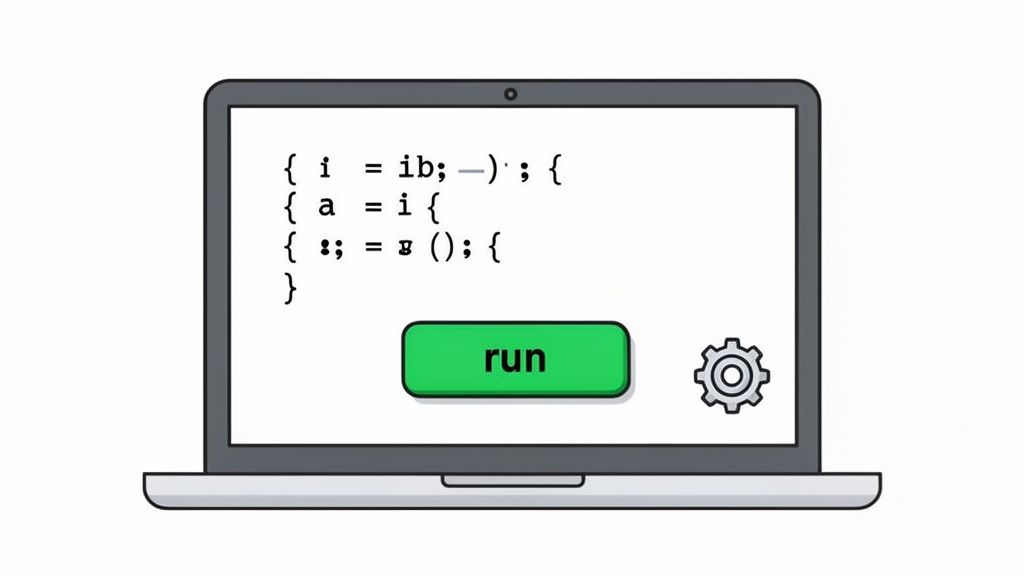
The value of a coding challenge lies in its direct simulation of on-the-job tasks. A full-stack developer might be asked to fix an integration bug between a frontend and backend service, while a DevOps engineer could be tasked with scripting an automation process. This approach provides a clear, objective measure of a candidate's ability to deliver functional, quality code.
Strategic Application
Effective coding challenges are not just about finding the correct answer; they reveal a candidate’s entire thought process. The way they structure their code, handle edge cases, and optimize for performance offers insights into their experience and work habits. Using interactive coding environments with automated tests provides immediate, data-driven feedback on a solution's correctness and efficiency.
Key Takeaway: The goal is to see how a candidate solves a problem, not just if they can. Evaluating their coding style, efficiency, and debugging process provides a holistic view of their technical capabilities.
To make these questions in aptitude test effective for technical hiring, consider the following:
- Job-Relevant Problems: Create challenges that mirror actual tasks and problems your team faces.
- Graduated Difficulty: Offer a mix of questions to differentiate between junior, mid-level, and senior candidates.
- Evaluate More Than Correctness: Assess code readability, scalability, and efficiency alongside the final output.
- Language Flexibility: Allow candidates to use the programming language they are most comfortable with, unless a specific language is a core job requirement.
By integrating these strategies, coding challenges become an essential tool in any pre-employment assessment for technical roles. To explore this topic further, you can find a curated list of software engineer interview questions that complement this approach.
6. Situational Judgment & Behavioral Role-Play Questions
Situational Judgment and Behavioral Role-Play questions move beyond what a candidate knows to evaluate how they behave. These assessments present realistic workplace scenarios and ask candidates to describe how they would respond, measuring soft skills like judgment, interpersonal effectiveness, and alignment with company values.
This format is valuable for roles where on-the-spot decision-making is critical. For example, a customer-facing role might be tested with a difficult client interaction, while a leadership assessment could present a scenario involving an underperforming team member. Some implementations even include interactive simulations and voice role-plays to gauge communication authenticity and emotional intelligence.
Strategic Application
Effective situational questions present dilemmas with multiple defensible approaches, revealing a candidate's reasoning process. The focus isn't on finding a single "correct" answer but on understanding the logic behind their chosen course of action. This method, used by companies like Google for culture assessment, provides a window into a candidate's problem-solving style.
Key Takeaway: The goal is to evaluate the why behind a decision, not just the what. This uncovers a candidate’s natural instincts, conflict resolution skills, and decision-making capabilities under pressure.
To make these questions in aptitude test more impactful, consider these strategies:
- Job-Specific Scenarios: Base scenarios on actual challenges the role will face, making the assessment highly relevant.
- Evaluate the Reasoning: Focus on the candidate’s explanation for their choice, as this often reveals more than the choice itself.
- Structured Follow-Up: Use a candidate's response as a starting point for a deeper conversation during the interview stage.
- Assess Cultural Fit: These questions are an excellent tool to see how a candidate’s approach aligns with your team's values and are a key component of a comprehensive personality and character test.
By integrating situational judgment tests, you can build a more holistic view of a candidate, ensuring they have both the technical skills and the behavioral competencies to succeed.
7. Case Study & Business Analysis Questions
Case Study and Business Analysis questions are a significant part of strategic thinking assessments. They move beyond isolated problems to present complex, real-world business scenarios, often with incomplete data. Candidates must analyze the situation, structure the problem, identify key factors, make logical assumptions, and propose a well-reasoned solution. This format is useful for assessing business acumen, analytical depth, and structured communication.
Popularized by consulting firms like McKinsey and BCG, this method is now used by companies like Amazon to evaluate leadership and strategic hires. A consulting candidate might be asked to devise a market entry strategy for a new product, while a finance applicant could be tasked with a company valuation case. The power of the case study lies in its ability to simulate the actual challenges of a role.
Strategic Application
Effective case studies are not about finding a single "correct" answer. Instead, they are designed to reveal a candidate's thought process. The evaluation focuses on how they structure their analysis, the clarity of their assumptions, the logic of their recommendations, and their ability to communicate complex ideas under pressure. The dialogue during the case can be as important as the final presentation.
Key Takeaway: The goal is to evaluate the candidate's journey from problem to solution. The quality of their reasoning and problem-solving framework is more insightful than the final number they calculate.
To make these questions in aptitude test effective, consider these points:
- Role-Relevant Scenarios: Tailor the case to reflect the actual business challenges the candidate will face. A product manager might get a market sizing case, while an operations role gets a process optimization scenario.
- Structured Ambiguity: Provide enough information for a solid analysis but leave some ambiguity to see how candidates handle incomplete data and make assumptions.
- Probe with Follow-ups: Use follow-up questions to test the robustness of their logic and see how they adapt their thinking when presented with new information.
By using case studies, you create a dynamic assessment that provides a deep, predictive look into a candidate's on-the-job strategic capabilities, making it a critical tool for high-stakes roles.
8. Subjective Reasoning & Open-Ended Prompt Questions
Subjective reasoning questions move beyond right-or-wrong answers, asking candidates to respond to open-ended prompts in their own words. This format is designed to evaluate the quality of a candidate's reasoning, their ability to articulate complex ideas, and their strategic thinking. It provides a window into their judgment and maturity that standardized tests often miss.
The value of these questions lies in uncovering how a candidate thinks, not just what they know. For instance, a candidate for a leadership role might be asked to discuss their approach to organizational culture, while a product manager could be prompted to analyze a market trend. The response reveals their perspective, communication style, and problem-solving framework.
Strategic Application
Effective open-ended prompts are carefully designed to probe for role-specific competencies. The goal is to present a situation that is complex enough to allow for a nuanced response but focused enough to be relevant. The evaluation hinges not on finding a "correct" answer, but on assessing the structure, logic, and insight within the candidate's argument.
Key Takeaway: The focus is on the process of reasoning. A well-structured answer with a flawed conclusion can be more revealing of a candidate's potential than a lucky guess on a multiple-choice question.
To make these questions in aptitude test insightful, consider these points:
- Establish Clear Rubrics: Create a consistent scoring guide based on criteria like clarity, logical consistency, and depth of analysis to reduce evaluator bias.
- Focus on Relevance: Design prompts that mirror the strategic challenges the candidate would face in the role, such as navigating technical debt or assessing competitive threats.
- Assess Reasoning, Not Polish: Prioritize the quality and structure of the candidate's thinking over perfect grammar or prose, especially for non-writing-intensive roles.
By integrating subjective prompts, you can add a layer of qualitative insight to your pre-employment assessment, helping you understand a candidate's judgment and strategic fit.
Comparison of 8 Aptitude Question Types
| Assessment Type | Implementation Complexity | Resource Requirements | Expected Outcomes | Ideal Use Cases | Key Advantages |
|---|---|---|---|---|---|
| Multiple Choice Questions (MCQs) | Low | Minimal (question writers, automated grading) | Objective recall and basic application; fast candidate ranking | High-volume screening, foundational competency checks | Fast, scalable, low scoring bias |
| Quantitative Reasoning & Numerical Aptitude | Medium | Moderate (problem authors, datasets, scoring rules) | Measures numerical problem solving, accuracy, and speed | Finance, data science, operations, consulting | Highly predictive for analytical roles; objective answers |
| Logical Reasoning & Analytical Problem-Solving | Medium–High | Moderate (expert item designers, calibration) | Assesses deductive/inductive reasoning and pattern recognition | Technical roles, consulting, strategic problem solving | Predictive of problem-solving and learning ability |
| Verbal & Reading Comprehension | Low–Medium | Moderate (content writers, optional translators) | Measures comprehension, inference, and communication clarity | Communication-heavy roles, client-facing positions | Cross-functional relevance; supports multilingual assessment |
| Coding Challenges & Technical Problem-Solving | High | High (infrastructure, test cases, auto-graders) | Direct measure of coding ability, correctness, and efficiency | Software engineering, data science, DevOps | Job-relevant, reduces resume inflation, objective metrics |
| Situational Judgment & Behavioral Role-Play | Medium–High | Moderate–High (scenario writers, evaluators, tech) | Assesses judgment, interpersonal skills, and decision-making | Leadership, customer-facing, team collaboration roles | Reveals authentic soft skills and cultural fit |
| Case Study & Business Analysis | High | High (SMEs, evaluators, extended evaluation time) | Evaluates strategic thinking, structured problem solving | Consulting, strategy, senior business roles, product management | Reveals methodology, business acumen, and presentation ability |
| Subjective Reasoning & Open-Ended Prompts | Medium–High | Moderate–High (prompt designers, trained evaluators) | Shows depth of judgment, reasoning quality, and communication style | Senior leadership, product strategy, roles needing nuanced judgment | Captures authentic voice and reasoning beyond right/wrong |
From Question Banks to Dynamic Skill Verification
We've covered a diverse landscape of questions in aptitude test assessments, from the precise logic of quantitative reasoning to the nuanced judgment required in situational role-plays. Each question type serves a distinct purpose, moving beyond simple right-or-wrong answers to uncover a candidate’s potential. The core insight is that a one-size-fits-all approach to assessment is no longer sufficient.
The most effective hiring strategies don't just rely on a single question type. Instead, they weave together a balanced mix to create a holistic and multi-dimensional view of a candidate.
- Quantitative questions are excellent for verifying analytical rigor.
- Logical reasoning puzzles test abstract problem-solving abilities.
- Situational judgment tests provide a window into a candidate’s decision-making and interpersonal skills.
- Coding challenges and case studies offer a direct measure of practical, role-specific skills.
The Shift from Filtering to Verifying
Implementing these nuanced, role-specific assessments at scale can be a challenge. Traditional methods often rely on static question banks that candidates can study for, a system that can reward test-taking ability over genuine skill. Candidates, in turn, often seek out resources to help them prepare. For those in the education sector, managing this process may require specialized tools like test prep center software to organize curricula and track student progress.
However, the goal for recruiters is to find individuals who will excel in their roles, not just pass tests. This suggests a shift from a model of filtering candidates to one of authentic skill verification. An ideal system might analyze job requirements and dynamically generate a relevant, multi-faceted assessment tailored to that role. This kind of assessment, where candidates receive unique questions that directly measure their ability to handle day-one tasks, can improve predictive accuracy and reduce the potential for bias.
By focusing on practical ability, problem-solving methodology, and authentic judgment, you create a more equitable and effective hiring process. This helps move beyond credentials and keywords, leading to hires who are better positioned to contribute to your team's long-term success.
Ready to move beyond static question banks? Cohesyve builds dynamic, role-specific assessments that verify skills, not just test knowledge. See how our AI-powered platform can help you design fair, predictive, and scalable hiring processes by visiting Cohesyve.