A personality and character test is a tool employers use to get a clearer picture of a candidate—their work style, their integrity, and how they’ll likely mesh with a team. It’s about looking beyond the resume to predict how someone will actually perform and behave on the job.
Going Beyond Resumes in Modern Hiring
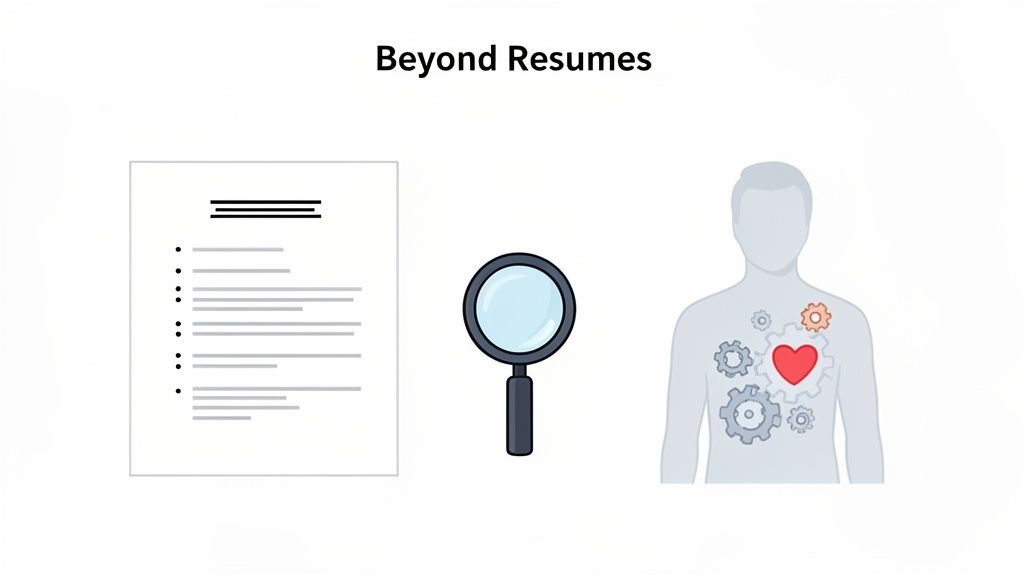
A traditional resume does a decent job of outlining what a person has done. It lists their roles, skills, and accomplishments. But it offers limited insight into how they do their work, solve problems, or handle a challenging day.
That information gap is a source of uncertainty for hiring managers. You’re left wondering about the very things that often determine a new hire’s success. That's why many companies are turning to personality and character tests to get deeper, more reliable insights.
Why Experience Is Only Half the Story
Relying solely on a resume is like judging a car by its odometer. It shows you where it’s been, but not how it was driven or if it’s been well-maintained. Two candidates with nearly identical experience on paper can be very different in how they approach teamwork, adapt to change, or take ownership of their mistakes.
This guide is designed to help you build a more complete picture of your candidates. We’ll cover the essentials, including:
- What personality and character reveal about a person.
- How to select the right kind of assessment for the role you’re hiring for.
- Why scientific concepts like reliability and validity are important for fairness and accuracy.
- Practical ways to integrate these tests into your hiring process ethically and effectively.
The demand for these tools is growing. In 2021, the global personality assessment market was valued at US$7,421.59 million. It's projected to more than double to US$16,461.43 million by 2028, growing at a 12.1% compound annual rate.
Building a More Informed Hiring Process
Moving past a resume-only approach isn't about ignoring past achievements; it's about shifting focus to a candidate's future potential. Assessments provide data to complement your interview impressions. To get an even fuller view, many employers also use detailed job references to back up what they’re seeing.
A successful hire is a combination of skill, will, and fit. Resumes might cover the skill, but assessments help uncover the will and the fit—the underlying drivers of long-term success and team cohesion.
The point isn't to let a test make the decision for you. It's about equipping yourself with better information to make a well-rounded decision. Used correctly, these assessments can reduce hiring bias, improve your odds of finding the right person, and help you build a team that’s not just skilled, but also aligned.
Understanding Personality Versus Character
In daily conversation, we often use "personality" and "character" interchangeably. But when you’re making a hiring decision that could shape your team for years, understanding the distinction can be valuable.
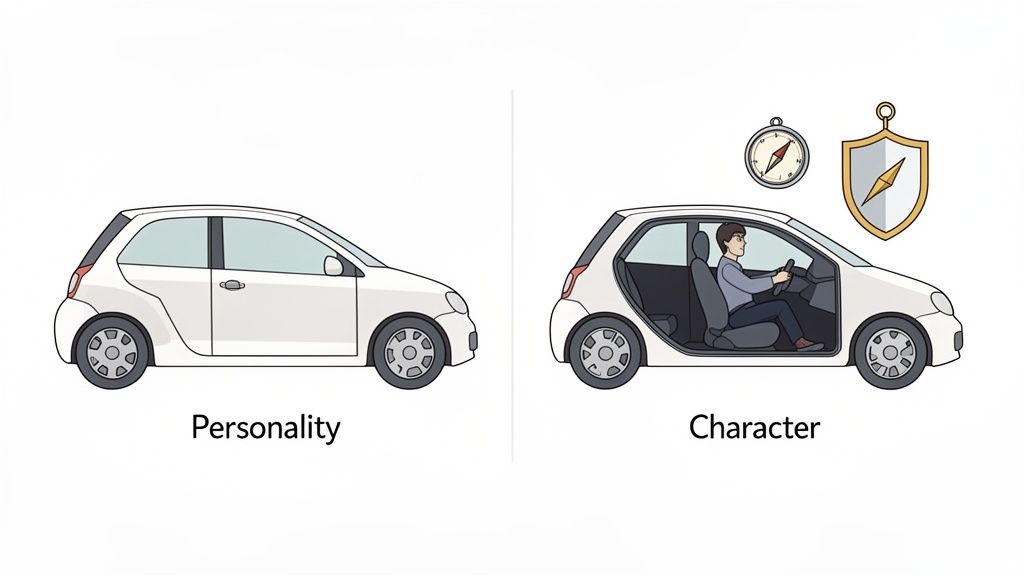
Let’s use a simple analogy: personality is the car, but character is the driver.
A car might be a sports car designed for speed (extroverted, fast-paced), an SUV built for rugged terrain (adaptable, resilient), or a sedan made for reliability (agreeable, steady). These are its built-in features—its personality. They describe its natural tendencies and how it’s engineered to perform.
Character, however, is about the person behind the wheel. Does the driver follow the rules of the road? Are they courteous to others? If they get into a minor accident, do they own up to it? These actions reflect learned values like integrity, accountability, and respect.
You can have a reckless driver in a sensible minivan, just as you can have a responsible one in a high-performance race car. The vehicle’s design doesn’t dictate the driver’s choices. This is why a holistic assessment is useful—it gives you a look at both the hardware and the operator.
Personality vs Character Key Distinctions for Hiring
To make this distinction clearer, let's break down how these concepts play out in a professional setting. The following table highlights the core differences and what each reveals about a candidate.
| Attribute | Personality | Character |
|---|---|---|
| Origin | Largely innate; natural predispositions and tendencies. | Developed through experience, choices, and learned values. |
| What It Is | A person's natural style of thinking, feeling, and behaving. | The moral and ethical compass guiding a person's actions. |
| Stability | Generally stable over a lifetime. | Malleable; can be cultivated and strengthened (or weakened). |
| Focus | How someone prefers to operate and interact. | Why someone makes the choices they do. |
| Example Traits | Introversion, Openness, Agreeableness. | Honesty, Integrity, Resilience, Accountability. |
| How to Assess | Psychometric tests (e.g., Big Five, MBTI, DiSC). | Behavioral interviews, situational judgment tests, reference checks. |
Understanding these differences is key. You're not just hiring a set of skills or a preferred communication style; you're bringing a person's guiding principles into your organization.
What Personality Reveals
Personality tests are designed to map out a person’s ingrained preferences and behavioral styles. They help answer practical questions about how a candidate is wired. For instance, will someone thrive in a bustling, collaborative office, or do they need quiet, focused time to do their best work?
These assessments often draw from established frameworks like the Big Five model, which measures key dimensions of someone's disposition:
- Openness: How curious, imaginative, and open to new ideas are they?
- Conscientiousness: Are they organized, dependable, and self-disciplined?
- Extraversion: Do they gain energy from interacting with others?
- Agreeableness: How cooperative and compassionate are they in their dealings with people?
- Neuroticism: How well do they handle stress and emotional pressure?
A personality profile gives you a window into a candidate's potential fit with a team's culture and the specific demands of a job. It predicts their likely work style, not their moral code.
What Character Reveals
While personality tells you how someone likes to work, character tells you why they make certain decisions. It's the internal compass that guides their actions, especially under pressure or when nobody's watching. Character is what determines whether an employee admits a mistake, speaks up about an ethical issue, or sees a difficult project through to the end.
Character traits like honesty, resilience, and accountability are often better predictors of long-term success and trustworthiness than personality alone. These are the qualities that build strong cultures.
Character isn’t something you can easily measure with a multiple-choice quiz. It reveals itself in action. This is where tools like situational judgment tests or structured behavioral interviews become so important. They prompt candidates to respond to realistic workplace dilemmas, asking them to show their judgment rather than just talk about it.
Ultimately, you need both parts of the story. A candidate might have the ideal personality for a sales role—charming, outgoing, and persuasive. But if they lack the character to be honest with clients or transparent with their team, they could become a liability. Grasping this distinction is the first step toward choosing the right assessments and building a team that has both talent and integrity.
Cohesyve
See what candidates can do before you interview them
Cohesyve turns your job description into a role-specific assessment with a scoring rubric. Each candidate gets a different version, so questions cannot be shared. Ten candidates free, no card.
Choosing the Right Assessment Tool
The world of personality and character tests offers many options, and the best choice depends on what you're trying to learn. A test that works well for hiring a creative director might be less useful for finding the right accountant.
The first step is always to understand what each assessment measures. The market for these tools is growing, especially in North America. Projections show the U.S. market alone could reach around USD 3,285.61 million by 2025. To navigate this space, it helps to know how different candidate assessment tools fit into a modern hiring strategy.
Let’s break down some of the most common frameworks you'll encounter.
The Big Five (OCEAN Model)
When it comes to scientifically respected personality models, the Big Five is a prominent framework. It’s backed by decades of research and, importantly, it avoids putting people into rigid boxes. Instead, it measures where an individual falls along a spectrum for five core personality dimensions:
- Openness: This reflects a person's curiosity and appetite for new things. High scorers are often imaginative and adventurous, while those on the lower end may prefer routine.
- Conscientiousness: This is a strong predictor of job performance. It’s about being organized, dependable, and self-disciplined.
- Extraversion: This measures a person's social energy. Extraverts are often energized by being around people, while introverts may need solo time to recharge.
- Agreeableness: How cooperative, compassionate, and trusting is someone? This trait is important for roles that depend heavily on teamwork.
- Neuroticism: Often framed as its opposite, Emotional Stability, this dimension gauges how sensitive someone is to stress. High scorers might experience more anxiety, whereas low scorers tend to be calm under pressure.
Because of its strong research backing, the Big Five is a solid choice for predicting general job performance across many different roles.
The DiSC Model
Another widely used tool is the DiSC assessment. Its focus is less on deep-seated personality and more on observable workplace behaviors and communication styles. It sorts people into four main profiles to help them—and their colleagues—understand how they can work together more effectively.
- Dominance (D): These are your direct, results-focused, and decisive people.
- Influence (i): Think enthusiastic, optimistic, and collaborative team players.
- Steadiness (S): These individuals are calm, patient, and supportive.
- Conscientiousness (C): This group is analytical, precise, and detail-oriented.
DiSC can be effective for improving team dynamics and coaching. As a hiring tool, it’s often used for team-building after someone is hired, not as the primary reason for the hiring decision.
While personality frameworks like the Big Five and DiSC offer valuable insights into a candidate's natural tendencies, they don't always capture how someone will apply those traits in a real-world scenario. That’s where character-focused assessments can be helpful.
Situational Judgment Tests (SJTs)
Situational Judgment Tests, or SJTs, are designed to bridge the gap between someone’s personality and their on-the-job character. Instead of asking candidates what they like to do, SJTs present them with realistic workplace scenarios and ask what they would do.
Imagine a question describing a project that’s falling behind schedule because a team member made a mistake. The candidate is given a few possible ways to handle it. Their choice can reveal information about their problem-solving skills, ethical compass, and how they navigate interpersonal situations. This approach measures applied character, not just abstract traits, making it a useful predictor of how someone will perform.
So, what’s the best strategy? It’s often a blend.
Pairing a scientifically-backed personality test like the Big Five with a character-focused tool like an SJT gives you a much richer, more complete picture. This dual approach helps you hire for both underlying potential and demonstrated judgment.
Ensuring Your Test Is Reliable and Valid
An assessment isn't useful if the results are inconsistent. To trust a personality or character test, you need to be certain it’s both consistent and accurate. In psychometrics, these two cornerstones are called reliability and validity. They are foundational to any scientifically sound assessment.
Think of it like a bathroom scale. If you step on it three times in a row and get three very different numbers, that scale isn't reliable. And if it consistently tells you you're ten pounds heavier than you are, it isn't valid. You need both consistency and accuracy for the measurement to be meaningful. The same principle applies to hiring assessments.
Without these safeguards, you risk making decisions based on poor data. An unreliable test might paint a different picture of the same candidate from one day to the next, while an invalid one could be measuring something unrelated to job success.
Reliability: The Consistency Check
Reliability is about consistency. A reliable test will give you very similar results for the same person under the same conditions.
Imagine a candidate takes your assessment on Monday and then again on Wednesday. If the test is reliable, their scores should be nearly identical, assuming nothing major changed over those two days.
Psychometricians measure this in a couple of key ways:
- Test-Retest Reliability: This is the Monday vs. Wednesday scenario. It checks for score stability over a short period of time.
- Internal Consistency: This looks at how well the questions within the test are related. If you have ten questions designed to measure conscientiousness, a person's answers should be fairly consistent across all ten.
A test with high reliability gives you confidence that the score isn't just a random fluke. It's reflecting a stable trait, which is what you need when making a hiring decision.
Validity: The Accuracy Check
Reliability ensures your test is consistent. But validity asks a crucial question: Does this test actually measure what it claims to measure? And for hiring, an even bigger question is: does it predict how someone will perform on the job?
A test can be reliable without being valid. Remember our scale that’s always off by exactly ten pounds? It’s reliable (consistent), but it’s consistently wrong. A personality test might reliably label someone as an "innovator," but if that trait has zero correlation with success in a specific role (say, an accounting clerk), the test lacks validity for that purpose.
The most important type is predictive validity. This shows a clear statistical link between a candidate's assessment score and their future job performance. This is what turns an assessment from an interesting tool into a legally defensible and effective hiring instrument.
Understanding these two pillars is important. For a deeper dive into how to prove an assessment is truly job-relevant, you can learn more about content validity examples and how they help create fair evaluations. Ultimately, choosing an assessment that is both reliable and valid means you're using a tool that is fair, accurate, and genuinely helpful.
Weaving Assessments into Your Hiring Process
Deciding to use a personality or character test is one thing; figuring out how to make it work within your hiring process is another challenge. If you just add a test to your existing workflow without a clear plan, you risk creating confusion. The goal is to use the assessment to illuminate areas you’ll want to explore in a deeper conversation.
Timing is important. Send the test out too early, and you may discourage qualified candidates with a lengthy application. Wait until the final round, and you miss the opportunity to use its insights during the interview.
A balanced approach is usually best. Consider sending the assessment after the initial screening but before the in-depth interviews. This way, you're only investing the time in candidates who already meet your basic requirements, and you’re arming your hiring team with data to guide their conversations.
From Scores to Conversations
A test score should not be a simple "yes" or "no." Its real power is in turning a generic interview into a meaningful, targeted discussion. Don't look at the results as a final verdict; see them as a list of conversation starters.
The best hiring managers treat assessment results like a map, not a destination. They use the data to explore a candidate's natural strengths and potential growth areas with sharp, behavioral questions.
Let’s say a test indicates a candidate is highly independent. Instead of taking that at face value, you can dig in: "Tell me about a time you had to drive a major project with very little supervision. How did you structure your work?" Or, if their results suggest they’re less comfortable with collaboration, you might ask: "Describe a complex team project you were part of. What was your role, and how did you navigate disagreements with your colleagues?"
This is how you turn a report into tangible evidence of how someone might behave on the job.
Building a Complete Picture of Your Candidate
Here's the most important rule of using these assessments: the test should only ever be one piece of the puzzle. Relying too heavily on a single score isn't just unfair—it can be legally risky and may lead to poor hiring decisions. A strong, defensible hiring process pieces together multiple sources of information to build a holistic view of each person.
Your process should be built to deliver consistent, accurate, and reliable insights.
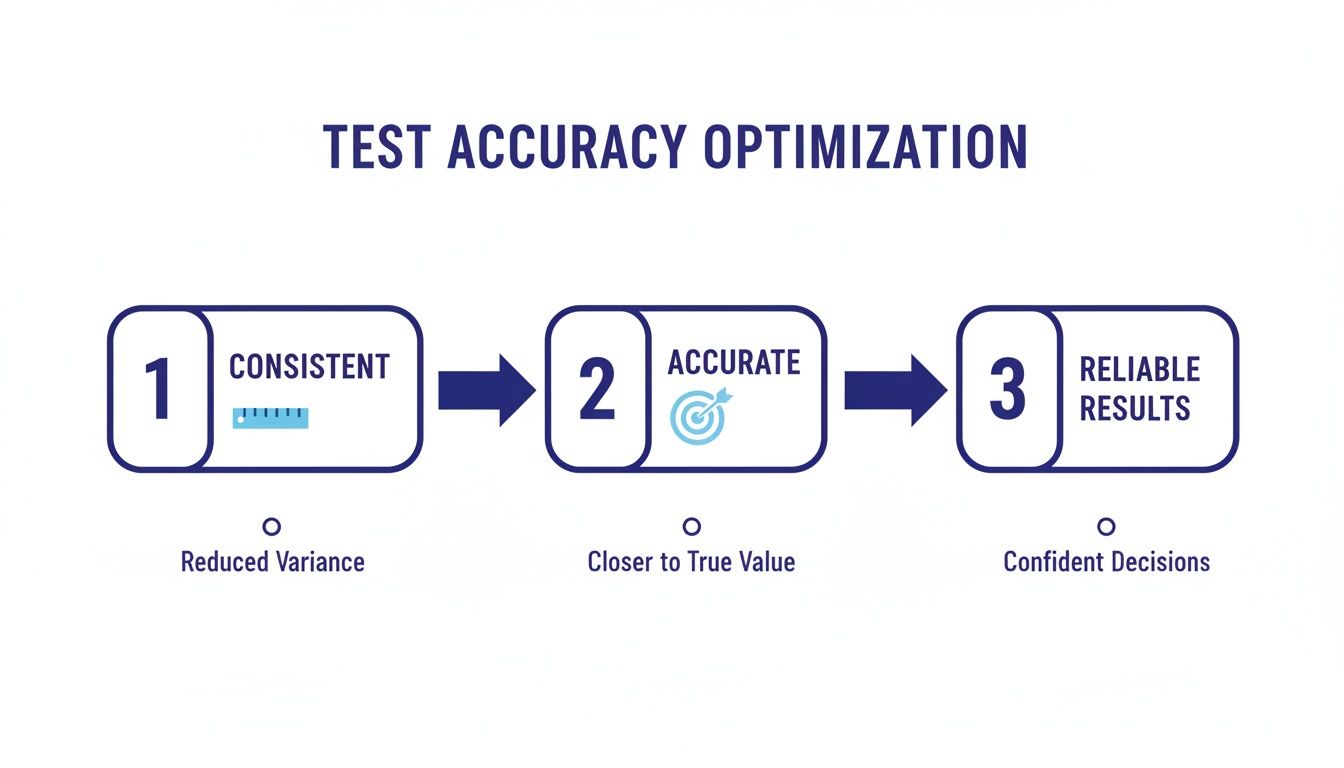
This image illustrates the core idea: you need a system that ensures your results are consistently measured and accurately reflect what a candidate can do, giving you hiring insights you can depend on. A complete process includes:
- Structured Interviews: You ask every candidate for a specific role the same core set of job-related questions. This levels the playing field, reduces "gut feeling" bias, and makes it easier to compare candidates fairly.
- Work Sample Tests: You give candidates a practical task that’s a direct slice of the work they’d be doing. This is often the single best predictor of job performance because you're seeing their skills in action, not just hearing about them.
- Reference Checks: You talk to former managers to get an outside perspective on a candidate’s work style, character, and achievements.
Even without a formal personality test, a well-run structured interview is a powerful assessment. To get the most out of it, using a smarter interview notes template helps ensure everyone is being evaluated on the same criteria.
The Move Toward Dynamic Skill-Based Assessments
Static questionnaires where every candidate gets the exact same questions are becoming less common. They can be predictable, and some candidates may learn how to answer in a way they think employers want to see. The future of assessment technology is more dynamic.
Modern adaptive tests adjust the difficulty and type of questions in real-time based on a candidate's answers. This can provide a more precise measurement of someone's true abilities.
Instead of just asking someone if they're a good problem-solver, an adaptive system might present them with a realistic business scenario that gets progressively more complex. This allows you to observe their judgment and reasoning skills directly. It's a subtle but important shift—moving from asking about skills to actively verifying them.
Navigating Bias and Legal Considerations
Using any kind of personality or character test in your hiring process is a serious responsibility. While these assessments can give you a different lens on a candidate, they also present a risk for bias if not used carefully.
It's possible for a test to unintentionally favor certain traits more common in one demographic, which can lead you to screen out qualified candidates from protected groups without realizing it.
The Legal Tightrope: Fairness and Compliance
This isn't just about being fair—it's a critical legal issue. In the U.S., the Equal Employment Opportunity Commission (EEOC) has guidelines on this. Their rules are straightforward: if any tool you use for hiring has an "adverse impact"—meaning it disproportionately filters out people based on their race, gender, age, or another protected status—you have to prove it's directly related to the job and essential for business.
This is why validation is not just a technical term; it's your single most important legal and ethical safeguard.
Keeping It Fair, Relevant, and Defensible
So, how do you use these tools responsibly? You have to forge a clear link between what the assessment measures and what the job actually demands.
Here’s what that looks like in practice:
- Start with a Job Analysis: Before anything else, clarify the essential skills, knowledge, and behaviors someone needs to succeed in the role.
- Validate the Test: The test you choose must be proven to measure those specific, job-related competencies. The goal is to predict who will perform well, not just who fits a certain personality archetype.
- Monitor for Adverse Impact: Regularly analyze your hiring data to make sure your assessments aren't creating an unfair disadvantage for any group.
The rule of thumb is simple: any hurdle you ask a candidate to clear must directly relate to their ability to do the job. If it doesn't predict success, it has no place in your process.
The Smart Shift: From Abstract Traits to Real-World Skills
This is where a change in mindset makes a difference. One of the safest, fairest, and most effective strategies is to focus less on measuring abstract personality labels and more on verifying observable, job-relevant skills.
Think about it this way. Instead of trying to figure out if a candidate is an "introvert," assess their ability to communicate complex information clearly in a written report—a tangible skill the job requires. This approach gives you a much more direct and defensible connection between the assessment and the role.
When you focus on what people can actually do, you naturally reduce bias. You're evaluating candidates on their capabilities, not their personality profile. This creates a more equitable playing field where every applicant gets a fair shot to show you their abilities. By prioritizing demonstrable skills, you build a hiring system that isn’t just more predictive—it’s also built on solid legal ground.
If you’re curious about how modern technology can help build more objective and skill-focused hiring pipelines, our guide on AI-powered recruitment tools is a great next step.
Answering the Tough Questions About Hiring Assessments
Even the most well-thought-out hiring process raises questions, especially when you introduce something new like personality and character tests. Let's tackle some of the most common concerns that hiring managers bring up.
Can't Candidates Just Fake These Tests?
This is a common and fair question. When using self-report questionnaires, candidates are motivated to present themselves well. Many professional assessments have built-in checks, often called validity scales, which can flag when someone may be trying to answer in a socially desirable way.
But there's a more effective way to handle this. The key is to shift the focus from what candidates say about themselves to what they can actually do.
When you pair personality insights with performance-based tasks—like a work sample or a situational judgment test—the picture becomes much clearer. You're no longer just taking their word for it; you're asking them to demonstrate their skills and judgment. It’s much harder to fake competence.
Are These Tests Legally Defensible?
Yes, but with a significant caveat: they have to be used correctly. For any hiring test to be legally defensible, you must be able to prove it's job-related and consistently predicts success in that specific role. You need a logical connection between what the test measures and what the job actually demands.
It's also critical to ensure the assessment doesn't create "adverse impact"—meaning it can't unfairly screen out people from protected groups. This is why validating any test against the job’s real-world requirements isn’t just good practice; it's essential.
How Should We Actually Use the Results?
Treat assessment results as a guide for your conversation, not a final judgment. These scores should never be the sole reason to hire or pass on someone. Their real value is in helping you craft smarter, more targeted interview questions.
Let’s say a test flags that a candidate might not be comfortable with ambiguity. Instead of just noting it, you can dig deeper in the interview. Ask them something like: "Tell me about a time you worked on a project where the goals were unclear or kept changing. What did you do to get things on track?"
This method transforms a number on a page into a meaningful conversation. When you combine these insights with what you learn from interviews, references, and skill demonstrations, you build a complete, defensible, and more accurate picture of your candidate.
At Cohesyve, we help you move beyond guesswork by verifying skills directly. Our platform generates dynamic, role-specific assessments that measure how candidates think, solve problems, and communicate, so you can confidently identify top performers who have proven they can do the job. See how it works.