Many roles involve no code: customer service, sales, administration, operations, marketing, finance, HR. These roles have skills that can be measured just as clearly, as long as you test the work itself.
This guide covers what to assess for each kind of non-technical role, which tools do it, and how to choose.
Disclosure: Cohesyve publishes this guide and is one of the tools compared. Other vendors are described from their own public pages as of October 2026; their prices are on their sites.
How do you assess candidates for non-technical roles?
Assess non-technical candidates with a short task taken from the real job, scored against a clear rubric, and add a reasoning or behavioural measure only where the job needs it. A support agent should handle a customer; an office manager should organise a messy schedule; a marketer should respond to a brief.
The four assessment types used for non-technical roles:
- Work samples and job simulations: the candidate does a piece of the job. The closest measure of whether someone can do the work. See what a work sample test is.
- Skills tests: shorter, focused checks of a specific ability, such as Excel, writing or typing.
- Situational judgement tests: realistic scenarios with a choice of responses, which check judgement quickly. Explained in our situational judgement test guide.
- Cognitive and personality tests: reasoning ability and working style. Useful for trainability and for roles where the work itself is hard to simulate; see personality testing for hiring.
What should you test for each non-technical role?
The table below maps common non-technical roles to what to test and the format that tests it best.
| Role | What predicts success | Best format | Assessment guide |
|---|---|---|---|
| Customer service and support | Empathy under pressure, clear writing, problem resolution | Simulated customer chat or call | Customer service assessment |
| Sales | Discovery, handling objections, persistence | Role-play or call simulation | Sales skills assessment |
| Administration and office roles | Accuracy, organisation, spreadsheet and document skills | Spreadsheet or inbox task, attention-to-detail test | Administration, Excel |
| Operations | Prioritisation, process thinking, numeracy | Case task with data, situational judgement | Operations management |
| Marketing | Judgement, writing, using data | Brief-response task, copy edit | Marketing skills assessment |
| Finance and accounting | Accuracy, applied accounting, spreadsheet modelling | Reconciliation or model-building task | Accounting assessment |
| Managers and team leads | Judgement with people, prioritisation, communication | Situational judgement, in-tray exercise, structured interview | Assessing soft skills |
Cohesyve
Test candidates on the work itself
Cohesyve builds an AI job simulation of the role from your job description, finds and contacts candidates for it and returns a ranked shortlist. Ten candidates free, no card.
Which assessment tools are best for non-technical roles?
Criteria, eSkill, TestGorilla and Testlify offer broad libraries that include non-technical tests. Vervoe, Canditech, Harver and Cohesyve focus on simulations of the job. SHL and Wonderlic supply the cognitive and personality layer.
| Tool | Non-technical coverage (from their own pages) | Format | Best for | Pricing |
|---|---|---|---|---|
| Criteria | Cognitive aptitude, personality, emotional intelligence, risk, skills, game-based, video interviewing | Tests and video | Roles where aptitude and behaviour matter alongside basic skills | Check their site |
| eSkill | Library of 600+ subjects for roles "from the factory floor to the front office"; custom questions | Modular tests, one-way interviews | Operations, call-centre and industrial roles; writing your own questions | Check their site |
| TestGorilla | Skills test library plus AI interviews | Tests | Small teams covering common office and customer roles | Free plan; check their site |
| Testlify | Sales, customer support, marketing, personality and cognitive tests; role-play simulations | 25+ question formats, including Google Docs and Sheets tasks | Mixed hiring where you want tests built from the job description | Check their site |
| Vervoe | Job simulations set in ticketing or CRM tools; spreadsheets, presentations, video | Simulations with AI grading | Professional and support roles at enterprise scale | Check their site |
| Canditech | Simulations for sales, customer service, account management, marketing, finance, HR, administration | Simulations | Sales and service hiring | Check their site |
| Harver | Live chat support simulation, situational judgement, language, personality, cognitive | Simulations and tests | Contact centres and retail at volume | Check their site |
| SHL | Cognitive, personality, situational judgement, business skills, call-centre simulations | Tests and simulations | Large organisations with standard role families | Check their site |
| Cohesyve (our product) | Simulations generated from your job description: a voice call with an unhappy customer, a chat negotiation, a spreadsheet to analyse | Job simulations, ranked shortlist | Customer-facing and business roles where you want interviews only with the strongest candidates | From $199/month |
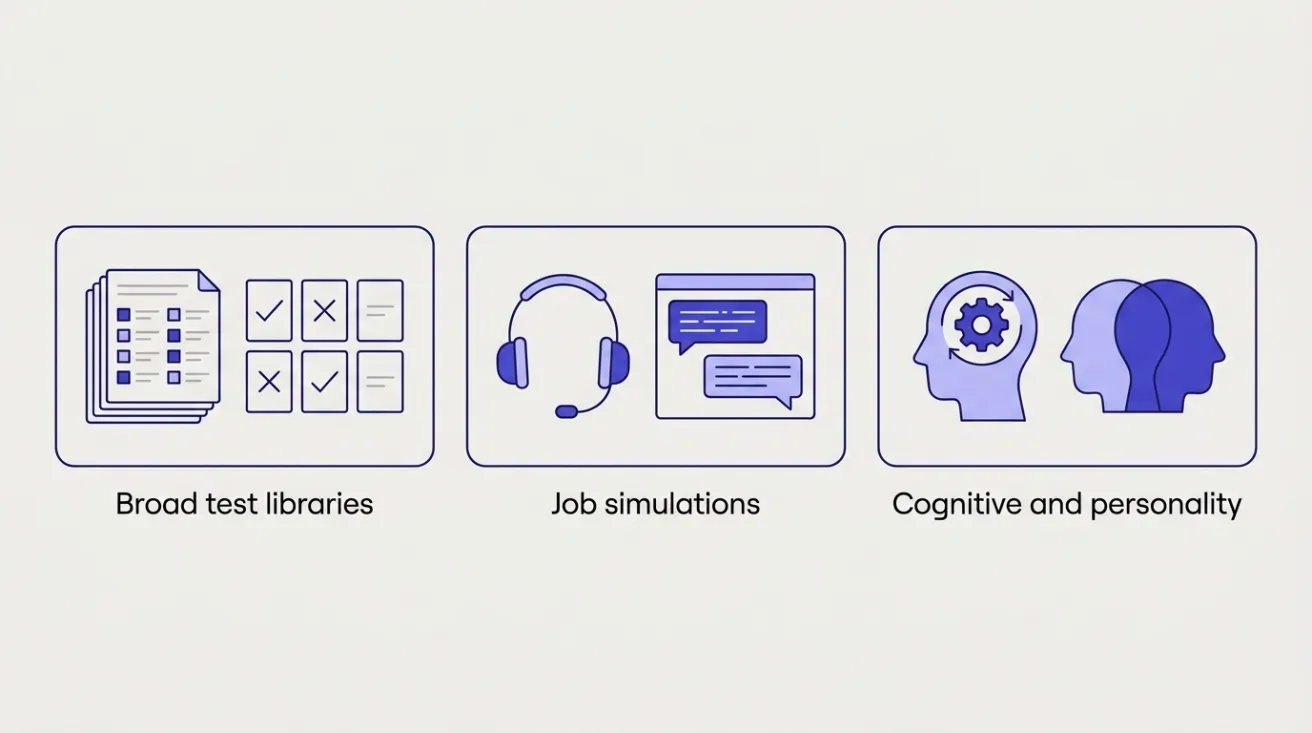
Verdict. For a contact centre at volume, Harver. For sales and service roles at a growing company, Canditech or Cohesyve. For broad coverage of common office and customer roles, TestGorilla (which has a free plan) or Testlify. For operational and industrial roles where you want to write your own questions, eSkill. For a validated aptitude and personality layer, Criteria or SHL.
Should you use personality tests for non-technical hiring?
Use personality tests as one input, never as the deciding factor. They describe how someone tends to work, which can help an interviewer, but they are weaker than a work sample at showing whether someone can do the job.
If you use one, choose a vendor that publishes validation evidence for selection, check adverse impact on your own applicants, and tell candidates there are no right answers. Our guide to what a psychometric assessment is explains the types.
How do you keep non-technical assessments fair?
Keep them fair by testing only what the job needs, scoring everyone on the same rubric, and checking pass rates across groups.
- Avoid hidden requirements. A customer-service test full of idioms tests fluency in a dialect as much as service skill.
- Offer adjustments such as extra time when candidates ask.
- Check pass rates by group. The US Uniform Guidelines say a selection rate for any race, sex or ethnic group below four-fifths (80%) of the highest group's rate will generally be regarded as evidence of adverse impact.
- Explain the process to candidates in a sentence before they start.
Common questions
What tests are used for customer service roles? Simulated customer conversations by chat or phone, writing tests, situational judgement tests and sometimes typing tests. A simulation is the closest to the job.
Can you use the same platform for technical and non-technical roles? Yes. Testlify, CodeSignal, SHL and Cohesyve all cover both. Engineering teams sometimes still prefer a specialist coding platform.
How long should a non-technical assessment be? As short as it can be while still showing the work. Take it yourself and ask whether a strong candidate with other offers would finish it.
Are soft skills measurable? Yes, through behaviour in a realistic task: how a candidate responds to an annoyed customer, or how they prioritise a crowded day. Self-report questionnaires measure what people say about themselves, which is a different thing. Our soft skills guide covers methods.
Where can I compare more tools? See the main comparison of pre-employment assessment tools and the sales assessment guide.