If an employer has sent you a Predictive Index link, you may get two assessments: a behavioural checklist and a timed reasoning test. Our guide to the Predictive Index test covers both. This page is only about the second one, the PI Cognitive Assessment: what each type of question asks you to do, how to pace 50 questions in 12 minutes, and what your score means once it reaches the employer.
What is the PI Cognitive Assessment?
It is a 12-minute test of general reasoning ability: 50 multiple-choice questions on simple maths, basic logic and language. PI says it measures how quickly a person learns, which is why the time limit is tight.
The details, from PI's own pages:
- 50 questions, 12 minutes. You are asked to answer as many as you can in the time.
- Three kinds of question: at most 16 verbal, 18 numerical and 16 abstract reasoning items.
- A unique set for you. PI uses a linear-on-the-fly design, which assembles a different set of items for each candidate. The questions are not adjusted to your earlier answers.
- Leave the window and the screen blurs. Copy and paste are blocked.
- Proctored or unproctored, at the employer's choice.
- Longer versions of 18 and 24 minutes exist as accommodations. If you need one, ask the employer before you start.
- 64 languages.
PI also says no job knowledge, formal education or test preparation is required. That is true in the sense that nothing on it is specialist. Familiarity with the pace still helps, which is what the sample is for.
The three types of question
The examples below are our own, written to show the style. They are not PI questions, and PI's item pool will look different. Try each in about 14 seconds.
Verbal reasoning
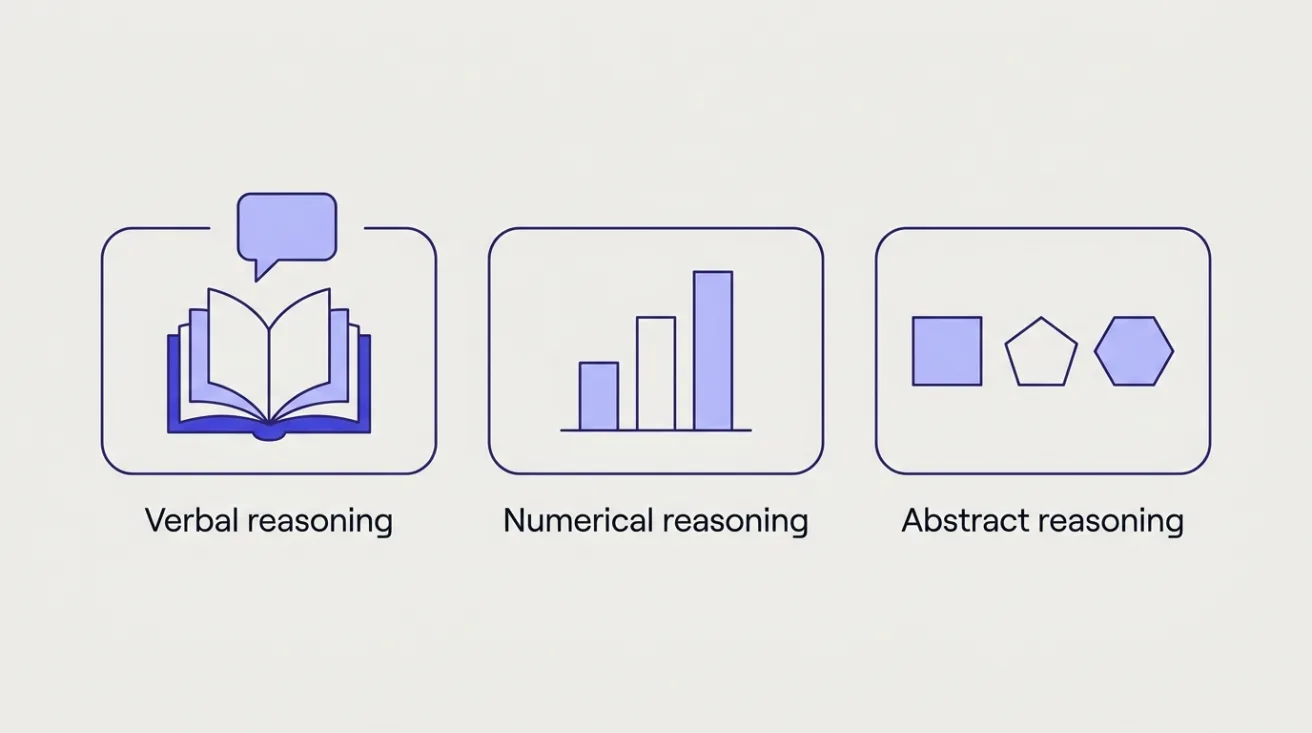
PI describes this as understanding and analysing written information. Expect word meanings, analogies and short logic statements.
- Our example: Thermometer is to temperature as odometer is to: speed, distance, fuel, or time? Distance.
- Our example: Which word is closest in meaning to tacit: loud, unspoken, careful, or brief? Unspoken.
- Our example: Every analyst on the team writes SQL. Priya writes SQL. Is Priya an analyst? Yes, no, or cannot tell? Cannot tell. The statement says analysts write SQL; it doesn't say only analysts do.
The trap in verbal logic is answering from what sounds likely. Answer from what the words guarantee.
Numerical reasoning
PI describes this as working with numbers and interpreting data quickly and accurately. The arithmetic is simple; the clock is the difficulty.
- Our example: What comes next: 3, 7, 15, 31, ...? 63. Each term doubles and adds one.
- Our example: A jacket costs $80 after a 20% discount. What was the full price? $100. $80 is 80% of the original.
- Our example: Which is largest: 3/5, 0.58, 61% or 5/9? 61%. Convert everything to decimals: 0.60, 0.58, 0.61, 0.56.
Fast habits pay off here: convert fractions to decimals, work backwards from percentages, and estimate before you calculate.
Abstract reasoning
PI describes this as spotting patterns and solving unfamiliar problems. On the real test these are usually shapes. Text versions of the same idea:
- Our example: A, C, F, J, ...? O. The gaps grow by one each time: +2, +3, +4, +5.
- Our example: A sequence of figures shows a square with one dot, a pentagon with two dots, a hexagon with three dots. What comes next? A heptagon with four dots. Two things change at once, and each follows its own rule.
With shapes, check one property at a time: number of sides, number of items, shading, rotation, position. Most patterns change one or two of these.
Cohesyve
Get used to being assessed before you sit the PI Cognitive Assessment
Cohesyve's practice runs are AI job simulations of the role you want, not copies of the PI Cognitive Assessment. They show where you lost marks. 3 free practice assessments, no card.
How to pace 50 questions in 12 minutes
Twelve minutes for 50 questions is 14.4 seconds each. Most people don't answer all of them, and the score doesn't expect you to.
Your score counts correct answers. PI scores the number of questions you answer correctly in the time. A guess can't lose you marks; only the time spent on a question you can't do costs you anything.
Use a two-speed rule. If you can see how to solve a question, solve it. If after a few seconds you can't see a route, pick your best guess and move on. A hard numerical question can eat the time of three easy verbal ones.
Expect to switch between types. In PI's official sample, verbal, numerical and abstract questions come mixed together, so you change modes from one question to the next. Practising that switching under time pressure is good preparation.
Check the units and the question. Under time pressure, it is easy to answer the question you expected to see. "Which is smallest" and "which is largest" look alike at speed, so read the last line twice.
Start only when you can finish. An abandoned attempt, or an invitation left to expire, uses one of your attempts. Open the link when you have 15 quiet minutes, a stable connection and nothing else to do.
How the PI cognitive score works
What is a good PI cognitive score? There is no single pass mark. Your score is compared with a target set for the specific job, so a good score is one at or above that job's target.
The detail:
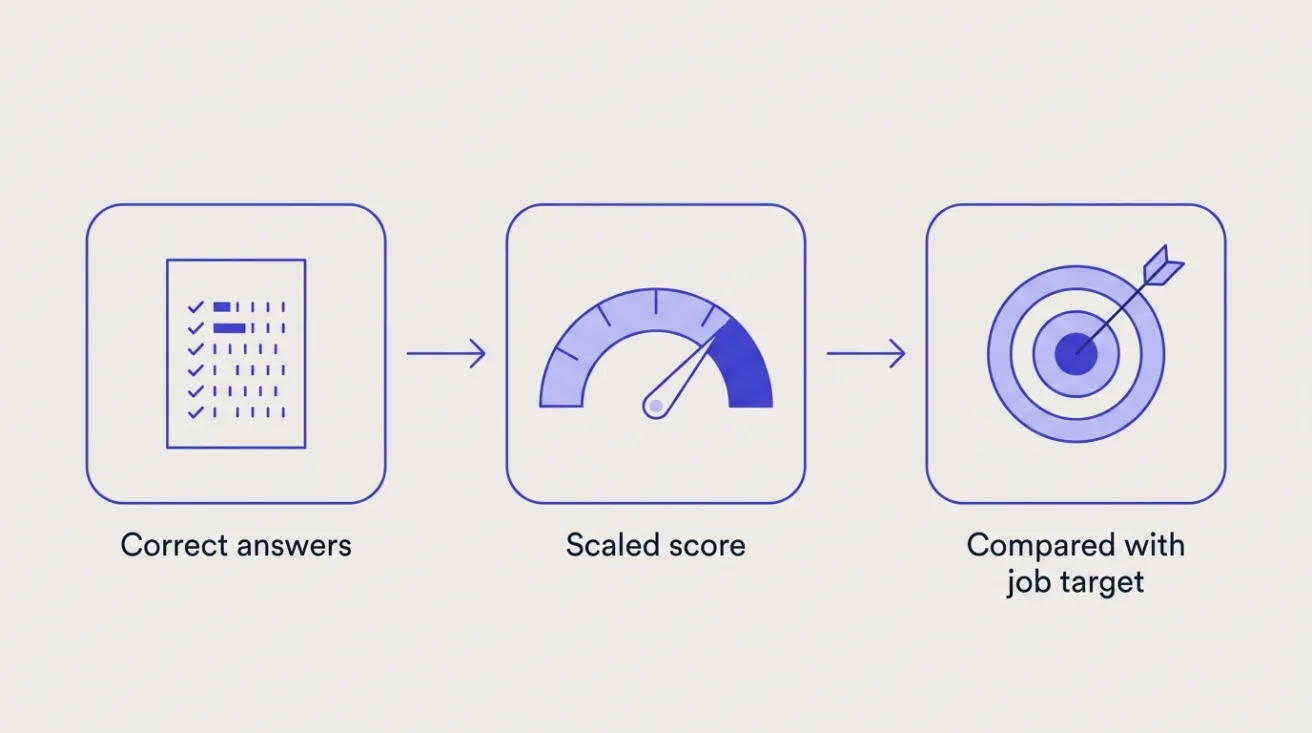
- The scaled score. Your number of correct answers is converted to a scaled score, referenced against the general population, where the average is 250.
- The job target. Employers set a cognitive target for the role. Because scaled scores are standardised, PI's own example is that a score of 270 is always a good match for a job with a target of 270.
- What PI tells employers to ignore. The report also shows raw counts and the number correct in each of the three areas. PI advises against using raw scores or these sub-scores for decisions, because they are not reliable enough, and says percentile ranks are for context only.
- Not the only factor. PI says the score should be used alongside other information, such as experience and behaviour, and not as the sole reason for a hiring decision.
The Cognitive Report is made for the employer's hiring team. PI calls cognitive data "an extremely sensitive piece of candidate information" and recommends keeping scores confidential, with results given in terms of fit to the job rather than the raw number. So you may not be told your score; if you want feedback, ask the employer.
Can you retake the PI Cognitive Assessment?
Only if the employer allows it. By default you get one attempt. The employer can resend the test up to two more times, three attempts in all, and PI tells them to consider only your highest score.
If something went wrong, such as a dropped connection, tell the employer straight away and ask whether they will send another attempt.
How to prepare
Take PI's official sample. It is 20 questions in 4 minutes and 48 seconds, the same pace as the real thing. At the end it shows which you got right and the correct answer to each, though no score. PI says sample performance doesn't predict your real result, so use it to learn the format and the pace.
Practise the switching. Mix verbal, numerical and pattern questions in one timed session instead of practising each type in a block.
Build quick arithmetic. Percentages, fractions to decimals, simple ratios and number series. These are where seconds go.
Rest first. A 12-minute speed test rewards being alert more than most tests do. Take it at the time of day you think best.
Where Cohesyve fits
The cognitive test is usually an early filter. After it, employers tend to look at how you handle the work itself, through interviews and tasks. Cohesyve, which publishes this guide, runs practice job simulations for that stage, with a report on where you lost marks. It won't prepare you for PI's reasoning questions; PI's own sample will. For the behavioural half of a PI invitation, see our Predictive Index guide.
Sources
Checked 21 October 2026.
- PI help: what is the PI Cognitive Assessment?
- PI: the Cognitive Assessment
- PI: cognitive assessment scoring
- PI help: allowing multiple cognitive attempts
- PI: cognitive assessment sample questions
- PI: official cognitive practice sample
- PI help: downloading a candidate's Cognitive Report
- PI: introduction to the PI Cognitive Assessment