
Before you can hire the right person, you have to get the green light to hire anyone at all. That official green light, the one that comes from finance and leadership, is called a job requisition. It’s the internal document that kicks off the entire hiring process.
What Is a Job Requisition and Why Does It Matter
Think of a job requisition less as a piece of paperwork and more as the formal charter for a new role. It’s the moment a hiring manager’s informal “we really need someone” becomes a company-approved, funded mission. While people often mix it up with a job description or a job posting, the requisition’s purpose is purely internal.
At its core, a job requisition is about control and strategic alignment. It’s a formal request that does a few critical things behind the scenes:
- It Justifies the Hire: The requisition requires managers to build a business case. Why this role? Why now? What will this person achieve? It shifts the focus from just adding headcount to making a strategic investment.
- It Secures the Budget: No role exists in a vacuum. The requisition is the document that goes to the finance department to get the official stamp of approval, confirming a salary is budgeted and ready.
- It Aligns All the Key Players: This document becomes the single source of truth for the hiring manager, HR, and leadership. Everyone is on the same page about the role's scope, level, and strategic importance right from the start.
The Foundation of Strategic Hiring
Without a formal requisition process, hiring can quickly become disorganized. Managers might try to fill roles that aren't budgeted for or create positions that don't fit the company's broader goals. This can lead to stalled hiring, rescinded offers, or worse—hiring the wrong person. A 2022 study by Leadership IQ found that 46% of new hires fail within 18 months, and a common reason is a poor upfront definition of the role and its expectations.
A job requisition is the internal alignment tool that prevents hiring mistakes before they happen. It ensures every new role is intentional, funded, and connected to a clear business objective.
When you get this first step right, you build a solid foundation for the entire hiring journey. It’s the crucial checkpoint that guarantees every dollar and hour spent on recruiting is tied to a real, validated business need.
Ultimately, a strong requisition process is one of the best ways to improve hiring process efficiency and make smarter talent decisions. It forces you to define exactly what success looks like, which is the first step in figuring out if your candidates have what it takes to deliver.
The Requisition Journey: From Spark to Signed-Off
A job requisition doesn't just appear out of thin air. It begins as a spark—a hiring manager realizes their team is stretched thin, a critical skill is missing, or a new market opportunity requires more people. But turning that spark into an actual hire is a formal process that ensures every new role is necessary, funded, and aligned with the company's strategy.
Think of this process as the company’s internal vetting system for growth. It’s a series of checkpoints where key leaders give their approval, transforming a single manager’s need into a collective business priority. This structure is what prevents reactive, disorganized hiring and makes every addition to the team a deliberate, strategic investment.
This workflow is all about building a solid business case, one step at a time.
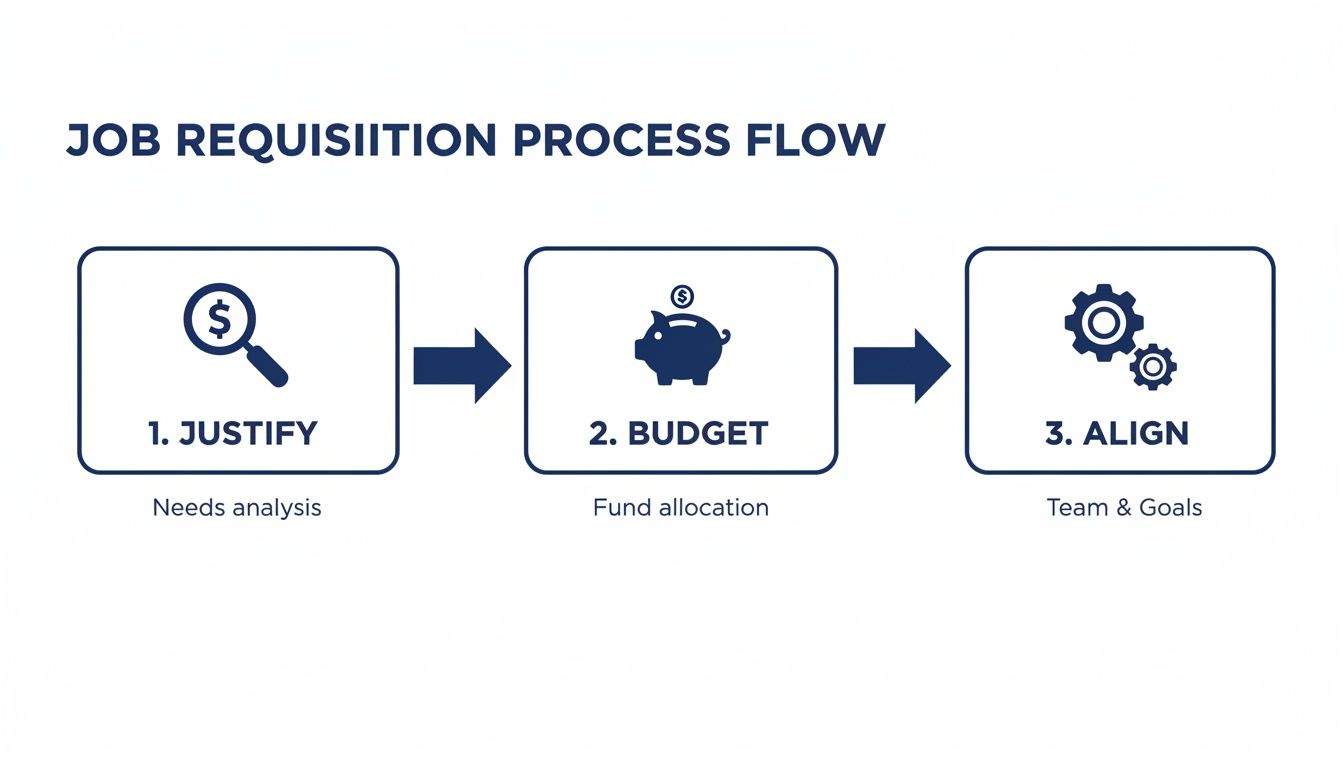
As you can see, it boils down to justifying the why, securing the how much, and aligning the who. Get these three right, and by the time a recruiter starts sourcing, the entire organization is already on board.
The Typical Approval Workflow
While the exact path can differ from one company to another, most requisitions travel a similar route. It’s less about bureaucracy and more about collaborative decision-making.
Hiring Manager to Department Head: It starts with the hiring manager. They are on the front lines and feel the pain of a gap in their team. They draft the initial requisition, outlining why this role is critical, and send it to their department head. This first checkpoint confirms the role supports the department’s immediate projects and long-term goals.
Department Head to Human Resources: Once the department lead agrees the role is strategically sound, the req lands with HR. This is a crucial quality control step. The HR team vets the requisition for compliance, benchmarks the salary against internal pay scales, and ensures the job level fits within the company’s existing framework. They are the guardians of consistency and fairness, preventing one-off roles that could create pay equity issues down the line.
Human Resources to Finance: This is often the final—and most important—gate. The finance team provides the ultimate green light. They confirm the headcount is actually in the budget and that the compensation lines up with financial forecasts. Misaligned budget expectations are a top reason for hiring delays, so getting finance's signature is non-negotiable. Without it, the role remains a good idea on a wishlist.
The requisition workflow is your company's internal system of checks and balances for talent acquisition. It ensures that every new hire is not just a good idea, but a financially vetted, strategically aligned one.
Thankfully, we're not stuck with spreadsheets and email chains anymore. Modern Applicant Tracking Systems (ATS) can automate this entire journey. They route the approvals, notify the next person in line, and give everyone visibility. This cuts down on back-and-forth communication and gets an approved, ready-to-fill role into a recruiter’s hands faster.
Cohesyve
See what candidates can do before you interview them
Cohesyve turns a job description into a role-specific assessment with a scoring rubric. Each candidate gets a different version, so questions cannot be shared. Ten candidates free, no card.
Building a Requisition That Gets Approved
A job requisition is more than just a form. It's a pitch to your own company. You're not just asking for headcount; you're asking for an investment in talent that will solve a problem, unlock revenue, or make a crucial team whole again. A weak, hastily written request gets stuck in a cycle of questions and delays. A compelling one, however, moves smoothly through approvals.
The key is to stop thinking about filling a seat and start building a business case. Every field on that requisition form is an opportunity to tell a story backed by data. When you can clearly articulate the why behind the hire, you make it easy for leadership and finance to say "yes."
This is your moment to frame the conversation around outcomes. A flimsy requisition says, "We need another software engineer." A powerful one declares, "We need a Senior Software Engineer to reduce our page load time by 30%, which we project will decrease cart abandonment and add $250,000 to our Q4 revenue." The difference is clear.
Crafting a Compelling Business Justification
The business justification is the core of your requisition. This is where you draw a straight line from this new role to a tangible business impact. Vague justifications invite scrutiny and delays, so get specific and let the data do the talking.
Instead of saying the team is "overloaded," quantify it. Explain that the team's workload has increased by 40% in the last two quarters, causing a 15% increase in missed deadlines on critical projects. When you put a number on the problem, hiring someone becomes a logical solution.
Make sure your justification answers these questions:
- What specific pain point will this person eliminate? (e.g., "Our customer support ticket response time has increased to 48 hours, causing a measurable drop in our NPS score.")
- What opportunity will this person help us seize? (e.g., "This new marketing role is essential for our expansion into the European market, which represents a $5M opportunity.")
- What's the cost of not hiring this person? (e.g., "Without a dedicated data analyst, we are less informed about our marketing spend. We're potentially wasting 10% of our budget each month.")
Essential Components for a Fast Approval
Beyond a solid justification, paying attention to the details prevents back-and-forth with finance and HR. Getting the details right from the start shows you've done your homework. If you need inspiration on defining a role's scope, our guide to writing a great software engineer job description can be a helpful resource.
The goal of a requisition is to build an undeniable case for the talent you need. A well-crafted document doesn't just ask for headcount; it presents a clear, data-backed business solution.
Here’s a final checklist to run through before you hit submit:
- Standardized Job Title and Level: Is the title consistent with your company’s internal leveling guide? This ensures compensation is benchmarked correctly from day one.
- Accurate Salary Band: Have you worked with HR to land on a competitive but realistic salary range? A mismatch here is one of the most common reasons finance will push back.
- Clear Headcount Type: Be explicit. Is this a backfill for a departing employee or a brand net new position? This distinction is critical for budgeting and forecasting.
- Well-Defined Scope: Are the core responsibilities outlined with precision? This clarity is what justifies the seniority level and salary you’re requesting.
From Requisition Requirements to Hiring Signals
Getting a job requisition approved is a big step. But once the budget is secured, the real work begins. The focus pivots from justifying the need for the role to identifying the person who can fill it. That list of requirements on your form isn't just a checklist—it's the raw material for your hiring signal.
This is where many hiring processes can stumble. Your requisition might call for "strong analytical skills" or "excellent communication," but what do those phrases actually look like in a candidate? If you can't measure it, you can't hire for it with confidence.
Translating Needs into Measurable Skills
Effective talent teams treat the requisition as a blueprint for skill verification. They don't just copy and paste requirements into a job description; they break them down into observable behaviors and real-world abilities.
Think about a requisition for a "proactive project manager." "Proactive" is a great starting point, but it's just an idea. You have to translate it into signals you can actually spot during the hiring process.
What does "proactive" really mean for this role?
- Can they tell you about a time they anticipated a project risk before it became a problem?
- Do they have an example of finding a process bottleneck and fixing it without being told?
- Did they ever build a project dashboard to give stakeholders an early heads-up?
This act of translation is the heart of skills-based hiring. It’s a shift away from focusing on resume keywords and prestigious-sounding companies, and a move toward what a candidate can actually do. Getting this right can expand your talent pool and help build more diverse and capable teams.
A well-defined need on paper should directly inspire how you verify that skill in a person. It’s the only way to ensure the candidate you hire has the abilities you budgeted for in the first place.
Connecting Requisitions to Real-World Verification
Once you’ve translated those high-level requirements into measurable skills, the next step is to design a hiring process that tests for them. This is how you close the gap between your internal document and the external talent market.
A requisition calling for a data-driven marketer shouldn't lead to an interview process that just asks about their past job titles. That’s a mismatch.
Instead, that requisition should inspire an evaluation where candidates interpret a dataset, propose a campaign based on their findings, and articulate the strategy behind it. This is how you move from hoping a candidate has the skills to knowing they do.
When you connect your requisition directly to skill verification methods, you create a logical system. The result is a hiring process where every step, from the initial internal request to the final offer, is grounded in a clear and consistent definition of success.
Common Requisition Mistakes That Stall Hiring
A job requisition should be the launchpad for your hiring process, but small mistakes can stop a great hire in its tracks. These common pitfalls can cause delays, frustrating everyone from the finance team to the final candidate.
We've all seen it. A request lands in your inbox that just says, "Need a new marketing person." This kind of vague justification is an invitation for pushback. It forces approvers to guess at the strategy behind the hire, and when leaders have to guess, the answer is often "no" or a long delay while they dig for more information.

The fix is to connect every request to a measurable business outcome. A small shift in framing makes a big difference:
- Before: "Need a marketing person."
- After: "We need a Content Marketing Manager to increase our inbound leads by 20% in the next six months. This directly supports our $2M revenue growth target for the year."
The "after" version isn't just a request; it's a business case. It gives your leadership team the confidence that this isn't just another expense—it's a strategic investment.
Hunting for Purple Squirrels
Then there's the classic "purple squirrel" hunt. This happens when a requisition reads like a wish list, demanding a set of skills so specific and varied that no single person could possibly have them all. Think of a request for a developer with ten years of experience in a programming language that's only been around for three years.
This pitfall usually emerges when a hiring manager tries to combine two or three different roles into one to save on headcount. The result? Recruiters spend weeks chasing a candidate who doesn't exist, only to come back empty-handed. The requisition has to be rewritten and sent back through approvals, costing time and momentum.
A job requisition isn't a wish list. It's a pragmatic tool for finding a real person who can solve a specific problem. Keep requirements grounded in market reality.
Misaligned Compensation and Leveling
Finally, nothing grinds the hiring process to a halt faster than a mismatch between the job duties and the salary. A requisition for a "Senior Director" role with an entry-level salary band is an immediate red flag for both HR and finance. It signals a disconnect from market reality and likely means the request will be rejected.
The best way to avoid this is to partner with your HR or People team from the start. They can help you benchmark the role against internal pay scales and external market data. Getting familiar with key talent metrics—like time-to-fill—helps you set achievable expectations. You can learn more about how these talent metrics are shaping the job market and driving smarter hiring.
When you align on compensation upfront, you're not just getting the role approved. You're making sure it’s genuinely attractive to the people you want to hire.
Your Questions on Job Requisitions, Answered
You’ve got the theory down, but what happens in practice? Let's dive into some common questions that hiring managers, recruiters, and finance partners wrestle with every day.
How Long Does Requisition Approval Usually Take?
This timeline can be anything from a few hours to a few weeks. The single biggest factor is your company’s size and structure.
At a small startup, approval might be as simple as a quick chat between the hiring manager and the CEO. But in a large enterprise, that same requisition is likely to go through a multi-stage journey.
Several things can affect the timeline:
- The Approval Chain: Simply put, the more people who need to sign off—from the department head to HR and finance—the longer it will take.
- The "Why" Behind the Hire: A vague, one-sentence justification is a bottleneck. A clear, data-backed business case gives every approver the confidence to say "yes" quickly.
- Your Tech Stack: Teams using an Applicant Tracking System (ATS) with built-in workflows have an advantage. The system can automatically push the requisition to the next person in line, providing visibility and preventing it from getting lost in an email inbox.
Can a Job Requisition Be Changed After Approval?
Yes, but proceed with caution. Tinkering with an approved requisition isn't like fixing a typo in an email—it often kicks off a formal change process. This isn’t just red tape; it’s about accountability. The original approval was given based on a specific role, budget, and business need.
Small fixes, like correcting a spelling mistake, are usually fine. But if you want to make a major change—like increasing the salary band, changing the seniority level, or moving the role to a new team—you'll almost certainly have to go back to square one for re-approval.
This is why it’s so critical to get the details right the first time. It saves you from losing weeks of hiring momentum.
What Is an Open Requisition Versus a Closed One?
These are simply status updates that tell you where a specific role is in the hiring lifecycle.
An open requisition is your green light. It means the role is fully approved, the budget is allocated, and the talent team has the official go-ahead to start finding candidates. A closed requisition means the role has been filled and a candidate has accepted the offer.
Once a requisition moves to "closed," all recruiting for that position stops. A critical metric for many TA teams is time-to-fill, which is the total time a requisition spends in that "open" state. It's a direct measure of hiring efficiency.
Does Every Company Use Job Requisitions?
Most established companies do. For any mid-to-large organization, a formal requisition process is the foundation of good financial governance and workforce planning. Trying to manage hiring at scale without it would be disorganized.
On the flip side, very early-stage startups often work more informally, where a conversation is enough to start hiring. But as a company grows, putting a formal requisition process in place becomes a necessary step toward building a scalable, fair, and budget-conscious recruiting engine.
Ready to make sure the candidates you source are a match for the skills you defined in your requisition? Cohesyve helps you move from guesswork to proof. Our platform creates role-specific assessments that verify a candidate's abilities. You get to interview top performers who have already proven they have what it takes.