The traditional interview is changing. Relying solely on resumes and unstructured conversations can lead to hiring mismatches, a costly outcome, with some studies suggesting bad hires can cost up to 30% of their first-year salary. Effective hiring processes now use structured interview test questions to see what candidates can do, not just what they say they have done. This shift allows you to move beyond gut feelings and toward evidence-based hiring decisions.
This guide provides an overview of assessment methods that can help identify skill. We will explore 10 distinct types of evaluations, from behavioral scenarios that reveal work styles to real-world coding challenges that test technical proficiency. The purpose is not to trick candidates but to create a fair opportunity for genuine talent to be recognized.
You will learn more than just a list of questions. For each category, we will analyze:
- Strategic Purpose: Why and when to use each question type.
- Actionable Design: How to craft questions that can help predict on-the-job success.
- Scoring Insights: Practical tips for evaluating responses consistently and fairly.
By understanding the mechanics behind these assessments, you can build a hiring process that helps isolate specific skills, gauge problem-solving abilities, and ultimately find a suitable person for the role. Let's get started.
1. Behavioral Interview Questions (STAR Method)
Behavioral interview questions operate on a simple principle: past performance can be a good predictor of future behavior. Instead of asking hypothetical "what would you do" questions, these prompts ask candidates to recall and describe specific, real-world experiences. This approach provides tangible evidence of their skills, decision-making processes, and how they navigate workplace challenges.
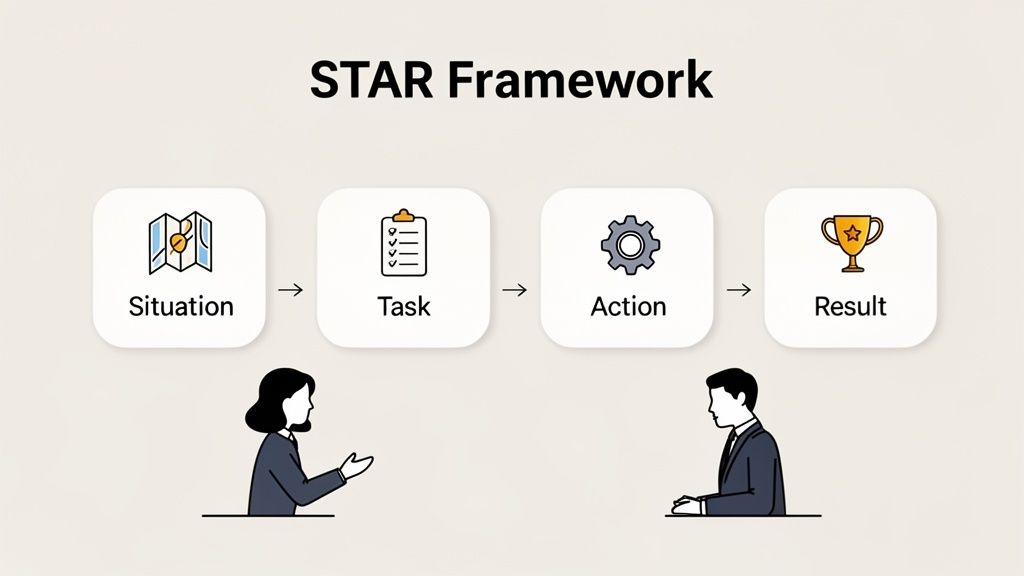
The STAR method (Situation, Task, Action, Result) is a standard framework for answering these questions, creating a clear narrative that is easy for interviewers to follow and evaluate. Companies like Google, Amazon, and Microsoft have built their hiring frameworks around this concept, making it one of the most widely used types of interview test questions. Amazon's Leadership Principles, for instance, are directly tied to behavioral prompts that assess qualities like "Customer Obsession" and "Bias for Action."
Strategic Breakdown
- Situation: What was the context? The candidate should set the scene briefly.
- Task: What was their specific responsibility or goal in that situation?
- Action: What specific steps did they take to address the task? This is the core of the story.
- Result: What was the outcome? Ideally, this includes measurable metrics (e.g., "reduced support tickets by 15%").
Key Insight: The STAR method can help reveal patterns. A single story is an anecdote, but a series of well-structured behavioral answers can paint a more reliable picture of a candidate's typical approach, from conflict resolution to project management.
Actionable Takeaways for Hiring Teams
To make these questions work for you, start by defining the core competencies for the role. Then, craft questions that directly probe for evidence of those competencies.
- For Leadership Roles: "Tell me about a time your team's project was falling behind schedule. What actions did you take?"
- For Technical Roles: "Walk me through your most complex debugging experience. What was the bug, and what was your process for finding and fixing it?"
By designing behavioral prompts connected to your company values and the specific demands of the job, you can move beyond generic answers and gather targeted, relevant information on each candidate. This methodical approach helps ensure you are hiring for demonstrated ability and cultural fit.
2. Technical Assessment Questions (Role-Specific Skills Verification)
Technical assessment questions are designed to verify a candidate's practical, domain-specific knowledge. Moving beyond resume claims, these tests directly measure proficiency in core competencies required for software engineering, data science, or DevOps roles. They evaluate both foundational understanding and the ability to apply skills to solve technical problems, offering concrete evidence of a candidate’s capabilities.
The structured technical interview, used by companies like Google and Meta, relies on these types of questions. Platforms such as HackerRank and LeetCode have made structured coding challenges a widespread practice. Whether it's reversing a linked list or designing a URL shortener, these interview test questions are a common part of modern technical recruiting, helping to ensure that hires possess the specific skills needed to contribute.
Strategic Breakdown
- Problem-Solving Approach: How does the candidate deconstruct the problem? Their ability to explain their thinking before writing code is often more telling than the final solution itself.
- Coding Proficiency: Can they translate their logic into clean, efficient, and bug-free code? This tests fluency in a specific language and its standard libraries.
- Optimization: Does the candidate consider performance? A working solution is good; a solution optimized for time and space complexity is better.
- Verification & Edge Cases: How thoroughly do they test their own work? This reveals their attention to detail and commitment to quality.
Key Insight: Technical assessments are not just about finding the right answer. They can reveal a candidate's thought process, their communication skills under pressure, and their ability to write maintainable code. A candidate who can articulate trade-offs and debug systematically often demonstrates a deeper level of engineering maturity.
Actionable Takeaways for Hiring Teams
Ground your technical questions in the actual challenges your team faces. Generic brainteasers may provide less value compared to problems that mirror your tech stack and business domain.
- For Data Science Roles: "Given this dataset, write a Python script using pandas to clean the data and identify the top three outliers. Explain your definition of an outlier."
- For Backend Engineering Roles: "Write an SQL query to find all users who have not logged in for 90 days but have made a purchase in the last year."
- For System Design: "Outline the architecture for a basic real-time notification service. What components would you use, and how would they interact?"
By connecting your assessments directly to the job's daily tasks, you create a high-fidelity signal for on-the-job performance. This helps ensure you are hiring for demonstrated skill, not just theoretical knowledge.
Cohesyve
See what candidates can do before you interview them
Cohesyve turns a job description into a role-specific assessment with a scoring rubric. Each candidate gets a different version, so questions cannot be shared. Ten candidates free, no card.
3. Coding Challenge Questions (Real-World Implementation)
Coding challenges move beyond abstract algorithms to assess a candidate's ability to build practical solutions under time constraints. These assessments require candidates to write functional code that solves a specific business-adjacent problem, evaluating their design choices, code quality, and debugging skills. This simulates the work an engineer performs, requiring them to think through trade-offs, handle edge cases, and produce a maintainable solution.
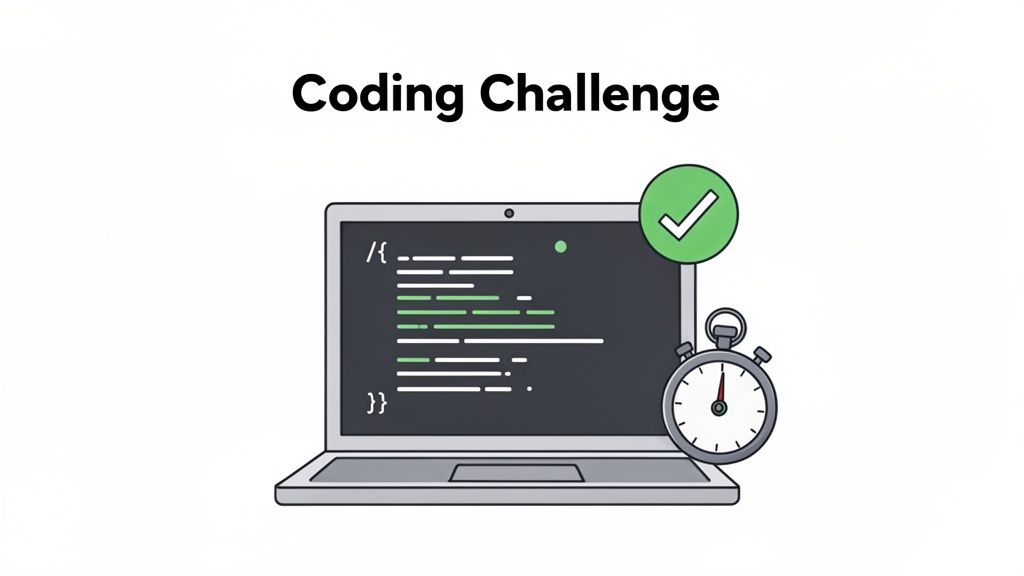
This method was adopted by tech companies like Google and Microsoft and further refined by platforms like CodeSignal and Codility. Now, companies like Stripe, Airbnb, and Uber use these interview test questions to gauge proficiency directly. For example, a candidate might be asked to build a simple payment processing endpoint or a real-time booking collision detector, mirroring the core business logic of the company they are interviewing with. These are useful tools for evaluating technical aptitude; you can explore a variety of Java coding tests to see how they can be applied.
Strategic Breakdown
- Problem: Define a clear, bounded problem with real-world constraints (e.g., "Build a URL shortener with basic analytics").
- Implementation: The candidate writes code to solve the problem, often in an online editor or their local environment.
- Validation: The solution is evaluated based on correctness, efficiency (time/space complexity), and code quality.
- Discussion: The interviewer and candidate review the code, discussing design decisions and potential improvements.
Key Insight: The value of a coding challenge is not just seeing if the code runs, but understanding how the candidate arrived at their solution. Their approach to clarifying requirements, structuring their code, and testing for edge cases can reveal more about their engineering maturity than a perfect answer alone.
Actionable Takeaways for Hiring Teams
Ground your challenges in problems relevant to your team’s daily work. This makes the assessment more engaging for candidates and gives you a more accurate signal.
- For FinTech Roles: "Implement a basic trade order execution system that includes input validation and simple risk checks."
- For Consumer Tech Roles: "Build a playlist deduplication function that can identify and flag duplicate songs across multiple user playlists."
By creating challenges that reflect your actual technical environment, you test for relevant skills and give candidates a realistic preview of the job. This focused approach helps ensure you are hiring for practical ability, not just theoretical knowledge.
4. Case Study Interview Questions (Strategic Problem-Solving)
Case study interviews evaluate a candidate's ability to tackle complex, often ambiguous business problems. Rather than testing memorized knowledge, these questions assess structured thinking, analytical skills, and strategic reasoning in real-time. They are designed to simulate the problem-solving scenarios common in consulting, finance, and product strategy roles.
This method moves beyond a candidate’s resume to show how they think. The interviewer presents a business challenge, such as "A quick-service restaurant chain wants to expand; analyze the market and recommend target cities," and observes how the candidate structures their approach. Companies like McKinsey & Company, Boston Consulting Group, and Amazon use these interview test questions to see problem-solving skills in action, identifying who can build a coherent business case from scratch.
Strategic Breakdown
- Clarify & Structure: The candidate should first ask clarifying questions to narrow the scope and then outline their analytical framework audibly.
- Hypothesize & Gather Data: They form an initial hypothesis and identify the key drivers and data needed to test it.
- Analyze & Calculate: The candidate performs necessary analysis, often including back-of-the-envelope calculations to estimate market size or financial impact.
- Synthesize & Recommend: Finally, they synthesize their findings into a clear, data-backed recommendation.
Key Insight: A case interview is not about finding a single "correct" answer. It is a collaborative dialogue that reveals a candidate's thought process, comfort with ambiguity, and ability to use frameworks like Porter's Five Forces not as a script, but as a flexible tool for thinking.
Actionable Takeaways for Hiring Teams
To effectively use case studies, present problems relevant to your company's strategic challenges. This makes the exercise more engaging for the candidate and gives you more relevant signals.
- For Product Strategy Roles: "Should we enter the grocery delivery business? Build a business case analyzing the market, competition, and potential synergies."
- For Finance & Investment Roles: "Estimate the market size for electric vehicle charging infrastructure in Europe by 2030 and identify key investment risks."
By grounding your case studies in realistic scenarios, you can directly assess the analytical and strategic skills required for the job. This approach provides a predictive window into a candidate's future performance when faced with your organization's real-world business puzzles.
5. Situational/Hypothetical Interview Questions (Judgment Under Uncertainty)
Situational questions challenge candidates with hypothetical workplace scenarios, asking "what would you do if...?" Unlike behavioral questions that draw from the past, these prompts explore a candidate's judgment, problem-solving framework, and values when faced with a novel or ambiguous situation. They are designed to reveal how a person thinks, not just what they have done.
This method tests for foresight, ethical reasoning, and alignment with company culture under pressure. Companies with strong values-based identities, like Zappos and Patagonia, often use these interview test questions to see if a candidate’s internal compass points in the same direction as the organization’s. The goal isn't just to get a "right" answer, but to understand the reasoning and priorities that guide the candidate's decision-making process.
Strategic Breakdown
- Explain the "Why": The candidate shouldn't just state their action; they must explain the rationale behind it. This reveals their decision-making framework.
- Acknowledge Complexity: Strong answers recognize competing interests and trade-offs, avoiding oversimplified solutions.
- Ask Clarifying Questions: A good candidate may ask for more context about priorities or constraints, showing they think before they act.
- Align with Values: The response can reflect the company's stated values, demonstrating the candidate has done their research and sees a genuine fit.
Key Insight: The value of a situational question is in its ability to test for judgment in gray areas. How a candidate navigates a scenario with no clear right answer can provide a signal about their character, integrity, and on-the-spot critical thinking.
Actionable Takeaways for Hiring Teams
To craft effective situational questions, work backward from the core values and difficult trade-offs inherent to the role and your company culture.
- For Ethical Judgment: "You discover a colleague is submitting another person's work as their own. What would you do?"
- For Prioritization: "Your manager asks you to cut corners on quality assurance to meet a tight deadline for a major client. How do you respond?"
- For Customer Focus: "A key client requests a feature that directly conflicts with our company's public privacy policy. How do you handle that conversation?"
By designing scenarios that reflect real-world tensions your team faces, you can evaluate a candidate’s likely behavior and ensure they are equipped to make sound decisions when it matters most.
6. Aptitude and Reasoning Questions (Cognitive Ability Screening)
Aptitude questions assess a candidate's cognitive abilities, independent of specific job knowledge. By testing logical, numerical, and verbal reasoning, these standardized assessments measure foundational thinking capacity. The idea is that a person's ability to learn, adapt, and solve novel problems can be a useful indicator of their potential for long-term success in a role.
These tests are a common feature for hiring in consulting, finance, and leadership programs where on-the-job problems are often ambiguous and complex. Companies like McKinsey & Company and Goldman Sachs use them as an early-stage filter, while SHL's assessments are used by many large corporations. This makes aptitude screening a widely validated type of interview test questions for predicting job performance.
Strategic Breakdown
Aptitude tests are designed to evaluate core cognitive functions rather than memorized information. They are typically timed and come in several forms:
- Logical Reasoning: Assessing the ability to identify patterns, complete sequences, and deduce conclusions from abstract information (e.g., Raven's Progressive Matrices).
- Numerical Reasoning: Evaluating how a candidate interprets and makes decisions based on data presented in charts, graphs, and tables.
- Verbal Reasoning: Measuring the capacity to understand, analyze, and draw logical conclusions from written passages.
Key Insight: Aptitude tests can provide an objective, data-driven baseline for a candidate's problem-solving ability. Unlike interviews, which can be subject to bias, these tests offer a standardized measure of cognitive potential, helping to level the playing field and identify high-potential candidates who might otherwise be overlooked.
Actionable Takeaways for Hiring Teams
Integrate cognitive screening early in your process to efficiently identify candidates with strong foundational abilities. This allows you to focus later, more time-intensive interviews on skills, experience, and cultural fit.
- For Analytical Roles: Use numerical reasoning tests to confirm a candidate can work with data effectively. This is helpful for finance, data science, and business analyst positions.
- For Strategy & Consulting Roles: Employ critical thinking and logical reasoning tests (like the Watson-Glaser) to find individuals who can break down complex problems and form sound arguments.
By combining aptitude results with other evaluation methods, you can build a more complete picture of each applicant. To learn more about how to implement this effectively, check out this guide on cognitive ability tests for hiring. This approach helps you hire for both current skills and future potential.
7. Whiteboard/Design Interview Questions (Collaborative Problem-Solving)
Whiteboard interviews move beyond rote memorization to assess a candidate's real-time problem-solving and communication abilities. By asking candidates to architect a system or solve a problem on a literal or virtual whiteboard, you can simulate the collaborative, iterative nature of actual work. Common in engineering, product, and design roles, these assessments reveal how a candidate deconstructs ambiguity, explains their thought process, and incorporates feedback.
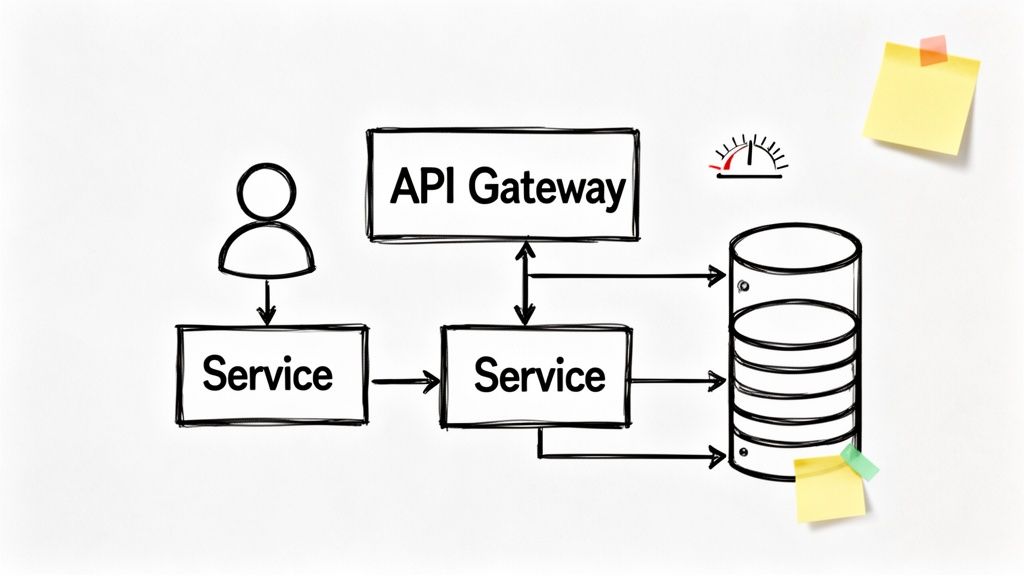
This method was popularized by tech companies like Google and Meta, who needed a way to evaluate how engineers would tackle large-scale challenges. Instead of just testing for correct answers, these interview test questions are designed to see how a candidate thinks. The final drawing on the board is often less important than the dialogue and trade-offs discussed along the way.
Strategic Breakdown
- Problem Decomposition: Can the candidate break down a vague prompt (e.g., "Design a parking lot system") into specific requirements and constraints?
- Systematic Thinking: Do they start with a high-level design and progressively add detail, or do they get lost in minor specifics?
- Communication & Collaboration: How well do they articulate their ideas and respond to clarifying questions or suggestions from the interviewer?
- Trade-off Analysis: Do they explicitly discuss the pros and cons of their choices, such as scalability versus cost or consistency versus availability?
Key Insight: The whiteboard interview is a test of collaborative thinking under pressure. A strong candidate treats the interviewer as a teammate, asking questions and thinking aloud to co-create a solution, rather than performing a silent, solo presentation.
Actionable Takeaways for Hiring Teams
Frame questions to mirror the real challenges your team faces. Focus on the candidate’s process, not just the final product on the board.
- For System Design: "Design a real-time notification system for our e-commerce platform. What are the key components, and how would you ensure low latency?"
- For Product/UX Roles: "Whiteboard a new feature for Spotify that improves music discovery for users. Walk me through your design process and user flow."
By making the interview a two-way conversation, you can gain a clearer picture of the candidate’s technical fluency, communication style, and ability to handle complexity—all indicators of on-the-job performance.
8. Culture Fit and Values Alignment Questions (Organizational Chemistry)
Culture fit questions go beyond assessing technical skill to explore whether a candidate’s values, work style, and personality align with an organization's core ethos. Instead of focusing on what a candidate can do, these prompts investigate how they do it. The goal is to understand preferences around collaboration, autonomy, risk tolerance, and what makes work meaningful to them, which can help predict long-term retention and engagement.
Pioneers like Zappos and Netflix showed the impact of this approach by making cultural alignment a key part of their hiring process. Netflix’s famous culture deck explicitly defined its values, allowing the company to hire people who would thrive in its high-performance, high-freedom environment. These companies found that hiring for cultural contribution can create a more cohesive and motivated workforce. This is a useful type of interview test questions for building a strong organization.
Strategic Breakdown
- Values Alignment: Questions like, "Our company values radical transparency. How do you feel about that working style?" directly test for resonance with core principles.
- Work Preference: Prompts such as, "Describe your ideal work environment. How much structure versus autonomy do you need?" reveal the conditions under which a candidate performs best.
- Motivation & Mission: Asking "Why does our mission matter to you personally?" connects a candidate's personal drivers to the company's purpose.
- Collaboration Style: Inquiries like, "Are you energized or drained by constant collaboration?" help place candidates in teams where they will be most effective.
Key Insight: The objective is not to hire clones or create an echo chamber. A better goal is to seek "culture add," not just "culture fit." The best candidates complement and enhance the existing culture, bringing diverse perspectives that align with core values while challenging groupthink.
Actionable Takeaways for Hiring Teams
To effectively measure cultural alignment, you must first define your culture with honesty and precision. Move beyond generic website copy and identify the real-world behaviors that lead to success at your company.
- For Mission-Driven Companies: "Tell me about a time your work had a positive impact on a community or customer. Why was that meaningful to you?"
- For Fast-Paced Startups: "We often have to make decisions with incomplete data. Describe a situation where you had to act with ambiguity. What was your process and what was the outcome?"
By framing questions around your actual operational values, you ensure the conversation is grounded in reality. This helps both you and the candidate make an informed decision, preventing the misalignment that often leads to short-term hires and a disengaged team.
9. Voice Role-Play and Communication Assessment (Interpersonal Effectiveness)
Voice role-play assessments evaluate how candidates handle realistic, high-stakes conversations by placing them in simulated scenarios. This method measures critical interpersonal skills like emotional intelligence, persuasion, and conflict de-escalation—dimensions that text-based or multiple-choice interview test questions cannot capture. By assessing verbal communication, you get a direct view of a candidate’s authentic interaction style.
These tests place candidates into common workplace situations, from handling an upset customer to giving a direct report sensitive feedback. The rise of AI-powered platforms has made these assessments scalable and more objective, allowing companies to evaluate a candidate's ability to listen, empathize, and problem-solve in real-time. This approach is common practice in customer service, sales, and leadership development, where effective communication is directly tied to business outcomes.
Strategic Breakdown
- Situation: The candidate is presented with a clear, job-relevant scenario (e.g., "A key client is threatening to leave due to a service failure.").
- Task: Their goal is defined (e.g., "Retain the client and restore their confidence.").
- Action: The candidate engages in a spoken dialogue, either with a trained role-player or an AI. Their responses, tone, and pacing are evaluated.
- Result: The outcome is assessed based on predefined competencies like empathy, clarity, problem-solving, and composure.
Key Insight: A resume can list "strong communication skills," but a voice role-play shows what that means under pressure. It can help separate candidates who can talk about empathy from those who can be empathetic when it counts.
Actionable Takeaways for Hiring Teams
To implement this, design scenarios that mirror the specific challenges of the role. Authenticity is crucial for gathering meaningful data on how a candidate will perform.
- For Customer-Facing Roles: "A customer received a damaged product and is very frustrated. Handle the call."
- For Sales Roles: "You have three minutes to convince a skeptical prospect why our B2B SaaS product is a better fit than their current solution."
- For Leadership Roles: "Address a sensitive interpersonal conflict between two of your top-performing team members who are unable to collaborate."
By simulating the conversational dynamics of the job, you gain predictive insight into a candidate's interpersonal effectiveness. This helps ensure you hire individuals who can not only do the work but also build the strong relationships necessary for success.
10. Adaptive and Multi-Stage Assessment (Intelligent Question Selection)
Adaptive assessments move beyond static, one-size-fits-all tests by dynamically adjusting question difficulty based on a candidate's real-time performance. This intelligent selection process uses algorithms to present questions that are challenging yet appropriate, providing a more precise and efficient measure of a candidate's true ability. Instead of a fixed set of questions, the test adapts, getting harder for strong performers and easier for those who are struggling.
This method, pioneered by standardized tests like the GMAT and GRE, can offer a more granular view of proficiency. Modern coding platforms and skill assessment tools, such as LinkedIn's, have adopted this approach to create a more accurate and engaging candidate experience. Combining this with a multi-stage process, where candidates progress through different assessment types (e.g., coding challenge to system design), creates a comprehensive evaluation funnel that respects everyone's time.
Strategic Breakdown
- Initial Question: The assessment starts with a question of medium difficulty.
- Performance Analysis: The system analyzes the candidate's answer. A correct answer leads to a harder question, while an incorrect one prompts an easier question.
- Iterative Adjustment: This process repeats, with the algorithm homing in on the candidate's peak skill level.
- Final Score: The final score is based not just on the number of correct answers, but on the difficulty level of the questions answered correctly.
Key Insight: Adaptive testing can be more efficient and equitable. It prevents top candidates from getting bored with easy questions and avoids discouraging promising candidates who might struggle with an overly difficult initial problem. It measures potential and resilience, not just existing knowledge.
Actionable Takeaways for Hiring Teams
To implement this, you can use platforms with built-in adaptive capabilities or structure your own multi-stage process. The goal is to filter candidates progressively based on the skills most critical at each stage.
- For High-Volume Technical Roles: Use an adaptive coding challenge as the first stage. Only those who pass a certain difficulty threshold advance to a technical phone screen, saving valuable engineering time.
- For Senior Leadership Roles: Create a multi-stage process. Start with a business case study, move to a behavioral interview focused on leadership, and conclude with a final-round presentation to stakeholders.
By building an assessment journey that adapts to each candidate, you can create a more accurate and respectful set of interview test questions. This approach helps ensure you are measuring ability with precision and identifying top talent who might otherwise be missed in a rigid, one-dimensional testing process.
Comparison of 10 Interview Test Question Types
| Assessment | Implementation complexity | Resource requirements | Expected outcomes | Ideal use cases | Key advantages |
|---|---|---|---|---|---|
| Behavioral Interview Questions (STAR Method) | Moderate — structured interviews and rubrics | Trained interviewers, interview time, scoring guides | Evidence of past behavior, soft-skill evaluation | Mid-to-senior roles, cross-functional and culture-fit hires | Predictive of job performance; rich qualitative insights |
| Technical Assessment Questions (Role-Specific Skills Verification) | Moderate–High — role-aligned test design | Subject-matter experts, testing platform, test validators | Objective measure of domain knowledge and competency | Engineering, data, DevOps pre-screening | Objective, comparable, filters technical gaps quickly |
| Coding Challenge Questions (Real-World Implementation) | High — real problems, testcases, grading criteria | Candidate time, evaluator time, execution environment | Demonstrated coding ability, code quality, problem-solving | Software engineering, take-home or timed practical tests | Highly predictive of practical coding performance |
| Case Study Interview Questions (Strategic Problem-Solving) | High — bespoke cases and interviewer skill required | Domain experts, lengthy interviewer time, scoring templates | Assessment of structured thinking, business judgment, analysis | Consulting, strategy, senior product and finance roles | Realistic simulation of strategic work; evaluates reasoning |
| Situational/Hypothetical Interview Questions (Judgment Under Uncertainty) | Low–Moderate — scenario creation and scoring guidance | Interviewer time, scenario library, calibrated rubrics | Insight into decision frameworks, values, and judgment | Early-career roles, leadership potential, value-alignment screens | Assesses judgment when past experience is limited |
| Aptitude and Reasoning Questions (Cognitive Ability Screening) | Moderate — validated test selection and administration | Licensed tests/platforms, timed delivery, scoring systems | Standardized cognitive scores and percentile rankings | High-volume screening, roles needing strong reasoning | Strong predictor of performance; objective and scalable |
| Whiteboard/Design Interview Questions (Collaborative Problem-Solving) | High — live facilitation and interactive evaluation | Skilled interviewers, whiteboard/collaboration tools | Visibility into thinking process, communication, trade-offs | System architecture, senior engineering, product design | Reveals problem decomposition, collaboration, adaptability |
| Culture Fit and Values Alignment Questions (Organizational Chemistry) | Low–Moderate — defined values and interviewer calibration | Interviewer time, culture definitions, behavioral probes | Assessment of values alignment and retention risk | Roles where retention and cultural fit are critical | Predicts engagement and reduces regrettable turnover risk |
| Voice Role-Play and Communication Assessment (Interpersonal Effectiveness) | Moderate–High — scenario scripting and evaluation | Audio/video platform, recording consent, trained raters | Measured communication, empathy, persuasion, composure | Customer-facing, sales, leadership, negotiation roles | Captures tone, authenticity, and real-time interpersonal skill |
| Adaptive and Multi-Stage Assessment (Intelligent Question Selection) | Very high — algorithm design and psychometric validation | Large item bank, engineering, psychometrics, platform support | Efficient, tailored ability measurement across domains | Scalable hiring pipelines, multi-skill role evaluations | Efficient, reduces cheating, matches difficulty to candidate level |
Building a Smarter Hiring Process, One Question at a Time
We have reviewed a wide array of interview test questions, from the logic of coding challenges to the foresight required in case studies. The central theme connecting them all is a move away from simple trivia and toward a genuine verification of on-the-job capability. Effective hiring is not about finding candidates who have memorized answers; it is about identifying individuals who possess the core skills and thought processes to succeed in a specific role.
The most effective hiring strategies recognize that a single question type is rarely sufficient. A top-performing software engineer needs more than just coding ability; they need to collaborate on system design and navigate team dynamics. Similarly, a standout sales leader needs more than just communication skills; they must demonstrate strategic thinking through case studies and situational judgment. The real benefit comes when you thoughtfully sequence these different assessment types to build a complete picture of a candidate.
Key Takeaways: From Theory to Application
Reflecting on the methods discussed, several core principles stand out as important for building a modern and effective assessment process. These are not just ideas but actionable steps you can implement.
- Context is King: The most important factor is tailoring your interview test questions to the specific, daily demands of the job. A generic aptitude test for a senior data scientist is a missed opportunity. A role-specific assessment that simulates a data modeling problem can be a powerful predictor.
- Combine and Conquer: Relying solely on behavioral questions or only on technical tests creates blind spots. Insightful interviews often blend different formats, like a technical challenge followed by a behavioral question about a similar past project. This approach verifies both "hard" skills and "soft" competencies.
- Focus on the "How," Not Just the "What": The final answer is only part of the story. Observing a candidate's problem-solving process during a whiteboard session, their communication style in a role-play, or their analytical approach to a case study provides deeper, more meaningful information on their true abilities.
Strategic Insight: The goal of an assessment is not just to filter people out, but to predict future success with more confidence. Every question should be a deliberate tool designed to measure a specific, job-critical competency.
Your Actionable Next Steps
Mastering the art of the interview is an ongoing process. To begin applying these concepts, start small but be deliberate.
- Audit Your Current Process: Select one critical role you are hiring for. Map your current interview questions directly to the top three to five responsibilities listed in the job description. Are there gaps?
- Introduce a New Method: If you primarily use behavioral questions, add a small, practical case study. If you rely heavily on technical screens, incorporate a situational question to assess judgment.
- Calibrate and Iterate: After a few interviews, gather feedback from your hiring team. Was the new question effective? Did it reveal useful information? Adjust your approach based on real-world results.
By shifting your focus from simply asking questions to designing intentional assessments, you create a system that is fairer to candidates and more effective for your organization. This is how you move beyond guessing and start making hiring decisions backed by verifiable evidence. This careful, methodical approach to crafting and deploying interview test questions is the foundation for building high-performing teams, reducing costly hiring mistakes, and establishing your company as an employer of choice.
Creating and automating custom skill verification tests that mirror real-world job tasks can help you truly predict performance. If you're ready to move beyond static question banks and build dynamic, role-specific assessments, Cohesyve offers tools to help. Explore how our platform makes it easy to design the exact interview test questions you need at Cohesyve.