The Predictive Index, usually called PI, is a hiring and management platform, and employers who use it often send two assessments together. One measures how quickly you reason; the other describes how you prefer to work. They are very different, and so is the way to prepare for each.
The PI Cognitive Assessment
PI's reasoning test has had a few names. It launched in 2016 as the PI Learning Indicator and is now called the PI Cognitive Assessment. For the question types in more depth, with worked examples and a timing plan, see our PI Cognitive Assessment guide.
The format
- 50 multiple-choice questions in 12 minutes, about 14 seconds each.
- Three kinds of question: up to 16 verbal, 18 numerical and 16 abstract reasoning.
- A unique set for each candidate. PI draws a different combination of questions for each person; it is not adaptive, so questions don't get harder as you go.
- Leave the page and it blurs. If you navigate away, the test screen blurs, and copy-paste is blocked.
- Proctored or not, depending on the employer.
- Extended-time versions of 18 and 24 minutes exist as accommodations, and the test is available in 64 languages.
What employers see
Your score is the number of questions you answer correctly, converted to a scale from 100 to 450. The average is 250, which corresponds to about 20 correct answers out of 50. Employers see that scaled score set against the job's target, shown as a cautionary, moderate or strong fit. PI tells employers to use only the scaled score, not the raw count or sub-scores, and to keep actual scores confidential.
Retakes
By default you get one attempt. An employer can allow up to three in total and is advised to use the highest. Note that an invitation that expires, or an attempt you abandon, counts as an attempt.
The PI Behavioral Assessment
This one is untimed and takes most people about six minutes. It is not a test in the pass-or-fail sense.
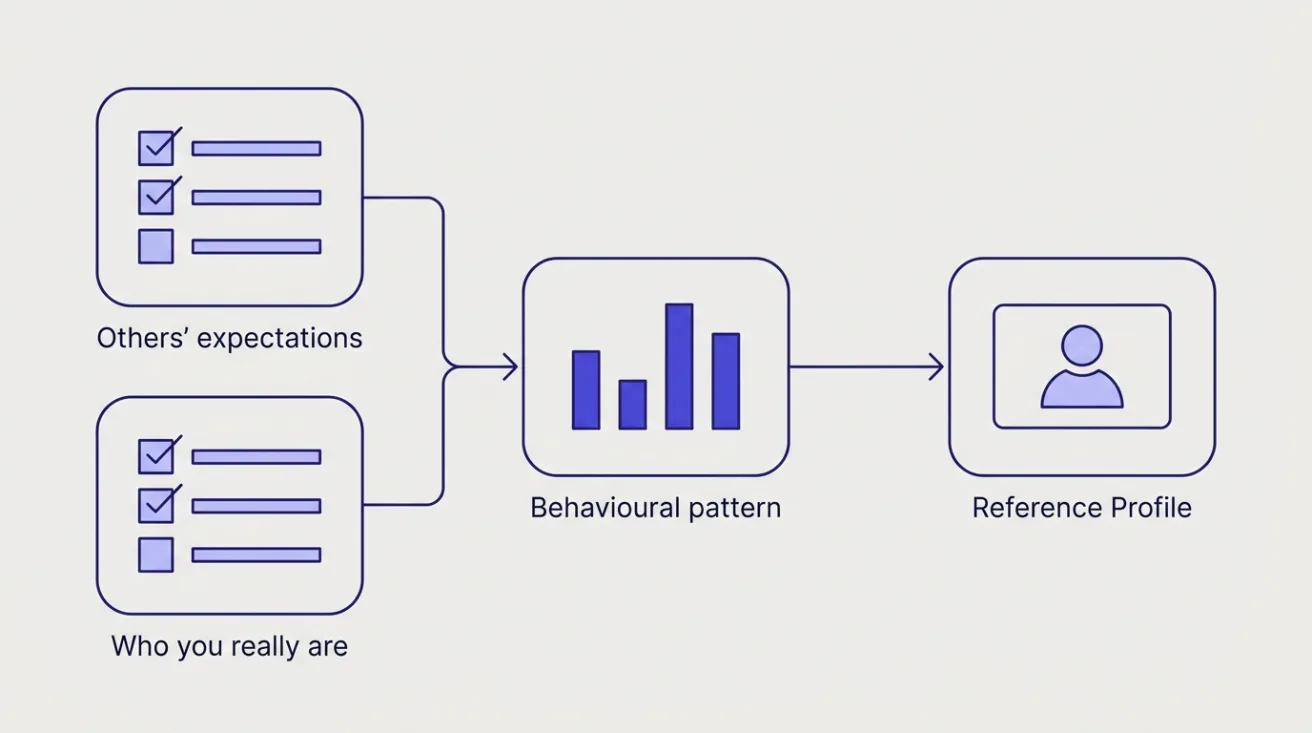
- Two questions, each with the same list of 86 adjectives. In the first, you pick the words that describe how others expect you to act. In the second, you pick the words that describe who you really are. You choose between 6 and 79 words each time.
- What it measures: four drives (Dominance, Extraversion, Patience and Formality) plus a measure of Objectivity.
- What comes out: a behavioural pattern, matched to one of 17 Reference Profiles. There are no right or wrong answers.
- How employers should use it: PI recommends comparing your pattern with the profile the job calls for, not applying cut-off scores.
It has been in use since 1955 and is available in 68 languages.
Cohesyve
Get used to being assessed before you sit the Predictive Index tests
Cohesyve's practice runs are AI job simulations of the role you want, not copies of the Predictive Index tests. They show where you lost marks. 3 free tests, no card.
How to prepare
Take PI's official sample. PI publishes a free practice version: 20 questions in 4 minutes and 48 seconds, the same pace as the real test. It is the best preview there is.
Pace yourself at 14 seconds a question. Most people answer about 20 of 50 correctly, so finishing isn't the goal. Answer the questions you can do quickly and accurately, guess on the rest, and keep moving.
Expect a mix. Verbal analogies and word meanings, quick arithmetic and number series, and shape patterns are interleaved. If one type is weak for you, practise it under time pressure.
Start only when you can finish. Because an abandoned or expired attempt counts, open the test link when you have 15 quiet minutes, a stable connection and nothing else to do.
Answer the behavioral assessment as yourself. It asks two different questions on purpose: how others expect you to act, and how you really are. Trying to game it usually just produces a profile that fits no job well, and the employer is matching you with a role's needs, not marking you.
Where Cohesyve fits
Employers who use PI often follow it with interviews and a task from the job itself. Cohesyve, which publishes this guide, runs practice job simulations for that later stage, with a report on where you lost marks. It won't prepare you for PI's reasoning questions; PI's own sample will.
Sources
Checked 2 October 2026.