What if your sharpest, most insightful screening interview could run on its own, 24/7? That’s the simple, powerful idea behind an interview on demand. It’s a way for candidates to complete structured, job-relevant tasks—like a quick case study or a reasoning exercise—on their own schedule, giving you a preview of their skills before you have a live conversation.
The Shift to Skill-Based Screening
For decades, hiring has kicked off with the resume pile. But many have learned that resumes are not always a reliable predictor of future success. We spend, on average, just 30 seconds glancing at a CV, our eyes scanning for familiar company logos or university names. This habit means we’re unintentionally filtering out qualified people who don't have a conventional background on paper.
This is where the on-demand interview changes the approach. It’s a deliberate move away from where someone has been to what they can actually do. Think of it as giving your top applicants a small piece of the real job from day one, instead of just asking for their employment history.
From Static Resumes to Dynamic Tasks
A traditional application is like a static photograph—it gives you a single, posed moment from a candidate’s past. An on-demand interview, on the other hand, is an assessment that shows you how they think and perform. This isn't about asking candidates to record themselves answering generic questions into a camera.
An effective on-demand interview is built around challenges that are specific to the role itself. This could be anything from:
- Practical Case Studies: Asking a marketing applicant to outline a go-to-market brief.
- Reasoning Exercises: Giving a future operations manager a logistical puzzle to solve.
- Coding Challenges: Tasking a software engineer with debugging a snippet of code.
- Voice Role-Plays: Simulating a customer call for a support or sales role.
When you ask people to do the work, you replace guesswork with tangible evidence of their skills. This helps talent teams spot high-potential candidates right from the start.
The point isn't to add more hoops for candidates to jump through. It's about creating smarter, more equitable opportunities for everyone to show what they're made of, regardless of what their resume says.
Suddenly, that initial screening process transforms from a calendar-clogging chore into something flexible and efficient for everyone. Recruiters can reduce the number of repetitive screening calls. And candidates get the freedom to showcase their abilities when it works for them, free from the pressure and scheduling headaches of a live interview. It sets the stage for much deeper, more meaningful conversations down the line, because you already know every finalist is capable of doing the job.
The ROI of On-Demand Interviews for Talent Teams
Moving to an interview on demand model isn't just about appearing modern—it's a business decision. For any talent team trying to balance packed schedules with ambitious hiring targets, the return on investment has to be clear. The data often tells a compelling story.
The most immediate change you'll notice is in your team's efficiency. Think about all the hours lost to scheduling conflicts and repetitive screening calls. By shifting that initial skill check to an asynchronous format, you give those hours right back to your recruiters.
This frees them up to do what they do best: build relationships with candidates who have already demonstrated they can do the job. For engineering managers, it's particularly helpful. No more wading through stacks of resumes that look great on paper but don't translate to practical skills.
Cutting Your Time to Hire
One of the biggest wins is a reduction in time-to-hire. We've seen high-growth companies using on-demand assessments fill critical roles up to 50% faster. This isn't just a vanity metric; it’s about business impact.
Think about it. Every week a key role sits empty, a project can stall. Your team feels the pressure, burnout can creep in, and you might lose momentum. Getting the right person in the door faster means your business moves faster.
An empty seat is more than a missing teammate; it's a drag on your entire organization's velocity. On-demand interviews help you fill that seat with the right person, faster.
The idea is to create a more efficient, candidate-friendly process that gets you to a qualified shortlist in less time. It’s about giving great candidates 24/7 access to show their skills, not just talk about them.
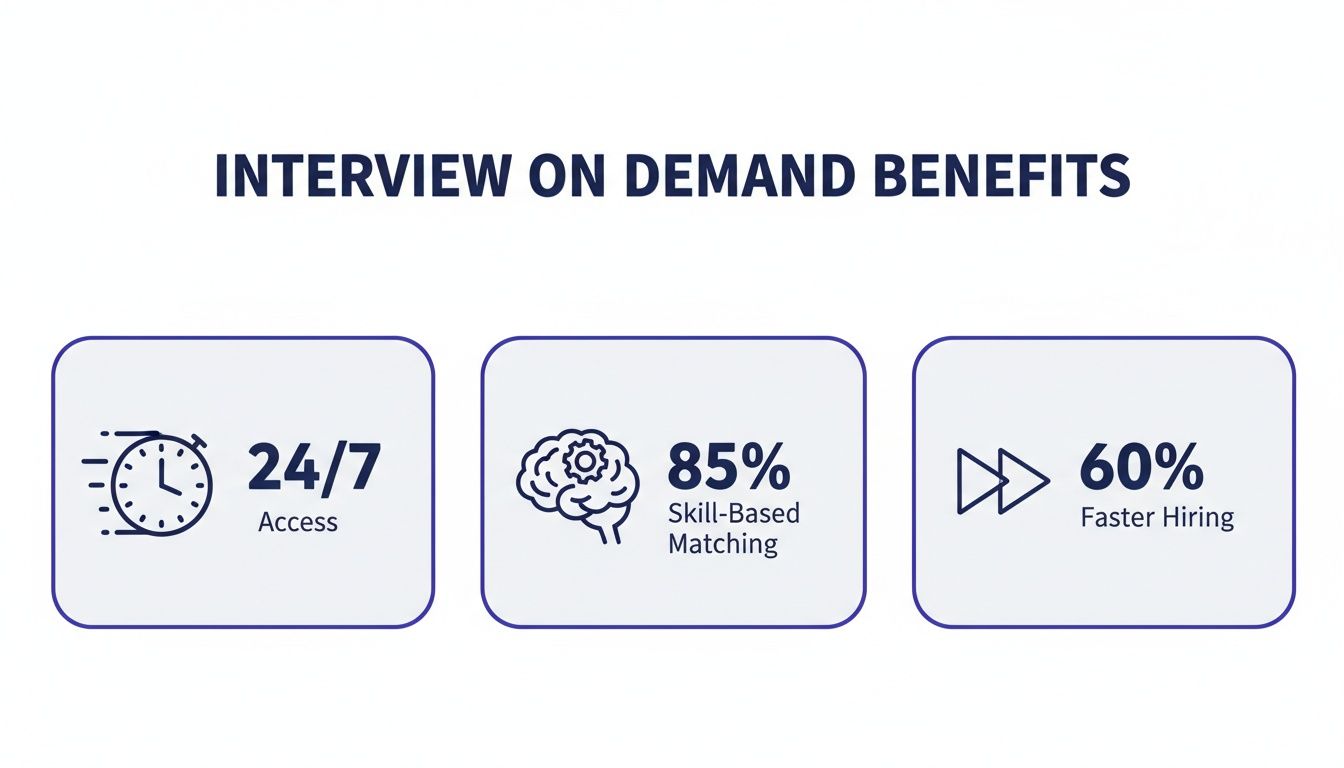
This visual highlights the core benefits. When you build a flexible, skills-first process, you can improve the top of your hiring funnel and deliver better-aligned candidates to hiring managers.
Minimizing the Cost of a Bad Hire
Beyond just speed, there's a powerful financial argument. A bad hire can be an expensive mistake. The U.S. Department of Labor estimates the cost can be substantial, with a conservative figure for a single mid-level position averaging around $15,000. That number accounts for wasted salary, lost productivity, and the recruitment costs to find a replacement—not to mention the impact on team morale.
On-demand skill verification is a strong defense against this. It replaces the guesswork of resume screening, which research has shown is not always a strong predictor of on-the-job success. In fact, some studies show it fails to predict performance 87% of the time.
By asking candidates to perform tasks that mirror the role, you gather evidence of their abilities before you make an offer. This naturally leads to better hires who can contribute from day one. It's an approach that is gaining traction, with 75% of engineering managers planning to bring AI-powered tools into their hiring process.
This trend is growing. With the global online recruitment market projected to grow from $39 billion in 2025 to $58 billion by 2032, tools that provide objective evidence of skill are becoming the new standard.
Ultimately, the ROI from an interview on demand platform is clear and adds up quickly.
- Financial Savings: You can reduce costs from bad hires and lower the operational overhead of your recruitment process.
- Time Savings: You automate a time-intensive part of the hiring funnel and let your talent team focus on high-impact work. Check out our guide on how to reduce time to hire for more tips.
- Strategic Advantage: You build a smarter, more agile hiring engine that scales with your company and helps you identify promising talent.
Cohesyve
See what candidates can do before you interview them
Cohesyve turns a job description into a role-specific assessment with a scoring rubric. Each candidate gets a different version, so questions cannot be shared. Ten candidates free, no card.
How to Implement On-Demand Interviews in Your Workflow
So, you're interested in the idea of interview on demand, but the thought of overhauling your entire hiring process feels daunting. The good news is, you don't have to. Bringing on-demand interviews into your workflow is less about a revolution and more about a smart evolution. It’s about shifting from a process dictated by calendars to one that’s focused on skills and results.
This isn't a niche trend. The market for video interview tools is projected to reach $3.2 billion by 2030. When you consider that traditional interviews can take up to 23 hours per hire, you can see why 70% of recruiters who have adopted these tools report a 50% faster time-to-hire. The proof is in the numbers, which you can dive into in this video interview tools market research.
Start with the Job, Not the Questions
One of the biggest mistakes teams make is trying to shoehorn their old interview questions into a new format. An effective on-demand interview starts with a deep dive into the role itself. This means moving beyond generic, one-size-fits-all question banks.
The best platforms today have moved far beyond static questions. They can analyze the core duties, must-have skills, and desired outcomes of your job description to generate challenges that mirror the work.
This is where the process becomes truly effective. A sales candidate might get a voice note role-play where they have to navigate a tough client objection. A software engineer could be asked to find and fix a bug in a relevant piece of code. This isn’t just a better candidate experience; it’s a more accurate way to see who can actually do the job.
The goal is to make the assessment feel less like an exam and more like a preview of the work itself. You’re essentially saying, "This is the kind of thinking we do here. Show us how you tackle it."
Integrate with Your Current Systems
Let's talk about disruption. No one wants to add another tool that doesn’t work with their existing setup. A well-designed on-demand interview platform shouldn't force your team to start from scratch. It should fit into the workflow you've already built.
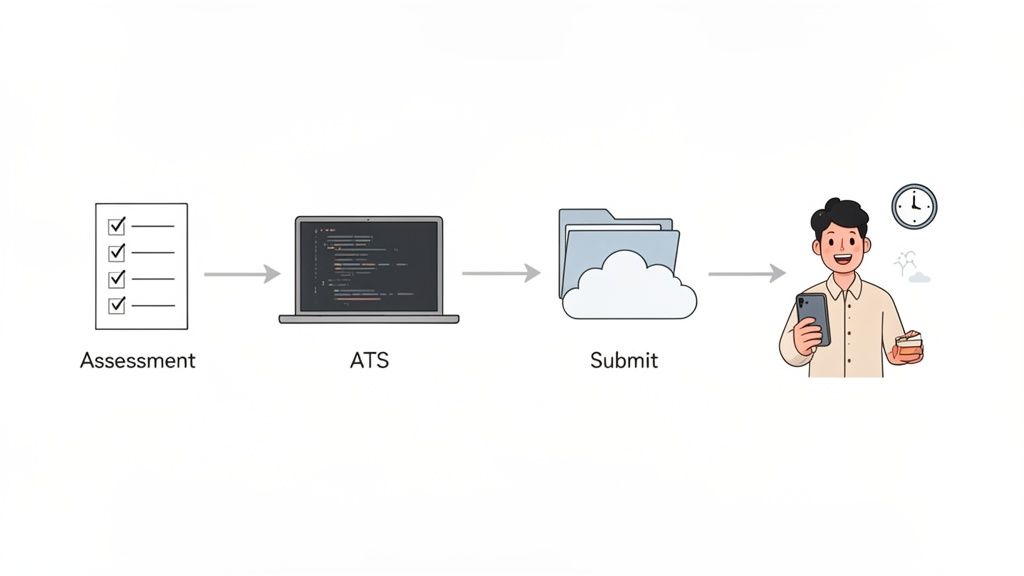
The key to making this happen is a seamless Applicant Tracking System (ATS) integration. Look for a solution that connects effortlessly with your ATS, so you can:
- Trigger Assessments Automatically: Send on-demand interview invites to candidates the moment they hit the right stage in your pipeline—no manual effort needed.
- Sync Results Effortlessly: Have completion statuses and performance scores appear directly on the candidate’s profile in your ATS.
- Maintain a Single Source of Truth: Keep all your candidate data in one place. Your team shouldn't have to jump between multiple tabs to figure out what's going on.
This is what makes the whole process scalable. It takes administrative busywork off your plate, freeing up your team to focus their energy on evaluating the candidates who rise to the top. To see how this fits into the bigger picture, check out our complete guide on using video for recruitment.
Prioritize the Candidate Experience
At the end of the day, even the smartest tech is useless if it creates a clunky, confusing, or frustrating experience for candidates. In a competitive market, you can't afford to drive away top talent with a poorly designed process. Putting the candidate first is non-negotiable.
Here are a few simple ways to make sure the experience is a great one:
- Provide Crystal-Clear Instructions: From the initial invite, a candidate should know exactly what to expect. Be upfront about the format, the kinds of challenges they'll face, and how you'll use their submission.
- Set Reasonable Time Expectations: Nobody wants to be stuck with an unexpected three-hour homework assignment. Be transparent about how long the assessment will take. A great on-demand interview is a quick, focused challenge.
- Offer Genuine Flexibility: This is a core benefit for candidates! Let them complete the interview when and where it works for them. Highlight this flexibility and make sure the platform works smoothly on any device.
Ultimately, a great on-demand interview should feel respectful. It’s your chance to give every candidate a fair and objective opportunity to show off their real-world skills in a comfortable, low-pressure environment.
Choosing Between Asynchronous and Live Interviews
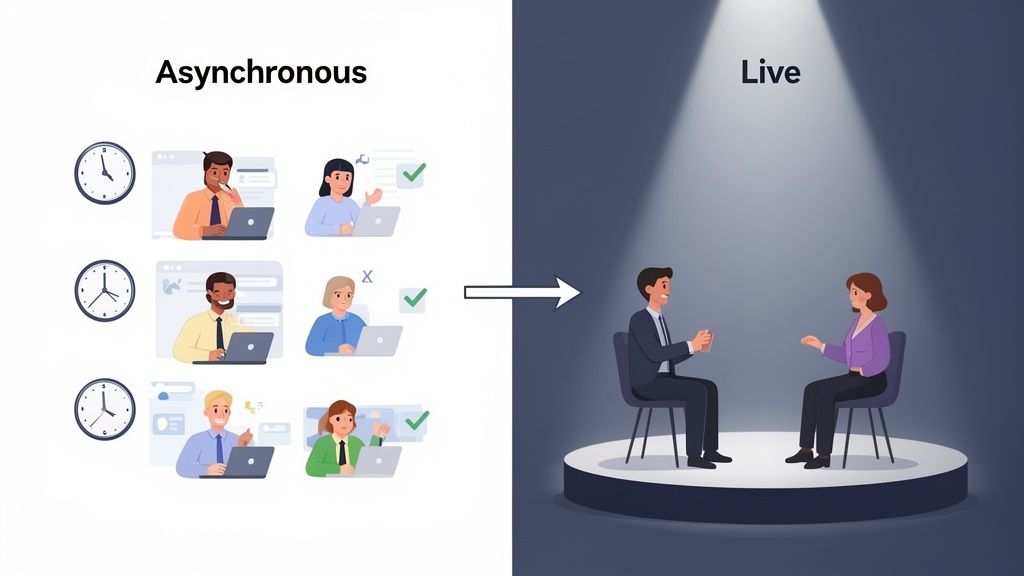
When talent teams first hear about an interview on demand, a question almost always comes up: "So, does this replace our live interviews?" It's a natural thing to ask, but it sets up a false choice. These two formats aren't enemies fighting for the same spot. They’re partners, each playing a distinct and vital role in an effective hiring strategy.
Thinking of them as competitors is like asking if the qualifying round of a tournament replaces the championship game. Of course it doesn't. One sets the stage for the other, making sure only the best contenders make it to the final stage.
The on-demand interview is your qualifier. It’s built to work at scale, letting you efficiently sort through a large applicant pool to find people who have the core skills for the role. Your live interview, then, becomes the main event—a deep, strategic conversation you save for the proven finalists who have already shown you they have what it takes.
The Qualifier Round: Screening for Skills
The purpose of an asynchronous, on-demand interview is to answer one fundamental question: Can this person actually do the job? It’s about cutting through the noise of a resume and getting straight to their abilities.
By having every candidate tackle the same real-world tasks on their own schedule, you establish a level playing field. It creates a standardized, objective benchmark you can use to compare everyone fairly. This is a powerful way to filter at the top of your funnel, ensuring anyone who moves forward has already cleared a critical hurdle.
Bringing this approach into your early screening has some significant upsides:
- Objective Measurement: Everyone is graded against the same rubric, which goes a long way in minimizing the unconscious bias that can influence initial phone screens.
- Scalability: You can screen hundreds of applicants without blocking out hundreds of hours on your calendar for one-on-one calls. It’s about finding top talent, faster.
- Candidate Flexibility: Candidates appreciate this. They get to prove their skills in a low-pressure setting, on their own time, without having to step away from their current job for a call.
This isn't about replacing human connection with automation. It’s about using technology to be more precise in your screening, so you can free up your team’s time for meaningful conversations with the people who matter most.
The Championship Match: Deepening the Conversation
Once your on-demand interviews have surfaced the top performers, the purpose of the live interview completely transforms. It becomes sharper, more focused, and more valuable. You’re no longer spending the first 20 minutes of a call with basic screening questions, trying to figure out if they have the baseline skills. You already know they can do the job.
Now, you get to find out how they’ll do it on your team.
This shift elevates the live interview from a simple Q&A into a genuine strategic dialogue. Your hiring managers can jump right into the conversations that really count:
- Cultural Alignment: How do they work? How do they approach collaboration and feedback? Will they fit in with the team?
- Problem-Solving Nuance: How do they navigate ambiguity? What’s their thought process when there isn’t a clear, easy answer?
- Motivation and Ambition: What drives them? What are their long-term goals, and how does this role fit into that vision?
By saving your live interviews for this pre-qualified shortlist, you respect everyone’s time—both your team’s and the candidate’s. Every conversation is richer and more insightful because the foundational skill check is already done. This two-part process gives you the best of both worlds: the efficiency of technology and the irreplaceable value of human judgment.
The Right Metrics to Measure On-Demand Success
Adopting an interview on demand model is a positive step for any talent team. But to prove its worth—and secure ongoing support from leadership—you need to look beyond the initial excitement and dig into the data. The right metrics don't just sit on a dashboard; they tell a story about your team's impact.
This is how you connect a new hiring tool to business outcomes. When you can show exactly how you’re improving efficiency, raising the bar on talent quality, and strengthening the company's bottom line, you're no longer just filling jobs. You're building a more resilient, high-performing organization.
Key Metrics for Proving Value
So, where do you start? Let's walk through the core metrics that will paint a clear picture of your on-demand interview success. Tracking these will give you a full view of your ROI, from the very first screen to long-term employee impact.
Here are the heavy hitters:
- Time-to-Hire: The classic. This measures the total time from posting a job to getting an offer accepted. With on-demand interviews, you’re reducing scheduling delays, so you should see this number drop as you get to a top-tier shortlist faster.
- Offer Acceptance Rate: Are your top candidates saying "yes"? A high acceptance rate is a good indicator of a positive candidate experience. When the process is modern, respectful, and engaging, candidates are more likely to be excited to join.
- Quality-of-Hire: This is the ultimate proof point. How do the people you hire actually perform? By tracking metrics like first-year performance reviews or feedback from hiring managers, you can directly link your new screening process to business results. Great screening leads to great hires.
Completion Rates and Candidate Experience
One of the most telling numbers in an on-demand process is the candidate completion rate. It’s simple: how many people who start the interview actually finish it? If that number is low, it’s a red flag that your assessment might be too long, too confusing, or doesn't feel like a good use of their time.
A high completion rate is a direct reflection of a positive candidate experience. When the process is engaging and respects their time, candidates are far more likely to see it through.
An excellent goal to aim for is a completion rate of 95% or higher. Hitting this mark tells you that your process is hitting the sweet spot—it’s seen as fair, relevant, and easy to navigate. It’s a powerful sign that you’ve managed to balance deep skill verification with a positive candidate journey. Getting this right often comes down to selecting the right tools, and you can learn more about picking the best candidate assessment tools in our complete guide.
Tracking Diversity and Inclusion
Finally, let's talk about one of the most profound benefits of a well-designed on-demand interview: its power to create a more equitable hiring process. Traditional screening methods can be susceptible to unconscious bias, where factors like a name, a resume's prestige, or someone's background can unintentionally sway decisions.
By standardizing that first crucial step around objective, role-specific skills, you level the playing field. Every candidate gets the exact same shot to show what they can do, free from outside noise.
Make sure you’re tracking the diversity of the candidate pool that moves past the on-demand stage. Over time, you should see a wider, richer variety of talent making it to the final rounds. This isn't just an abstract goal; it's hard data proving you're building a more diverse and innovative team by focusing on what truly matters: a person's ability to excel in the role.
Common Pitfalls to Avoid in On-Demand Hiring
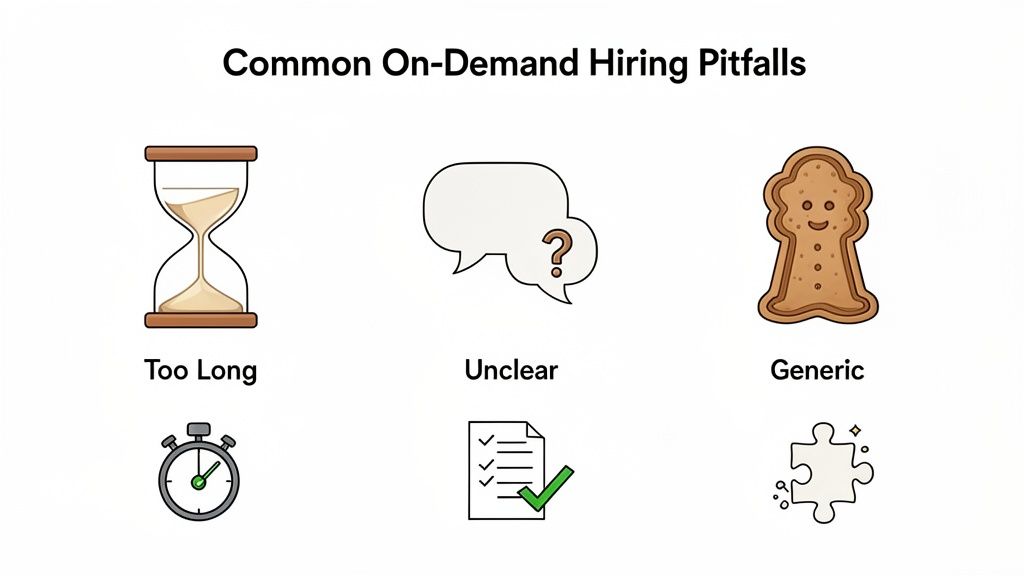
Making the switch to an interview on demand process can be highly effective, but some teams stumble when they treat it like a simple plug-and-play solution. If you're not careful, you can end up frustrating candidates and creating more work for your team. But by sidestepping a few common traps, you can build a system that works well for everyone involved.
The first mistake is often making the initial assessment too long. Remember, your candidates are busy people. Asking for a large time commitment right at the start can feel disrespectful and is a sure way to see your best talent drop out of the process. The goal isn’t to replicate a full workweek; it's to get a quick, targeted signal that tells you they have the core skills to succeed.
Another major hurdle is simply not being clear. Ambiguity can cause anxiety. If a candidate is left wondering what's expected, how long it will take, or how they'll be judged, they're either going to disengage or deliver a performance that doesn't reflect their true abilities.
Creating Generic and Gameable Assessments
A common issue is using a generic, one-size-fits-all question bank. When you’re asking every applicant the same handful of static questions, you’re not just missing an opportunity to assess role-specific skills—you’re making the assessment easier to game. These question banks are known for leaking online, which means you might be testing a candidate's ability to Google, not their ability to problem-solve.
This approach misses the point. A great marketer thinks differently from a great engineer, and your on-demand interview should reflect that.
Using a static question bank is like giving every athlete the same generic fitness test, whether they're a weightlifter or a marathon runner. It measures something, but it probably isn't what you actually need to know.
The answer isn't static questions; it's dynamic challenges unique to each candidate. When an assessment can generate a specific, relevant task right from the job description—like a real-world coding problem or a situational judgment prompt—you get a much more honest signal of what someone can do. It’s fairer for them and more insightful for you.
Forgetting the Human Connection
Perhaps the biggest trap of all is thinking that on-demand interviews are meant to replace human interaction. They’re not. This technology is a tool to empower your team's judgment, not eliminate it. Using an asynchronous interview to screen a high volume of applicants is smart. Using it to make a final hiring decision without ever having a real conversation is a mistake.
The purpose of an interview on demand is to make your human conversations better. By verifying skills and fit early on, you ensure that the time you spend in live interviews is with genuinely promising candidates. This frees you up to have deeper, more meaningful discussions about motivation, culture, and strategy.
Let a well-designed platform do the heavy lifting of skill validation. That way, your team can focus on what they do best: connecting with people.
Frequently Asked Questions
It's natural to have questions when you're thinking about evolving your hiring process. Let's walk through some of the most common ones we hear from teams exploring the world of the interview on demand.
Is an Interview on Demand Fair to All Candidates?
Yes, and here’s why: when designed with intention, it's one of the fairest ways to start your hiring process. A thoughtful on-demand interview shifts the focus from gut feelings and first impressions to what really matters—objective, job-specific skills.
Think about it. This approach helps sidestep the unconscious bias that can so easily find its way into live conversations. You're giving every candidate the same questions and the same opportunity to shine in an environment where they feel comfortable. The best platforms also build in accessibility, offering multiple languages and adaptive questions that get to the heart of a person's ability, not just how well they perform under pressure.
How Does This Work for Non-Technical Roles Like Sales?
This is a great question. On-demand interviews are incredibly versatile and are just as powerful for roles in sales, marketing, or operations as they are for tech. The secret is to stop thinking in terms of one-size-fits-all tests.
Instead of a generic quiz, you can create interactive scenarios that mirror the actual work. That's when you really find out if a candidate has what it takes.
For a sales role, imagine using a voice role-play to hear how a candidate handles a challenging customer objection. For a marketing position, you could present a mini-case study to gauge their strategic thinking. It's all about assessing practical skills like judgment, communication, and problem-solving by asking them to analyze data, draft a response to a customer complaint, or outline a project plan. You're simulating the job itself.
Will AI in Our Hiring Process Feel Impersonal to Candidates?
It's a common concern, but the reality can be the opposite if you use AI smartly. The point isn't to replace the human element; it's to make your human interactions count for more. When you use technology to handle the initial, high-volume screening, you're respecting everyone's time.
By the time you're sitting down for a live conversation, you already know the person is highly qualified and a strong potential fit. The best systems apply AI with surgical precision—using it to design fair assessments and score results without bias—while saving the authentic, human-to-human conversations for where they matter most. A truly great candidate experience is one that feels fair, efficient, and leads to meaningful discussions with your team.
Ready to stop guessing and start knowing? With Cohesyve, you can replace resume scanning with dynamic, role-specific assessments that identify top talent in seconds. Find out how we help teams close roles faster and build a stronger, more capable workforce.