
AI now shows up early in many hiring processes. CareerTrainer.ai's AI interview training statistics cite SHRM data showing that 24% of employers use AI to conduct or evaluate video interviews, and a ResumeBuilder survey in which 45% of employers use AI to screen or rank candidates before anyone interviews them. That matters for candidates because early screening is no longer just a recruiter call. For many roles, it starts with a structured video assessment that measures how clearly you think under time limits.
HireVue helped normalize that format. Candidates record short responses to standardized prompts, often with limited prep time and a tight answer window. The setup can feel stiff at first. From the hiring side, though, the logic is straightforward. Teams want a faster way to compare candidates on the same questions before they invest live interview time.
That is also why generic advice falls short. Strong HireVue preparation is not about memorizing polished lines. It is about understanding what each question is trying to verify. Some prompts test judgment. Some test communication under constraint. Some test whether your examples show repeatable habits instead of one good story. That is the same logic hiring teams use in broader soft skills assessment methods, even when the format changes.
I have seen candidates hurt themselves by treating one-way video like a performance exercise. Rehearsed answers often sound neat but thin. Good answers sound specific, structured, and credible.
There is a bigger shift underneath all of this. Traditional HireVue questions are static, which means they are easier to rehearse. Newer assessment models, including interactive formats such as Cohesyve's, push further by checking how someone responds in motion, not just how well they deliver a prepared story. That is the lens to use throughout this guide. Do not focus only on what to say. Focus on what the question is trying to prove, and make your answer show real capability.
1. Tell Me About a Time You Failed and What You Learned

This question shows up for a reason. It quickly reveals whether you take ownership, whether you can reflect, and whether you improve after a setback.
Most weak answers fail in one of two ways. The candidate either picks a fake failure that isn't really a failure, or they tell a dramatic story and spend the whole answer defending themselves. Neither works. Hiring teams want a grounded example with real judgment.
What a strong answer sounds like
A software engineer might say a deployment they managed caused a brief outage, then explain how they reviewed the release process and helped introduce stricter canary testing afterward. A marketing candidate might describe a campaign that underperformed because the audience research was too shallow, then show how they changed the research process before the next launch.
The second part matters more than the first. I care less about the stumble than about how you diagnosed it.
Practical rule: Spend a small part of your answer on the failure itself, then use the rest on ownership, correction, and learning.
You don't need a heroic recovery story. You need a believable one. Pick something meaningful enough to show judgment, but not so catastrophic that it raises questions about basic competence.
Use STAR, then add one more step
Coursera's advice, referenced in HireVue prep guidance, recommends the STAR structure: situation, task, action, result. For this question, add an L at the end for learning. That last beat is where good candidates separate themselves.
- Situation: Set the scene quickly.
- Task: Explain what you were responsible for.
- Action: Say what you did, not what the team broadly did.
- Result: Be honest about what happened.
- Learning: Name the change you made afterward.
If you want to sharpen the reflection part of your answer, this breakdown of how to assess soft skills is useful because it mirrors how hiring teams think about accountability and communication in structured screening.
One more note. Don't blame the timeline, your manager, or another team. Even if they contributed, your answer should focus on your part. That's what shows maturity.
2. Walk Me Through Your Approach to Role-Specific Problem
Some of the best HireVue interview questions are the least polished ones. Not because they're messy, but because they force you to think instead of recite.
A data analyst might get asked how they'd investigate conflicting retention numbers. A backend engineer might be asked to sketch a caching strategy for a busy commerce product. A finance candidate might need to explain the first questions they'd ask after seeing a margin decline. In each case, the interviewer isn't just listening for the answer. They're listening for the sequence.
Your reasoning is the product
Good candidates often rush to a recommendation. That's a mistake. In role-specific problem questions, your reasoning is the thing being evaluated.
Start by clarifying the problem. Then state your assumptions. Then walk through your approach in order. If there are trade-offs, say them out loud.
For example, if you're asked how you'd investigate conflicting retention metrics, a solid answer might sound like this:
- Clarify definitions: Ask how each team defines retention and over what time window.
- Check data lineage: Identify whether dashboards pull from different sources or transformation logic.
- Segment the discrepancy: Compare by cohort, acquisition channel, device, or geography.
- Validate instrumentation: Look for tracking breaks, duplicate events, or missing events.
- Decide next action: Recommend a single source of truth and document metric logic.
That style of answer tells me you can work through ambiguity without panicking.
Trade-offs matter more than perfection
Role-specific prompts often have no single perfect answer. That's intentional. Hiring teams want to see whether you recognize constraints.
A candidate who says, "I'd first confirm what success means and what assumptions I'm making," usually sounds stronger than one who jumps straight into tactics.
If you're interviewing for product, mention user impact, delivery cost, and sequencing. If you're in engineering, talk about reliability, performance, maintenance burden, and failure modes. If you're in operations, bring in process clarity, handoffs, and ownership.
One practical tip. If the prompt is broad, ask a clarifying question before you answer. In recorded formats, that can feel awkward, but it's often a sign of maturity. You can say, "I'd normally clarify two things before deciding," and then proceed with those assumptions if no response is possible.
That's how experienced people handle real work. They don't pretend every brief is complete.
Cohesyve
Practise this before it counts
Run the same kind of AI job simulation employers use and get a scored report on where you stand. 5 free assessments a month, no card required.
3. Describe Your Most Significant Professional Achievement

This question sounds easy. It isn't. Plenty of candidates talk for two minutes and never explain what they achieved.
The common problem is vagueness. People describe a project, a team effort, or a responsibility. They don't clearly identify their own contribution, the problem being solved, or why the result mattered.
Pick impact, not prestige
Your best example doesn't have to be your biggest title or the most famous company on your resume. It needs to show useful impact.
An operations specialist could talk about redesigning onboarding so handoffs were cleaner and new hires got productive faster. An engineer could describe a refactor that reduced recurring incidents and made releases easier to manage. A marketer could highlight a campaign that didn't just launch, but taught the team what message converted.
What I want to hear is simple:
- The problem: What wasn't working
- Your role: What you specifically owned
- The action: What you changed
- The outcome: Why the business or team cared
Keep the spotlight where it belongs
This is not the moment for false modesty. You can acknowledge the team and still explain your role with precision.
Say "I led," "I built," "I proposed," or "I redesigned" when that's true. Don't hide behind "we" so much that the interviewer can't tell what you did.
The fastest way to weaken this answer is to make it sound like a project update. The fastest way to strengthen it is to make the cause-and-effect obvious.
There's also a strategic angle here. Choose an achievement that maps cleanly to the job you're pursuing. If the role emphasizes stakeholder management, don't default to a purely technical win unless you can connect it to cross-functional influence. If the role values execution under ambiguity, pick an example that shows judgment, not just effort.
One warning. Don't invent metrics. If you have concrete numbers from your own work and you're allowed to share them, use them. If you don't, explain the impact qualitatively. Clear specifics beat padded claims every time.
4. How Do You Stay Current With Industry and Technology Trends?
This question is less about curiosity than discipline. Hiring teams aren't asking whether you've heard of the latest tool. They're asking whether you have a repeatable way to keep learning after you're hired.
Weak answers sound like this: "I read articles online and keep up with trends." That's generic and forgettable. Strong answers name sources, habits, and application.
Show a system, not a vibe
A software engineer might say they follow a few engineering blogs, contribute to a small open-source project, and test new ideas in side experiments. A digital marketer might mention specific newsletters, platform updates, and the way they compare changes against live campaign work. A compliance professional might monitor regulatory alerts, attend industry forums, and turn those updates into internal guidance.
The pattern is what matters. You're showing that learning is built into your routine.
- Source selection: Name the publications, podcasts, communities, or experts you follow.
- Cadence: Explain when or how often you learn.
- Application: Give one example of something you recently applied at work.
- Relevance: Tie that learning back to the role you're interviewing for.
Applied learning always lands better
If you say you follow AI trends, tell me what you've tested, adopted, rejected, or learned from. If you say you stay current on analytics, mention a recent change in how you validate data or report performance. If you're in product, explain how customer behavior or tooling changes affected one roadmap decision.
This answer gets stronger when it sounds practical. "I spend time each week reviewing release notes for the tools my team relies on" is better than "I'm passionate about innovation."
That applies in HireVue formats especially well because the structure rewards clarity. A concise answer with named sources and one recent example is usually stronger than an enthusiastic but loose monologue.
5. Tell Me About a Time You Disagreed With a Manager or Peer
Disagreement questions aren't really about conflict. They're about judgment under friction.
Anyone can sound collaborative when everyone agrees. Hiring teams ask this because real work involves trade-offs, pressure, and competing ideas. They want to know whether you can challenge a view without becoming defensive or political.
Pick a disagreement with substance
A good story has a real issue at stake. It might be a timeline, a technical approach, a launch decision, or a prioritization call. It shouldn't be a personality clash dressed up as strategy.
One strong example is a candidate who disagreed with a manager's project timeline, brought evidence about current team workload, and proposed a phased rollout instead. Another is a peer disagreement where two engineers explored different approaches through small proofs of concept, then chose the stronger option even when it wasn't the speaker's original idea.
That's mature disagreement. It stays focused on the work.
What hiring managers listen for
I listen for three things in answers to this kind of question:
- Respect: Did you treat the other person like a professional, even while disagreeing?
- Method: Did you use evidence, experiments, or stakeholder input instead of emotion?
- Resolution: Did the situation lead to a better decision, a clearer process, or a useful lesson?
If your story ends with "and then I proved I was right," it usually backfires.
That kind of ending makes you sound combative, even if your judgment was sound. Better answers show that you considered the other person's view and moved the work forward.
If you want examples of how employers frame these prompts, this guide to situational interview questions and examples is a useful reference because it shows how structured responses reveal decision-making under pressure.
One more thing. Never trash a former manager in a recorded answer. Even if they were difficult, the interviewer is watching how you talk about people when they aren't in the room.
6. Describe a Project Where You Had to Quickly Learn a New Skill
This question gets at learning agility, and learning agility matters more now because many roles change faster than job descriptions do.
The strongest answers don't just say, "I learned fast." They show the gap, the pressure, the method, and the application. You want the interviewer to see that you can get competent quickly without needing constant rescue.
Make the skill gap real
A useful example has a clear before-and-after. Maybe an analyst had to learn SQL to query data directly for a market review. Maybe a designer had to learn a prototyping tool because the team needed working demos instead of static mocks. Maybe an engineer had to get productive in a new language or framework because a product deadline didn't move.
That kind of answer works because the challenge is visible. So is the response.
- State the gap clearly: What didn't you know at the start?
- Explain the pressure: Why did you need to learn it quickly?
- Show your method: Courses, documentation, peer feedback, hands-on practice.
- Close with application: How did the new skill help you deliver?
Resourcefulness matters
I usually trust candidates more when they explain how they learned, not just what they learned. Did you break the topic into parts? Did you ask a senior teammate for targeted feedback instead of broad help? Did you build a small test case before using the skill in production work?
Those details make your answer believable.
There's also a deeper signal here. Good teams don't just hire for current competence. They hire for how quickly someone can close a gap when priorities shift. If your story shows calm under ambiguity, that's often more persuasive than a polished answer about a familiar strength.
Choose a story where the learning changed your output, not just your confidence. That's what makes the example stick.
7. Why Are You Interested in This Specific Role and Company?
A large share of candidates waste this question by giving an answer they could reuse anywhere. Hiring teams notice that immediately.
In a HireVue interview, this prompt often acts as a motivation check. In newer assessment models, it also works as a credibility check. Do your interests line up with the actual work, or did you memorize a polished pitch that sounds good on camera? That distinction matters because employers are trying to separate interview fluency from genuine fit.
Strong answers make a clear case in three parts. First, show that you understand what the role asks for day to day. Second, point to something specific about the company that makes that work worth doing there. Third, explain why this move fits your direction, not just your availability.
The order matters less than the substance. I recommend starting with the role itself, because that is the easiest place to sound concrete. Mention one or two responsibilities from the job description and connect them to work you have already done well. Then add a company-specific reason that goes beyond brand admiration. Product direction, operating model, customer segment, or the kind of problems the team is solving are all stronger than generic praise.
A good answer sounds like this:
- Role fit: Name the work you want to do and why you are prepared to do it.
- Company fit: Point to a real detail about the business, team, product, or market.
- Career logic: Show why this role is a sensible next step, not a random application.
For example, if the company is hiring for a role focused on internal tools and operational efficiency, say that directly. Explain that you have already improved workflows, reduced manual reporting, or built systems that helped teams move faster. Then connect that to why this company stands out. Maybe it is scaling fast, maybe operations are central to margin, or maybe the business model creates a lot of process complexity. That answer shows judgment.
What hurts candidates is vagueness. “I love your mission” is weak unless you can tie it to how the team works. “I'm excited about growth” is also thin unless you can explain what kind of growth work you want to do.
This is also where static interview prep reaches its limit. Traditional HireVue questions can be rehearsed, so employers listen for whether your reasoning holds up under scrutiny. Interactive assessments, including platforms like Cohesyve, push this further by testing how well your stated interests match your choices in real scenarios. Candidates who understand the why behind the role usually perform better in both formats, because they are describing a fit they can demonstrate.
If your answer could be swapped into five other applications without changing a word, it is not ready.
8. Tell Me About a Time You Influenced Others Without Authority
Real leadership often shows up before the title does. That's why this question matters.
Hiring teams use it to see whether you can move work forward when nobody has to listen to you. That means persuasion, credibility, timing, and empathy. It also means you need a story where resistance was real.
Influence is usually built, not announced
A solid example might be a team member who wanted peers to adopt a better testing approach and built a small proof of concept to make the case. Another might be someone in support or operations who partnered with another function, gathered evidence, and changed a rollout plan before it created avoidable customer pain.
Both examples work because they show strategy. The candidate didn't just push harder. They built alignment.
Show how you earned buy-in
Most convincing answers include a few elements:
- The obstacle: Why others weren't immediately on board
- Your tactic: Data, examples, coalition-building, a pilot, or direct stakeholder conversations
- Your tone: Respectful and solution-focused
- The outcome: A decision, a process change, or a clearer path forward
Influence without authority usually comes down to one thing. Can you make it easy for other people to see the benefit of changing direction?
That's the heart of the answer. If your story is all force and no listening, it won't land well. If it's all harmony and no actual influence, it won't land either.
This is one of those HireVue interview questions where candidates often underestimate the behavioral signal. The interviewer isn't just hearing whether people followed you. They're hearing whether you'd be useful in cross-functional work, where persuasion matters more than hierarchy.
9. Live Problem-Solving and Interactive Scenarios
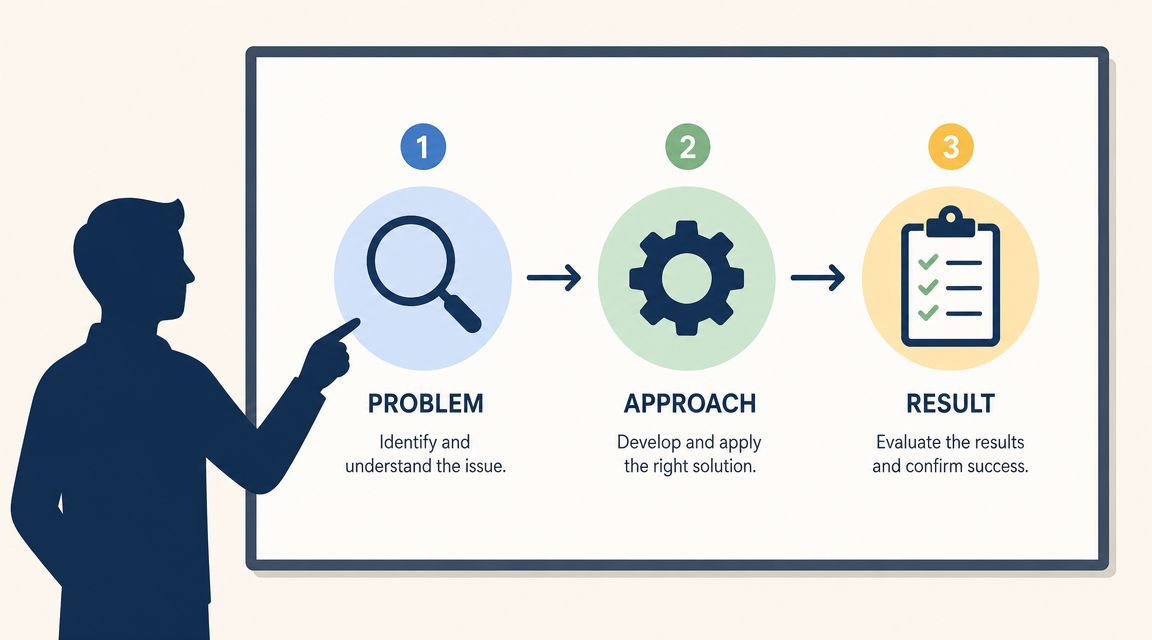
Modern hiring starts to reveal more. Instead of only asking you to talk about what you'd do, some assessments ask you to do it.
That might mean debugging code in a live environment, responding to a simulated customer objection, analyzing a mini case, or working through a business scenario with changing information. These formats are harder to bluff because performance is tied to process.
Why this format changes the game
Traditional one-way interview questions are still useful. They capture communication, reflection, and motivation. But they're also rehearsable.
Interactive assessments shift attention toward demonstrated skill. If you're debugging, the interviewer can see how you isolate the issue. If you're handling a voice role-play, they can hear whether you stay calm, listen well, and respond with judgment. If you're working through a business case, they can see whether your analysis stays structured under pressure.
That's one reason conversations about AI hiring tools increasingly focus not just on the questions being asked, but on what signals are being scored and whether those signals are job-related. Independent discussion of HireVue-style interviews has also raised concerns about fairness, transparency, consent, and accessibility in one-way video screening (Duke University resource on typical HireVue questions and broader concerns).
How to prepare when you can't script it
You can't memorize your way through an interactive scenario. You can prepare, though.
- Narrate your reasoning: Talk through your assumptions and next step.
- Stay steady: If you hit a wall, explain what you'd test next.
- Prioritize relevance: Focus on the factors that matter most for the role.
- Respond like it's real: In role-plays, acknowledge the other person before solving.
If you want a practical sense of how this differs from standard asynchronous screening, this piece on one-way video interviewing is worth reading.
From a hiring perspective, I like these formats because they reduce the advantage of polished storytelling alone. From a candidate perspective, they're demanding but fair when designed well. They give you a chance to show actual capability, not just interview fluency.
9-Point HireVue Interview Question Comparison
| Item | Implementation complexity | Resource requirements | Expected outcomes | Ideal use cases | Key advantages |
|---|---|---|---|---|---|
| Tell Me About a Time You Failed and What You Learned | Low | Minimal (standard interview or video prompt; optional AI tone analysis) | Assesses accountability, resilience, and learning agility | Leadership, engineering, consulting, operations | Reveals ownership, growth mindset, and corrective actions |
| Walk Me Through Your Approach to [Role-Specific Problem] | Medium | Subject-matter case design; potential adaptive prompts | Shows structured problem-solving and technical reasoning | Technical, data, consulting, operations roles | Exposes reasoning, trade-off evaluation, and clarity of thought |
| Describe Your Most Significant Professional Achievement | Low | Minimal | Measures ability to quantify impact and isolate contribution | Results-driven roles (sales, marketing, leadership) | Highlights measurable outcomes and clear personal impact |
| How Do You Stay Current With Industry and Technology Trends? | Low | Minimal (candidate research evidence: subscriptions, courses, projects) | Demonstrates continuous learning habits and source specificity | Tech, data science, finance, marketing, knowledge work | Shows proactivity, relevancy of skills, and applied learning |
| Tell Me About a Time You Disagreed With a Manager or Peer | Low–Medium | Minimal | Evaluates conflict resolution, emotional intelligence, and professionalism | Leadership, cross-functional, collaborative teams | Reveals diplomacy, perspective-taking, and constructive negotiation |
| Describe a Project Where You Had to Quickly Learn a New Skill | Low–Medium | Minimal (evidence of learning resources and timeline) | Assesses learning velocity, resourcefulness, and adaptability | Startups, fast-paced tech environments | Demonstrates rapid upskilling, initiative, and delivery under pressure |
| Why Are You Interested in This Specific Role and Company? | Low | Candidate research (company materials, JD alignment) | Assesses motivation, cultural fit, and career alignment | Universal, every role and level | Differentiates genuine fit from generic interest; shows preparation |
| Tell Me About a Time You Influenced Others Without Authority | Medium | Minimal | Measures persuasive ability, stakeholder management, and coalition building | Senior ICs, project leads, product managers, matrixed orgs | Highlights influence tactics, data-driven persuasion, and cross-team impact |
| Live Problem-Solving and Interactive Scenarios | High | Significant (interactive platforms, coding/role-play environments, AI evaluation) | Evaluates real-time problem-solving process, not just final answers | Engineering, data science, sales, customer success, management | Provides realistic, practical assessment of on-the-job skills and execution |
From Screen to Signature Your Next Steps
A recorded interview can reduce a strong candidate to a flat answer in under two minutes. I have seen that happen often, and it usually comes down to one mistake. People prepare for performance instead of proof.
HireVue-style interviews are easier to handle once you understand what the employer is trying to verify. The prompt on screen is only the surface layer. Under it sits a scoring decision about judgment, communication, learning speed, ownership, or motivation. Candidates who answer the visible question alone sound polished but generic. Candidates who answer the underlying competency sound hireable.
That distinction matters even more now because video screening sits in an awkward middle ground. Static questions are efficient and easy to standardize, but they are also easier to rehearse. Dynamic assessments push closer to real work, which usually gives hiring teams better signal, but they demand more thoughtful design and a fairer candidate experience. Good preparation accounts for both formats.
A practical approach looks like this:
- Build a small bank of real examples. Use stories on failure, conflict, achievement, influence, rapid learning, and teamwork.
- Tag each story to a skill. Know which example shows accountability, stakeholder management, resilience, or decision-making.
- Practice on camera, not in your head. Time pressure changes pacing, clarity, and confidence.
- Cut the setup. Hiring teams remember the action you took and the result you produced.
- Finish with the lesson or business impact. That is often the clearest proof of maturity.
The candidates who do well are rarely the ones with the fanciest wording. They give specific answers, show their reasoning, and make it easy for a reviewer to score them against the role.
That is also why memorized scripts break down. A polished answer can still miss the mark if it does not fit the exact prompt, role, or competency being assessed. A repeatable structure works better. Situation, action, reasoning, result, lesson. Use that framework enough times and you can adapt without sounding robotic.
For employers, the same principle applies in reverse. A useful interview process does not ask questions because they sound professional. It asks questions that map to job requirements and can be scored consistently. The strongest assessment systems go one step further and verify skill through work-relevant tasks, not just self-reporting. That is the key distinction between older video interview models and more interactive approaches.
Cohesyve fits into that shift in a straightforward way. It gives employers a way to assess role-specific ability, judgment, and communication through practical exercises instead of relying only on static question banks and resume interpretation.
If you are a candidate, prepare to demonstrate capability, not just confidence. If you are hiring, choose methods that reward evidence over polish. That standard produces better decisions on both sides.
If you're rethinking how your team uses HireVue-style screening, Cohesyve is worth a look. It helps employers move from static question banks to role-specific assessments that measure practical ability, judgment, and communication in a more direct way.