Google's hiring process has six possible steps: an online application, assessments, recruiter conversations, project work for some roles, a panel of interviews, and a decision. Google says that once interviews start, the process typically takes roughly six to eight weeks, and your recruiter will give you your own timeline.
Google says the same basics apply to engineering and non-engineering jobs, internships and leadership roles, though the details vary by team. Everything below is from Google's careers pages, linked as we go.
The Google hiring process at a glance
| Step | What happens | Who it applies to |
|---|---|---|
| 1. Application | A resume tailored to the job; up to three applications every 30 days. | Everyone |
| 2. Assessments | The Google Hiring Assessment (workstyle), plus a role-related test such as a coding exercise. | "May be asked", depending on the role |
| 3. Recruiter conversations | One or two short calls by phone or video. | Typically everyone |
| 4. Project work | A case study, writing sample or code sample before interviews. | Some roles |
| 5. Interviews | A panel of structured interviews, by video or in person. | Everyone who gets this far |
| 6. Decision and offer | Your application and interviews are reviewed, taking a number of perspectives into account; if you're selected, your recruiter reaches out with an offer. | Everyone who interviews |
What is the hiring process at Google?
You apply for up to three roles every 30 days, may take an assessment, talk to a recruiter, sometimes complete a short project, then interview with a panel of Googlers before a review and decision. The rest of this guide goes through each step.
Cohesyve
Get some practice in before you apply to Google
Try an AI job simulation of the everyday work in roles like these and see where you lost marks. 3 free practice assessments, no card.
How should you apply to Google?
Google's hiring page is specific about resumes:
- Start from a blank document for each job, and tie your experience directly to the job's qualifications.
- Make sure you meet the minimum qualifications and that your resume shows it clearly.
- Describe outcomes, using Google's formula: "accomplished [X] as measured by [Y], by doing [Z]."
- Mention leadership, with the team size and scope.
- Recent graduates should include relevant school projects and coursework.
- Keep it short. There's no length requirement.
Cover letters aren't required. You can apply for up to three jobs in a rolling 30-day window, so choose roles that genuinely match. Most roles accept applications on a rolling basis until they're filled, so apply early. Google says recruiters can't follow up with every applicant individually, so create a candidate profile: it shows the status of your application and of the role.
Google also notes that most Googlers applied for other roles before they eventually reached interviews.
What is the Google Hiring Assessment?
It's an assessment Google may ask you to take before interviews, "designed to measure workstyle skills required for success in a role" at Google. You might also get a role-related assessment, such as a coding exercise.
Google's hiring page doesn't give the assessment's length, format or scoring. You'll see claims online that it takes 30 minutes or uses a particular question style; Google hasn't published either, so treat them as unconfirmed.
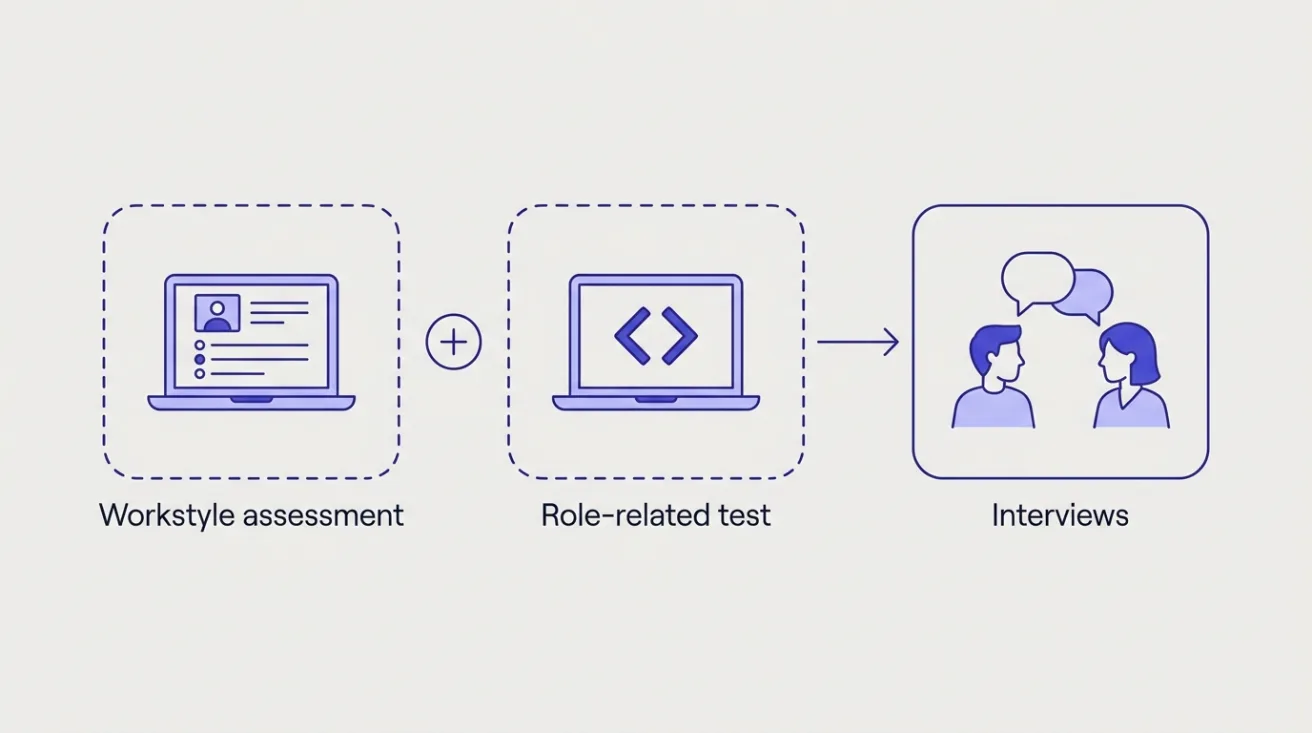
Workstyle assessments in general ask how you prefer to work or what you would do in workplace situations. If yours presents scenarios, our guide to situational judgement tests explains the format. Google publishes no answer key, so answer honestly and consistently rather than guessing what it wants.
What happens in the recruiter conversations?
Before in-depth interviews you'll typically have one or two shorter calls with your recruiter, by phone or video. Google says these usually assess key skills for the role, explain the organisation and team, and cover your preferences, such as location. You can ask questions too. Your recruiter stays your main contact for the rest of the process.
Does Google ask for project work?
For some roles, yes. Google may ask you to complete a small project before your interviews, from preparing a case study to providing writing or code samples. It tells you early if it needs anything.
What are Google interviews like?
A panel of interviews, by video or in person, with what Google calls a "rotating cast of Googlers". Google describes three features:
- Structured interviewing. Every candidate for a role is assessed against the same clear rubrics.
- Open-ended, role-related questions about how you solve problems, how you work with a team and what your strengths are.
- No brainteasers. Google says its data showed they didn't predict job performance, so it stopped asking them years ago.
From Google's interview tips page:
- Expect behavioural and hypothetical questions, along the lines of "Tell me about a time when..." or "How would you approach this situation...?"
- Think out loud. Questions often leave room for clarification, and interviewers look at your thought process as well as the answer. Say when you're making an assumption and why.
- Prepare to talk about ambiguity, collaboration and leadership, including how you'd handle a conflict with a colleague and how you've helped a team succeed, even when you weren't officially the leader.
- No AI. Google says AI tools and Google Search aren't permitted during interviews.
- Some interviews are in person. Google has reintroduced in-person interviews for some roles, often after initial virtual ones; your recruiter will confirm.
- Dress comfortably. Most roles and offices are casual.
Accommodations are available, from sign language interpreters to extended time; ask your recruiter to connect you with Google's accommodations team.
Technical interviews
For software engineering, Google says a broad background with a strong understanding of computer science is key. Its hiring FAQ links to its own videos on preparing for coding and systems design interviews, including mock interviews with Google engineers. Use them first; they show the format directly.
How long does the Google hiring process take?
Google says roughly six to eight weeks once interviews have started for a specific role, and that it varies by role. After your interviews, expect a wait: Google's interviewers write structured feedback and the decision goes through internal reviews, so it may be several weeks before your recruiter can share an outcome.
What happens after the Google interviews?
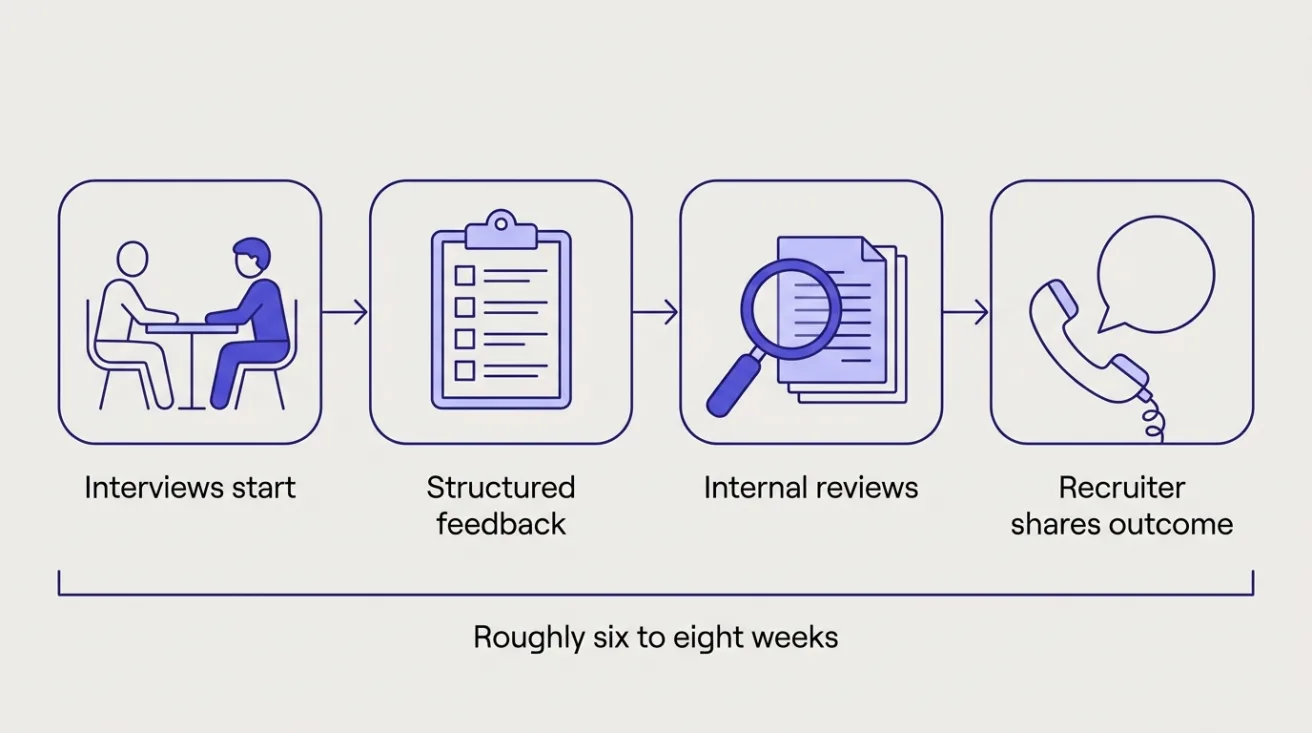
Google brings together everything from your application and interviews and reviews it, taking "a number of perspectives" into account. If you're selected, your recruiter reaches out with an offer and walks you through compensation and benefits. After you accept, Google's onboarding team handles badging, insurance and the rest.
If you're not selected, Google typically asks you to wait at least a year before reapplying for the same type of role. Google also says that if your first application doesn't work out, you shouldn't let that stop you from applying to other roles in the future.
How to prepare for Google's hiring process
- Build a library of examples. Google suggests cross-referencing your resume with the job description and preparing stories for each overlap.
- Put numbers in every story. Use the X-Y-Z formula on your resume and in your answers.
- Structure answers with STAR. Google's tips page recommends it, describing the steps as situation, task, activity and result. Our STAR method guide has worked examples, and our list of behavioural interview questions is a good practice bank.
- Keep answers concise. Google reminds candidates that interview time is limited.
- Practise thinking out loud on open-ended problems, ideally in a mock interview with someone who will push back.
- Prepare your space for video interviews: quiet room, reliable connection, tested mic and camera, and a notebook.
- Bring questions. Google calls interviewing a two-way street.
Practising realistic work tasks
Interviews reward well-prepared examples. Role-related assessments, such as a coding exercise, and project work reward doing realistic tasks well, and that improves with practice. Cohesyve, which publishes this guide, runs practice job simulations for your role, with a scored report on where you lost marks. It isn't affiliated with Google and doesn't use Google's assessments or questions.
FAQs
How many jobs can I apply for at Google?
Up to three in a rolling 30-day window.
Does Google still ask brainteasers?
No. Google says it stopped years ago because its data showed brainteasers didn't predict job performance.
Can I use AI during a Google interview?
No. Google says AI tools, including Google Search, aren't permitted during interviews.
Does Google require a cover letter?
No. Google says to focus your time on your resume. If you include a cover letter, tailor it to the job.
How long should I wait to reapply to Google?
Typically at least a year for the same type of role, according to Google's FAQ.
Will Google tell me if a job has been filled?
Not individually. Your Google Careers profile shows the status of your application and the role.
Sources
Google's own pages, checked 21 October 2026:
- Our hiring process, including its FAQs
- Interviewing at Google: best practices, advice and tips