Teams don’t set out to run chaotic hiring. They get there one urgent req at a time.
A manager loses someone unexpectedly. Another team gets budget approval late. A founder decides a role is now critical. Suddenly recruiting becomes a chain of rushed handoffs, vague job descriptions, overloaded interview panels, and a lot of hope pinned on resume stacks. Everyone feels busy. Few people feel confident.
That pattern is expensive in ways finance can’t fully see on a spreadsheet. Recruiters spend hours screening the wrong profiles. hiring managers complain about candidate quality but haven’t aligned on what good looks like. candidates drop out because the process drags. Teams lower the bar because the role has been open too long, then pay for that decision later in missed deadlines, manager time, and avoidable re-hiring.
A good recruitment and hiring plan fixes that, but not in the way most templates suggest. It isn’t a document you fill out once and forget. It’s an operating system for how your company defines talent needs, attracts the right people, verifies capability, and makes decisions with consistency.
When that system works, hiring stops feeling like a fire drill. It becomes a repeatable part of company growth.
The Chaos of Reactive Hiring and How to Escape It
Monday starts with a hiring manager asking for three shortlisted candidates by Friday. By Tuesday, the scope has changed. By Thursday, the interview panel still has not agreed on what good looks like, but recruiters are already screening resumes. That is reactive hiring in its natural habitat.
I have seen this pattern many times in high-growth teams. The company says it has a pipeline problem, then you look closer and find a decision-quality problem. The role is vague. The process changes midstream. Interviewers are evaluating from personal preference instead of a shared scorecard. More activity does not fix that. It just hides it for a week or two.
The cost shows up everywhere. Recruiters burn time on candidates who were never right for the role. Hiring managers reject profiles for reasons they cannot define clearly. Strong candidates opt out because the process feels disorganized. If your team wants to move faster, start by fixing the operating system behind hiring, not by pushing more volume into the top of the funnel. That is the same principle behind how to reduce time to hire without wrecking quality.
Candidate perception matters here too. Teams often talk about employer brand as if it lives only on the careers page. It does not. Your hiring process is part of the brand. Slow follow-up, inconsistent interviews, and unclear expectations tell candidates how your company handles decisions under pressure. Strong teams pair process discipline with clear messaging, and they usually borrow from proven employer branding best practices to attract top talent instead of treating candidate experience as an afterthought.
A strong recruitment and hiring plan turns that chaos into a system the business can trust.
It does four jobs well:
- Sets the success profile early so recruiters, hiring managers, and interviewers are assessing the same role.
- Connects sourcing strategy to actual hiring goals so the team is not buying more pipeline than it can evaluate well.
- Builds skill verification into the process so evidence shows up before interview opinions harden.
- Uses metrics to spot failure patterns early so bottlenecks, low-conversion stages, and weak calibration do not drag on for a quarter.
The shift is practical. Stop treating the plan like a static approval document. Use it as a working system that gets updated as the market changes, candidate data comes in, and the team learns which signals predict success. That is how hiring stops being a fire drill and starts acting like a repeatable growth engine.
Laying the Foundation Before You Source Anyone
Most hiring mistakes happen before sourcing starts.
Teams rarely say that out loud because sourcing feels like “real work” and planning feels slow. But when the early thinking is shallow, every downstream stage gets noisier. You attract the wrong candidates, interview against different standards, and debate opinions instead of evidence.
The foundational planning phase is usually the most overlooked part of recruiting, even though it’s the one with the greatest impact. The strongest plans start with gap analysis, cross-functional alignment, and a clear reason a candidate should join. As noted in this recruitment planning resource from OHSU, this stage is often neglected, while 91.2% of companies adopting skills-based hiring saw improved retention, and bad hire costs can exceed 200% of salary in high-growth tech roles.
Start with the business problem, not the req
A hiring manager may ask for “a senior product marketer” or “a backend engineer.” That’s not enough. A strong plan starts by asking what the business needs to change because this person joins.
Sometimes the company needs a builder. Sometimes it needs a stabilizer. Sometimes the role exists because a manager wants to gain an advantage. Sometimes it exists because a process is broken and leadership is trying to hire around it. Those are very different hiring motions.
I like a simple test. If the hiring manager can’t explain what this person must accomplish in their first stretch in role, the search isn’t ready.
Use a role definition document as your single source of truth. It should include:
- Business context with the reason the role exists now, not six months ago.
- Core outcomes written as tangible expectations, not broad responsibilities.
- Must-have capabilities separated from nice-to-haves.
- Non-negotiables such as location constraints, licensing, communication demands, or stakeholder complexity.
- Deal shapers like flexibility, growth path, compensation philosophy, and manager fit.
If you want a practical way to run this exercise, a skills gap analysis template for hiring teams can help structure the conversation before the role goes live.
Get the right people in the room early
One of the easiest ways to waste three weeks is to let alignment happen during interviews instead of before them.
Bring in the hiring manager, recruiter, a likely interview panel lead, and anyone who will influence the final decision. Keep the group small enough to decide things. Large alignment meetings usually create polite ambiguity.
Use that meeting to force clarity on trade-offs:
| Question | Why it matters |
|---|---|
| What outcomes define success in this role? | Keeps the search tied to business impact |
| Which skills are teachable after hire? | Prevents impossible wish lists |
| Where will this person struggle in our environment? | Surfaces real context, not generic fit language |
| What would make us reject a candidate quickly? | Sharpens screening criteria |
| What will make a strong candidate say no? | Improves attraction strategy |
This is also where teams should define what they’re selling. Too many companies write job descriptions as compliance documents and wonder why response rates are weak. Candidates want to know why the role matters, how decisions get made, who they’ll learn from, and what kind of work environment they’re stepping into.
For that part, I often point teams toward practical employer branding best practices to attract top talent. Not because branding replaces process, but because it helps turn internal clarity into language candidates respond to.
Practical rule: If your panel can’t agree on the top three capabilities for the role, don’t open the search yet.
Write the brief recruiters can actually use
A recruiter needs more than a requisition and a copied job description. They need a brief that helps them calibrate.
Good briefs answer questions like these:
What does excellence look like here?
Not in theory. In your environment, with your constraints.Which backgrounds are adjacent enough to count?
This matters more than teams realize. It widens the pool without lowering standards.What evidence should show up early?
Portfolio depth, systems thinking, stakeholder management, technical judgment, writing quality, or something else.What are the likely objections?
Compensation, title, hybrid policy, scope, pace, or manager experience.
Without that level of specificity, recruiters will optimize for response volume and hiring managers will complain that the pipeline feels off. Both will be right.
A recruitment and hiring plan starts paying off here. You’re not trying to predict every detail. You’re creating enough shared structure that sourcing, screening, and interviews all point at the same target.
Cohesyve
See what candidates can do before you interview them
Cohesyve turns your job description into a role-specific assessment with a scoring rubric. Each candidate gets a different version, so questions cannot be shared. Ten candidates free, no card.
Designing Your Sourcing and Attraction Strategy
A req opens on Monday. By Wednesday, the hiring manager wants candidates. By Friday, the team is blaming the market because the pipeline is thin or off-target.
That pattern usually has less to do with talent scarcity than teams assume. It comes from treating sourcing as a burst of activity instead of a system. Strong hiring plans define how you attract, qualify interest, and convert attention into credible candidates before the search gets noisy.
Once the role is clear, sourcing becomes a question of strategy and execution. The essential work is choosing where to compete, what message earns a response, and how to tell early if the market is giving you the right signal.
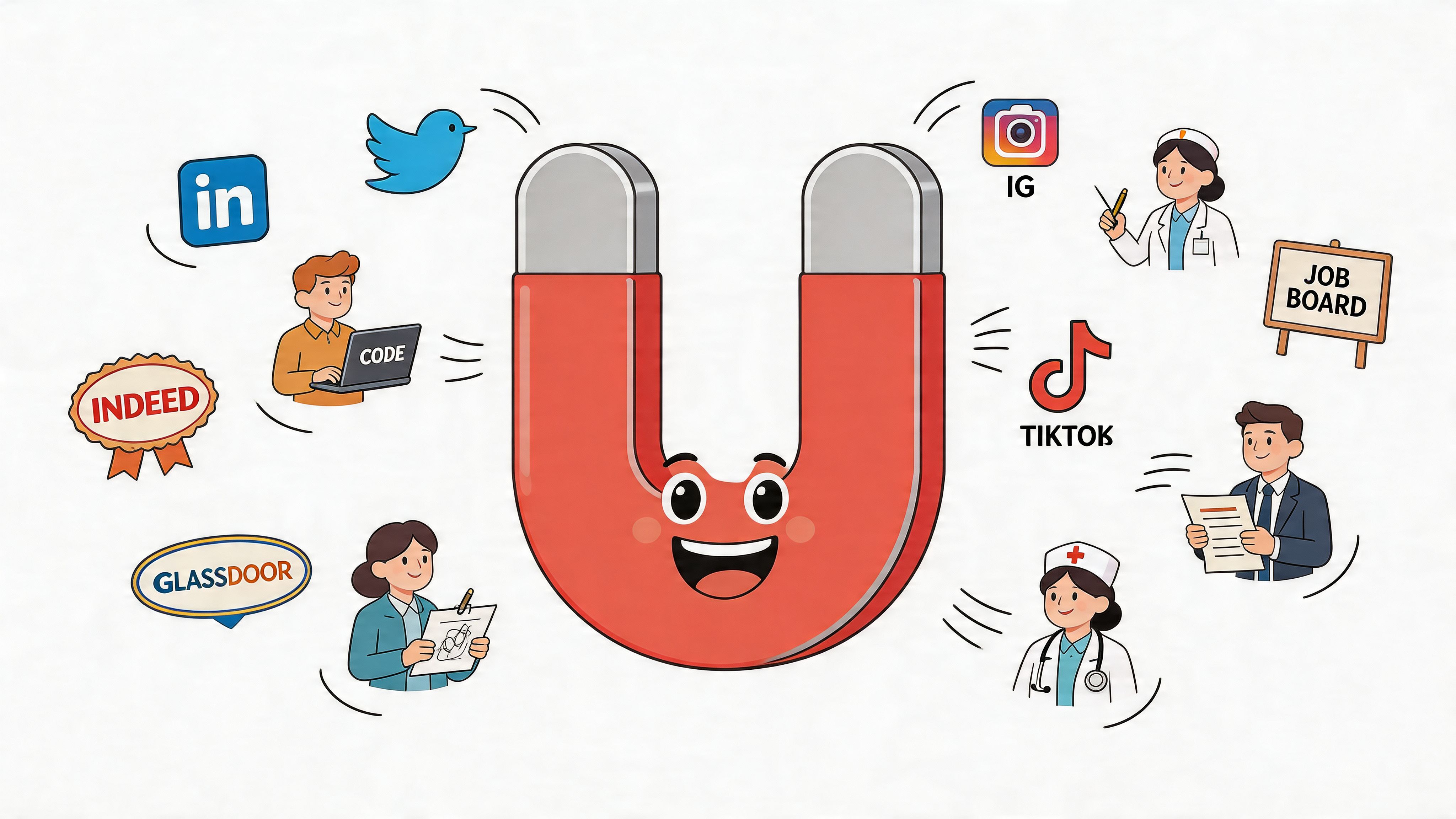
Build around candidate decision criteria
Candidates rarely reject jobs because a company failed to publish enough responsibilities. They opt out because the details that drive a real career decision were missing, buried, or vague.
Good attraction strategy answers five questions fast:
- How will I work? Flexibility, location, hours, travel, and collaboration norms
- What will I own? Scope, decision rights, and the problems that need solving now
- What will I get? Compensation range, level, growth path, and benefits if they matter in your segment
- Who will I work for? Manager quality, team shape, and how decisions get made
- How hard is it to engage? Application steps, response times, and whether the process respects their time
That is the difference between a posting that gets clicks and one that gets qualified interest.
In practice, I see teams lose strong candidates by hiding the trade-offs. If the role has ambiguity, say so. If the pace is intense, say so. If the upside is unusual because the hire will build a function from scratch, explain that clearly. The right candidates do not need a polished fantasy. They need a credible picture of the job they are considering.
Split inbound and outbound like separate operating motions
Inbound and outbound should not share the same success criteria.
Inbound is useful when the market already understands the role, your company has some brand pull, or you hire enough volume to justify career page and job post optimization. It usually brings more applicants, wider quality variance, and more work at the top of funnel.
Outbound is a targeted search motion. It works better for niche roles, leadership hires, and situations where the strongest people are busy and unlikely to apply. It gives the team more control, but only if recruiter calibration is strong and the outreach sounds specific.
Referrals and communities sit in their own category. They can outperform both. They can also narrow your pipeline if you rely on them without checking for pattern bias.
A practical split looks like this:
| Motion | Best use case | Common mistake |
|---|---|---|
| Inbound | Scaled hiring, recognizable roles, brand-led attraction | Posting and waiting for the right people to appear |
| Outbound | Hard-to-fill roles, technical talent, leadership hires | Sending the same message to every profile |
| Referrals | Trusted networks, high-context teams | Assuming referred means qualified |
| Communities and events | Specialist talent pools | Showing up only when there is an open req |
Write messaging for conversion, not just visibility
A lot of sourcing plans fail because the team picks channels before it sharpens the message. Channel choice matters. Message quality usually matters more.
Good outreach gives the candidate a reason to care now. It references the problem, the scope, and the reason their background maps to the work. Good job ads do the same thing at scale. They do not read like legal documents with a few marketing lines at the top.
Use a simple message architecture for each role family:
- Hook: why this role matters now
- Problem: what is broken, growing, or changing
- Scope: what the hire will own in the first year
- Fit hypothesis: why someone from this background should see themselves in it
- Decision details: location, level, process, and compensation range when you can share it
That structure creates consistency across outbound messages, recruiter screens, and job ads. It also gives you something to test. If response rates are fine but screen pass-through is weak, the issue is likely targeting. If open rates are decent but replies are poor, the message is probably underselling the role or hiding key details.
Build a sourcing playbook your team can update in real time
A static list of channels becomes stale fast. A useful playbook behaves more like a working market map.
For each recurring role family, define the target companies or adjacent backgrounds, the priority channels, the outreach themes that get traction, and the early signs that someone is worth fast-tracking. Add notes on what usually blocks closes, such as compensation ceilings, title mismatch, remote constraints, or manager concerns. Then update it every time a search teaches you something real.
That last part matters. A hiring plan should get smarter as searches run. If senior backend engineers from larger companies consistently stall at the same point, record it. If candidates from a certain adjacent background ramp well even when they look unconventional on paper, record that too. Over time, the playbook becomes less about activity volume and more about repeatable pattern recognition.
This is also the point where modern skill verification starts influencing attraction strategy. Teams that know how they will test real ability can source more broadly and with more confidence. A practical example is using structured skill assessments to widen the pool without lowering the bar. That changes who counts as viable talent before the interview loop even begins.
Good sourcing messages sound like a thoughtful explanation of a real opportunity, not a copied job description with a first name at the top.
Treat application flow as a conversion system
Attraction does not stop when someone clicks apply or replies to outreach. The application flow either confirms your credibility or weakens it.
Candidates notice friction immediately. Re-entering resume data. Unclear next steps. Slow follow-up. Generic emails that suggest nobody is running the process. Each one reduces conversion, especially for candidates who already have options.
Strong teams measure this like a funnel. They track where interested people drop, how long response steps take, and whether the candidate experience matches the story recruiters are telling. That is how sourcing stops being a fire-drill. It becomes an operating system that connects market insight, message quality, skill evidence, and process discipline into a hiring engine that gets better over time.
Verifying Skills Not Just Resumes
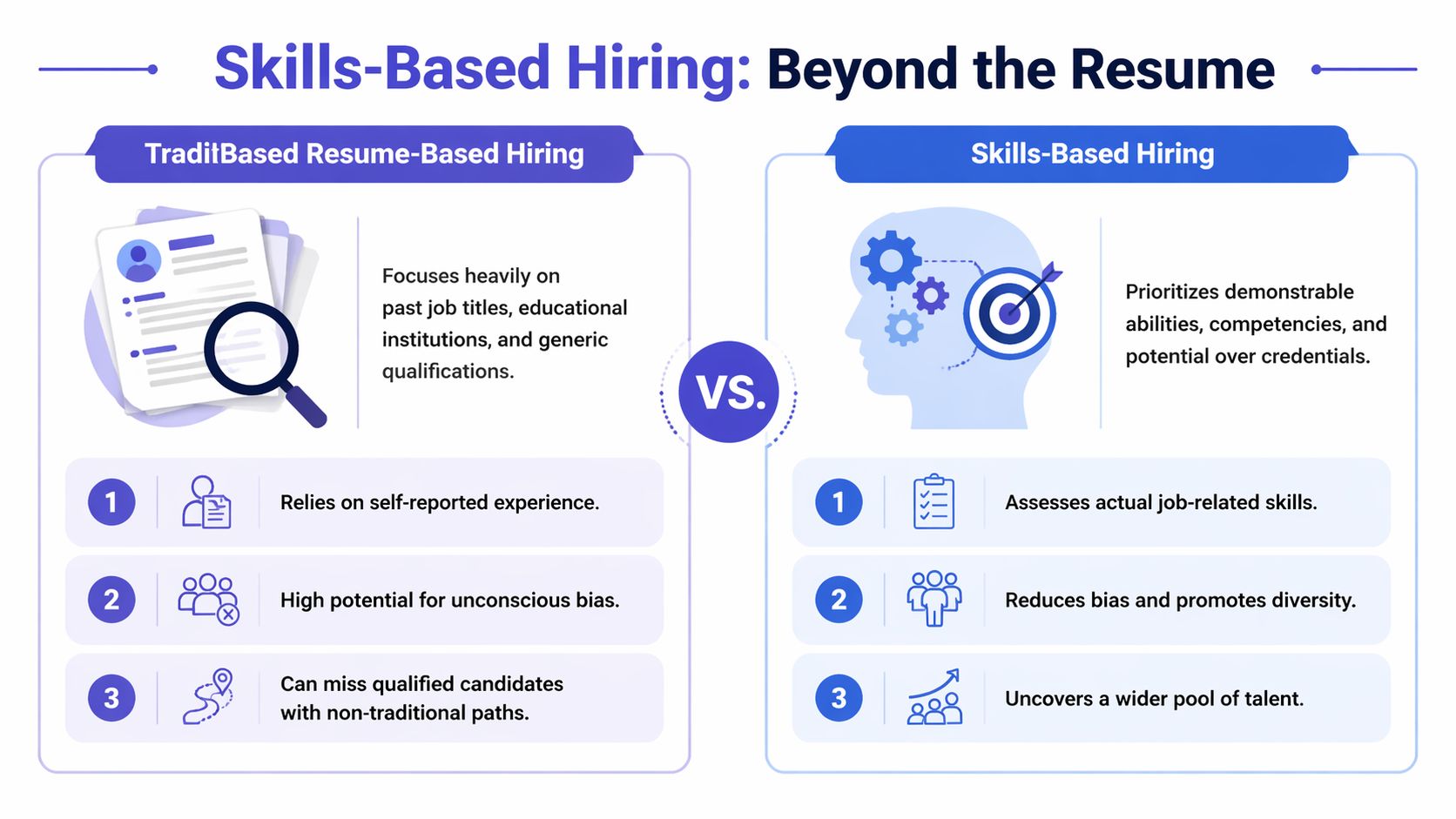
The resume is still useful. It gives context, trajectory, and clues about judgment. It shouldn’t be the main proof that someone can do the work.
That’s where many hiring plans fail. Teams spend serious time sourcing, then revert to old habits at selection. They screen for pedigree, infer skill from job titles, and let unstructured interviews carry too much weight. The process feels familiar, but familiarity isn’t the same as predictive value.
The case for skills-based hiring is strong. In ADP research cited by the US Chamber of Commerce, 94% of organizations that use skills-based hiring agreed it predicts on-the-job success better than resumes, and 90% reported fewer mis-hires. The source is the US Chamber of Commerce overview of top hiring trends.
Resumes are context, not evidence
A resume can tell you where someone has worked. It can’t reliably tell you how they think, how they prioritize, how they handle ambiguity, or how they perform in the actual shape of your role.
This matters most in high-growth companies because jobs drift. A “senior analyst” at one company may have done deep operational work. At another, the same title may have meant reporting support and stakeholder coordination. Titles compress reality.
That’s why good hiring plans shift the sequence. Instead of reviewing resumes and deciding who seems promising, they define the skills that matter and test those directly.
Match the assessment to the work
The best assessment is rarely the most elaborate one. It’s the one that reflects the decisions and judgment the role requires.
A clean design principle is to assess only what matters for early-stage selection. Don’t create a marathon.
Here are examples that work well:
- For engineering roles use practical coding challenges, debugging tasks, architecture reasoning, or trade-off prompts tied to the level of the role.
- For go-to-market hires use writing exercises, objection handling, account prioritization, or messaging critiques.
- For operations and finance use case analysis, spreadsheet reasoning, scenario judgment, and communication summaries.
- For consulting-style roles use structured problem solving, recommendation memos, and verbal reasoning.
The mistake is using generic aptitude tests that don’t resemble the work, or using take-home projects so large that they punish candidates with less spare time.
If an assessment doesn’t help a manager imagine this person doing the job, it’s adding effort without adding signal.
Build a shortlist from proof
The practical advantage of skill verification isn’t theoretical fairness. It’s operational clarity.
When candidates complete a role-relevant assessment early, recruiters stop guessing which resumes deserve escalation. Hiring managers stop asking for “stronger profiles” without defining strong. The shortlist gets smaller and better.
Tooling matters. Some teams build these workflows through their ATS, scheduling tools, and separate assessment vendors. Others use more integrated options. For example, Cohesyve’s guide to skill assessments reflects a model where a job description can be used to generate role-specific assessments with adaptive questions, then rank candidates based on demonstrated performance before interviews begin.
That kind of approach is useful when you want a verified shortlist rather than a broad top-of-funnel screen.
What a good assessment process looks like
A useful process usually has four characteristics:
Role relevance
The task should mirror real decisions from the job. Not trivia, not brainteasers.Consistent scoring
Reviewers need clear criteria. Otherwise you’ve just moved subjectivity into a different step.Reasonable candidate effort
Respect the candidate’s time. Ask for enough to judge, not enough to create free labor.Workflow fit
The result needs to move cleanly into the next stage. If recruiters still have to manually reconcile five systems, adoption drops.
A short comparison helps:
| Approach | What it usually measures | Main weakness |
|---|---|---|
| Resume screen | Background, brand signals, writing quality | Heavy inference, high bias risk |
| Generic test | Broad ability | Weak role relevance |
| Unstructured take-home | Effort and output | Inconsistent scoring |
| Role-specific assessment | Practical skill and judgment | Requires upfront design discipline |
When teams make this shift, the interview becomes much more valuable. Interviewers can spend time probing how a candidate thinks through the work they’ve already demonstrated, instead of trying to infer capability from credentials.
Structuring Interviews for Signal Not Noise
Interviews still matter a lot. They just work better when they stop trying to do every job at once.
Most interview loops fail because each interviewer is asked to assess everything. Technical skill, communication, culture, leadership, motivation, collaboration, potential. That creates overlapping questions, inconsistent standards, and debrief meetings full of broad impressions.
A better loop assigns purpose to each stage.
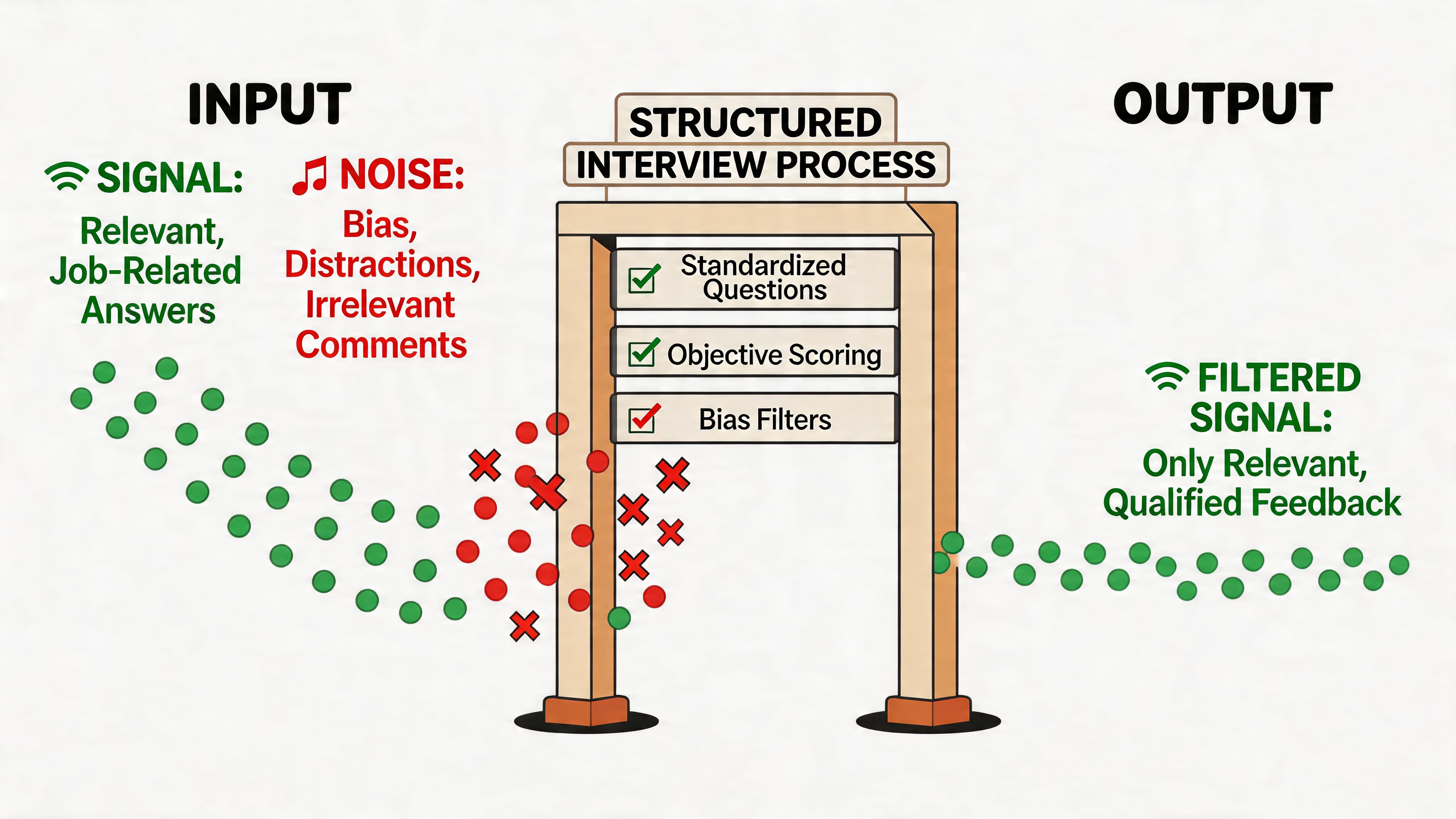
Give every interview a job
If the role has already been calibrated and early skill has been verified, the interview loop can focus on specific open questions.
A clean structure often looks like this:
- Recruiter screen checks motivation, logistics, communication basics, and candidate priorities.
- Hiring manager interview explores role fit, decision quality, and how the candidate approaches relevant problems.
- Functional or technical deep dive tests depth in a focused area.
- Cross-functional interview examines collaboration and stakeholder judgment.
- Final conversation resolves concerns and helps both sides decide.
What doesn’t work is letting every interviewer freestyle. Some will over-index on likability. Others will ask hypotheticals nobody can score. Someone will spend half the interview rehashing the resume.
Use scorecards before the interview starts
A scorecard should be written before the interview, not after. If the rubric appears only during debrief, people will retrofit their impressions to match the outcome they already prefer.
Keep scorecards narrow. Tie them to the competencies defined in the planning phase and the evidence still needed after assessment.
For example:
| Interview stage | Competencies to assess | Evidence to capture |
|---|---|---|
| Hiring manager | Prioritization, judgment, ownership | Specific examples, trade-off logic |
| Technical deep dive | Depth, problem solving, quality bar | Reasoning, accuracy, approach |
| Cross-functional | Collaboration, influence, clarity | Stakeholder examples, communication quality |
A good scorecard also asks for examples, not just ratings. “Strong communicator” is weak feedback. “Explained a complex trade-off clearly, invited challenge, adapted answer when context changed” is useful feedback.
Structured interviews don’t remove judgment. They give judgment somewhere solid to stand.
Train interviewers to compare evidence, not vibes
Even experienced leaders need interviewer calibration. Being senior doesn’t automatically make someone good at evaluation.
Teach interviewers to do a few things consistently:
- Ask the same core questions for the same competency across candidates
- Probe for specifics instead of rewarding polished narratives
- Write feedback independently before the debrief starts
- Separate concern from preference so “not how I’d do it” doesn’t become a false negative
For teams that want a practical refresher on interviewer craft, this guide on how to conduct effective interviews is a useful companion.
Run debriefs like decision meetings
Debriefs should produce a decision, not a storytelling session.
Go interviewer by interviewer, but anchor each person to their assigned competencies. Start with evidence. Save general impressions for the end. If someone introduces a late-breaking criterion that wasn’t part of the agreed plan, name it and decide whether it’s relevant or just moving the goalposts.
The strongest hiring teams are disciplined here. They don’t confuse confidence with accuracy, and they don’t let the most senior voice decide the room before everyone else has spoken.
Finalizing the Plan with Metrics Budgets and Guardrails
A recruitment and hiring plan becomes real when it shows how the work will be measured, funded, and governed.
This is the part many teams leave vague. They have interview stages and maybe a rough sourcing strategy, but no dashboard, no budgeting logic, and no explicit guardrails for equity or compliance. That’s how plans look fine in a kickoff doc and fall apart in execution.
The process also breaks down when it stays too manual. In a review of common recruitment strategy failures, SocialTalent notes that manual processes affect 47% of talent acquisition teams, and that structured onboarding is associated with 82% higher new hire retention. The same piece stresses the importance of measurable objectives and tracking metrics such as time-to-hire, cost-per-hire, and retention.
Pick metrics that change behavior
You don’t need a giant dashboard. You need a few measures that expose where the system is working and where it’s leaking.
At minimum, track:
- Time-to-hire to see whether speed issues are in sourcing, scheduling, or decision-making
- Pass-through rates between stages to identify where candidate quality or stage design is off
- Source quality so channel decisions aren’t made on volume alone
- Offer acceptance patterns to surface compensation, process, or positioning issues
- Early retention and hiring manager satisfaction to test whether the process is producing the right hires
Use metrics as diagnostic tools, not performance theater. If one stage has a steep drop-off, don’t just push more people into the top of the funnel. Inspect the stage.
Build a budget around the actual process
Recruiting budgets often cover obvious line items and ignore labor costs hiding in plain sight.
Your true hiring cost includes job ads, tools, agencies, assessment vendors, and employer branding work. It also includes interviewer time, recruiter time, hiring manager calibration, candidate scheduling, and the opportunity cost of open roles.
That’s why vendor decisions should be tied to workflow value, not feature count. Ask practical questions:
- Does this reduce manual coordination?
- Does it improve decision quality?
- Does it integrate with our existing ATS and reporting flow?
- Can we use it selectively by role type, or are we buying an always-on expense?
For many teams, flexible pricing models are easier to justify than broad subscriptions when hiring volume is uneven.
Put equity and compliance into the design
This isn’t the “nice to have” section of the plan. It belongs in the operating model.
A major gap in hiring plans is the failure to redesign selection for equity. As discussed in HR Future’s piece on reaching underrepresented groups in hiring, skills-based hiring can improve diversity outcomes by 91.1%, yet many plans still miss the process safeguards that make those gains possible. The same source notes that over 70% of traditional plans lack compliance steps for auditable hiring AI, while inefficient manual processes remain a common source of delay and inconsistency.
That has a few practical implications.
Guardrails worth writing down
- Structured criteria for every stage, so decisions aren’t driven by pedigree or similarity bias
- Blind or partially blinded reviews where appropriate, especially in early skills evaluation
- Diverse interview panels for roles where panel composition could shape candidate experience or assessment fairness
- Auditable AI use with clear ownership over what the tool evaluates and how outputs are reviewed by humans
- Documentation standards so hiring decisions can be explained later if challenged
These guardrails improve decision quality even if compliance were never an issue. They force teams to be explicit.
The fairest process is usually the clearest one. Candidates know what’s being evaluated, interviewers know what they’re responsible for, and the company can explain why a decision was made.
Turn the plan into an operating cadence
A plan isn’t finished when the document is approved. It’s finished when someone knows how it will be reviewed.
Create a simple cadence:
| Cadence | Focus |
|---|---|
| Weekly | Pipeline movement, bottlenecks, urgent decisions |
| Monthly | Channel quality, pass-through rates, interviewer load |
| Quarterly | Retention patterns, role calibration, tooling ROI, equity review |
Hiring plans drift. Markets shift. Team priorities change. Managers get busier. If nobody revisits the plan, reactive hiring sneaks back in.
The strongest teams don’t rely on memory or heroics. They rely on shared definitions, practical metrics, and a few essential process rules.
Your Plan as a Living Document
A recruitment and hiring plan works best when nobody treats it like a static template.
The market changes. Roles evolve. Managers learn the precise requirements only after they’ve hired into a function a few times. Candidate expectations shift. Internal bottlenecks appear in places that looked fine on paper. A strong plan has to absorb that reality.
That’s why the best version of this document is usually a working system with clear owners. Recruiters refine sourcing plays. hiring managers sharpen scorecards. interviewers get calibrated. People Ops reviews metrics and process fairness. Leadership decides where speed matters most and where selectivity should stay high.
If the plan is doing its job, it should make hiring calmer. Not effortless, but calmer. Fewer surprise debates. Better shortlists. Cleaner interviews. Faster decisions with more confidence behind them.
Keep the plan close to the work. Review it after major hires. Update it when a role profile changes. Cut steps that don’t add signal. Add structure where the team keeps improvising. The point isn’t process for its own sake. The point is making talent acquisition dependable enough to support growth.
That’s when recruiting stops being a reaction function and starts becoming part of company strategy.
If your team wants a more evidence-based hiring process, Cohesyve is one option to consider. It uses job descriptions to create role-specific skill verification, supports adaptive assessments across different functions, and helps teams move from resume-heavy screening to interview-ready shortlists with demonstrated capability.