Recruitment looks busy from the outside. Post a job, review applicants, run interviews, make an offer. In practice, it’s one of the easiest business functions to underestimate and one of the most expensive to get wrong.
Start with the math. The average cost per hire is about $4,700, a failed hire can cost $7,000 or more, the average posting pulls in 250 resumes, and many teams still need 36 to 42 days to fill a role. Worse, 45% of new hires resign within six months according to these recruiting statistics from MyShortlister. That isn’t an admin problem. It’s an operating problem.
What makes modern recruitment frustrating is the paradox. Teams have more tools than ever, more channels than ever, and more applicants than ever. Yet hiring often feels slower, noisier, and less certain. The issue usually isn’t a lack of activity. It’s a lack of reliable signal.
A strong recruitment function doesn’t win by processing more resumes. It wins by finding better evidence of who can do the work.
Why Recruitment Is Harder Than Ever
A lot of hiring teams still treat recruitment like workflow management. Open requisition. Publish job. collect applications. Schedule interviews. Push offer. That process matters, but process alone doesn’t solve the core problem.
The problem is signal quality.
When every role attracts a large pile of applicants, volume creates false confidence. A stack of resumes can make a team feel like the funnel is healthy even when the shortlist is weak. Meanwhile, the business is absorbing the cost of delay, backfilling work internally, and asking already-stretched teams to carry the vacancy.
Volume isn’t the same as clarity
The old assumption was simple. More applicants should increase the odds of finding a great hire. In reality, more applicants often just create more manual screening, more inconsistency, and more room for bias.
That’s why modern recruitment feels harder even with better software. Most tools increase throughput. Fewer improve judgment.
Recruitment breaks down when teams mistake activity for evidence.
A hiring manager doesn’t need 250 self-reported summaries of competence. They need a reliable way to identify who can solve the problems the role contains. That sounds obvious, but many hiring processes still prioritize pedigree, formatting, and keyword matching over demonstrated ability.
The cost sits beyond HR
Long hiring cycles don’t just affect the talent team. They hit delivery, customer experience, product velocity, and team morale. Failed hires multiply the problem because replacement starts the cycle again, usually with less patience and more pressure.
That’s why the most useful shift a company can make is moving from a process-centric view of recruitment to a signal-centric one. Instead of asking, “Did we run the steps?” ask, “Did each step improve our confidence with real evidence?”
Teams that want to tighten that thinking can start with a practical view of what the recruiting process should actually optimize. The point isn’t to add complexity. It’s to remove noise.
The Modern Recruitment Funnel Explained
A useful way to think about recruitment is film casting. You don’t cast a movie by reading biographies and hoping for the best. You announce the role, attract interest, narrow the field, run screen tests, choose the fit, and then see whether the person can perform once production starts.
Hiring works the same way.
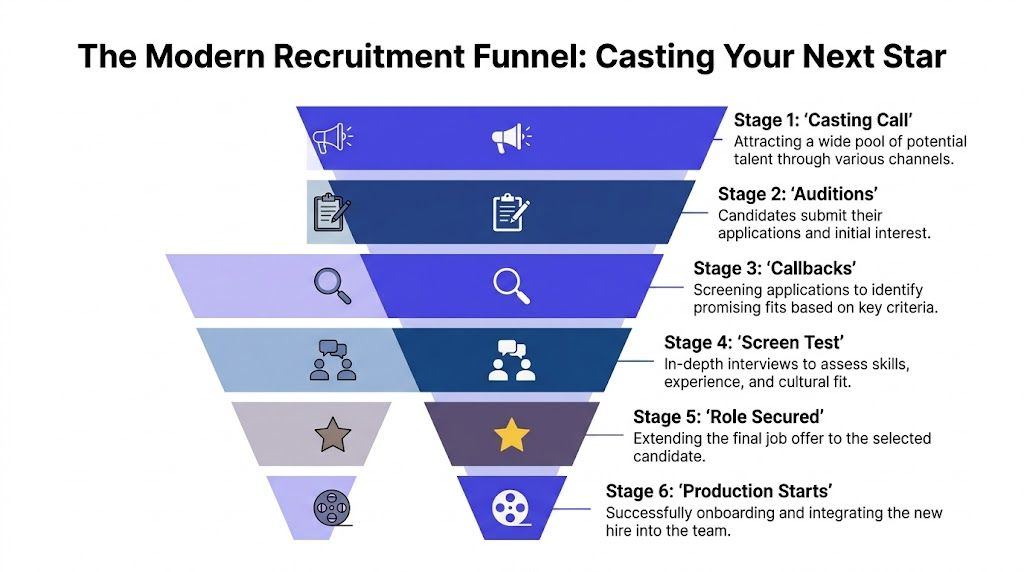
Casting call
At the top of the funnel, the job needs to reach the right people. This includes job boards, employee referrals, outbound sourcing, talent communities, social channels, and career pages. The mistake here is assuming reach alone is enough.
A broad top of funnel helps only if the message is precise. Vague job descriptions attract mismatched interest. Clear descriptions filter before screening even begins.
Auditions and callbacks
Applications are the auditions. Screening is the callback round.
Many hiring teams lose time by using weak proxies. Resume keywords, employer brands, and degree requirements can be convenient, but they rarely tell the full story. Screening should reduce uncertainty, not just reduce volume.
Three practical questions matter at this stage:
- Can this person do the core work
- Can they do it in this context
- Do we have enough evidence to keep investing time
If the answer to the third question is no, the process needs a better screening mechanism, not more recruiter effort.
Screen test, offer, and start
Interviews are the screen test. They should validate what earlier stages already suggested, not serve as the first meaningful evaluation of competence. When interviews carry too much diagnostic weight, teams over-index on confidence, communication style, and chemistry.
That creates two problems at once. Strong candidates get missed because they don’t perform perfectly in conversational settings. Weak candidates advance because they interview well.
The best recruitment funnels narrow by evidence, not by gut feel.
A clean funnel has six connected stages:
- Awareness through targeted visibility
- Application through clear role interest
- Screening through initial fit checks
- Interview through deeper evaluation
- Offer through decision and close
- Hire through onboarding and integration
Every weak handoff causes downstream pain. If sourcing is noisy, screening gets overloaded. If screening is shallow, interviews get bloated. If interviews are inconsistent, offers become risky. A modern funnel works when each stage earns the right to pass a candidate to the next.
Cohesyve
See what candidates can do before you interview them
Cohesyve turns your job description into a role-specific assessment with a scoring rubric. Each candidate gets a different version, so questions cannot be shared. Ten candidates free, no card.
Sourcing and Attracting Top Talent
Most sourcing strategies fail for a simple reason. They confuse application volume with sourcing quality.
That’s why many teams keep feeding job boards, boosting posts, and celebrating top-of-funnel traffic while complaining that none of the applicants are right. The channel isn’t useless. It’s just often misread.
According to G2’s recruitment statistics, employee referrals account for 7% of applications but 40% of new hires, while online job boards generate 60% of applications and convert far less efficiently. That tells you something important. The best source isn’t always the loudest one.
Quality channels versus quantity channels
Job boards are useful for reach. They help with visibility, employer brand presence, and inbound interest. But they also bring resume overload. If your screening process is weak, job boards can turn into a sorting exercise rather than a sourcing strategy.
Referrals are different. They usually arrive with built-in context. Employees understand the role, the team, and the company’s working style, so they tend to recommend people with a stronger chance of fitting both the work and the environment.
That doesn’t mean referrals should dominate every hiring plan. Referral-heavy systems can become insular if teams don’t actively watch for sameness. The point is balance.
A practical sourcing mix
A sensible sourcing mix usually combines broad awareness with narrower, higher-signal channels:
- Job boards for coverage. Use them when you need visibility across a wide market and can clearly define must-have criteria.
- Outbound outreach for hard-to-fill roles. This works better when recruiters personalize around the role’s real problems, not generic flattery.
- Social recruiting for discovery. It’s useful when candidates want to understand the team, the work, and the company before applying.
- Employee referrals for precision. These often produce a smaller but stronger pool.
Social recruiting deserves more discipline than it usually gets. A lot of companies post jobs on LinkedIn and stop there. Better teams treat social as a way to build familiarity before the requisition opens. If you want practical ideas on that front, these 10 LinkedIn growth hacking strategies offer useful tactics for increasing visibility and engagement around professional profiles and company presence.
Attraction starts before the application
Candidates don’t just evaluate compensation and title. They evaluate whether the work sounds meaningful, whether the team seems credible, and whether the company communicates clearly. That’s employer value proposition work, not just recruiting operations.
One of the easiest ways to sharpen attraction is to clarify what makes the role worth doing for the right person. These employee value proposition examples are a good reminder that specificity beats generic culture language every time.
A sourcing strategy improves when you stop asking where applicants come from and start asking which channels consistently produce credible evidence of fit.
The strongest teams don’t fish with one giant net. They choose channels based on the role, then design the top of funnel so the right candidates are more likely to self-select in.
Moving Beyond the Resume to Prove Skills
The resume has always been a rough proxy. It summarizes experience, signals ambition, and gives recruiters something fast to scan. But it’s still self-reported. It tells you what a candidate says they’ve done, not what they can do now in your environment.
That gap is where many hiring mistakes begin.

A polished resume can hide weak execution. A messy resume can hide strong judgment. Traditional screening often rewards familiarity with hiring norms more than actual capability. That’s a problem in any role, but it becomes especially costly in technical, operational, and client-facing work where practical performance matters.
What better evidence looks like
Skill verification changes the question from “Does this person look qualified?” to “Can this person demonstrate the work?”
That evidence can take different forms depending on the role:
- Adaptive multiple-choice questions for foundational knowledge and reasoning
- Real-world coding challenges for engineering and data roles
- Case-study responses for consulting, operations, and strategy positions
- Voice role-plays for sales, support, and communication-heavy jobs
- Short judgment exercises that test prioritization and decision-making
The important point isn’t the format. It’s the realism. Good assessment design mirrors the actual demands of the role closely enough that performance becomes meaningful.
Why this improves hiring outcomes
When companies replace traditional resume screening with skill-verification platforms using adaptive assessments, they can raise Quality of Hire from an average of 68% to over 82%, while reducing first-year attrition by up to 40%, according to this recruitment metrics analysis. That’s the kind of shift recruiters care about because it affects both speed and long-term quality.
Those numbers also explain why resume-heavy hiring often feels inefficient even when the process is moving. A team can process candidates quickly and still make poor decisions if the evidence base is weak.
The trade-off most teams need to manage
Assessment can go wrong too. If the task is too long, irrelevant, or generic, candidates drop off or perform in ways that don’t reflect the job. If every applicant gets the same static test, answers spread and signal quality erodes. If the assessment replaces human judgment completely, teams miss context that matters.
The better approach is to use dynamic, role-specific skill checks early enough to improve the shortlist, then use interviews to explore judgment, collaboration, motivation, and context.
For teams building that approach, practical guidance on skill assessments helps separate useful evaluation from busywork. Tools such as HackerRank, Codility, WorkSample, and Cohesyve can all support this shift in different ways, especially when they’re tied closely to the actual role rather than to generic testing libraries.
Resumes are useful for history. Hiring decisions need evidence about present ability.
The biggest recruitment upgrade many companies can make isn’t adding another interview round. It’s replacing weak early-stage guesswork with proof.
Building Inclusive and Unbiased Hiring Processes
Bias doesn’t only show up in dramatic hiring mistakes. More often, it enters subtly through defaults. Degree filters that exclude capable people. “Polish” standards that reward familiarity with corporate norms. Unstructured interviews that favor candidates who remind interviewers of themselves.
That’s why inclusive recruitment has to be built into the process, not added as a value statement on the careers page.

Where bias usually enters
Most hiring bias comes from inconsistency. One interviewer improvises. Another values confidence. A recruiter screens for background familiarity. A manager picks the person who feels “safe.”
A fairer process is usually a more structured one. That means:
- Clear job requirements that separate must-haves from preferences
- Standardized screening criteria so candidates aren’t compared on different terms
- Consistent interview questions tied to role outcomes
- Defined scorecards that force evidence-based discussion
- Review discipline so hiring teams debate examples, not vibes
None of this removes human judgment. It makes judgment more accountable.
Skill verification can widen access
This matters even more when recruiting from historically underserved populations. Traditional methods often miss strong candidates because the signal they rely on is shaped by systemic bias. School prestige, prior brand-name employers, and resume style don’t tell the whole story.
Career Ladders Project guidance on underserved student outreach makes a point that carries over to hiring: produce outreach materials in more than one format and language, so the people you most want to reach can actually use them. A task-based assessment widens access in a similar way, because it judges the work rather than the résumé.
That’s a meaningful shift. It means a candidate can demonstrate reasoning, communication, and practical ability even if they don’t have the usual markers recruiters are trained to notice.
Fair hiring gets stronger when teams evaluate work samples before they evaluate polish.
A short explainer on unconscious bias is worth sharing internally before redesigning interviews:
Inclusion isn’t separate from quality
Some teams still talk about fairness and hiring quality as if they pull in opposite directions. In practice, weak and biased filters often describe the same thing. They both hide talent.
Inclusive recruitment works best when companies stop trying to predict potential from pedigree alone and start collecting stronger evidence from a wider group of people. That’s not just a diversity initiative. It’s a better talent strategy.
Measuring What Matters with Recruitment KPIs
Recruitment teams often drown in activity metrics and miss the numbers that help them improve. The useful KPIs are the ones that tell you where confidence is breaking down, where speed is leaking, and whether your hires are holding up after they start.
If I had to narrow the list, I’d focus on Time-to-Hire, Quality of Hire, source effectiveness, and early retention. Together, they tell you whether the funnel is efficient, whether decisions are sound, and whether your sourcing channels deserve continued investment.
Time-to-Hire tells you where momentum dies
In tech, Time-to-Hire averages 42 days, and a 10-day delay can cause 27% candidate loss to competitors according to AIHR’s recruiting metrics overview. That number matters because candidate drop-off isn’t random. Strong candidates usually have options, and slow processes test their patience first.
The practical lesson isn’t “go faster at all costs.” It’s “remove the slow parts that don’t improve signal.”
AI-driven assessments can cut screening from 10 days to 3, help companies close roles up to 50% faster, and lift offer acceptance from 71% to over 90% in the same source. That’s useful because screening is one of the most common bottlenecks in modern recruitment. Recruiters are sorting too much weak data by hand.
Quality of Hire tells you whether speed was worth it
Time-to-Hire is visible, so leaders obsess over it. Quality of Hire is harder to measure, which is exactly why it matters more.
A practical Quality of Hire model includes a mix of post-hire indicators such as performance, retention, peer or manager feedback, and ramp-up time. No single company uses the exact same recipe, but the principle is consistent. Good hiring isn’t about how quickly someone signed. It’s about whether they became effective and stayed.
A fast hire who misses expectations is not an efficiency win. It’s deferred rework.
Here’s a simple KPI view that hiring teams can use:
| KPI | What It Measures | Why It Matters |
|---|---|---|
| Time-to-Hire | The time from approved role to accepted offer | Shows where the process is too slow and where candidates may disengage |
| Quality of Hire | The long-term value of a new hire after joining | Connects hiring decisions to business performance, retention, and ramp-up |
| Source effectiveness | Which channels produce interviewable and hireable candidates | Helps teams shift budget and effort away from low-signal sources |
| Early retention | Whether hires stay and settle into the role | Flags mismatch in assessment, expectations, or onboarding |
Metrics should change behavior
The point of KPI tracking isn’t monthly reporting theater. It’s operational change.
If Time-to-Hire is creeping up, don’t just pressure recruiters. Check whether hiring managers are slow to review, whether interviews are redundant, or whether screening criteria are too vague. If Quality of Hire is weak, don’t add another panel. Check whether the evidence used early in the funnel predicted performance.
Good recruitment analytics make trade-offs visible. They help talent teams explain why a slower step might be justified in one role and a shorter process is necessary in another. That’s how recruiting starts being treated like a business function instead of an admin queue.
Practical Playbooks for Modern Hiring Teams
There isn’t one correct recruitment model. A startup hiring its first product engineer shouldn’t run the same process as an enterprise filling a regional operations team. The principles stay steady. The execution changes.
The high-growth startup playbook
A startup usually needs speed, but not recklessness. Every hire changes the company more visibly, so the process has to protect quality without becoming bureaucratic.
A practical startup playbook often looks like this:
- Keep role design tight. Define the outcomes the person must own in the first stretch of the job. Don’t build a wish list.
- Use targeted sourcing early. Founders, hiring managers, and recruiters should all contribute, especially through networks and referrals.
- Screen with work-relevant tasks. A short, role-specific assessment gives the team signal before calendars get clogged.
- Run fewer, sharper interviews. Each conversation should have a purpose. One for role depth, one for collaboration and judgment, one for mutual fit.
- Close with clarity. Strong candidates want to know what they’re joining, what they’ll own, and how decisions are made.
The startup mistake is copying enterprise process too soon. Multiple panels, lengthy debrief chains, and generic competency interviews can slow hiring without increasing confidence.
The enterprise playbook
Large organizations have the opposite problem. They usually don’t lack process. They lack consistency across many teams, geographies, and hiring managers.
An enterprise-friendly playbook tends to emphasize:
- Standardized intake so recruiters and hiring managers define success the same way
- Structured screening criteria across similar roles
- Assessment layers that can scale without overburdening recruiters
- Clear governance around compliance, fairness, and documentation
- Centralized reporting through the ATS and related tools
This doesn’t mean every role should feel identical. It means the decision quality shouldn’t depend on which manager happens to be hiring.
Borrow ideas without copying context
One of the healthiest habits in talent teams is reading outside your own company stage. The Parakeet AI blog is a useful example of the kind of operational thinking worth following if you want to see how AI and workflow design are changing recruiting execution more broadly.
Good hiring teams don’t copy playbooks whole. They adapt principles to the pressure they’re actually under.
The startup needs focus. The enterprise needs repeatability. Both need better signal, cleaner handoffs, and enough discipline to stop adding steps that don’t improve decisions.
Integrating Your Recruitment Tech Stack
Recruitment falls apart operationally when tools don’t talk to each other. The recruiter sources in one platform, collects resumes in another, sends assessments somewhere else, and then updates the ATS manually. That creates delays, duplicate work, and inconsistent reporting.
The ATS should stay at the center. It’s the system of record. Every other tool should either feed it cleanly or justify why it sits outside the workflow.
What a clean stack should do
A practical recruitment stack usually needs to handle four jobs well:
- Attract candidates through sourcing tools, social platforms, and career pages
- Evaluate candidates through screening workflows and skill assessment tools
- Coordinate hiring through interview scheduling, scorecards, and approvals
- Report outcomes through shared dashboards and consistent stage data
If one tool creates signal but traps the data, the team loses half the value. If another tool adds admin overhead without improving candidate quality, it shouldn’t stay.
Integration rules that keep teams sane
A few rules help:
- Keep the ATS as the source of truth. Notes, decisions, and stage movement should land there.
- Automate transitions where possible. Screening results should trigger next steps, not more spreadsheet work.
- Use role-specific evaluation tools. Generic testing can clutter the stack without improving decisions.
- Protect the candidate experience. Fewer logins, fewer repeated steps, and clearer communication matter.
The best recruitment stack isn’t the one with the most logos. It’s the one your team can run consistently, with enough data flow to support faster and better decisions.
If your team wants to reduce resume guesswork and add stronger skill signals earlier in the funnel, Cohesyve is worth a look. It creates role-specific assessments from a job description, supports formats like coding tasks, spreadsheet work, chat simulations and voice role-plays, and ranks every candidate on one rubric so recruiters can move from large applicant pools to interview-ready candidates with clearer evidence.