Have you ever felt like you're trying to build a championship team with half the staff you used to have? That's what recruiting can feel like right now. The core challenge is simple but significant: we have to do more with less. This isn't just a fleeting trend—it's the new standard, demanding a more efficient way to find great people.
The New Reality of Recruiting
Picture this: your company is growing, and the need for new talent is high. But your recruiting team is smaller than it was a few years ago. This is the daily reality for many organizations today. The talent acquisition landscape has shifted, creating a paradox where working harder doesn't necessarily mean hiring better.
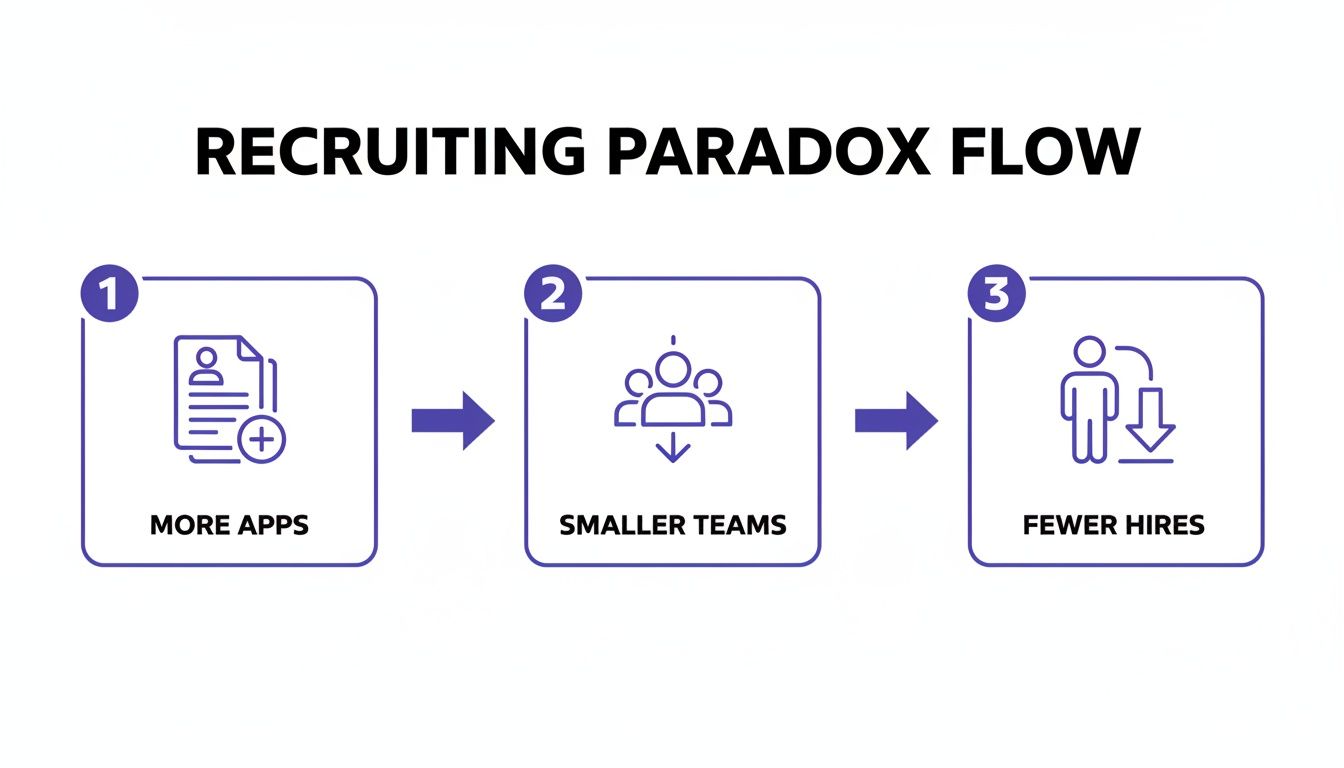
Data from recent years highlights the challenge. Recruiters are managing a 93% increase in applications and 40% more open roles on average. At the same time, the average recruiting team has shrunk by 14%. The result? A measurable dip in output: the number of hires per recruiter has fallen by 43%.
The Problem with Traditional Methods
In this high-pressure environment, conventional recruiting tactics are becoming less effective. Manually sifting through hundreds of resumes for one open position isn’t just slow—it’s unsustainable.
When teams are stretched thin, the pressure to fill a seat can lead to compromises on quality, which increases the risk of a bad hire. The cost of a bad hire goes beyond salary; it can impact team morale, productivity, and company culture. It's a cycle that even large companies like Amazon have had to learn to manage. For a closer look, you might find our guide on Amazon's unique recruitment process insightful.
This situation highlights a need for more efficient and accurate hiring. Relying on resumes alone has always been a bit of a gamble, offering little real proof of whether a candidate can actually do the job.
The real issue isn't a shortage of applicants. It's the challenge of identifying genuine skill in a vast pool of resumes. The future of effective recruiting lies in moving beyond what a resume claims and verifying what a candidate can do.
A Shift Toward Precision
The solution is to pivot from a wide-net, volume-based approach to a focused, skills-first strategy.
By putting practical, verifiable skills at the front of your process, you can filter out the noise early. This lets you focus your energy on a small, curated pool of genuinely qualified talent. It’s not just about saving time; it’s about making objective, reliable hiring decisions that build a team that is truly capable. It's time to work smarter, not just harder.
Mapping Your Modern Hiring Journey
Think of your recruiting process like a well-coordinated plan. Every step and decision should connect to the next. That's why taking the time to map out your entire hiring journey—from the moment you identify a need to a new hire's first day—is so important.
This journey is a funnel. It starts wide, with many potential candidates, and narrows down to the right person for the job. But it doesn't begin with a job post. It begins with a clear conversation between recruiters and hiring managers. What problem are we trying to solve with this hire? What skills are essential, and which are just nice-to-haves?
Getting this part right is the foundation for your entire search. Once you have a clear picture of who you need, you're ready to start looking for them.
Sourcing Your Future Team Members
Sourcing is where the art and science of recruiting meet. It’s about finding and attracting the right people, using a mix of strategies to build a pipeline of talent.
- Inbound Recruiting: This is about drawing candidates to you. It’s like opening a popular new restaurant—people hear about it and want to come in. This includes your job board posts, social media presence, and especially employee referrals. Referrals often bring in well-suited candidates.
- Outbound Recruiting: This is where you actively seek out talent. You’re looking for qualified people who may not even be searching for a new job. This approach is often used for hard-to-fill, senior, or highly specialized roles.
The best recruiting strategies use a healthy dose of both. Relying only on inbound can lead to an overwhelming number of resumes. Focusing solely on outbound can be resource-intensive and difficult to scale.
From Longlist to Shortlist
So, the applications are coming in. This is where the real work begins, and where many teams get bogged down. We're all facing a paradox: more applications than ever, but with smaller teams, we're making fewer hires.
This is what that pressure looks like. A flood of applications meets a stretched team, and the result is a bottleneck.
This is precisely why we need a smarter way to filter candidates. The screening and assessment phase is your biggest opportunity for an efficiency gain. Let’s be honest, staring at resumes all day is slow and not a reliable way to predict if someone can do the job. A resume can look polished, but that tells you little about their real-world skills.
The goal here isn't to find reasons to reject people. The goal is to find clear, objective proof that lets you say "yes" to the best candidates who have shown you they have what it takes.
This is where skill verification can be a useful tool. By asking candidates to show you what they can do early on, you cut through the noise. You can confidently and quickly separate the genuinely qualified from the merely interested. You’re no longer dealing with a long list of unknowns; you have a short list of proven contenders.
The Final Stretch
Now that you have a small, curated group of verified candidates, you can move on to the human part.
- Interviews: This is where interviews become what they were always meant to be: real conversations. You’re not grilling them on technicalities—you already have an indication they can do the work. Now you can explore culture fit, motivation, and how they’ll collaborate with the team.
- Offer and Negotiation: It’s time to make a compelling offer that shows you value their talent and the future they have with your company. Be transparent, be prompt, and keep the conversation going.
- Onboarding: The journey isn’t over when they sign the offer. A good onboarding experience is the final, crucial step. It makes your new hire feel welcome, sets them up for success, and helps affirm they made the right choice.
Cohesyve
See what candidates can do before you interview them
Cohesyve turns your job description into a role-specific assessment with a scoring rubric. Each candidate gets a different version, so questions cannot be shared. Ten candidates free, no card.
Moving from Resumes to Real Skills
A great resume is like a well-designed book cover. It grabs your attention and hints at an interesting story, but it says little about the quality of the writing inside. For decades, recruiting has relied on these covers—resumes, credentials, and past job titles—to make critical hiring decisions. But what happens when the substance doesn't live up to the presentation?
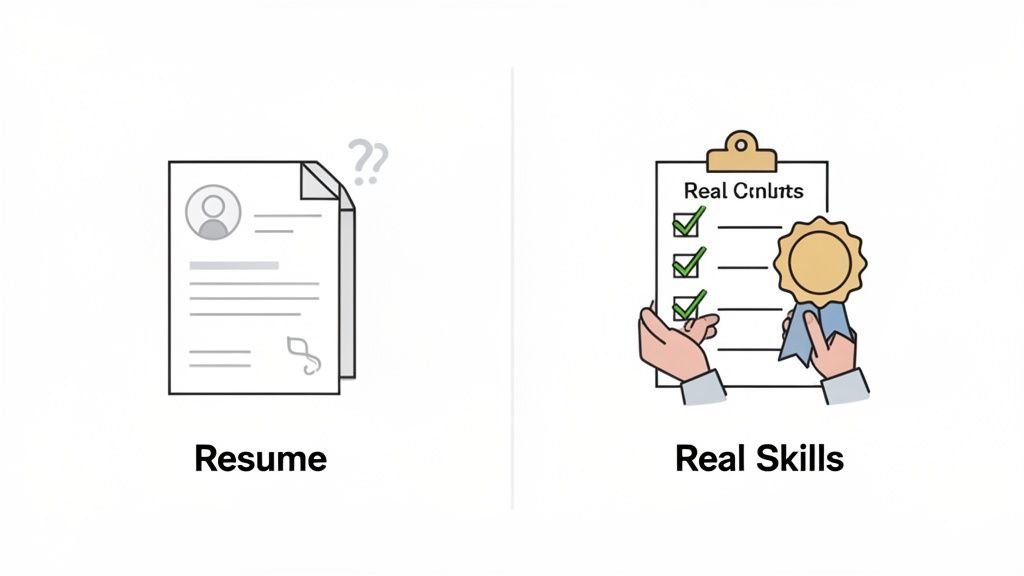
The traditional approach of screening candidates based on their resumes has limitations. It’s built on an assumption that past experience and education are reliable predictors of future performance. In reality, this method can be inaccurate and may unintentionally filter out talented candidates.
The Limits of Traditional Screening
A polished resume is often more a testament to good writing and formatting than it is to on-the-job capability. It’s a highlight reel, curated to show a candidate in their best light. But it’s missing important context: their real-world performance, their problem-solving approach, and their ability to collaborate. This creates some challenges for recruiting teams.
First, there's the issue of unconscious bias. When we scan a resume, our brains instinctively look for familiar patterns. We might gravitate toward candidates from certain universities, companies, or backgrounds similar to our own. This can cause us to overlook skilled people from non-traditional paths, shrinking our talent pool and hindering diversity goals.
Second, resumes are not effective at communicating soft skills and practical judgment. A candidate can list "strong communication skills" or "strategic thinker," but a resume offers no proof. How do they handle a difficult client? How do they approach an unexpected roadblock? These are the moments that define a great hire, and a document simply can’t answer those questions.
The core problem with resume-first recruiting is that it forces you to make decisions based on proxies for skill, not on skill itself. You're betting on a candidate's history, hoping it translates to future success, instead of directly measuring their ability to do the job.
This reliance on proxies injects uncertainty into the recruiting process. It can lead to long interview cycles where you're trying to validate a candidate’s claims, hoping to see their true abilities. It’s an inefficient and often frustrating process for everyone involved.
The Shift to Skills Verification
So, what's the alternative? It’s a simple but powerful idea: instead of asking candidates to tell you what they can do, you ask them to show you. This is the heart of skill-based hiring. It’s a deliberate move away from credentials and toward genuine capability.
To see how different these two mindsets are, take a look at this comparison:
Recruiting Approaches: Traditional vs. Skill-First
| Aspect | Traditional Recruiting (Resume-First) | Modern Recruiting (Skill-First) |
|---|---|---|
| Primary Filter | Resumes, keywords, education, past employers | Role-specific skills assessments |
| Focus | What a candidate has done (past) | What a candidate can do (present & future) |
| Bias Risk | High; prone to unconscious bias from names, schools, etc. | Low; focus is on objective performance |
| Predictive Accuracy | Low; past titles don't guarantee future success | High; directly measures job-relevant abilities |
| Talent Pool | Narrow; limited to those with the "right" background | Wide; open to anyone who can prove their skills |
| Candidate Experience | Often passive and uncertain | Engaging and fair; candidates get to showcase their talent |
This table shows a fundamental philosophical shift. It's about moving from a system of guessing to a system of knowing.
Imagine you're hiring a chef. You wouldn't hire them based on their resume alone; you'd ask them to cook a meal. The same logic applies to many professional roles today. By using well-designed, role-specific assessments, you can create a realistic simulation of the job's key challenges.
- For a software engineer, this might be a coding challenge that tests their problem-solving process, not just memorization.
- For a marketing manager, it could be a task where they analyze a dataset and pitch a campaign strategy.
- For a sales representative, it might involve a voice role-play where they navigate a customer objection.
These assessments, often delivered through a virtual job tryout, provide concrete evidence of a candidate's skills. They allow you to see how a person thinks, communicates, and applies their knowledge in a practical context—something far more predictive of success than a resume.
This method transforms the hiring dynamic. Instead of starting with a mountain of resumes and spending weeks trying to narrow it down, you begin with a clear, objective measure of skill. Your shortlist is no longer a collection of "maybes"—it's a ranked list of candidates who have already shown they can do the work. This frees you up to focus your interview time on the top performers, diving deep into culture, motivation, and team fit, confident that the core competencies are already there.
Building Your Recruiting Technology Stack
Your recruiting technology stack is the central nervous system of your hiring operation. It’s not just a collection of software; it’s the interconnected system that helps your team find, engage, and hire people efficiently. Building the right stack is like assembling a high-performance crew—every piece should work in harmony to give you a competitive edge.
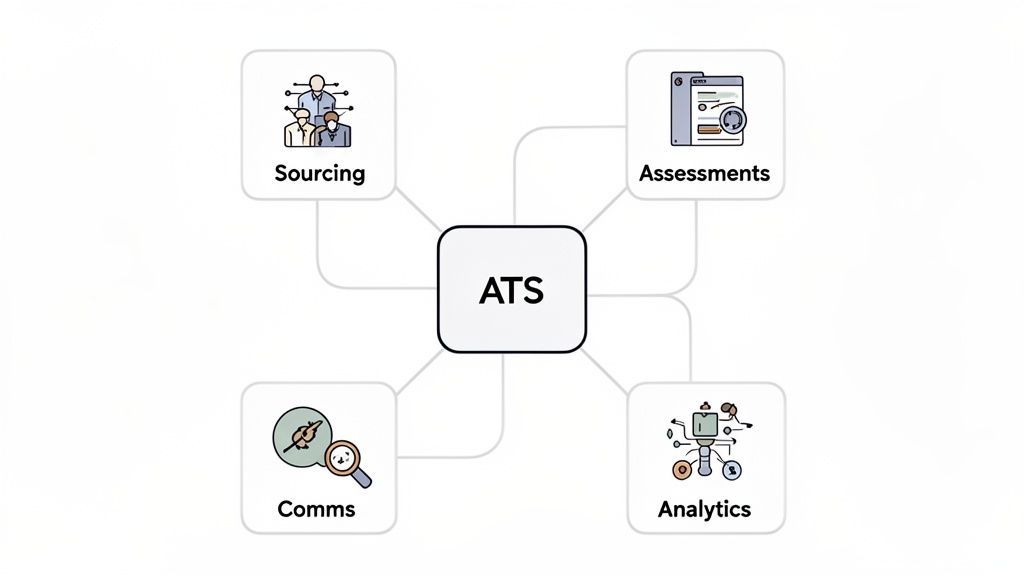
At the heart of this system is your Applicant Tracking System (ATS). Think of the ATS as the core structure that holds everything together. It’s your home base for managing job postings, tracking candidates through the pipeline, and storing critical information. A modern ATS should be your single source of truth, but its real power is unlocked when you connect it with other specialized tools.
The Foundation: Your Applicant Tracking System
Choosing an ATS is one of the most fundamental decisions a recruiting team will make. Its job is to do more than just store resumes. A good ATS automates administrative work, helps maintain compliance, and provides the data you need to understand what’s happening in your hiring pipeline.
When you’re evaluating an ATS, look beyond the surface features. A critical factor is its ability to integrate with the other platforms you rely on. A closed-off system creates data silos and forces your team into a cycle of manual data entry and toggling between browser tabs. A well-connected ATS, on the other hand, becomes a true command center.
Your goal should be to build a seamless workflow, not a clunky collection of separate tools. The best recruiting tech stack feels like a single, unified platform, even if it’s composed of several best-in-class solutions.
This integrated approach is where you start seeing significant gains in both efficiency and your ability to hire better people.
Essential Tools to Enhance Your Stack
With your ATS as the core, you can start adding specialized tools that enhance each stage of the recruiting process. The key is to choose platforms that solve a specific problem for your team and integrate directly into your central workflow.
Here are the core components of a modern recruiting stack:
- Sourcing Platforms: Tools like LinkedIn Recruiter or dedicated sourcing software help you proactively find and engage passive talent—the people who aren't actively applying. These platforms expand your reach far beyond your inbound applicants.
- Communication & Scheduling Tools: Automated scheduling assistants can eliminate the back-and-forth emails required to set up interviews. Integrated communication tools also help you keep candidates informed directly from your ATS.
- Skill Assessment Platforms: This is arguably one of the most impactful additions for a modern team. Instead of guessing a candidate's ability from their resume, these platforms can give you objective, data-driven evidence of their skills right at the start.
Integrating a skill verification tool directly into your ATS can be a powerful combination. Imagine a new applicant enters your system, and an email with a role-specific assessment is automatically triggered. A day later, their score and rank appear on their candidate profile inside your ATS.
This one workflow can transform your process. You can instantly see who the top performers are without leaving your main dashboard. This automation doesn't just save hours of manual work; it helps ensure your shortlisting decisions are based on proven ability, not just resume keywords. It’s a fast path from a long list of applicants to a shortlist of genuinely qualified contenders.
When your data flows effortlessly like this, you get a clear, consolidated view of every candidate’s journey and capabilities. This is how you build a recruiting engine that is both fast and accurate.
Measuring What Matters in Recruiting
In recruiting, the old saying holds true: what gets measured gets managed. The real value comes when you focus on the key performance indicators (KPIs) that tell the true story of your hiring success, moving beyond vanity stats to measure real impact.
Think of it like a pilot's dashboard. A pilot isn't just staring at the altitude gauge; they’re monitoring speed, fuel levels, and engine performance to ensure a safe and efficient flight. In the same way, the best recruiting teams look at a balanced set of metrics to navigate their journey toward building a strong workforce.
The Core Four Recruiting Metrics
While you could track dozens of data points, four fundamental metrics form the bedrock of a strong recruiting strategy. Together, they give you a clear, 360-degree view of your team's performance, from speed and cost to the quality of your hires.
These aren't just numbers for a quarterly report; they're diagnostic tools. When one metric starts to dip, it’s often a signal of a deeper issue in a specific part of your process. This helps you pinpoint where to focus your energy and make meaningful improvements.
Let's break down each one.
Time-to-Hire
Time-to-Hire is the clock on your entire process. It measures the total number of days from the moment a job is opened to the day a candidate formally accepts their offer. It’s a key benchmark of your team's efficiency and a major factor in the candidate experience.
A long Time-to-Hire is a red flag. It can frustrate hiring managers, slow down team productivity, and cause you to lose strong candidates to companies that can move faster. Some studies show the best candidates are often off the market in just 10 days.
Every day you shave off your Time-to-Hire is a competitive advantage. It’s a direct reflection of a smooth, decisive process that respects everyone's time—both your team's and your candidates'.
One of the most effective ways to shrink this metric is to front-load your quality checks. By using skill verification early in the funnel, you can filter out unqualified candidates from the beginning. This prevents your team from spending weeks interviewing people who were never the right fit, freeing you up to move quickly on the candidates who have already shown they can do the job.
Quality of Hire
Quality of Hire is arguably the most important metric, but it’s also the trickiest to measure. It tries to answer the question: did we make a good hire? At its core, it gauges a new employee's contribution to the company's long-term success.
Measuring it well means looking beyond the hire date and combining a few key post-hire data points:
- Performance Reviews: How is the new hire rated by their manager after 6 or 12 months?
- Productivity Metrics: Are they hitting their goals and contributing to team objectives?
- Retention Rate: Is the employee still with the company a year or more after being hired?
A low Quality of Hire is an expensive problem, leading to disengaged employees and high turnover. The key to improving it is to make hiring decisions based on evidence, not just a gut feeling. When you assess for job-specific skills from the start, you create a direct link between your hiring process and on-the-job performance. You're hiring for proven capability, which is a strong predictor of future success. You can explore more about connecting hiring choices to business outcomes by learning about HR data analytics.
Cost-per-Hire
Cost-per-Hire calculates the total investment your company makes to fill a single role. This isn't just about agency fees; it includes everything from recruiter salaries and sourcing tools to job board ads. It's a critical measure of your recruiting function's financial efficiency.
Understanding this number helps you justify your budget and make smarter decisions about where to put your resources. A consistently high Cost-per-Hire might signal an over-reliance on expensive agencies or point to inefficient internal processes that are draining your budget.
Here’s the good part: by improving the other core metrics, you naturally lower your Cost-per-Hire. A faster Time-to-Hire means less money spent on advertising and recruiter time for that one role. A higher Quality of Hire means lower turnover costs, which are a significant and often-hidden drain on a company's bottom line. It’s all connected.
Your Blueprint for Recruiting Success
Building a high-performing recruiting function isn't about chasing trends. It’s about mastering the fundamentals with consistency. Think of this as your blueprint—a practical guide to turning these principles into action, shifting your team from a reactive unit into a strategic partner for the business. The journey begins with a few deliberate steps.
The best hiring happens when it’s a genuine partnership, not just a series of handoffs. The most common point of failure in any hiring process is often the disconnect between recruiters and hiring managers. Your first and most critical mission is to close that gap.
This goes beyond passing a job description back and forth. It’s about deep collaboration—getting in a room together to define what success in the role looks like, agreeing on which skills are essential, and aligning on what kind of evidence you need to see. When everyone agrees on the "what" and the "why" from day one, the entire process runs smoother and yields better results.
Championing the Shift to Skills
Your next move is to lead the charge from relying on résumés to proving skills. This isn’t just about adopting a new tool; it's a fundamental mindset shift for the organization. It means educating stakeholders on why a candidate’s actual abilities are a much stronger predictor of on-the-job success than their educational background.
The key is to start small and build momentum. Don't try to overhaul everything at once.
- Pilot a single, critical role. Pick a position that’s tough to fill or where a bad hire would be particularly costly.
- Showcase the results. Use this pilot to gather data. Show how a skills-first approach created a stronger shortlist, cut down your Time-to-Hire, and led to more confident decisions.
- Build your case. Let the numbers do the talking. A clear win in one area is the best way to get the buy-in you need to expand the strategy to other teams.
This methodical approach turns skeptics into advocates, one successful hire at a time. It demonstrates the value of focusing on what people can do, not just what they say they've done.
An Actionable Checklist for Implementation
Turning a great strategy into a daily habit requires a clear plan. Use this checklist to embed these best practices into your team's workflow.
Forge Strong Partnerships: Mandate a kickoff meeting between the recruiter and hiring manager for every single role. Document the non-negotiable competencies and agree on how you'll measure them before the search begins.
Start Your Skills-First Pilot: Identify one key role and introduce a skills assessment early in the funnel. Track its impact on your most important metrics.
Optimize Your Technology: Make sure your Applicant Tracking System (ATS) and assessment tools are seamlessly integrated. Automate sending assessments and syncing results to eliminate tedious manual work and accelerate your process.
Train for a Better Candidate Experience: Coach your team to explain the "why" behind your process. Frame the assessment not as a test, but as a candidate's opportunity to showcase their real talent.
The future of recruiting belongs to teams that prioritize proven skills. By making these changes, you aren't just filling open seats—you're building a workforce that is truly capable of driving your organization forward.
Answering the Tough Questions About Modern Recruiting
Shifting how you hire is a big deal, and it's natural for questions to pop up from around the business. Moving away from the comfort of resumes and toward a skills-first mindset requires a clear vision, open conversations, and a solid plan to demonstrate its effectiveness. Let's tackle some of the most common concerns you'll likely encounter.
How do you win over skeptical hiring managers? Don't just tell them—show them. A powerful approach is to start small with a pilot program. Find a willing manager, pick one important role, and position it as a joint experiment. The goal? To reduce their interview time while delivering a handful of truly qualified candidates. Once you prove that this approach gives them a pre-vetted, high-quality shortlist, other managers may become interested in the change.
But Does Skill-Based Recruiting Really Work for Non-Technical Roles?
Absolutely. It’s easy to think of skill assessments as just coding challenges, but the core idea is universal: can the person actually do the job? That's what matters, whether you're hiring an engineer or an event planner.
Think about it this way:
- A sales candidate could participate in a voice role-play to navigate a tricky customer objection.
- A marketing applicant could be given a small dataset and asked to outline a campaign brief.
The secret is designing tasks that are a slice of the real job. This gives you a look at their problem-solving skills, judgment, and how they communicate when it counts.
How Do I Actually Measure the ROI of a New Recruiting Tool?
Proving the value of any new tool comes down to connecting the investment to real, tangible business results. It’s about tracking the impact on the metrics that your leaders care about.
Your goal is to draw a straight line from what you spent to what you gained. Focus on measurable wins in speed, cost, and, most importantly, quality.
Before you roll out anything new, take a snapshot of your current performance. This is your baseline. After the new tool is in place, track the "before and after" for key indicators:
- Time-to-Hire: Are you filling roles faster? By how many days?
- Cost-per-Hire: Are you spending less on job boards or external agency fees?
- Quality of Hire: Are the people you’re hiring with this new method getting better performance reviews six months down the line?
Walking into a meeting with hard numbers—like a 15% reduction in Time-to-Hire or a 20% jump in new hire performance scores—is the most compelling argument you can make. It transforms the conversation from a cost-focused debate to a value-driven discussion.
Ready to see how verifying skills can change your hiring outcomes? At Cohesyve, we help teams move beyond the resume to confidently identify top talent with objective, AI-driven assessments. Discover a smarter way to hire.