Canditech and Codility both sell skills-based hiring, and both now talk about assessing how candidates work with AI. They are built for different buyers. Canditech is a broad assessment platform for many kinds of role. Codility is built for engineering hiring and is only starting to reach beyond it.
This comparison uses what each company says on its own website, checked in October 2026. One disclosure: Cohesyve, which publishes it, sells job simulations for hiring. We cover that as a separate option at the end and have kept it out of the head-to-head.
What is the difference between Canditech and Codility?
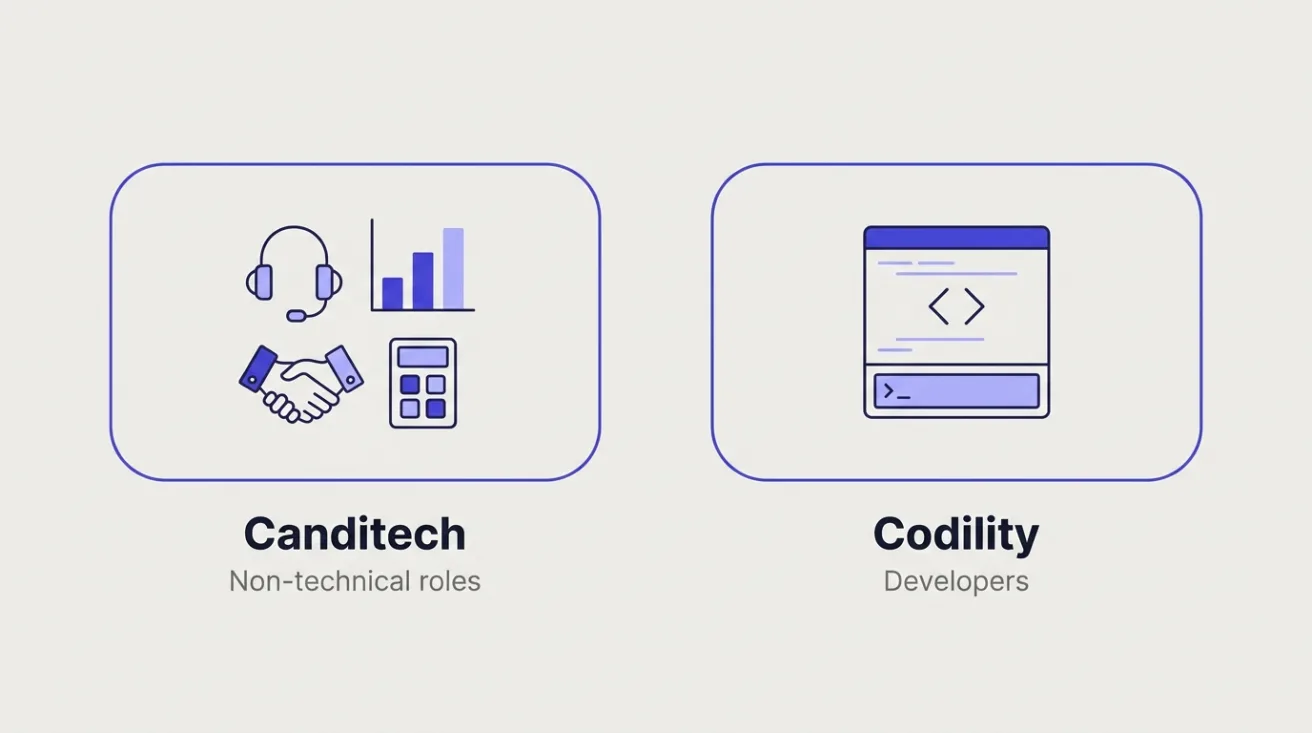
Canditech covers many functions with job simulations and pre-built tests; Codility goes deep on software engineering. If you hire developers alongside sales, support, finance or operations staff, Canditech's range is the closer fit. If you hire mostly engineers and want a realistic coding environment and structured technical interviews, Codility is built for that.
The difference shows in how each describes itself. Canditech calls itself "the skill assessment platform for the AI-age" and lists use cases from engineering and data to marketing, sales, customer success, HR, call centres, finance, administration and healthcare. Codility's home page is aimed at engineering leaders, and its three products are about screening, interviewing and mapping engineers' skills.
Canditech and Codility side by side
| Canditech | Codility | |
|---|---|---|
| Built for | Technical and non-technical roles across most functions | Software engineering hiring; AI skills tasks for business roles added in 2026 |
| Main formats | Job simulations, coding tests, cognitive and personality tests, video answers | Take-home coding screens, live technical interviews, engineering skills mapping |
| Test library | 500+ pre-built tests, plus tests generated from a job description | Engineering tasks and a library of AI-specific tasks |
| Candidate environment | Browser-based tests, with optional embedded AI tools | VS Code with terminal, package installs and multi-file projects |
| AI use by candidates | You can allow or block AI tools; tests can measure how candidates use them | You choose how AI is allowed; tasks cover prompting and reviewing AI-generated code |
| Integrity checks | Copy-paste, tab-switching, full-screen and IP-change detection; optional webcam snapshots | Identity verification, impersonation detection and proctoring |
| ATS integrations | 40+ named, including Greenhouse, Lever, Workday and iCIMS | Greenhouse, Lever, Ashby, Workday and SAP, plus a full API, on the Custom plan |
| Pricing | Tiered plans by assessments and users; free start. Check their site | Starter, Scale and Custom plans; trials run through sales. Check their site |
Cohesyve
Comparing Canditech and Codility? Try a third option on a live role
Cohesyve takes a job description, finds candidates, reaches out to them and runs an AI job simulation of the real work, then returns a ranked shortlist. Ten candidates free, no card.
What is Canditech?
Canditech is a pre-employment assessment platform whose core format is the job simulation: tasks that "mimic the actual job". Around that it offers coding and SQL tests, Excel tests, a cognitive test covering abstract, verbal and quantitative reasoning, a Big Five personality assessment, short on-demand video answers and a WhatsApp or SMS pre-screening chatbot.
Several of its features are about AI. An AI test builder generates role-specific tests from a job description, AI scoring can mark open answers, and candidates can be given tools such as ChatGPT or Claude inside the test so you can see how they use them. You can also block AI tools and rely on its anomaly detection.
What is Codility?
Codility is a technical assessment platform with three products. Screen gives candidates real engineering problems to complete on their own time. Interview runs structured technical interviews in VS Code. Skills Intelligence maps the skills of an existing engineering team.
Codility's pitch is realism: a full editor with a terminal, package installation and multi-file projects, and automated analysis of code quality, maintainability and complexity. It says its assessments are designed by I/O psychologists, that it is SOC 2 audited and ISO 27001 certified, and that more than 20,000 engineering teams use it. In 2026 it added an "AI for Business" offering: work tasks completed with an AI assistant, for roles such as customer support, sales, marketing, product and finance.
Which is better for non-technical roles?
Canditech, on the evidence of both sites. Its library and use-case pages cover sales, customer success, HR, call centres, finance and administration, with simulations and video answers suited to those jobs. Codility's business-role tasks are new and built around AI: Codility says "how a person works with AI is what gets measured" and that the tasks cannot be completed without AI. Its pricing page lists the Business task library on the Custom plan.
For developers the comparison reverses. Codility's IDE, live interview product and engineering focus are deeper than a general platform's coding tests, which matters for senior engineering hires where candidates expect a realistic environment.
How do they handle AI and cheating?
Both have moved away from treating AI as cheating. Canditech lets you allow or block AI tools per test and detects copy-pasting, tab-switching, leaving full screen, a second screen and IP changes, with optional webcam snapshots. Codility lets you choose how AI is allowed, and describes integrity as "knowing who is at the keyboard, not policing which tools they use", with identity verification, impersonation detection and proctoring.
The practical question for either is the same: decide before you send the test whether the job will involve AI tools, and set the policy to match. A test that bans tools the job uses measures the wrong thing.
How do Canditech and Codility price?
Both sell plans rather than single tests. Canditech lists tiers by number of assessments and users, from an individual plan up to unlimited, and invites you to start free. Codility lists Starter, Scale and Custom plans, metered by invite credits and platform users, with free trials arranged through its sales team. Prices change, so check each vendor's pricing page for current figures, and compare the total for your real annual volume. Our guide to assessment software pricing explains the common models.
Choose Canditech if…
- You hire across several functions and want one platform for developers, sales, support and operations.
- You want job simulations, video answers and chat pre-screening in the same tool.
- You want to generate a test from a job description instead of picking one from a library.
- You want a wide choice of ATS connections: Canditech says it integrates with 40+ ATS tools, including iCIMS, SmartRecruiters, BambooHR and Teamtailor, while Codility's pricing page lists Greenhouse, Lever, Ashby, Workday and SAP integrations on its Custom plan only.
Choose Codility if…
- Most of your assessment volume is software engineers.
- You want candidates working in a real editor with a terminal and multi-file projects.
- You run structured live technical interviews and want them on the same platform as the screen.
- You also want to map the skills of your current engineering team.
A third option: job simulations from your job description
Some teams compare these two because neither library quite matches the role they are hiring for. Cohesyve, which publishes this comparison, works differently: you give it a job description, it sources and contacts candidates, puts them through an AI job simulation of the real work, and returns a ranked shortlist, so interview time goes on the strongest applicants. It suits teams that want evidence of performance on the actual job across technical and non-technical roles. Plans are subscriptions sized to annual hiring volume, from $199 a month. It is not a coding-interview platform, so a team that runs most of its engineering interviews live in an IDE may still want Codility for that stage.
More comparisons
Sources
Checked 21 October 2026. Vendor claims are the vendors' own.