A lot of teams start measuring performance only after something has already gone wrong.
A role stays open too long. A new hire looks strong on paper but struggles in the work. A manager says someone is “doing fine,” while peers compensate for missed deadlines. Then HR gets asked to “build a better process” with half a job description and three conflicting opinions about what success means.
That’s why how to measure job performance can’t be reduced to a generic scorecard or a once-a-year review. Good measurement gives hiring teams, managers, and employees a shared definition of performance. Bad measurement creates noise, politics, and false confidence.
In high-growth companies, this gets sharper. Teams need speed, but speed without a clear measurement model usually leads to bloated shortlists, vague interview feedback, and inconsistent reviews. The fix isn’t more forms. It’s a system that combines role clarity, practical evidence, and calibrated judgment.
Understanding Job Performance Measurement
Job performance measurement is the practice of turning “good at the job” into something people can observe, compare, and improve.
That sounds obvious. In practice, many companies skip the hard part. They jump straight to reviews, dashboards, or interview questions before agreeing on what the role is supposed to produce. The result is predictable. One manager values output, another values polish, and a third rewards whoever communicates best in meetings.
What performance measurement should actually do
A useful measurement system answers four questions:
- What outcomes matter most
- What behaviors support those outcomes
- How will those outcomes be observed
- Who gets input into the final judgment
If one of those is missing, the system gets shaky fast.
For repeatable roles, the signals are often easier to spot. Task throughput, quality checks, and deadline reliability can tell a lot. For nuanced roles like strategy, consulting, product, or leadership, numbers alone rarely tell the full story. You also need evidence of judgment, communication, and decision quality.
Practical rule: If two strong managers would rate the same employee very differently, the issue usually isn’t the employee. It’s the measurement model.
Why vague systems break down
The most common failure pattern is simple. Teams confuse activity with impact.
Someone attends every meeting, responds quickly, and looks busy. Another person solves the hard problems, improves team execution, and enables others. If the measurement system only tracks visible activity, it rewards performance theater.
Good systems avoid that by using a mix of:
- Output signals tied to role expectations
- Quality signals that show whether work meets the standard
- Context signals that explain how results were achieved
- Multi-rater input when the role depends on collaboration or influence
That mix creates consistency. It also gives employees better feedback, because they’re no longer guessing what “strong performance” means.
Understanding Roles with Clear Performance Objectives
Before you choose metrics, build a clear definition of success for the role itself.
Most performance problems don’t begin with a weak employee. They begin with a fuzzy job. If the role asks for “strategic thinking,” “ownership,” and “cross-functional collaboration” without defining what those look like in practice, no KPI will save the process.
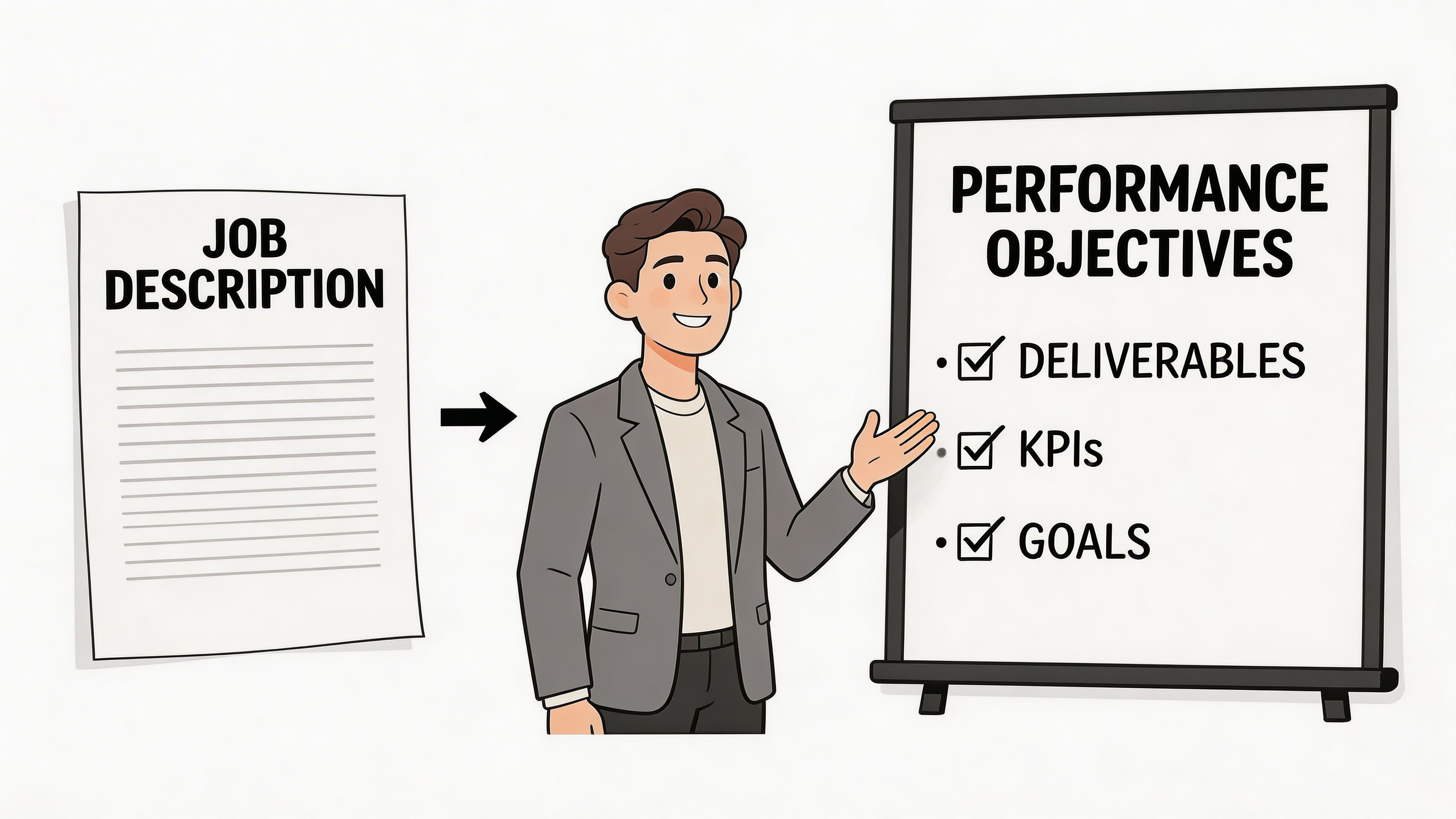
Translate the job description into observable outcomes
A good role objective isn’t a slogan. It links the job to a business result and names the evidence you expect to see.
Compare these two versions:
- Weak objective: “Own product launches and align stakeholders.”
- Clear objective: “Lead launch planning, keep cross-functional workstreams moving, surface risks early, and drive launch readiness through documented decisions and timely follow-through.”
The second version is easier to measure because it gives you anchors. You can evaluate planning quality, risk management, communication, and delivery discipline.
A simple scorecard usually works best when it covers three layers:
| Layer | What to define | Example |
|---|---|---|
| Business outcome | What the role exists to influence | Launch readiness, client delivery quality, reporting accuracy |
| Core deliverables | What the person must produce | Plans, analyses, code, recommendations, stakeholder updates |
| Behavioral expectations | How strong performance shows up | Clear communication, prioritization, follow-through, judgment |
Get alignment before the role opens
Hiring teams often move too fast at this stage. They collect requirements from a hiring manager, post the role, and hope the interview panel figures out the rest. That usually creates mixed signals later.
A better approach is to ask stakeholders a few blunt questions:
- What would make you say this hire is excellent after a few months?
- What mistakes would create pain for the team?
- What can be taught on the job, and what must be proven early?
- Where does this role need autonomy versus support?
Those answers help separate must-have performance signals from nice-to-have preferences.
Strong objective setting removes a lot of future conflict. It gives hiring managers a fair hiring bar and employees a fair performance bar.
Use role-specific examples, not company-wide clichés
A product manager and a data analyst can both be asked to “drive impact,” but their objectives should look different.
For a product manager, you might focus on decision quality, launch coordination, and ability to translate ambiguity into action. For a data analyst, you might focus on analytical rigor, clarity of reporting, and trustworthiness of dashboards used by the business.
That’s also where task completion rate becomes useful for some roles. It measures on-time task completion, and top teams often aim for 90 to 95%, with teams reporting up to 20% efficiency improvements when paired with qualitative feedback according to AIHR’s overview of employee performance metrics. It’s helpful for project-heavy roles, but it shouldn’t be the only lens. A person can finish every task and still solve the wrong problem.
A short walkthrough can help managers think more concretely about this balance:
Write objectives so they can survive handoffs
Performance objectives should still make sense when passed from recruiter to manager to interviewer to employee.
That usually means avoiding broad terms unless you define them. Words like “ownership,” “leadership,” and “strategic” aren’t useless. They’re just incomplete without examples, trade-offs, and expected outputs.
A practical format is:
- Primary mission of the role
- Critical outcomes expected in the work
- Failure modes to watch for
- Evidence sources you’ll use to evaluate performance
That’s the point where measurement starts to become fair. People can argue about results. They can’t argue productively about vague language.
Cohesyve
See what candidates can do before you interview them
Cohesyve turns your job description into a role-specific assessment with a scoring rubric. Each candidate gets a different version, so questions cannot be shared. Ten candidates free, no card.
Select KPIs for Your Team
Once the role is clear, KPIs become much easier to choose. Without that clarity, teams often pick metrics that are easy to report and weak at predicting success.
The best KPI set is narrow, role-specific, and balanced. It should tell you whether someone is producing meaningful output, whether the work meets the standard, and whether their way of working helps or hurts the team.
Comparison of common performance KPIs
| KPI | Definition | Best for | Benchmark |
|---|---|---|---|
| Task completion rate | Share of assigned work completed on time within a defined period | Project management, operations, customer support, delivery-heavy roles | Top teams often aim for 90 to 95% |
| Revenue per employee | Total revenue divided by full-time equivalent employees | Sales, consulting, finance, high-output commercial teams | Top tech firms range from $300K to $500K per employee |
| 360-degree feedback | Multi-source feedback from managers, peers, direct reports, or clients | Leadership, cross-functional roles, consulting, people management | Use input from 5 to 8 stakeholders |
| Quality review score | Structured review of output against a rubric | Creative, analytical, and strategic roles | No universal benchmark |
| Customer satisfaction signal | Feedback tied to service quality or client experience | Support, account management, services | Context-specific |
Match the KPI to the job, not the trend
A KPI earns its place only if it reflects work the employee can reasonably influence.
That sounds basic, but a lot of teams still assign team-wide commercial numbers to roles that have little control over them. Then they wonder why reviews feel political. A useful KPI should be close enough to the work that employees can act on it.
For example:
- Sales roles often benefit from output and commercial KPIs.
- Engineering roles need output paired with quality and problem-solving evidence.
- Consulting roles need client impact, communication quality, and judgment.
- Support teams often need throughput plus resolution quality.
If you need a broader refresher on structuring employee key performance indicators, that guide is a good companion when you’re deciding which metrics belong at the individual level versus the team level.
One strong KPI is better than five weak ones
Revenue per employee is a good example of a high-signal metric when used in the right setting. It benchmarks efficiency, and top tech firms often range from $300K to $500K per employee annually. Firms that prioritize this KPI in reviews also see 15 to 30% faster role closures, according to Scoop Analytics’ breakdown of employee performance measurement.
That doesn’t mean every team should use it. It means commercial output deserves a place where the role directly shapes revenue.
Here’s what usually works better than a giant dashboard:
- One output KPI that reflects core contribution
- One quality KPI that protects standards
- One behavioral indicator for collaboration, judgment, or reliability
- A review cadence that allows interpretation, not just reporting
Avoid vanity metrics
Vanity metrics look tidy and feel objective. They’re also often misleading.
Examples include counting meetings attended, messages sent, or raw activity that says little about actual value created. These measures can push people toward visible busyness instead of better work.
If a metric can go up while actual performance gets worse, it’s not a performance KPI. It’s noise.
A practical test is to ask whether you’d trust that metric alone when making a promotion or hiring decision. If the answer is no, it probably belongs as supporting context, not as a headline measure.
Teams that want a more complete hiring-performance link should also look at how their KPI choices connect to quality of hire. This guide on quality of hire metrics is useful for that handoff between recruiting and post-hire evaluation.
Design Role-Specific Assessments
KPIs tell you what happened. Assessments help you understand whether someone can do the work.
That distinction matters most before hiring, during ramp-up, and in roles where outcomes take time to show. If you wait for lagging indicators alone, you often find problems too late. The better approach is to test capability in a way that mirrors the job.
Mirror the work, don’t imitate interview tradition
A lot of assessments fail because they measure interview skill instead of job skill.
A generic panel interview may reveal confidence, polish, or familiarity with the language of the role. It usually won’t tell you much about how the person reasons through an actual challenge. That’s why role-specific assessment design matters.
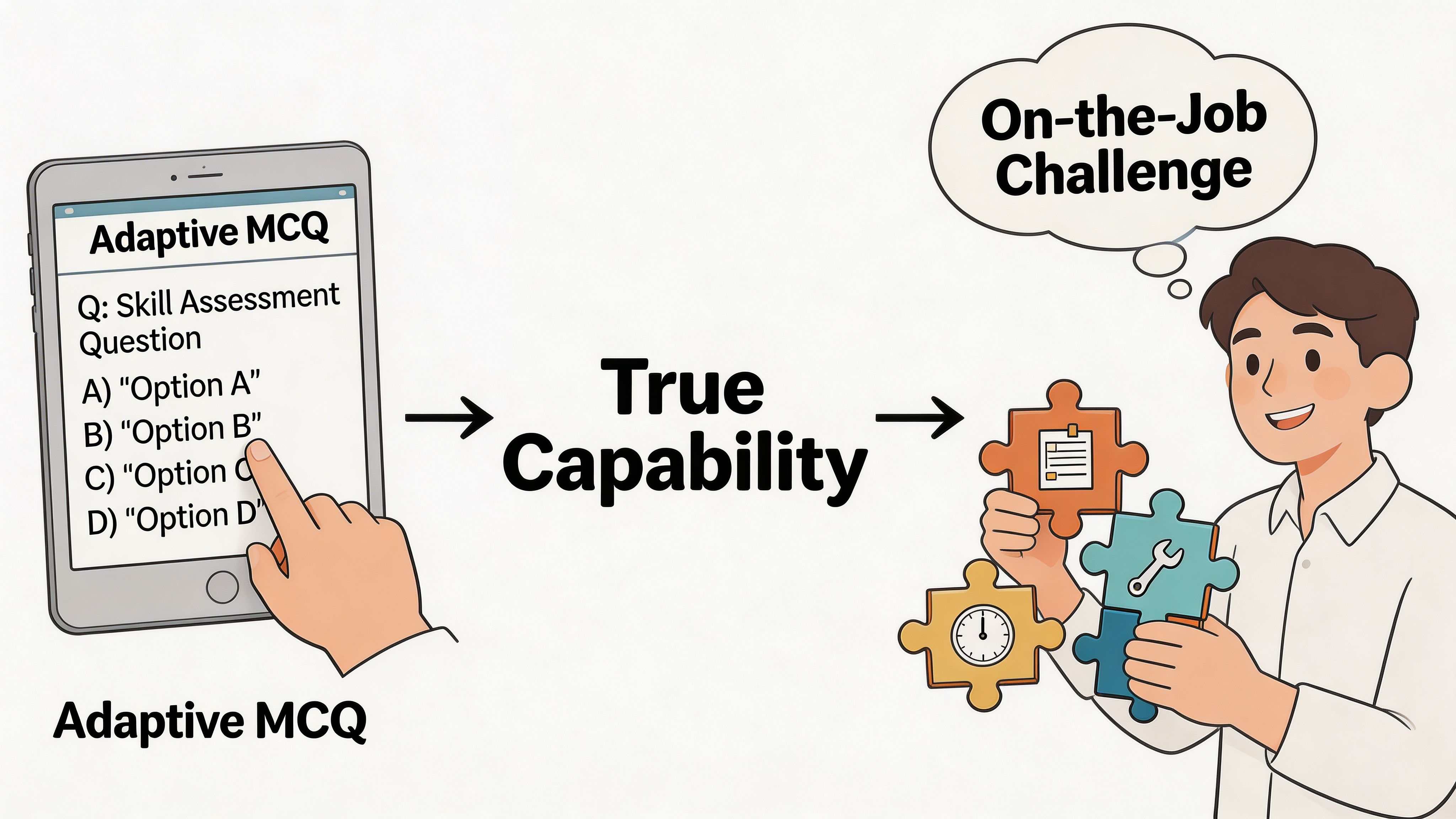
A strong assessment usually includes tasks drawn from the actual work:
- Technical judgment prompts for engineering, data, or operations roles
- Case-based reasoning for consulting, product, and strategy work
- Writing or communication exercises for client-facing or cross-functional roles
- Role-plays for support, sales, and leadership positions
- Work sample reviews for creative or analytical jobs
The question to ask is simple. What would a strong person need to demonstrate in week one or month one?
Build around evidence types
Different roles require different proof.
For an engineer, you may need to see code quality, debugging logic, and trade-off thinking. For a finance hire, you may need structured reasoning, numerical discipline, and ability to explain recommendations to non-finance stakeholders. For a people manager, you may care more about feedback quality, prioritization, and judgment under tension.
That means one assessment format won’t fit everything. Use a small portfolio of evidence instead.
Good evidence for nuanced roles
For strategic and less easily quantified jobs, use prompts that reveal how candidates think.
Examples:
- A product candidate reviews conflicting stakeholder requests and must propose a prioritization path.
- A consultant receives an ambiguous client scenario and has to structure the problem, not just give an answer.
- A marketing hire critiques a weak campaign brief and identifies what’s missing before execution.
These tasks surface judgment, not memorization.
Good evidence for execution-heavy roles
For operational or technical roles, make the task concrete enough that scoring is consistent.
Examples:
- Resolve a support scenario with limited information
- Debug a broken function
- Review a dashboard and identify likely data issues
- Draft a short client update based on changing project facts
Short, role-relevant tasks often outperform long take-home exercises because they focus attention and reduce noise.
Use rubrics before reviewing results
The fastest way to ruin an assessment is to score it after seeing the response.
Write the rubric first. That forces the team to define what strong, acceptable, and weak performance looks like before personalities enter the room. It also protects against overvaluing style at the expense of substance.
A simple rubric should score:
| Dimension | What to look for |
|---|---|
| Accuracy | Is the core answer correct or defensible? |
| Reasoning | Does the person explain trade-offs and logic clearly? |
| Communication | Is the response structured, concise, and usable? |
| Role fit | Does the response reflect how the work is actually done? |
If your team needs a starting point, this interview scoring rubric template is a practical framework for standardizing evaluation across interviewers.
Assessments work best when they test judgment in context. The goal isn’t to trap people. It’s to create enough evidence that the hiring decision feels earned.
Keep assessments tight and comparable
Many teams overdesign assessments. They create too many stages, too many prompts, and too much reviewer freedom. That usually lowers consistency.
A better design principle is:
- Keep tasks short enough to finish with focus
- Standardize the core challenge across candidates
- Allow enough variation to prevent memorized answers
- Use the same rubric every time
That balance is what makes skill verification useful. You’re not trying to simulate the entire job. You’re trying to create fair, comparable moments where the right capabilities can show up.
Collect and Interpret Performance Data
Once objectives, KPIs, and assessments are in place, the next job is operational. You need a clean way to gather signals, review them on a useful cadence, and interpret them without drowning in dashboards.
Most companies don’t fail because they lack data. They fail because the data sits in five systems and nobody agrees on which signals matter.
Build one performance data flow
A working measurement system usually pulls from several sources at once. Recruiting platforms hold interview evidence. Project tools show task completion. Surveys capture peer or stakeholder feedback. Managers hold context that no dashboard can infer on its own.
The key is not to collect everything. It’s to collect the right things consistently.
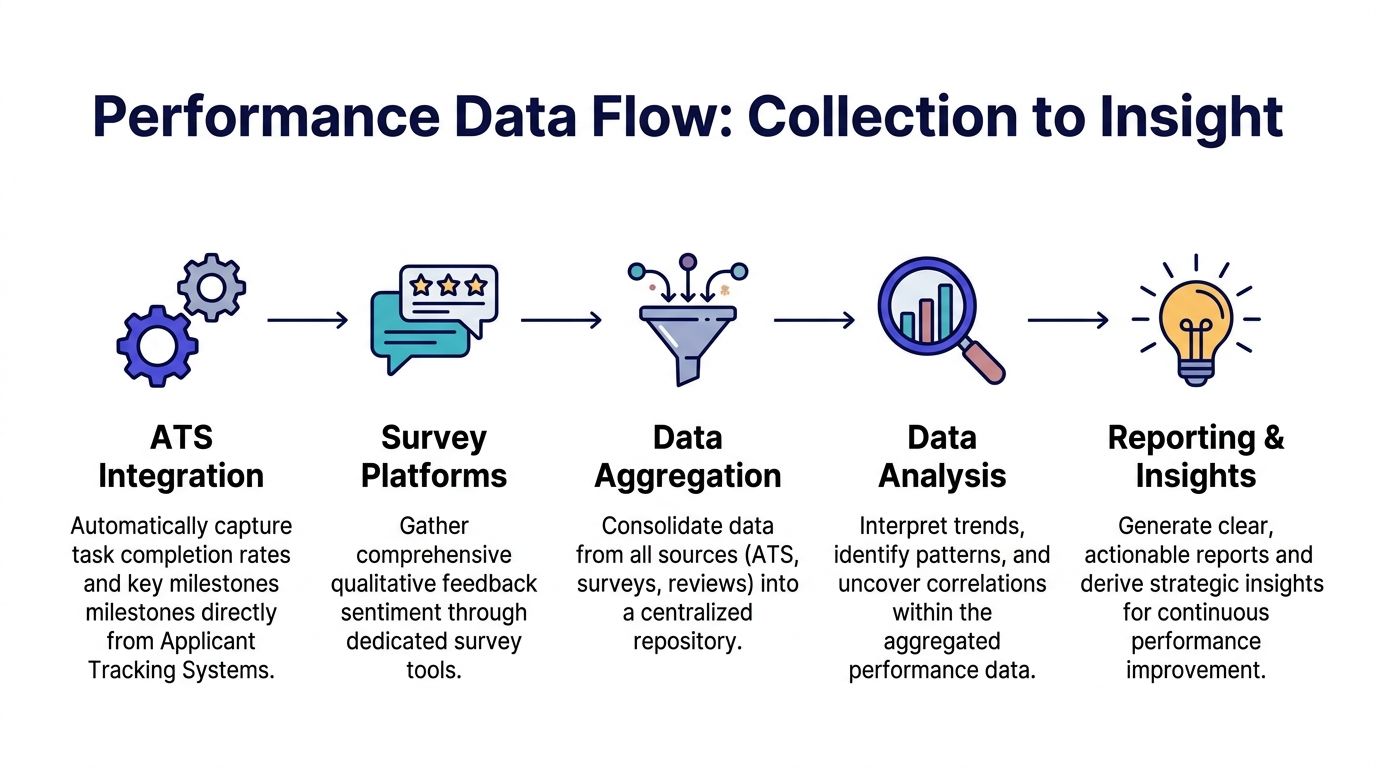
A practical flow often looks like this:
- Capture structured evidence from ATS workflows, assessments, project systems, and review forms
- Add qualitative input through peer, manager, or client feedback
- Aggregate records into one place where role, level, and time period stay consistent
- Interpret patterns rather than isolated scores
- Report decisions with enough context that managers can act on them
Choose a review cadence people will actually use
The right cadence depends on the work.
For fast-moving hiring or probation decisions, teams often need tighter review loops. For broader performance management, the better rhythm is usually one that lets trends appear without waiting so long that feedback goes stale.
What matters most is consistency. If one team reviews monthly, another quarterly, and a third only when something goes wrong, the system stops being comparable.
A simple operating model helps:
- Weekly checks for hiring-stage evidence and process bottlenecks
- Periodic manager reviews for role-specific performance trends
- Scheduled calibration points for comparing across teams
- Documented follow-ups when action is required
Separate signal from context
The data itself won’t tell you what to do unless you interpret it carefully.
Take low task completion. That could indicate weak prioritization. It could also reflect poor scoping, unclear ownership, or a team carrying too much work. A strong review process asks whether the metric reflects individual performance, system constraints, or both.
The same is true for assessment scores. A candidate might be excellent in structured tasks but weak in communication. An employee might get strong stakeholder praise while struggling with consistency. The point is not to force one score to represent everything.
Instead, look for patterns across dimensions:
- Do assessment strengths show up in the actual work?
- Do low quality scores cluster with unclear role expectations?
- Do peer comments repeat the same strengths or concerns?
- Do some teams rate much higher or lower than others?
That kind of interpretation matters more than a leaderboard.
Raw scores help with sorting. Decisions still require judgment, context, and a willingness to question the system when patterns look odd.
Use AI carefully where it improves consistency
AI can be useful here, especially in the collection and standardization layer. It can help structure responses, compare candidates on the same rubric, and reduce some of the inconsistency that comes from manual review.
Used well, it also helps teams scale across languages and geographies. The basics still come first, as Baldwin’s overview of performance assessment sets out: clear goals, agreed metrics, regular check-ins and self-assessments.
Those gains are meaningful, but they don’t remove the need for human oversight. AI can support evidence gathering and pattern detection. It shouldn’t become an excuse to stop checking whether the underlying rubric still fits the role.
Look for predictive value, not just neat reporting
The strongest performance systems become more useful over time because teams compare early signals with later outcomes.
That’s where you find out whether your interview scores predict strong onboarding, whether certain assessment dimensions correlate with success, and whether some KPIs create more distortion than insight.
A lean review template can help:
| Data source | What it tells you | Risk if used alone |
|---|---|---|
| Task and project data | Delivery discipline and follow-through | Misses judgment and complexity |
| Assessment results | Demonstrated capability in controlled tasks | Can miss real-world context |
| Peer or stakeholder feedback | Collaboration and impact on others | Can reflect popularity or politics |
| Manager review | Role context and coaching view | Can reflect rater bias |
When teams combine these inputs well, performance reviews stop feeling like opinion contests. They become operational decisions backed by evidence.
Calibrate Results and Mitigate Bias
Even a thoughtful system can drift if teams don’t calibrate it.
One manager scores harshly. Another gives everyone the benefit of the doubt. One interviewer loves polished communicators. Another overweights technical depth. Without calibration, those habits become part of the measurement system whether you intended them or not.
Why calibration matters
Calibration is the discipline of checking whether different people are applying the same standards to the same kinds of evidence.
It matters because bias rarely announces itself. It usually shows up as inconsistency. Two employees produce similar work and receive different ratings. Two candidates solve the same problem and one gets called “confident” while the other gets called “too direct.” Those differences often come from raters, not performance.
A reliable way to reduce that distortion is 360-degree feedback. When designed well, it uses input from multiple perspectives instead of relying on one manager’s view. According to Buddy Performance’s guide to measuring employee performance, feedback from 5 to 8 stakeholders helps reduce individual bias and can improve review accuracy by 20 to 30%.
Run calibration sessions with structure
A good calibration meeting isn’t a free-form debate.
It needs a clear packet of evidence, agreed criteria, and a facilitator who can push the group back to specifics when conversation slips into vague impressions.
A practical sequence looks like this:
Review the role standard first
Start with the expectations for the role, not the personalities involved.Compare evidence, not narratives
Bring examples of work, rubric scores, and multi-source feedback.Flag score gaps
If one reviewer scored far higher or lower than others, ask what evidence drove the difference.Separate style from substance
Some people communicate with more polish than others. That shouldn’t automatically outweigh judgment or results.Document the final rationale
If the group changes a rating, capture why. This creates a trail for future consistency.
Anonymize where it helps
For some parts of the process, anonymity improves honesty.
That’s especially true in peer feedback, where employees may hold back if they expect direct attribution. Anonymized comments won’t solve every issue, but they can reduce the halo effect that comes from hierarchy, likability, or strong personalities.
This matters even more in collaborative roles where managers only see part of the picture. The people doing the work together often spot strengths and friction long before a formal review does.
A fair system doesn’t remove judgment. It disciplines judgment.
Watch for common distortions
Most bias in performance evaluation appears in familiar forms:
- Halo effect where one strong trait colors the entire rating
- Recency bias where recent work outweighs the fuller period
- Similarity bias where raters favor people who think or communicate like them
- Confidence bias where style gets mistaken for competence
The fix is rarely another training slide. It’s better evidence and stronger review habits.
One simple tactic works well. Ask reviewers to justify ratings with examples tied to the rubric. If they can’t point to observable evidence, the rating should be treated as provisional.
Make calibration normal, not corrective
Teams often only calibrate when they sense conflict. That’s too late.
The best organizations make calibration a regular operating habit. It becomes part of hiring debriefs, promotion reviews, and performance cycles. Over time, that builds trust because people can see the standards are shared rather than improvised.
It also makes managers better. They start learning how others interpret the same evidence. That sharpens their own evaluations and improves the quality of coaching they give employees.
Drive Continuous Improvement and Scaling with AI
Performance measurement works best as a loop, not a launch.
You set objectives. You choose signals. You test for capability. You review results. Then you adjust the system based on what predicts strong work. That’s how the process gets smarter instead of heavier.
Treat the model as a living system
Roles change. Teams change. Business priorities shift.
When the measurement system stays frozen, it starts rewarding yesterday’s version of success. That’s why strong teams revisit their KPIs, rubrics, and assessments on a regular basis. They ask whether the current model still reflects the work the business needs now.
That review is especially important in fast-growing companies where one role can evolve dramatically as the team matures.
Use AI to scale consistency, not replace judgment
AI is most useful when it handles the repetitive parts that humans are bad at doing consistently.
That includes generating structured assessments from role requirements, standardizing review inputs, ranking evidence against rubrics, and surfacing patterns that would otherwise stay buried across systems. It’s a support layer for better decision-making.
If you’re tracking the broader shift in people operations, this piece on Artificial Intelligence in HR is a helpful read on where teams are using AI thoughtfully versus where they’re overreaching.
A practical scaling path usually looks like this:
- Start with one high-friction role family
- Define the role outcomes and evidence model
- Pilot structured assessments and scorecards
- Review post-hire performance against early signals
- Refine the model before rolling it out wider
Make the business case in operational terms
Leaders rarely need another speech about “modernizing talent.” They respond better to operational clarity.
Show where the current process breaks:
- Too much interviewer variance
- Too many weak candidates reaching final rounds
- Too little consistency across regions or functions
- Too much manager time spent reconstructing hiring decisions
Then show how structured measurement improves the workflow. Better signal earlier in the process usually means cleaner shortlists, more grounded debriefs, and stronger post-hire alignment.
If you’re evaluating platforms that support that shift, this guide to AI-powered recruitment tools is a useful starting point for comparing approaches.
Keep the loop tight
The best performance systems don’t just produce reports. They change behavior.
When recruiters understand which assessment signals connect to later success, they screen differently. When hiring managers see where role definitions created noise, they write sharper scorecards. When employees know how performance is measured, feedback gets more usable.
That’s the main payoff. Not a prettier dashboard. A measurement system people can trust, use, and improve.
If your team wants to move from resume guesswork to role-specific skill verification, Cohesyve is worth a look. It helps hiring teams generate customized assessments from a job description, evaluate practical ability across formats like coding challenges, reasoning prompts, voice role-plays, and case tasks, and rank candidates based on demonstrated skill instead of interview polish alone. It’s a practical way to measure what matters before a bad hire becomes a performance problem.